

Article by
Aaisha
A passionate content writer at PYQKosh focused on simplifying Current Affairs and PYQs for competitive exam aspirants. I love turning complex topics into easy, student-friendly content that helps learners prepare smarter and stay consistent in their exam journey.
Did you know that most aspirants spend 80% of their time reading 500-page PDFs but only score 20% in General Awareness? It’s a trap, yaar. You’re working hard, but without a clear ssc cgl tier 2 general awareness pyq analysis, you’re just shooting in the dark.
I know how it feels to drown in unorganized Telegram files while your mock scores stay stuck. You keep repeating the same silly mistakes and don’t even know your accuracy in specific subtopics. It’s frustrating to feel like you’re doing everything right but seeing no progress.
This guide will show you how to stop the “PDF hoarding” and start mastering the high-weightage subtopics that actually matter for 2026. You’ll get a clear roadmap to target the exact areas toppers focus on to crack the 300+ mark.
We’ll break down the latest trends from recent exams and show you how to use the Aaina dashboard to track your daily progress. You’ll also learn how to use the wrong question tracker to turn your weaknesses into strengths before the big day.
Key Takeaways
- Stop wasting time on unorganized 500-page PDFs and switch to a targeted subtopic-wise approach to build real exam confidence.
- Master the 2025-2026 trend of statement-based questions and current-linked static GK that now dominates the Tier 2 pattern.
- Use a detailed ssc cgl tier 2 general awareness pyq analysis to pinpoint high-weightage subtopics instead of guessing which areas to study.
- Create a dedicated “Mistake Tracker” to identify your accuracy red zones and fix recurring errors before the actual test.
- Monitor your daily practice streaks and peer ranking with the Aaina dashboard to ensure your strategy is actually working.
SSC CGL Tier 2 PYQ Analysis: Why Your Old PDF Strategy is Failing
Bhai, let’s be honest. How many 200MB PDFs are rotting in your “Downloads” folder right now? You probably downloaded them from Telegram thinking you’d solve them “tomorrow,” but that day never comes. Even if you do open them, solving random year-wise papers often gives you a sense of fake confidence. You might score well in an easy 2023 shift, but that doesn’t mean you’ve mastered the SSC Combined Graduate Level Examination Tier 2 level. A proper ssc cgl tier 2 general awareness pyq analysis isn’t about just checking your total score; it’s about knowing exactly which subtopic is pulling you down.
Toppers don’t just “solve” papers. They spend 30% of their time on analysis and 70% on targeted practice. They know the difference between a “hard shift” and a “high-weightage topic.” If a shift was hard because of one weird question from an obscure topic, they ignore it. But if they miss a question from a high-weightage area like Delhi Sultanate or Indian Constitution, they attack that weakness immediately. Stop wasting time on random PDFs that offer zero insights and start focusing on data that actually improves your rank.
The Trap of Year-Wise Practice
Year-wise papers are great for timing, but they’re terrible for diagnostic analysis. They hide your specific subtopic-level weaknesses. For example, you might be great at Modern History but terrible at Ancient History. In a year-wise paper, if only Modern History questions show up, you’ll feel safe. But on the real exam day, a shift toward Ancient History will crush your score. Repeating “easy” questions you already know while skipping the “rank-makers” is a waste of time. Centralized practice on platforms like PYQKosh saves you from this “PDF-hunting” fatigue and keeps you focused on your actual gaps.
What Real Analysis Looks Like in 2026
In 2026, analysis means moving beyond “Subject-wise” (like History or Polity) to “Subtopic-wise” precision. Subtopic analysis is the process of breaking down broad subjects into 10 high-yield focus areas that carry the most weightage. This is why a data-backed ssc cgl tier 2 general awareness pyq analysis is the only way to survive the competition. You need to identify “Exam Booster” tips hidden in every explanation to handle confusion points. By tracking your accuracy at the subtopic level, you move from random effort to strategic action. Don’t just work hard; work smart by knowing exactly where your marks are hiding.
High-Yield Subtopic Weightage: Where the Marks Hide
If you look at the Staff Selection Commission (SSC) official website, the syllabus looks like a never-ending ocean. But here is a secret: you don’t need to swim across the whole thing. You just need to know where the islands of high marks are. For the 2026 exam, the pattern has shifted. It is no longer about rote memorization of old facts. Toppers are now focusing on “current-linked” static GK, where a static topic is asked because it was in the news recently.
Performing a deep ssc cgl tier 2 general awareness pyq analysis reveals that specific subtopics in Science and Economics repeat every single year. Instead of guessing, you should use the “sorting by question count” feature on your dashboard. This lets you prioritize topics that have appeared 50+ times over those that only show up once in three years. Why spend five hours on an obscure topic when you can master the Delhi Sultanate or Indian Constitution in the same time?
General Awareness: The Tier 2 Game Changer
Don’t study History like a UPSC aspirant, yaar. You don’t need deep philosophy; you need high-frequency events and dates. In the 2025-26 cycle, we’ve seen a massive jump in questions related to recent government schemes and budget highlights. Science questions are also moving away from basic biology to recent technological developments. Check out this SSC CGL Previous Year Paper Guide to see why topic-wise practice is the real game-changer for these sections.
English Comprehension Analysis
With 45 questions and 135 marks, English is your biggest leverage point. Recent shifts show that Reading Comprehension and Cloze Tests now carry more weightage than pure Grammar rules. If you can master the context, you win. Vocabulary isn’t random either; SSC tends to repeat specific subtopics every 2-3 years. Use topic-wise practice to fix your “Confusion Points” in Narration and Active-Passive voice. These are low-hanging fruits that can easily boost your score if you track your accuracy daily.
You can start by sorting topics by question count to see exactly where you should focus your energy tonight.
2025-2026 Trend Report: Decoding New Question Patterns
Bhai, if you think solving 10,000 random questions from 2015 is going to save you, think again. The game has changed. A solid ssc cgl tier 2 general awareness pyq analysis reveals that the TCS pattern in 2026 is far more analytical than it was even two years ago. It is no longer about just knowing the “who” and “when.” Now, you need to know the “how” and “why” behind every event.
The biggest change is the “Statement-Based” revolution. Earlier, SSC asked direct one-liners. Now, they give you three statements and ask which ones are correct. This shift in General Awareness (GA) is designed to filter out people who just “rattofy” facts. You need a deeper understanding of the subtopics to clear these hurdles. If you look at the Official SSC Previous Year Question Papers, you will see this trend clearly in every shift from the 2025 cycle.
A common myth among aspirants is that later shifts are always harder. “Yaar, third shift ka paper to out of syllabus tha!” is a common cry. But shift analysis shows this is mostly noise. The real challenge isn’t the shift difficulty; it’s the variation in subtopic depth. One shift might lean heavily on Science, while another focuses on Economics. This is why practicing with a recency-first mindset is the only way to stay prepared for these surprises.
The Analytical Shift in GA and English
In 2026, English questions are becoming context-heavy. Instead of simple rule-based grammar, you’ll face questions where two options look almost identical. These are “Confusion Points” that SSC builds intentionally. To beat this, don’t just stick to CGL papers. Practicing GA and English questions from exams like CDS and CAPF on PYQKosh gives you that extra edge. It prepares your brain for higher-level logic that SSC is now adopting.
Why ‘Recency’ Matters More Than Volume
Solving 2018-2019 papers is like practicing for a different exam. The 2023-2024 PYQs are your real goldmine because they follow the current TCS logic. You should prioritize these using the “Sort by Year” feature on your practice platform. Don’t drown in volume; focus on the most recent patterns to understand what examiners are thinking today. Check out the SSC Exam Questions and Answers Pillar to see exactly how to filter out irrelevant old questions and focus on what actually repeats.
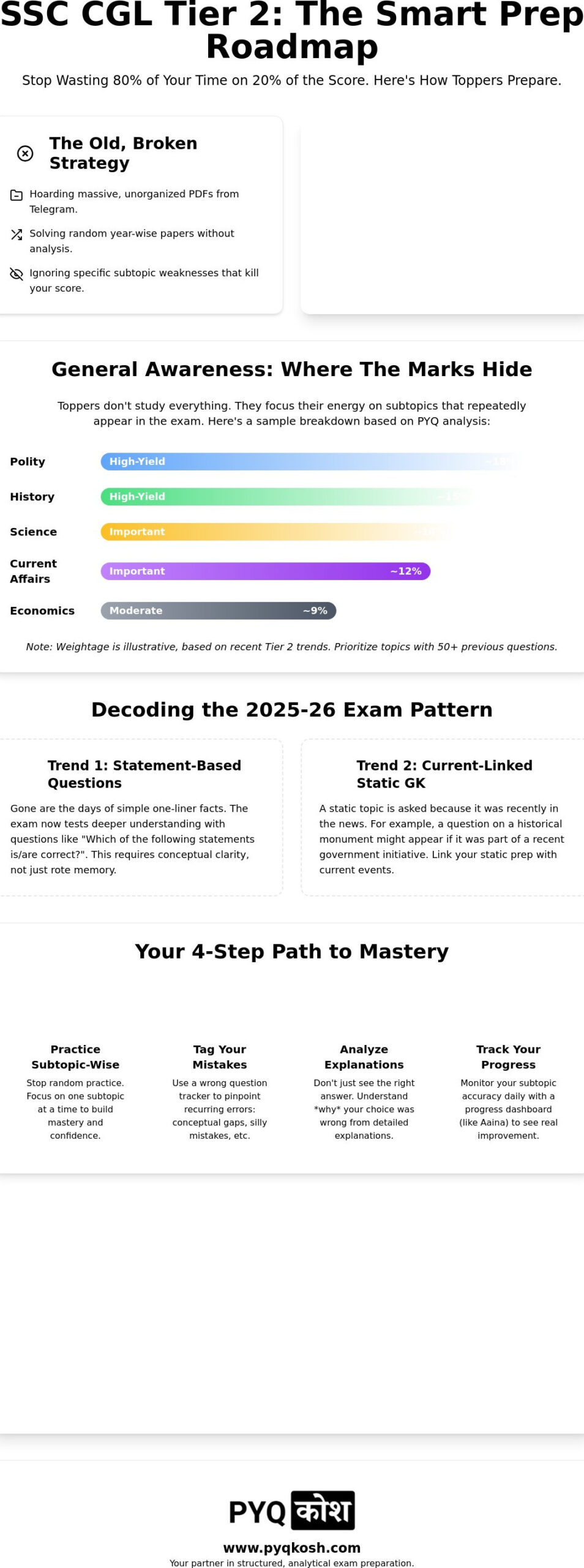
The ‘Mistake Tracker’ Method: Your 5-Step Tier 2 Strategy
A lot of aspirants ask, “Bhai, topper banne ka shortcut kya hai?” The truth is, there is no shortcut, but there is definitely a smarter way. If you’re still making manual notebooks for your mistakes, you’re wasting precious hours every day. A data-backed ssc cgl tier 2 general awareness pyq analysis should lead to immediate action, not more paperwork. You need a system that catches your errors before they become habits.
- Step 1: Start with a subtopic-wise test to identify your “Red Zones.” These are specific areas where your accuracy is below 60% despite studying the theory.
- Step 2: Use in-depth explanations to understand the “Why” behind every wrong answer. Don’t just look at the correct option; read the confusion points to see why you got tricked.
- Step 3: Leverage the “Wrong Question Tab” to automate your revision. This feature stores every mistake you make, allowing you to re-attempt them without flipping through pages.
- Step 4: Bookmark “Confusion Points” that you keep forgetting during mocks. These become your customized revision list for the final ten days before the exam.
- Step 5: Monitor your daily “Aaina” stats. Check your accuracy graph and peer rank to ensure your preparation strategy is actually moving the needle.
Automating Your Revision Loop
The Wrong Question tab is a total lifesaver for busy aspirants. It automatically stores questions you get wrong and lets you sort them by frequency. If you’ve made the same mistake three times, it pops to the top. This means you fix your biggest weaknesses first. Consistency beats 12-hour marathon sessions every single time. Use ‘Test Mode’ to build your real exam-day temperament and switch to ‘Practice Mode’ when you want to focus on learning from the “Exam Booster” tips included in the explanations.
Analyzing Speed vs. Accuracy
Having 100% accuracy is great, but if you’re taking two minutes per question, it’s a trap. In the Tier 2 exam, speed is just as important as knowledge. Use subtopic-wise test analysis to see exactly where you’re losing time. You might find that you’re fast in Polity but slow in Geography. Once you have this data, you can stop guessing. A pro tip is to practice 50 subtopic-wise questions every morning before your full mock. It warms up your brain and builds the precision you need to score 300+.
You can start tracking your mistakes automatically today and stop the manual struggle that holds most aspirants back.
Tier 2 Mastery with PYQKosh: Work Smarter, Not Harder
Most aspirants fail because their preparation is scattered across ten different apps and a hundred messy Telegram groups. To score 300+ in 2026, you need a single source of truth. A structured ssc cgl tier 2 general awareness pyq analysis is only possible when you have all the data in one place. PYQKosh centralizes over 130 exams, helping you see patterns that others completely miss.
Subtopic-level tracking is the real secret weapon for Tier 2. If you know your accuracy in “Fundamental Rights” is 90% but “Indian Rivers” is 40%, you know exactly where to put your effort tonight. This level of precision is what separates a ranker from someone who just qualifies. You stop guessing and start knowing exactly which subtopic will give you the most marks.
Peer ranking on the platform also gives you a reality check without the toxicity of social media. You can see your standing among serious aspirants who are practicing every day. This keeps you grounded and focused on your own improvement rather than getting distracted by random “cut-off” discussions on YouTube. Focus on your data, and the results will follow naturally.
Aaina: The Dashboard That Doesn’t Lie
The Aaina dashboard is like having a mentor who shows you the mirror every single day. It tracks your accuracy, daily practice streaks, and weekly progress in one structured place. This helps you stay motivated during that “boring” middle phase of prep when most people quit. Check out the SSC CGL Exam Selection Page to see how your progress looks for your specific target.
The Power of Multi-Exam PYQs
SSC often “borrows” question patterns from exams like CDS, CAPF, or Railway. If a new type of statement-based question appears in a recent CDS paper, there is a high chance it will show up in your CGL Tier 2. By practicing similar subtopics across different exams, you build bulletproof concepts. You don’t just learn the answer; you learn the logic that works across all TCS-conducted exams.
Ready to stop the guesswork? Start your topic-wise practice today.
Your Path to 300+ Marks Starts Today
You’ve seen the data. You know that 2026 is going to be about analytical thinking and precision, not just rote learning. The days of drowning in unorganized PDFs are over. By using a structured ssc cgl tier 2 general awareness pyq analysis, you move from the “hope and pray” method to a data-backed strategy that actually works. You’ve learned how to identify high-yield subtopics and how to automate your revision loop so you never repeat the same mistake twice.
Now, it’s time to take action. With over 100,000 questions and subtopic-level analytics at your fingertips, you have everything you need to dominate the competition. Use the Aaina progress dashboard to keep yourself accountable and watch your accuracy climb every single day. Don’t let another day go by just “planning” to study. It’s time to turn your weaknesses into your greatest strengths and secure your spot in the merit list.
Crush Tier 2 with Topic-Wise PYQ Practice-Start Now!
Success isn’t about working the hardest; it’s about working the smartest. You’ve got the tools and the roadmap, so go out there and make it happen. I’ll see you on the other side of the selection list.
Frequently Asked Questions
How many years of PYQs are sufficient for SSC CGL Tier 2?
Focus on the last 3 to 5 years of papers to stay aligned with the current TCS pattern. While older questions help with basic concepts, the 2023 to 2025 sets reflect the recent analytical shift in the exam. A detailed ssc cgl tier 2 general awareness pyq analysis of these specific years is enough to understand the modern examiner’s mindset. Don’t waste your energy on 2015 papers when the logic has completely changed.
Is the difficulty level of Tier 2 increasing every year?
The difficulty level is increasing in terms of analytical depth rather than just hard facts. You’ll find fewer direct one-liners and more statement-based questions that test how well you actually understand a topic. This makes the exam feel tougher for those who rely only on rote memorization. Adapting your strategy to handle these complex options is the only way to stay competitive and secure a top rank in 2026.
Can I clear Tier 2 by only practicing PYQs?
You can definitely clear Tier 2 using PYQs if you learn to analyze the why behind every single option. PYQs aren’t just for practice; they are the best syllabus you have. When you perform a thorough ssc cgl tier 2 general awareness pyq analysis, you realize that the core concepts repeat even if the wording changes. Master the logic of previous questions, and your final marks will improve significantly without needing extra books.
Which subtopic has the highest weightage in SSC CGL English?
Reading Comprehension and Cloze Tests are the highest weightage areas in the English section. Together, they often account for nearly 40% of the total English questions in the Tier 2 exam. While grammar rules like Narration and Active-Passive voice are important, your ability to understand context will determine your final rank. Focus on these leverage points during your daily practice to boost your score quickly and efficiently.
How should I use the ‘Wrong Question’ tab for maximum benefit?
Sort your mistakes by frequency to identify your most persistent weaknesses immediately. Re-solving a question you’ve missed three times is much more valuable than solving ten new ones you already know. This feature eliminates the need for messy manual mistake notebooks and keeps your revision focused on your actual red zones. It’s the smartest way to ensure you don’t repeat the same silly errors on the actual exam day.
Is it necessary to solve UPSC or Railway PYQs for SSC CGL?
It isn’t mandatory, but it’s a topper’s secret for mastering the General Awareness section. SSC frequently picks up question styles from recent CDS or Railway NTPC exams conducted by TCS. Practicing these similar subtopics helps you prepare for the out-of-the-box questions that often appear in Tier 2. It builds a level of conceptual clarity that practicing a single exam’s papers simply cannot provide, giving you a massive edge.
What is the best way to analyze a mock test for Tier 2?
Move beyond your total score and look at your subtopic-level accuracy to see the real picture. Identifying that you lost 10 marks in Ancient History is more useful than just knowing you got a decent total score. Check which questions took you the longest to solve even if you got them right. This helps you balance speed and precision, ensuring you don’t run out of time during the actual pressure of Tier 2.
Does the Aaina dashboard help in tracking speed or just accuracy?
The Aaina dashboard primarily tracks your accuracy, practice streaks, and overall progress trends across subtopics. It shows you a mirror of your daily consistency and peer ranking to keep you motivated. By looking at your weekly accuracy graphs, you can easily see if your speed is coming at the cost of precision. It’s designed to keep your preparation structured and data-driven so you always know where you stand.