

Article by
Aaisha
A passionate content writer at PYQKosh focused on simplifying Current Affairs and PYQs for competitive exam aspirants. I love turning complex topics into easy, student-friendly content that helps learners prepare smarter and stay consistent in their exam journey.
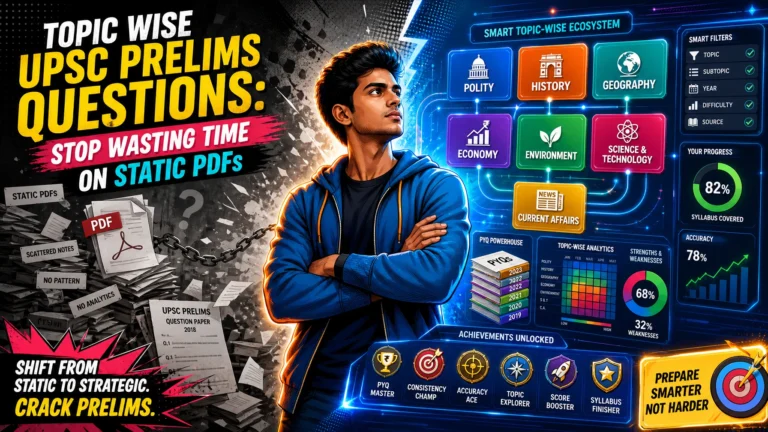
Your Google Drive folder full of upsc last year question paper PDFs is likely a graveyard for your Prelims dreams. You’ve spent months collecting every file from 2013 to 2025, yet you still feel anxious when looking at a blank OMR sheet.
It’s frustrating to scroll through a fifty-page PDF just to find one Economics question you actually studied today. You’re drowning in information but starving for actual practice that sticks.
I’ve been there, and I know that static PDFs are actually slowing your progress. This guide will show you how to swap those messy files for subtopic-wise practice to help you clear the May 24, 2026 Prelims and secure one of the 933 vacancies.
We’ll explore how to identify high-yield topics instantly and use structured, analytical exam preparation to stop making the same old mistakes. It’s time to move from just saving papers to actually mastering them.
Key Takeaways
- Stop hoarding messy PDFs and switch to active practice to avoid “Analysis Paralysis” and a false sense of security.
- Master the art of decoding the upsc last year question paper by identifying recurring concepts and frequent trap options.
- Break broad subjects into micro-topics like ‘Governor Generals’ to ensure you don’t miss high-yield details during revision.
- Monitor your daily progress and accuracy using a structured dashboard to stay motivated and data-driven.
- Use a dedicated wrong questions tracker to automatically catch and fix your recurring mistakes before exam day.
The PDF Trap: Why your UPSC last year question paper collection is useless
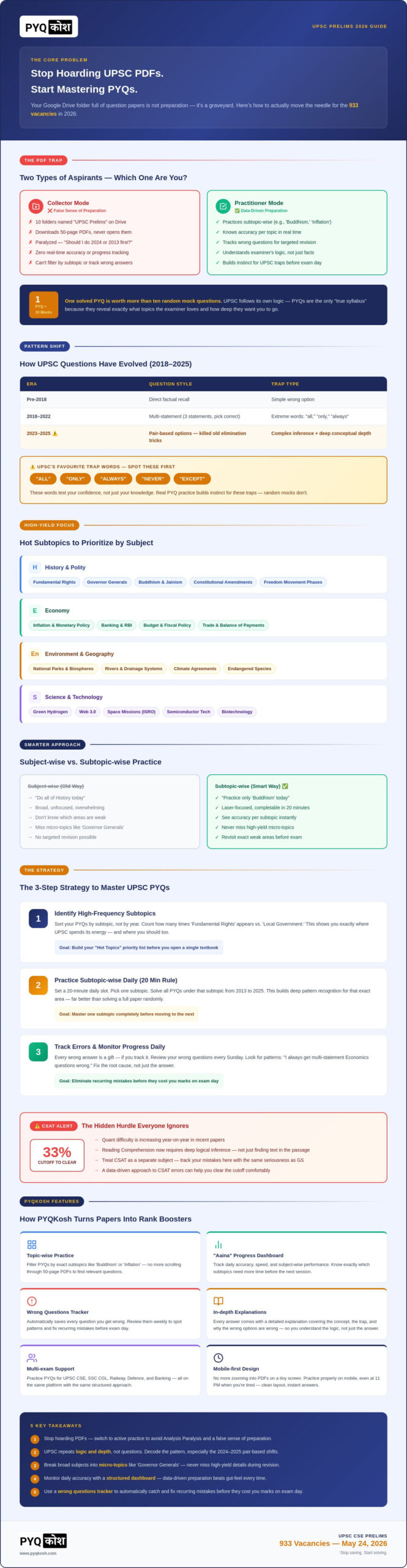
Be honest, your Telegram and Google Drive folders are overflowing with files. You have at least ten folders named “UPSC Prelims,” but most are just upsc last year question paper downloads you never opened. We call this “Collector Mode.” It makes you feel productive, but it’s actually a trap, yaar.
Hoarding hundreds of PDFs gives you a false sense of preparation. You think you’re ready because you have the resources on your phone. In reality, you’re just drowning in data. You spend more time sorting papers by year or subject than actually solving a single question.
This habit leads to “Analysis Paralysis.” You open a 50-page PDF and don’t know where to start. Should you do 2024 first? Or start from 2013? While you’re busy deciding, your competitors are already finishing their daily practice. Don’t let your phone become a graveyard for PDFs.
Static PDFs are dead weight. They can’t track your speed or show your real-time accuracy. To crack the 933 vacancies in 2026, you must stop hoarding files. You need a data-driven approach where every upsc last year question paper you solve actually moves the needle for your rank.
What is a UPSC PYQ and why does it matter?
The Union Public Service Commission (UPSC) doesn’t follow any coaching institute’s syllabus. It follows its own logic. PYQs are the only “true” syllabus because they reveal the examiner’s mind and show you exactly what topics they love. While mock tests are great for practice, they often miss the subtle “UPSC touch” that only real previous papers provide. One solved PYQ is worth more than ten random mock questions because it sets your frequency to the level of the actual exam.
The problem with traditional UPSC PDF downloads
PDFs are a nightmare on mobile screens. You spend half your time zooming in and out just to read a four-line question. Then, you have to scroll for five minutes to find the answer key at the very end. It’s soul-crushing and kills your momentum. If you want to check your progress on UPSC CSE practice, you need something better than a static document.
- You can’t filter questions by specific subtopics like ‘Buddhism’ or ‘Inflation.’
- Checking answers at the end of a 100-page file is a total waste of time.
- There’s no way to track which questions you got wrong for later revision.
- You never know your real-time accuracy or how you compare to other aspirants.
Stop scrolling and start solving to build real confidence for 2026.
Decoding the UPSC pattern: What last year’s papers really tell you
Many aspirants think solving a upsc last year question paper is about finding questions that might come again. That’s a huge mistake, yaar. UPSC doesn’t repeat questions; it repeats the logic and the depth of concepts. If you understand the ‘why’ behind a question, you’re halfway to the finish line.
Look at the papers from 2018 to 2025. The shift is clear. We moved from direct factual questions to complex, multi-statement ones. The 2024 and 2025 papers are your most valuable resources for the 2026 attempt. They show the current ‘pair-based’ option patterns that have effectively killed the old elimination tricks we used to rely on.
UPSC loves setting traps. They use extreme words like ‘all’ or ‘only’ to test your confidence. By practicing real papers, you learn to spot these patterns before you touch your pen to the OMR. It’s about building an instinct for the examiner’s tricks through structured, analytical exam preparation.
Spotting high-yield subtopics in General Studies
You don’t need to master every single page of your textbooks. Instead, use the UPSC PYQ to see which subtopics are actually ‘hot.’ For example, look at how often ‘Fundamental Rights’ appears compared to ‘Local Government’ in recent years to prioritize your energy.
- Identify themes like ‘Green Hydrogen’ or ‘Web 3.0’ that recur in Science and Tech.
- Focus on mapping ‘National Parks’ and ‘Rivers’ in Environment based on recent trends.
- Sort questions by frequency to see where your effort gives the most marks.
CSAT: The hidden hurdle in last year’s papers
Don’t treat CSAT as a side project. If you analyze the upsc last year question paper for CSAT, you’ll see a scary trend. Quant is getting much tougher. Reading Comprehension now requires deep logical inference. It’s no longer just about finding the answer directly in the text.
You need a data-driven approach to clear the 33% cutoff comfortably. Analyzing your mistakes in past papers helps you see if your weakness is Permutation and Combination or logical reasoning. You can use topic-wise practice to fix these weak spots before they cost you a year.
Subject-wise vs. Subtopic-wise: A smarter way to analyze UPSC PYQs
Imagine you just finished reading about the 1857 Revolt. You’re feeling confident. You open a upsc last year question paper to test yourself. But wait, you have to scroll through 100 questions just to find the two that matter to you right now. By the time you find them, your focus is gone, yaar.
This is why subject-wise practice is often a trap. “History” is a massive mountain. You can’t master it all at once. If you treat it as one big block, you’ll never know which specific part is pulling your score down. Subtopic-wise practice is like using a sniper rifle instead of a shotgun. It’s precise, fast, and deadly effective for the 2026 Prelims.
When you solve ten questions on ‘Governor Generals’ or ‘Fundamental Rights’ in one go, you build muscle memory. You start noticing the tiny patterns in how UPSC changes the phrasing. You see the “Confusion Points” that make aspirants fail. Targeted practice is the real topper banne ka shortcut because it forces your brain to stay active and sharp.
The hierarchy of effective practice
Think of your preparation in layers. It goes from the Exam level down to the Subject, then Topic, and finally the Subtopic. Mastering the subtopic level is the real secret. It helps you clear up doubts that a general reading can’t touch. Using topic wise upsc prelims questions saves you months of aimless study. You stop guessing and start knowing.
Identifying your weak links
Subtopic-level data is like an X-ray for your preparation. You might think you’re great at ‘Modern History’ because you know the dates. But what if you’re consistently failing ‘Indian National Congress’ session questions? Without subtopic tracking, you’ll just keep re-reading the whole textbook. That’s a huge waste of time.
Data-driven insights help you fix these specific gaps before you step into the exam hall. If you know exactly where you are losing marks, you can fix it in a day. Don’t wait for the upsc last year question paper to surprise you on exam day. Use subtopic analysis to become bulletproof for 2026.
The 3-Step Strategy to master UPSC previous year papers
You don’t need to pull 12-hour marathons every day to clear the cutoff. Most toppers simply work smarter. They use a “Practice-Review-Fix” loop to ensure they never make the same mistake twice. This strategy turns every upsc last year question paper into a clear roadmap for your success in 2026.
Consistency matters more than intensity. Solving 20 questions every single day is better than solving 200 questions once a month. To stay on track, you need a system that balances new study material with old question practice. This ensures you’re not just consuming information but also learning how to apply it under pressure.
The goal is to move from being a confused aspirant to a data-driven candidate. By following this 3-step framework, you’ll stop guessing and start knowing. It’s the only way to handle the 933 vacancies with total confidence.
Step 1: The First Pass (Topic-Wise Practice)
Don’t jump into a full upsc last year question paper immediately. It’s overwhelming and often counterproductive. Instead, solve questions for the specific topic you just finished in your textbook. If you read about ‘Inflation’ today, solve only ‘Inflation’ questions tonight. This keeps your focus sharp and reinforces what you just learned.
Use ‘Test Mode’ to simulate the actual pressure of the exam hall. Don’t just look for the right answer; focus on understanding the logic behind every option. UPSC often hides clues in the wrong statements. Mastering this “topic-wise” approach builds the mental stamina you’ll need for the full two-hour grind in May.
Step 2: The Mistake Audit (Wrong Question Tracker)
Forget the red pen and heavy physical registers. Manually marking mistakes in a book is slow and disorganized. You need a system that automatically catches your errors and stores them in one place. Dedicate every Sunday to your ‘Wrong Questions’ tab. Re-solving your mistakes is the fastest way to increase your score because it stops the leak in your marks.
Reviewing these mistakes helps you spot your personal “trap” patterns. Maybe you’re rushing through the “not correct” statements or getting confused by economic terms. Whatever it is, the wrong questions tracker will find it. Fix these gaps early, and your accuracy will skyrocket before the next mock test.
Step 3: The Aaina Check (Performance Dashboard)
Motivation is temporary, but data is permanent. Use a dashboard to track your accuracy and daily streaks. Seeing a weekly graph of your progress keeps you going when you’re feeling tired at 11 PM. This “Aaina” or mirror shows you the reality of your preparation without any sugar-coating.
Compare your performance with your peers to see where you stand in the national competition. If your accuracy in ‘Ancient History’ is only 40%, the dashboard will tell you to pause and revise. Use these data-driven insights to decide which subtopic needs one more round of revision. Start your 3-step practice now to see the difference.
How PYQKosh turns UPSC question papers into your personal rank booster
You’ve already seen why hoarding PDFs is a losing game. It’s time to switch to a platform that actually understands your struggle. PYQKosh isn’t just another question bank; it’s a structured, analytical exam preparation tool designed to help you clear the 2026 Prelims. This platform was built by an aspirant who survived the same PDF mess you’re facing right now.
The Aaina dashboard is your biggest ally. It shows you exactly how many questions you’ve practiced and where your accuracy stands. No more guessing. If your accuracy in ‘Modern History’ is dipping, the dashboard will flag it. It turns every upsc last year question paper you solve into a data point for your success.
The wrong questions tracker is a game-changer. It automatically stores every mistake you make. You can sort them by recency or frequency to see which concepts are still haunting you. Instead of flipping through old books, you just open your dashboard and fix your gaps in minutes. This is how you move from random effort to targeted, strategic action, yaar.
Centralize your preparation
Get rid of those 50 Telegram channels and random apps. You can access over 1 lakh questions across UPSC, SSC, and Railway exams in one place. Practicing questions from CAPF or CDS is a great way to sharpen your skills for UPSC. The examiner’s logic is often similar across these exams.
Seeing how they frame questions in different contexts gives you a huge edge. You start to see the “UPSC style” of thinking. Everything is organized by subtopic, so you never waste time searching. Just pick a topic, enter test mode, and start building your rank. This is the definitive destination for the 2026 attempt.
Smart features for the modern aspirant
We don’t just give you a dry answer key. Our in-depth explanations cover why the right answer is right and why the wrong ones are wrong. We include ‘Exam Booster’ tips and ‘Confusion Points’ to help you handle the tricky language UPSC loves to use. It’s like having a senior mentor sitting right next to you.
- In-depth explanations that clarify every doubt instantly.
- Exam Booster tips to give you that extra 2-mark advantage.
- Bookmark tab to save tricky questions for last-minute revision.
- Wrong question tracker to stop you from repeating old mistakes.
You can also use the bookmark tab to save specific questions from a upsc last year question paper for a quick revision 10 days before the exam. This is the real topper banne ka shortcut. Stop being a collector and start being a solver.
It’s time to take control of your 2026 preparation with data and clarity. Practice 10 questions on your weakest subtopic right now to see the difference.
Take control of your 2026 Prelims journey
Success in UPSC isn’t about how many files you’ve saved; it’s about how many concepts you’ve mastered. You’ve seen how the old way of hoarding PDFs creates a false sense of security. To clear the 933 vacancies announced for 2026, you must switch from being a collector to a solver. It’s time to work smarter.
By breaking down every upsc last year question paper into subtopics, you stop guessing and start building real muscle memory. Use the Aaina progress dashboard to keep your preparation honest and the wrong questions tracker to fix your gaps before exam day. With over 1 Lakh+ questions and detailed subtopic-wise analysis at your fingertips, you have everything you need to stay ahead of the competition.
Don’t wait for the next mock test to realize your weak spots. Every small session on your specific confusion points brings you one step closer to the final list. Stop wasting time on PDFs and start your subtopic-wise UPSC practice on PYQKosh today!
You have the dream and the drive. Now, use the right tools to make your success inevitable. Start practicing now and turn your hard work into a top rank.
Frequently Asked Questions
How many years of UPSC last year question papers should I solve?
You should solve at least 10 to 12 years of papers, starting from 2013 when the syllabus changed significantly. However, focus most of your energy on the papers from 2020 to 2025. These recent years reveal the shift toward tougher pair-based options and complex logical reasoning in CSAT. Mastering these recent trends is the best way to prepare for the 2026 attempt.
Does UPSC repeat questions from previous years?
Direct question repeats are very rare, but UPSC repeats concepts and themes every single year. For instance, topics like Buddhism, Jainism, and Inflation appear frequently with a new twist. Solving a upsc last year question paper isn’t about memorizing the answer; it’s about learning the examiner’s logic and the depth of the subtopics they love to target.
Can I rely only on PYQs to clear UPSC Prelims 2026?
No, you cannot rely only on questions. PYQs are your roadmap, not the entire journey. You still need to read standard books like Laxmikanth for Polity or Spectrum for History. Use PYQs as a filter to identify which chapters need more time. Once you finish a topic, solve the relevant questions to see if your study method is actually working.
How do I analyze UPSC previous year papers without a mentor?
You don’t need a mentor if you have the right data. Use subtopic-wise practice to see your accuracy levels in real-time. If you’re consistently getting ‘Governor General’ questions wrong, you know exactly what to fix. Tools like the Aaina dashboard give you this feedback automatically, allowing you to self-correct and improve your accuracy without any external guidance.
Which is better for UPSC prep: Topic-wise or Year-wise practice?
Topic-wise practice is much better for building a strong foundation. It allows you to master one concept at a time, like ‘Fundamental Rights,’ before moving on. Year-wise practice is only useful in the last two months of your prep to simulate the full exam pressure. Start with a topic-wise upsc last year question paper approach to ensure you don’t leave any weak links.
Where can I find UPSC Prelims questions with detailed explanations?
You can find them on PYQKosh, where we provide in-depth explanations for both right and wrong options. We also include ‘Exam Booster’ tips and ‘Confusion Points’ to help you handle the tricky language UPSC uses. This level of detail ensures you understand the “why” behind every answer, which is much better than just looking at a dry answer key.
Is practicing CDS or CAPF papers helpful for UPSC CSE?
It’s incredibly helpful. The same organization sets these papers, and you’ll often see themes from CDS or CAPF appear in the Civil Services Prelims later. Multi-exam support allows you to see how the same subtopic is tested in different ways. It’s a great way to broaden your practice and stay ahead of the curve for the 2026 exam.
What is the best way to track my progress while solving UPSC PYQs?
The best way is to use a digital dashboard that tracks your accuracy, daily streaks, and weekly progress. A wrong questions tracker is also vital because it automatically stores your mistakes for revision. This structured, analytical exam preparation replaces messy notebooks and helps you see exactly where you stand compared to other aspirants in the national competition.
Stop overthinking and start solving to build real confidence for your attempt.