

Article by
Aaisha
A passionate content writer at PYQKosh focused on simplifying Current Affairs and PYQs for competitive exam aspirants. I love turning complex topics into easy, student-friendly content that helps learners prepare smarter and stay consistent in their exam journey.
What if I told you that reading Laxmikanth for the tenth time won’t actually help you crack the 15 to 18 upsc polity questions waiting for you on May 24, 2026? It sounds harsh, but many aspirants get stuck in a loop of endless reading without ever building the MCQ accuracy needed to clear the cutoff.
I’ve been there too. It’s incredibly frustrating to spend hours memorizing articles only to get confused between similar provisions during a mock test. Wasting time on low-weightage topics while high-yield themes like the 106th Amendment slip through your fingers is a mistake you can’t afford.
This guide will help you stop the random reading and start a targeted strategy. You’ll learn how to master upsc polity questions by breaking them down into subtopics. We’ll show you how to identify high-yield themes and track your progress at a granular level so you’re fully prepared for the 2026 Prelims.
Key Takeaways
- Learn why solving upsc polity questions subtopic-wise is more effective than reading the entire textbook ten times over.
- Identify high-yield themes like Fundamental Rights and the Preamble that give you the highest return on your limited study time.
- Move beyond messy static PDFs and adopt a structured practice method that lets you test your knowledge the moment you finish a chapter.
- Discover how to use a data-driven dashboard like Aaina to track your daily streaks and accuracy so you don’t repeat the same mistakes.
- Master the exact steps to eliminate confusion between similar constitutional provisions and boost your MCQ solving speed for 2026.
Why UPSC Polity Questions are the Backbone of Your Prelims
If you want to clear Prelims, you need a safety net. Polity is exactly that. While History can feel like a bottomless pit and Science can get weird, the Constitution of India provides a stable foundation. The rules of our democracy don’t change every morning, which makes this section your best shot at a high score.
Solving upsc polity questions from previous years isn’t just about checking what you know. It’s about learning the “language” of the exam. You’ll start to notice that certain themes like Parliamentary committees or Emergency provisions keep coming back. This isn’t luck; it’s a pattern you can master with the right practice.
When you solve these questions, you develop a “sixth sense” for elimination. You learn how to spot those tiny, tricky words like “only,” “all,” or “must” that UPSC loves to use. This logic is what separates a serious aspirant from someone who just reads textbooks without a plan.
The Reality of Polity Weightage
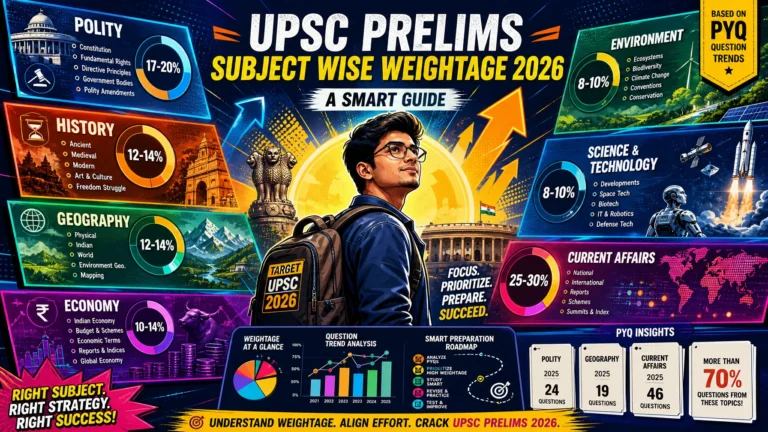
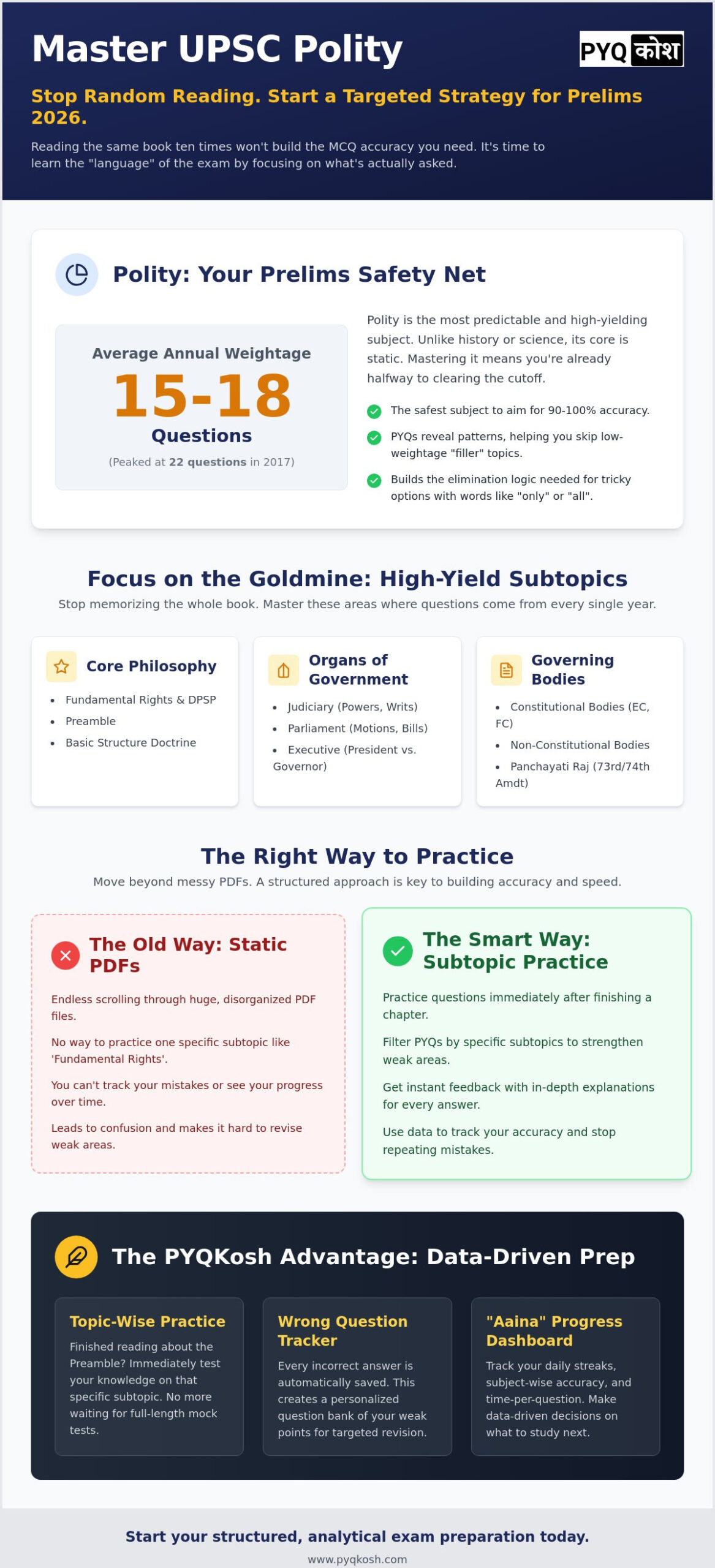
Polity is a heavy hitter. On average, you can expect 15 to 18 questions from this section every year. In some years, like 2017, it went as high as 22 questions. It’s the ultimate “make or break” subject for clearing the cutoff. If you get 90% accuracy here, you’re already halfway through the gate.
For new aspirants, PYQs act as a personal syllabus decoder. Don’t try to memorize every single page of your study material. Use the upsc cse pyqs to see which parts of the book actually matter. Focus on what is being asked, not just what is written.
- Polity questions are predictable and high-yielding.
- It’s the safest subject for 100% accuracy.
- PYQs help you skip low-weightage “filler” topics.
- Targeted practice builds the logic needed for tricky options.
Static vs. Dynamic Polity Questions
Don’t get distracted by the “current affairs” hype. Even a news item about a new law is usually a “hook” for a static question. For example, if there’s news about a Speaker’s decision, UPSC will likely ask you about the static powers of the Speaker under the Constitution. The secret of every topper is mastering the static core first.
You can actually predict future themes by looking at old questions. Themes like the Preamble or Judicial Review are revisited almost every two years in different forms. If you master the static subtopics, current updates feel like easy additions rather than a whole new burden. Practice these patterns on PYQKosh to see the data-driven reality of how questions evolve over time.
High-Yield Polity Subtopics You Cannot Ignore
You don’t need to be a scholar to clear Prelims; you just need to be smart. Stop trying to memorize every page of Laxmikanth from cover to cover. Instead, focus on the “goldmine” areas where upsc polity questions actually come from every single year.
Fundamental Rights and Directive Principles of State Policy (DPSP) are the heart of the paper. UPSC loves testing the fine line between individual liberty and social welfare. If you haven’t mastered the 106th Amendment or the latest debates on personal laws, you’re leaving marks on the table.
Don’t ignore the Preamble and Basic Structure doctrine either. These are small topics, but they offer the highest ROI (Return on Investment). A few hours of targeted practice can guarantee you two or three correct answers. It’s the easiest way to boost your score without burning out, yaar.
- Judiciary: Focus on Supreme Court powers, writ jurisdiction, and the concept of Judicial Review.
- Parliamentary System: Master the types of motions, the budget process, and how different bills are passed.
- Executive: Understand the real powers of the President versus the Governor, especially in the context of state elections.
Constitutional and Non-Constitutional Bodies
UPSC has a soft spot for bodies like the Election Commission and the Finance Commission. They won’t just ask what these bodies do. They’ll grill you on the “Who and How”—who appoints the members and how are they removed?
Practice these as a standalone subtopic to avoid mixing up the removal processes of a CAG with a CEC. You can use the UPSC CSE PYQs to see exactly how these bodies are compared in the actual exam.
Local Government and Panchayati Raj
The 73rd and 74th Amendments are recurring favorites. You must know the mandatory versus voluntary provisions. The Official Portal on the Indian Constitution is a great place to verify the exact wording of these powers and functions.
Look for questions specifically on the ‘Powers and Functions’ of local bodies and the role of the State Election Commission. If you’re feeling overwhelmed, try sorting these questions by “most recent” on PYQKosh to see what examiners are currently focusing on.
Static PDFs vs. Subtopic-Wise Practice: Which is Better?
Let’s be honest, yaar. We all have that one “Polity” folder on our phones filled with 50 different PDFs from Telegram. But when was the last time you actually learned something from them? PDFs are a mess. You can’t track your mistakes, and you definitely can’t see your progress over time.
Subtopic-wise practice changes the game. Instead of drowning in a 100-page document, you finish one chapter and test it immediately. This is how you master upsc polity questions without losing your mind. Centralized platforms eliminate the wasted time of searching through files, letting you focus on what matters: solving questions.
Real-time accuracy tracking beats manual checking any day. Why spend 30 minutes matching answers with a key when a dashboard can do it instantly? It’s about working smarter, not harder. You need to know your weak spots before the exam day, not after.
The Problem with Random Practice
Solving a full 100-question mock paper is exhausting, especially for beginners. It’s easy to get demotivated when you see a low score, but random practice doesn’t tell you why you failed. Was it because you forgot the articles or because you didn’t understand the logic?
Random practice creates chaos. You jump from the Preamble to the Supreme Court and back to the President. Your brain can’t build a clear connection between topics. To clear UPSC 2026, you need to transition from this chaos to organized clarity.
The Power of Granular Organization
Focusing on a specific subtopic like “Governor” instead of the entire “State Executive” saves you hours. It allows you to go deep into the nuances. You’ll start noticing how UPSC tricks you on the discretionary powers of the Governor versus the President.
This granularity helps you build a “mental map” of the subject. When you practice at this level, you’re not just memorizing; you’re analyzing patterns. Check out this guide on UPSC Subtopic-Wise Practice to see why this is the secret weapon for toppers. You can use the “Wrong Question” tab on PYQKosh to automatically track every mistake you make by subtopic.
How to Solve UPSC Polity Questions Like a Topper
Toppers don’t have a different brain; they just have a better system. If you want to crack upsc polity questions in 2026, you need to stop passive reading. Start treating every subtopic like a mini-exam to build your confidence.
Step 1: Read a specific subtopic from your notes or Laxmikanth. Stay focused. If you’re reading about “Writ Jurisdiction,” don’t wander off into “Judicial Activism.” Keep your session tight and goal-oriented.
Step 2: Solve 20-30 PYQs on that exact subtopic immediately. This is the “active recall” secret. It forces your brain to store the data you just read while the logic is still fresh in your mind.
Step 3: Read the explanations for both right and wrong answers. In-depth breakdowns on PYQKosh highlight confusion points and exam booster tips. This helps you understand exactly why you fell for a trap.
Step 4: Revisit your mistakes after 7 days. Use the “Wrong Question” tracker to sort mistakes by frequency or recency. If you’ve got a question wrong three times, that’s a signal to re-read the theory, yaar.
Mastering the Art of Elimination
UPSC loves extreme words like “Only,” “All,” or “Always.” In Polity, these are usually red flags. The Constitution is full of exceptions, so absolute statements are often incorrect. Learning this pattern saves you from silly mistakes.
Practice spotting these trap options using real exam data. For a deeper dive into this logic, check out Mastering the Prelims UPSC Question Paper. It helps you think like an examiner.
Revision is the Real Game
Don’t just solve and forget. Bookmark your “Confusion Points” using the bookmark tab. These are the specific areas where you always get stuck between two options. Revisiting them regularly is the real topper banne ka shortcut.
Consistency wins the race every time. It’s better to solve 10 questions every night than to do a 100-question marathon once a month. Make it a daily habit to keep your momentum high and your anxiety low.
Ready to build your topper’s habit? Start your topic-wise practice on PYQKosh right now and see your accuracy climb.
Master Polity with the PYQKosh Advantage
Stop hunting for questions across ten different Telegram channels and websites. You need a single, definitive destination to execute your strategy. With access to over 1 lakh questions, you can practice upsc polity questions with surgical precision. Everything is organized by subject, topic, and even the smallest subtopic.
Your progress shouldn’t be a mystery. The Aaina dashboard acts as your personal mirror, showing you exactly where you stand. It tracks your daily practice streaks and accuracy levels through a weekly graph. Seeing your peer rank helps you stay competitive without the stress of disorganized chaos.
Mistakes are actually your best teachers if you track them. The Wrong Question tab automatically stores every question you miss. You can sort these by recently committed mistakes or by frequency. If you keep getting the “Election Commission” questions wrong, the system will highlight it for you, yaar.
- Access 1 lakh+ questions across all major government exams.
- Use the Aaina dashboard to visualize your daily streaks.
- Sort topics by question count to focus on high-yield areas.
- Track your accuracy at a granular subtopic level.
Centralize Your UPSC Prep
UPSC often repeats themes across different exams. You don’t need to search for CDS or CAPF papers separately. They are all here on one platform. This multi-exam support gives you a massive edge in understanding how the commission thinks.
Switch between “Practice Mode” and “Test Mode” to build real exam stamina. Practice mode helps you learn, while Test mode simulates the pressure of the 2026 Prelims. This structured, analytical exam preparation ensures you are never surprised on the big day.
Booster Tips and Confusion Points
A right answer isn’t enough; you must know why the other three options are wrong. Our in-depth explanations cover right and wrong choices. We include “Exam Booster” tips and specific “Confusion Points” to help you remember tricky constitutional articles. This is the real topper banne ka shortcut.
Stop being a “PDF collector” and start being a data-driven aspirant. When you see your accuracy improve on the dashboard, your anxiety naturally turns into confidence. It’s time to move from random effort to targeted, strategic action. Practice daily on PYQKosh to turn your weak subtopics into your strongest assets.
Take your first step toward mastering Polity by practicing today’s subtopic on PYQKosh.
Time to Turn Your Polity Fear into Your Greatest Strength
Mastering Polity isn’t about reading the same book until you’re bored. It’s about testing your knowledge at a granular level. You now know that subtopic practice beats messy PDFs and how elimination logic saves you from traps. This is your topper banne ka shortcut, yaar.
The road to clearing Prelims 2026 starts with mastering upsc polity questions through a data-driven approach. Stop guessing and start tracking your growth. With access to 100,000+ questions across 130+ exam categories, you can build a foundation that no tricky option can shake. Everything you need is centralized in one place.
Use the Aaina Progress Dashboard to watch your accuracy grow every single day. It’s your journey, and you finally have the tools to make success inevitable. Keep your momentum high and stay consistent.
Start your subtopic-wise Polity practice on PYQKosh today!
Believe in your prep and keep pushing toward that dream seat in LBSNAA!
Frequently Asked Questions
Are UPSC Polity questions repeated in Prelims?
Themes and concepts repeat very often, even if the exact wording changes. UPSC loves to revisit core areas like the basic structure doctrine or the powers of the President. Solving old upsc polity questions helps you spot these recurring patterns and saves you from surprises on exam day.
Which is the best book for UPSC Polity preparation?
M. Laxmikanth is the most recommended book and acts as the “bible” for most toppers. It covers the syllabus comprehensively for Prelims. You should supplement it with the latest Current Affairs and the Bare Act for exact constitutional wordings when needed.
How many years of Polity PYQs should I solve for 2026?
You should aim to solve at least the last 10 to 15 years of papers. This range covers the major shifts in question patterns and difficulty levels. For your 2026 attempt, looking at recent CDS and CAPF papers on PYQKosh will also give you an edge on the latest trends.
Can I clear UPSC Prelims by only solving questions?
No, you need a solid balance between reading theory and practicing MCQs. Theory builds your foundation, while solving upsc polity questions trains your brain for the actual exam pressure. Use practice to identify your weak subtopics and then go back to your notes to fill those gaps.
How to remember all the Articles and Schedules of the Constitution?
Don’t try to memorize them in one go. Use mnemonics like “TEARS OF OLD PARLIAMENT” for Schedules and focus on one subtopic at a time for Articles. Repeated practice through topic-wise tests makes these numbers stick in your memory naturally without extra effort.
Is subtopic-wise practice better than year-wise practice?
Yes, subtopic-wise practice is much better for building deep conceptual clarity during your first few rounds of revision. It helps you master one specific area before moving on. Year-wise practice is more useful for full-length mock tests once you have finished the entire syllabus, yaar.
What are the most important Polity topics for UPSC 2026?
Fundamental Rights, Parliament, the Judiciary, and Local Government are always high-yield areas. For 2026, pay special attention to the 106th Amendment regarding women’s reservation and the 131st Amendment Bill. These current themes are highly likely to appear in the static part of the paper.
How to use the PYQKosh Aaina dashboard for Polity?
The Aaina dashboard is your personal progress tracker. Use it to check your accuracy for specific subtopics like “Emergency Provisions” or “Governor.” If the dashboard shows low accuracy in a particular area, you’ll know exactly what to revise instead of wasting time on topics you already know.