
Article by
Aaisha
A passionate content writer at PYQKosh focused on simplifying Current Affairs and PYQs for competitive exam aspirants. I love turning complex topics into easy, student-friendly content that helps learners prepare smarter and stay consistent in their exam journey.
How many “Ultimate GK” PDFs are currently rotting in your phone’s downloads folder? You spend hours reading about Indian Polity or the 2025-26 budget, yet you still freeze when you see four similar-looking options in the actual exam. It’s the classic aspirant’s trap where you’re working hard, but you aren’t working smart.
I know how it feels to watch your score stay stuck in single digits despite the effort. To fix this, you need a targeted approach using ssc general awareness questions with answers that focus on subtopic mastery rather than bulk reading. This guide will help you stop hoarding useless files and start building a data-backed strategy.
We’ll break down the vast syllabus into manageable pieces that actually stick in your memory. You’ll also discover exactly which topics TCS is repeating for the upcoming 2026 exams, ensuring you’re ready for the 12,256 CGL vacancies and beyond. It is time to turn your confusion into organized clarity.
Key Takeaways
- Learn why mastering specific subtopics like “Delhi Sultanate Architecture” is more effective than reading broad, generic subjects.
- Discover how to use ssc general awareness questions with answers to build long-term retention through focused, subtopic-level practice sessions.
- Understand the “TCS Shift” and why prioritizing 2025-26 previous year questions is essential for beating the current exam pattern.
- Stop the cycle of forgetting by using the Aaina dashboard to track your accuracy, daily streaks, and subtopic-wise progress.
- Transition from a “PDF hoarder” to a smart aspirant by shifting your focus from bulk reading to organized, analytical practice.
Why Reading Random SSC General Awareness Questions is a Trap
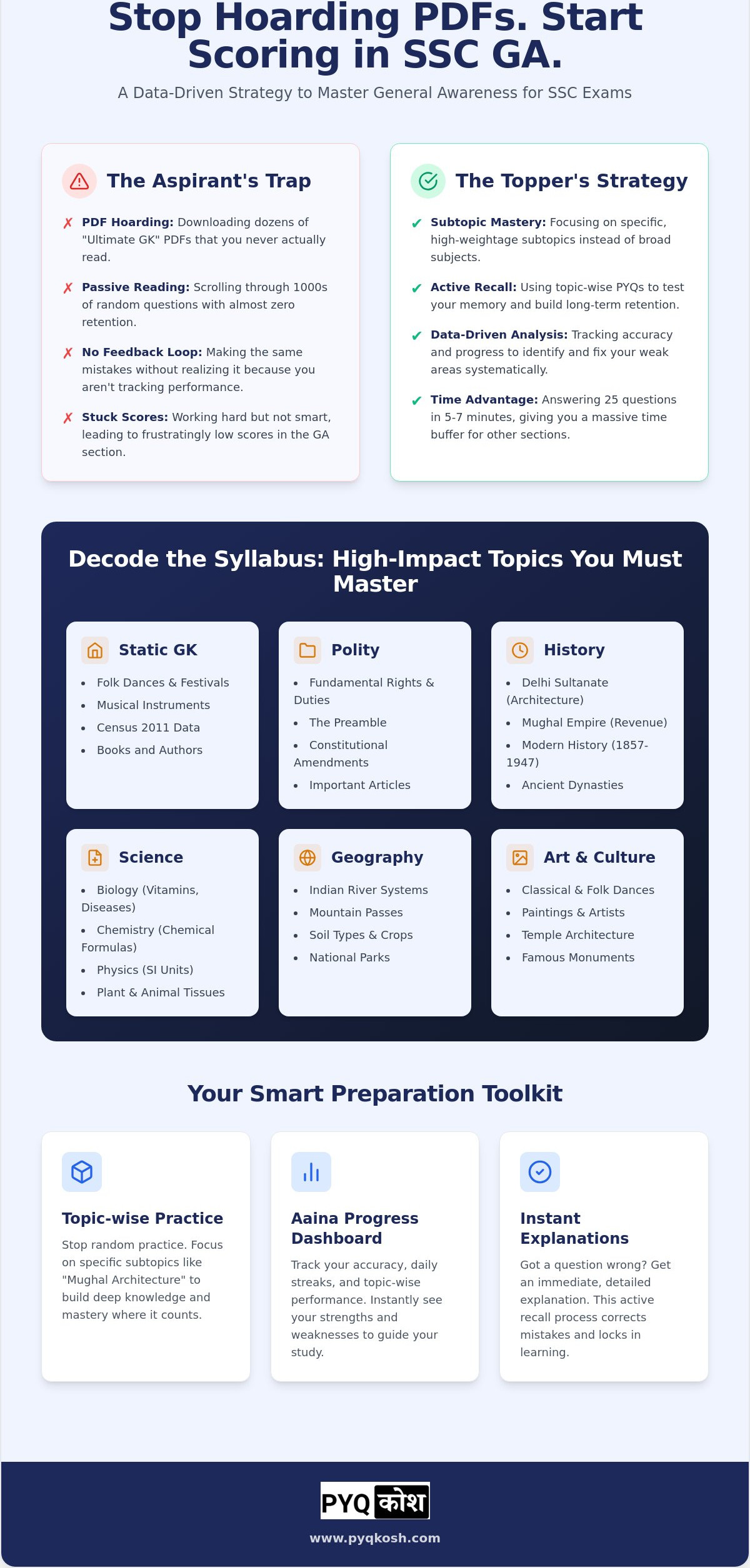
Yaar, let’s be honest. We all have that one Telegram folder filled with 50+ “Ultimate GA” PDFs that we never actually open. Downloading 1,000 random ssc general awareness questions with answers feels like you’re making progress, but it’s often just a distraction. When you sit for the exam, that passive reading won’t help you choose between two similar-looking options.
The Staff Selection Commission (SSC) designs the General Awareness section to test your memory and speed. It’s 25 questions of pure “know it or leave it.” You can’t solve a History question using a formula like you do in Maths; you either have the fact stored in your head or you don’t.
Effective practice isn’t about reading a 100-page document. It’s about identifying recurring subtopics like Folk Dances, Articles of the Constitution, or Mughal Architecture. Randomly jumping from one topic to another is a trap. You might be a genius in History but failing Science without even realizing it because you aren’t tracking your performance.
The PDF Hoarding Syndrome
Downloading a massive PDF feels productive, but it’s just passive reading. You scroll through pages, your eyes glaze over, and you retain almost nothing. Active testing is the only way to make these facts stick in your long-term memory for the 2026 exam.
When you use topic-wise practice on a platform like PYQKosh, you get immediate feedback. If you mark a wrong answer, you see the explanation instantly. This “active recall” is the real topper banne ka shortcut because it forces your brain to correct its mistakes on the spot.
Why GA is the Secret to Clearing the Cutoff
Most aspirants spend 90% of their time on Quant and Reasoning. While those are important, they’re time-consuming. You can finish the entire GA section in just 5 to 7 minutes if you’re well-prepared. This speed gives you a massive “time buffer” for those tricky Maths questions that require extra calculation.
Hitting 20+ correct answers in the first few minutes gives you a huge psychological boost. You feel confident, and that energy carries you through the rest of the paper. To avoid the random practice trap, use the Aaina progress dashboard to see exactly which subtopics need more work. Stop guessing and start using a structured, analytical exam preparation strategy.
Decoding the SSC General Awareness Syllabus: Subtopics You Must Master
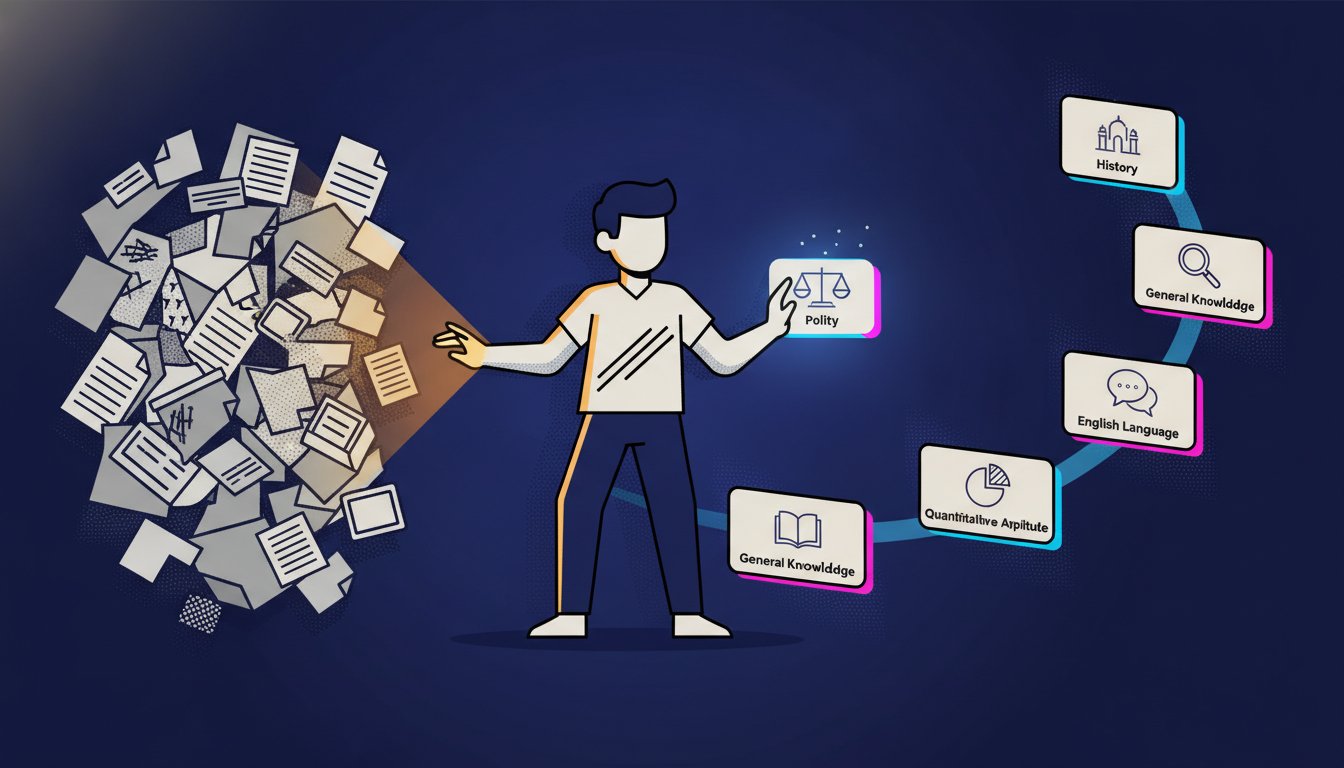
Stop looking at “History” as one giant monster you can’t defeat. The truth is, the Staff Selection Commission doesn’t just ask about History; it asks about “Delhi Sultanate Architecture” or “Mughal Land Revenue.” If you check the official SSC website for the latest notifications, you’ll see the syllabus looks broad, but the actual ssc general awareness questions with answers follow a very specific subtopic hierarchy.
You need to move from Subject to Topic and then to Subtopic. For example, don’t just study “Polity.” Study “Polity” then “Constitutional Framework” and finally “Fundamental Rights.” This is the only way to build a structured, analytical exam preparation mindset. For the 2026 pattern, focus on Art & Culture, the Indian Constitution, and Modern History as they carry the highest weightage.
Don’t ignore Science either. Biology and Chemistry have become the “make or break” sections in recent shifts. A single question on chemical formulas or plant tissues can decide if you clear the cutoff or wait another year. Mastering these specific areas is the real topper banne ka shortcut.
Static GK: The Weightage King
Static GK is where most aspirants lose marks because it feels endless. Focus your energy on folk dances, festivals, and musical instruments. These are guaranteed marks if you’ve practiced enough. Census 2011 is another TCS favorite; you’ll almost always see a question on literacy rates or sex ratios.
Using SSC CGL topic-wise previous year questions is the only way to see these patterns clearly. It helps you focus on what actually matters instead of reading everything under the sun. It’s better to know 50 subtopics perfectly than to have a vague idea of 500 subjects.
Polity and Geography: Concepts that Repeat
Polity is high-scoring because the concepts repeat constantly. Master the Fundamental Rights, the Preamble, and major Constitutional Amendments. In Geography, stick to Indian river systems, mountain passes, and soil types. These are the “fixed” questions that rarely change in style.
When you hit a tough, concept-heavy question, use the bookmark tab on PYQKosh to save it for later. This lets you revisit the tricky stuff right before the exam without hunting through old notebooks. Tracking your progress at the subtopic level ensures you never leave a high-yield area untouched.
How to Practice SSC General Awareness Questions with Answers for Retention
Ever read a whole chapter on Buddhism and forgot the names of the councils by the next morning? You’re not alone, yaar. To fix this, you need a system that turns passive reading into active recall so the facts actually stay in your head.
Start by picking one specific subtopic. Let’s say you just finished reading about Buddhism and Jainism. Immediately practice 30 to 50 ssc general awareness questions with answers from that specific area. This narrows your focus and reinforces exactly what you just learned.
While the Official SSC Syllabus tells you what to study, the real magic happens in the analysis. Read the “Exam Booster Tips” for every question, even if you got it right. It adds extra context that might help you solve a different question in the actual exam.
Finally, use the “Wrong Question Tab” on PYQKosh to your advantage. Don’t just look at your mistake and move on. Re-attempt those specific questions after exactly 24 hours to ensure your brain has corrected the error.
The Power of In-Depth Explanations
SSC loves setting traps with options that look almost identical. Understanding why three options are wrong is just as vital as knowing why one is right. This is where “Confusion Points” in the solutions become your best friend.
These tips help you avoid common traps set by examiners. This approach shifts you from a “mug-up” strategy to a “deep understanding” strategy. When you understand the logic behind a fact, you don’t have to struggle to remember it.
Practice Mode vs Test Mode
Use Practice Mode when you’re in the learning phase. It’s a relaxed way to go through questions and read explanations without the pressure of a clock. It’s about building your foundation subtopic-by-subtopic.
Switch to Test Mode once you feel confident. Set a mental timer and aim for 15 seconds per GA question. Speed is everything in the 2026 pattern, and this helps you build that “know it or leave it” instinct.
Check your Aaina dashboard regularly to track accuracy at the subtopic level. If your accuracy in “River Systems” is below 60%, mark it as a “red zone.” Focus your next practice session there until that graph starts moving up.
Analyzing TCS Patterns: Why 2025-26 PYQs are Your Best Friend
Still using that old 2010 “Golden Book” for General Awareness? Yaar, you’re practicing for an exam that no longer exists. The pattern has shifted significantly after 2022-23. TCS has moved away from simple one-liners and now focuses on deeper, more analytical facts.
To master ssc general awareness questions with answers, you must focus on the 2025-26 shifts. These latest papers show you exactly what the examiner is thinking right now. Practicing ancient questions might actually hurt your 2026 prep because the depth of Science and Economics has increased tremendously.
Sorting by recency is a complete game-changer for your preparation. It helps you identify “Hot Topics” that appeared in nearly 80% of last year’s shifts. Why waste time on something that hasn’t been asked in five years when you can master what’s currently trending in CGL, CHSL, and MTS?
Multi-Exam Overlap
Did you know? A question from RRB General Awareness often repeats in SSC exams. Since TCS handles multiple government bodies, the question bank overlaps more than most aspirants realize. Practicing across these exams builds a massive mental bank of facts.
Using one centralized platform to see these patterns is much smarter than hunting through different books. It allows you to see how a topic like “Indian River Systems” is tested in both Railway and SSC exams. This structured, analytical exam preparation ensures you never miss a recurring question.
Current Affairs Integration
Static GK isn’t random anymore; it’s often inspired by current events. If a new UNESCO site is announced, expect a question on its historical background. You should link your Current Affairs topics with their static roots to stay ahead of the curve.
You generally only need the last 12 months of Current Affairs for most SSC exams. Focus on quality over quantity. Instead of reading daily news for hours, practice topic-wise questions to see what’s actually relevant. This helps you build a high-scoring habit without the burnout of bulk reading.
Start practicing the latest 2025-26 patterns on PYQKosh to ensure your preparation is data-driven and accurate.
Mastering the GA Section with PYQKosh: Your Data-Driven Mentor
You’ve been studying for 10 hours a day, but your mock scores aren’t moving. Yaar, the problem isn’t your effort; it’s your organization. Topper banne ka shortcut is not just grinding through books; it is about organized work that targets your specific weak spots.
Finding the right ssc general awareness questions with answers is only half the battle. Knowing what to do with them is the real game. This is where PYQKosh steps in as your data-driven mentor, turning your random practice into a targeted mission.
The platform offers a Peer Rank feature that tells you exactly where you stand among thousands of other serious aspirants. It also features a Wrong Question Tab. This isn’t just a list; it’s a personalized “Weakness List” that updates itself every time you make a mistake, allowing you to focus only on what you don’t know.
Aaina — Your Reflection in Preparation
The Aaina dashboard acts as your mirror in this journey. It tracks your progress at the subtopic level, so you can’t hide from your weak spots. If your accuracy in “Delhi Sultanate” is low, the dashboard will show it to you in clear, simple numbers.
Weekly graphs help you stay consistent even when your motivation is low. Seeing your daily streaks grow has a powerful psychological effect. It turns the boring task of practice into a high-scoring habit that you won’t want to break.
The Practice-to-Revision Loop
Stop being just a “student” who reads and start being an “analyst” of your own performance. Use the Bookmark feature to create your own “Last Minute Revision” set. This saves you from hunting through multiple books or PDFs two days before the exam.
You can also sort topics by “Question Count” to prioritize high-weightage areas first. This ensures you spend more time on things like Art & Culture and less time on low-yield topics. Instead of drowning in static PDFs, use a structured, analytical exam preparation approach to clear the 2026 cutoff.
Start your first subtopic-wise practice session today on PYQKosh.
Time to Turn Your GA Confusion into Organized Clarity
You’ve seen why those dusty Telegram PDFs won’t help you on exam day. The real secret to a high score lies in breaking the syllabus down into subtopics and attacking them with the latest 2025-26 patterns. By focusing on high-yield areas and analyzing why you’re making mistakes, you stop guessing and start knowing. This shift from passive reading to active practice is what separates the toppers from the crowd.
Mastering ssc general awareness questions with answers is no longer a luck factor; it’s a data-driven game. With over 1 Lakh structured questions and subtopic-level performance tracking, you can finally see where you stand among serious aspirants across India. Stop wasting time on outdated materials and start using a system that actually builds your memory.
Start your subtopic-wise practice on PYQKosh today and stop the PDF clutter!
You’ve got the strategy and the tools. Now, you just need the discipline to show up every day. You’re closer to that dream post than you think, yaar. Keep practicing and stay focused.
Frequently Asked Questions
How many years of PYQs are sufficient for SSC General Awareness?
Focus primarily on the last 3 to 5 years of questions. The TCS pattern changed significantly after 2022, so practicing questions from 2010 might actually waste your time. Priority should always be given to the 2025-26 shifts to understand the current depth of Science and Static GK.
Is it possible to score 40+ in SSC CGL General Awareness?
Yes, scoring 40+ is definitely possible if you move beyond broad subjects. Most aspirants fail because they study “History” instead of mastering specific subtopics like “Mughal Architecture.” Focus on high-yield areas and use data-driven practice to hit those high scores consistently.
How do I handle the negative marking in the GA section?
Follow a strict “know it or leave it” rule during the exam. GA is a speed game where you should spend no more than 15 seconds per question. If you aren’t 100% sure, don’t mark it; blind guessing is the quickest way to ruin your chances of clearing the cutoff.
Can I rely only on PYQs for SSC General Awareness preparation?
You can rely on ssc general awareness questions with answers if you study the in-depth explanations. PYQs cover nearly 80% of the recurring themes. The key is to understand the logic behind the right and wrong options rather than just memorizing the answer.
How much time should I dedicate to GA practice daily?
Dedicate about 90 minutes to 2 hours every day. Spend the first 30 minutes reading a specific subtopic and the rest of the time on active practice. This structured approach is the real topper banne ka shortcut because it builds retention better than 5-hour random study sessions.
What is the best way to remember Static GK facts for a long time?
Active recall through testing is the best way to make facts stick. Instead of reading a list of folk dances ten times, try solving 30 questions on them. Testing your brain forces it to store the information more deeply, especially if you review your mistakes after 24 hours.
Are SSC General Awareness questions repeated in every shift?
The exact questions rarely repeat, but the subtopics always do. If one shift asks about a specific Buddhist Council, another shift will likely ask about a different one. Mastering the subtopic hierarchy ensures you are ready for any variation the examiner throws at you.
How do I use the Aaina dashboard to improve my accuracy?
Check your accuracy graph on the Aaina dashboard every evening to find your “red zones.” If your accuracy in “Indian Rivers” is low, don’t move to a new topic yet. Use the Wrong Question Tab to fix those specific errors until your subtopic-level score improves.