

Article by
Aaisha
A passionate content writer at PYQKosh focused on simplifying Current Affairs and PYQs for competitive exam aspirants. I love turning complex topics into easy, student-friendly content that helps learners prepare smarter and stay consistent in their exam journey.
Why are you still scrolling through a 100-page PDF at 2 AM just to find one question on the Preamble? It’s 2026, and that old-school way of solving papers is actually slowing you down.
We’ve all been there, yaar. You download a subject-wise file, only to realize it’s just a mess of scanned pages where you can’t even track what you’ve learned. You make a mistake in a mock, promise to fix it, and then forget it three days later.
This ends today. You’re going to learn how to turn your scattered upsc pyq prelims practice into a sharp, data-driven strategy that guarantees you won’t repeat the same mistakes on May 24.
We’ll show you how to master high-yield subtopics like Monetary Policy individually and use smart tracking to see your real progress every single day.
Key Takeaways
- Stop wasting hours on disorganized Telegram PDFs that make it impossible to track your actual progress.
- Master the syllabus with precision by practicing specific subtopics like the Preamble or 1857 Revolt instead of solving random years.
- Prioritize recent trends by using year-wise filters to focus on the 2023-2025 upsc pyq prelims patterns.
- Build a fail-proof revision loop by automatically storing and re-solving every question you get wrong.
- Replace heavy books with a mobile-friendly practice habit that tracks your daily streaks and accuracy.
The UPSC PYQ Prelims Trap: Why PDFs Won’t Save You
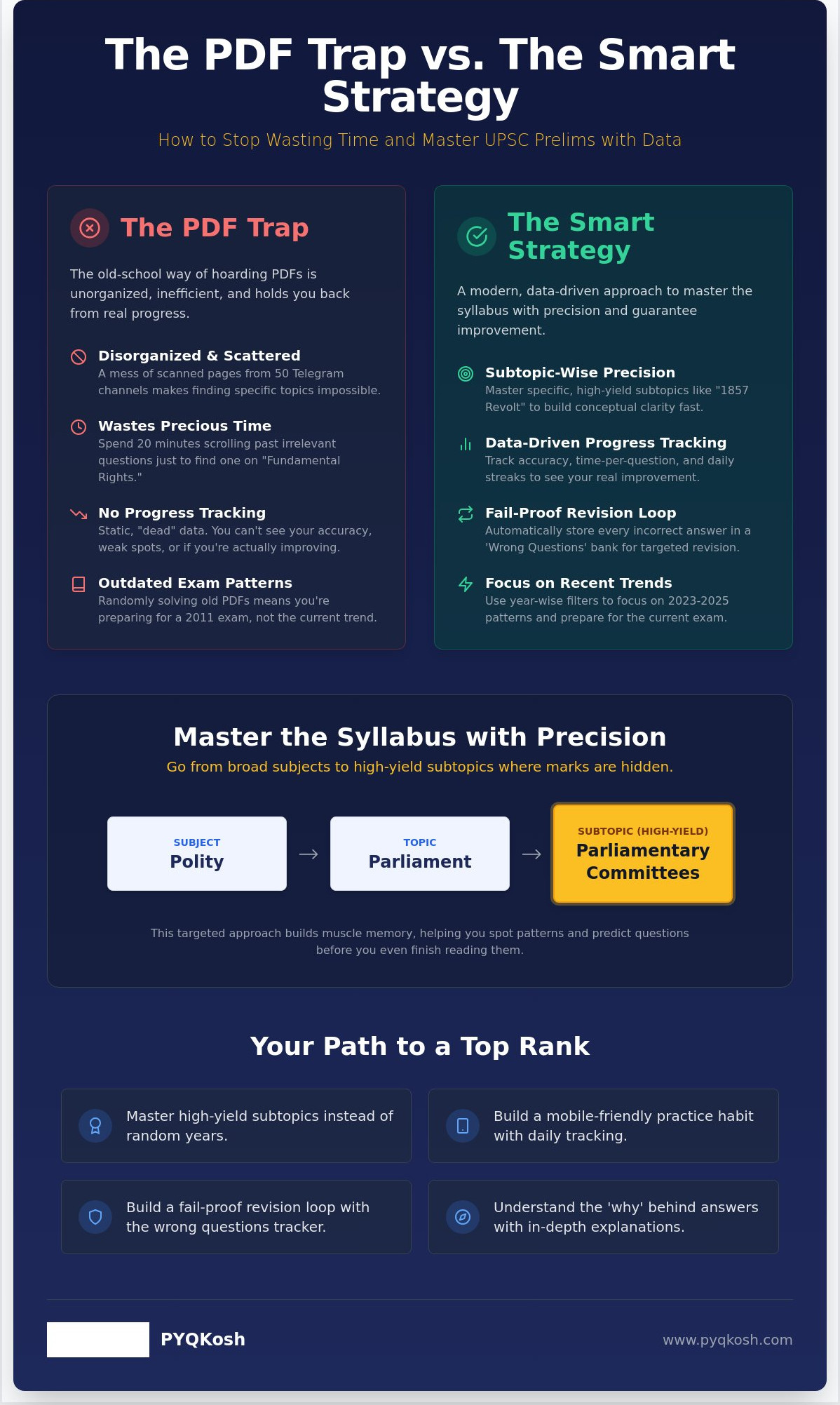
You probably have fifty Telegram channels pinned, each full of “Mega-Drive” links for every upsc pyq prelims paper ever released. It feels like you’re preparing, but hoarding 100 PDFs doesn’t equal 100 marks. It just equals a cluttered phone and a confused mind.
The PDF trap is real. When you want to practice “Fundamental Rights,” you open a 2018 paper and spend 20 minutes scrolling past questions on Ancient History and Science just to find what you need. That’s time you’ll never get back, yaar. Manual searching is the enemy of efficiency.
Static papers are “dead” data. They don’t tell you where you’re failing. You might feel confident about Polity, but you won’t realize you’re consistently messing up “Parliamentary Committees” until the actual exam day. By then, it’s too late to fix your mistakes.
Worse, these files don’t show you how the exam is changing. The pattern of questions from 2023 to 2025 is very different from the 2011 era. If you’re just reading old PDFs, you’re preparing for an exam that doesn’t exist anymore. You need a method that highlights these trends clearly.
PDFs vs. Structured Practice: The 2026 Reality
PDFs are great if you just want to print something, but they’re terrible for targeted revision. For 2026, you must move from “reading” questions to “solving” them. You need to feel the pressure of a timer and the risk of negative marking to build real exam temperament.
- PDFs lack a timer, making your practice feel “too easy” compared to the real hall.
- Searching for specific topics in a year-wise file wastes precious study minutes.
- You can’t track your accuracy or improvement over time with static files.
A simple answer key isn’t enough anymore. You need in-depth explanations for all four options. Often, a wrong option in a 2024 question becomes the main topic for a 2026 question. If you don’t understand why the other three options were incorrect, you’re missing 75% of the potential learning.
The Hidden Cost of Unorganized Study
Every minute you spend manually sorting through old papers is a minute lost in actual learning. Toppers don’t solve random papers; they use subtopic-wise analysis to find high-yield areas. This is the only way to master the massive syllabus without burning out before May.
Understanding the UPSC Civil Services Examination structure shows that the Prelims stage is the biggest filter. You can’t afford to be disorganized here. Precision is your only weapon against the rising competition and unpredictable patterns.
Switching to a focused UPSC PYQ strategy helps you find your weak spots instantly. It replaces messy folders with a clear path to the cut-off. Don’t let unorganized PDFs kill your dream of becoming an officer. Practice with purpose instead of just collecting files.
Mastering UPSC Prelims PYQ with Subtopic-Wise Precision
Ever felt like you’ve finished a whole subject but still fail the mocks? It’s a common frustration, yaar. Mastering the UPSC Civil Services Examination requires more than just reading books. You need to break the syllabus into tiny, manageable pieces.
The secret lies in the hierarchy: Subject to Topic to Subtopic. If you try to “solve Modern History,” you’ll get overwhelmed. But if you focus only on the “1857 Revolt” subtopic, you can master every question UPSC has ever asked on it in thirty minutes.
This approach builds real muscle memory. When you see twenty questions on the same niche topic, you start noticing how the commission traps you. You begin to predict the next question before you even finish reading the options. That’s how you conquer upsc pyq prelims with confidence.
Subject-Wise vs. Subtopic-Wise: What’s the Difference?
Subject-wise practice is like using a hammer; it’s broad and often misses the mark. Subtopic-wise practice is like using a surgical scalpel. While “Polity” is a subject, “Parliamentary Committees” is the subtopic where the marks actually hide.
Deep-diving into subtopics helps you spot “Confusion Points” early. You’ll learn exactly why you keep mixing up the Estimates Committee with the Public Accounts Committee. For a fully structured breakdown, check out the UPSC CSE section to see how we’ve organized thousands of questions for you.
Building Conceptual Clarity, One Subtopic at a Time
Solving a question is only half the battle. You need to understand the logic behind the answer. Our “Exam Booster Tips” act like a smart mentor sitting right next to you. They explain the “why” and “how” so the concept sticks in your brain forever.
Seeing the exam name, date, and shift on every single question builds massive confidence. It proves you’re solving real, high-stakes questions, not some random mock. This transparency helps you respect the level of the exam while keeping your anxiety low.
Topper banne ka shortcut is simple: Master the themes, not just the years. Don’t just solve 2024; solve “Monetary Policy” across all years. This targeted action is what separates the serious aspirants from the crowd. You can start your journey by exploring topic-wise practice right now to see the difference.
Decoding Trends: Sorting UPSC Questions by Year and Recency
Stop looking at 2011 papers like they are gospel. The 2023-2025 pattern has completely flipped the game. If you are still stuck in the logic of the 2011-2015 era, you are preparing for an exam that no longer exists.
UPSC has moved away from the old elimination method that helped many seniors clear the cut-off. Now, they use the “only one pair” or “only two pairs” style to test your absolute conceptual clarity. You simply can’t guess your way through the upsc pyq prelims anymore.
Using recency filters to prioritize 2025–26 questions is the smartest move you can make. It helps you catch the latest trends in how the commission frames options. At the same time, you’ll spot “Evergreen” topics that appear every three years, like National Parks or Constitutional Bodies.
Sorting by question count is another pro-move. It instantly shows you which topics are “Hot” and which ones are just noise. This data-driven approach saves you from reading 500 pages of a textbook when only 5 pages actually matter for the exam.
Why 2026 Aspirants Must Focus on Recent Shifts
The shift in question framing is the biggest hurdle for new aspirants. Practicing the prelims upsc question paper from the last five years is non-negotiable. It’s the only way to understand how the commission is evolving.
When you sort topics by question count, you realize where to put your energy. Why spend three days on a topic that has only appeared twice in ten years? Focus on the high-yield subtopics that repeat consistently to maximize your score.
Pattern Recognition: The Multi-Exam Advantage
Did you know that themes often overlap across different exams conducted by the commission? Practicing CDS and CAPF PYQs can give you a massive edge in the Civil Services GS paper. The level of difficulty might vary, but the core concepts remain the same.
Identifying these common themes across multiple exams on one platform is a total game-changer. It saves you from buying ten different books and keeps your preparation centralized. You get to see how a single concept, like the “Governor’s Powers,” is tested across different exam formats.
This centralized practice ensures you don’t miss out on high-quality upsc pyq prelims questions just because they weren’t in a “UPSC-only” book. It’s about being smart and using every available resource to build your confidence for 2026. Topper banne ka shortcut is simply staying ahead of the trend.
How to Build a Fail-Proof Revision Loop for Prelims 2026
Ever notice how you keep getting the same type of question wrong in every mock? It’s like a loop of failure, yaar. You read the solution, think you’ve learned it, and then make the same mistake three weeks later.
This happens because reading isn’t the same as solving. To break this cycle, you need a systematic revision loop. It turns your mistakes into your biggest strengths before the actual upsc pyq prelims day arrives.
Follow these four steps to build a preparation strategy that actually sticks:
- Step 1: Solve a subtopic test in ‘Test Mode’. This simulates real exam pressure and forces you to decide between two close options under a timer.
- Step 2: Review ‘Wrong Questions’ immediately. Don’t wait for the weekend. These are automatically stored for you so you can face them again until the concept is clear.
- Step 3: Bookmark ‘Confusion Points’. If a specific question on “Article 356” always trips you up, save it in a dedicated folder for the final 30-day revision marathon.
- Step 4: Use the Aaina Dashboard. Check your accuracy and daily streaks before you sleep. It’s the only way to know if you’re actually improving or just wasting time.
The Aaina Dashboard: Your Personal Progress Mirror
Tracking your daily practice and streaks keeps you motivated when the syllabus feels like a mountain. Seeing your peer rank reminds you that you’re not alone in this struggle. It pushes you to do just five more questions every night.
A weekly graph of your performance is much better than a random guess about your preparation. It shows you exactly which days you were productive and where you lost focus. Accuracy tracking tells you the hard truth: are you getting better or just solving more questions mindlessly?
Never Repeat a Mistake Again
The ‘Wrong Question Tab’ is your secret weapon for 2026. It automatically collects every mistake you make. You can sort these by the frequency of errors. If you’ve gotten a question wrong three times, it’s a clear signal that your basic concept is weak.
Re-practicing your errors is 10x more effective than reading a brand-new book. It’s the ultimate topper banne ka shortcut. Use your Bookmark folders to organize questions by subject for a quick revision during your commute or lunch break.
Stop guessing your way through your preparation and start using a structured, analytical exam preparation method. You can track your UPSC progress and start building your own revision loop today.
Ready to see your real progress? Start your daily streak on PYQKosh and stop repeating the same mistakes.
Why PYQKosh is the Smart Choice for Modern UPSC Aspirants
Carrying 10kg of heavy textbooks and bulky PYQ books is a nightmare for any aspirant. Why struggle with physical clutter when you can have a structured, mobile-friendly library in your pocket? You can replace those dusty piles of paper with a streamlined system that works as hard as you do.
Data-driven preparation beats “blind” practice every single time. Instead of just guessing if you’re ready, you get to see your real accuracy and progress. This platform understands your 11 PM struggles because it was built by an aspirant who knows the pain of staying up late with zero clarity.
You get affordable access to over 1 lakh+ questions with detailed, logical explanations for every single option. This level of detail ensures you don’t just find the right answer but also understand why the other three were wrong. This is the exact precision needed to master upsc pyq prelims.
Efficiency Over Effort: Work Smarter, Not Harder
Stop wasting time hunting for answer keys or “booster” notes across different apps. You can consolidate your entire workflow—Practice, Test, and Revise—in one single destination. It’s the ultimate topper banne ka shortcut for those who value their time.
Having a single destination for SSC, UPSC, and Railways means you don’t need to switch between five different platforms. Everything you need for a structured, analytical exam preparation is right here. You can focus on learning instead of managing resources, yaar.
Start Your 2026 Journey Today
Early birds who master the upsc pyq prelims now will have the highest chance of clearing the cut-off on May 24, 2026. Mastering these patterns early gives you a massive psychological edge over the competition. You’ll enter the exam hall with the confidence of someone who has already seen it all.
Visit the Pricing Page to unlock full subtopic access and start your journey with a clear plan. Don’t wait for January to start your serious preparation. The more you practice now, the easier those final months will feel.
The final word is simple: stop downloading and start practicing. Messy folders of PDFs will only increase your anxiety. A structured practice habit will build your career.
Start your daily practice on PYQKosh today and see your accuracy climb.
Master the 2026 Prelims with Data, Not Luck
The May 24 exam date is closer than it looks. Success in 2026 won’t come from your collection of Telegram files; it’ll come from your ability to spot patterns under pressure. You need to move beyond static reading and embrace a strategy that highlights your weak spots before the commission does.
By shifting to subtopic-wise practice and using a dedicated tracker for your mistakes, you ensure that no concept remains a mystery. This is the real topper banne ka shortcut. You’ve seen how recent shifts in the upsc pyq prelims require a sharper, more analytical approach. Now, it’s time to put that knowledge into action every single night.
With access to 1 Lakh+ Questions and the Aaina Progress Dashboard, you can track your growth across 130+ exams. Don’t let your hard work go to waste in a messy folder of unorganized notes. You have the potential to clear this cut-off; you just need the right system to prove it.
Stop wasting time on PDFs and start your subtopic-wise UPSC practice now!
Keep your streaks alive, stay consistent, and remember that every question you solve today brings you one step closer to that LBSNAA dream.
Frequently Asked Questions
Is the UPSC prelims PYQ really repeated in the actual exam?
Yes, themes and concepts repeat almost every year. While you might not see the exact same wording, UPSC loves repeating high-yield topics like Buddhism, Jainism, or Parliamentary Committees. Solving upsc pyq prelims helps you identify these recurring patterns so you aren’t surprised on exam day. It’s about mastering the logic the commission uses to frame its questions.
How many years of UPSC PYQ prelims should I solve for 2026?
You should aim for the last 10 to 15 years to cover all major concepts thoroughly. However, the last 5 years are the most critical for understanding recent shifts in question framing. Focus on these recent papers to master the “how many pairs” style questions that have become the new standard for the 2026 cycle.
Can I practice UPSC prelims subject-wise on PYQKosh?
Yes, you can practice subject-wise and even go much deeper into subtopics. Instead of solving a random mix of questions, you can pick “Polity” and then specifically choose “Preamble” or “President.” This helps you finish your syllabus in a structured way rather than jumping around between unrelated subjects in a messy PDF.
What is the benefit of subtopic-wise practice over year-wise papers?
Subtopic-wise practice allows you to master one specific concept with surgical precision. Year-wise papers are good for full-length mocks, but they don’t help you find niche weaknesses easily. When you solve 20 questions just on “Monetary Policy,” you build the muscle memory needed to spot traps instantly and clear your conceptual doubts forever.
Does PYQKosh provide explanations for UPSC Prelims questions?
Yes, every question comes with in-depth explanations for both right and wrong options. We also include “Exam Booster” tips and confusion points to help you understand the logic behind the answer. This ensures you don’t just memorize the correct option but actually learn the underlying concept for your 2026 attempt.
How does the ‘Wrong Question’ tracker help in UPSC preparation?
The tracker automatically saves every question you get wrong so you can re-solve them whenever you want. You can sort these by how many times you’ve made the mistake. This forces you to face your weak areas until you stop repeating the same errors in your upsc pyq prelims practice sessions.
Is there a way to track my daily consistency for UPSC?
The Aaina dashboard is designed exactly for this purpose. It tracks your daily practice streaks, accuracy, and even provides a weekly graph of your performance. Seeing your streak grow every day is a huge motivator to keep going even when you’re feeling tired or overwhelmed by the massive syllabus.
Can I use PYQKosh for other exams like SSC or CDS as well?
Yes, the platform supports over 130 exam categories, including SSC, CDS, CAPF, and Railways. You get multi-exam support on one platform, which is helpful because themes from CDS and CAPF often overlap with the Civil Services GS paper. It keeps all your preparation centralized and saves you from buying multiple books.