
Article by
Aaisha
A passionate content writer at PYQKosh focused on simplifying Current Affairs and PYQs for competitive exam aspirants. I love turning complex topics into easy, student-friendly content that helps learners prepare smarter and stay consistent in their exam journey.
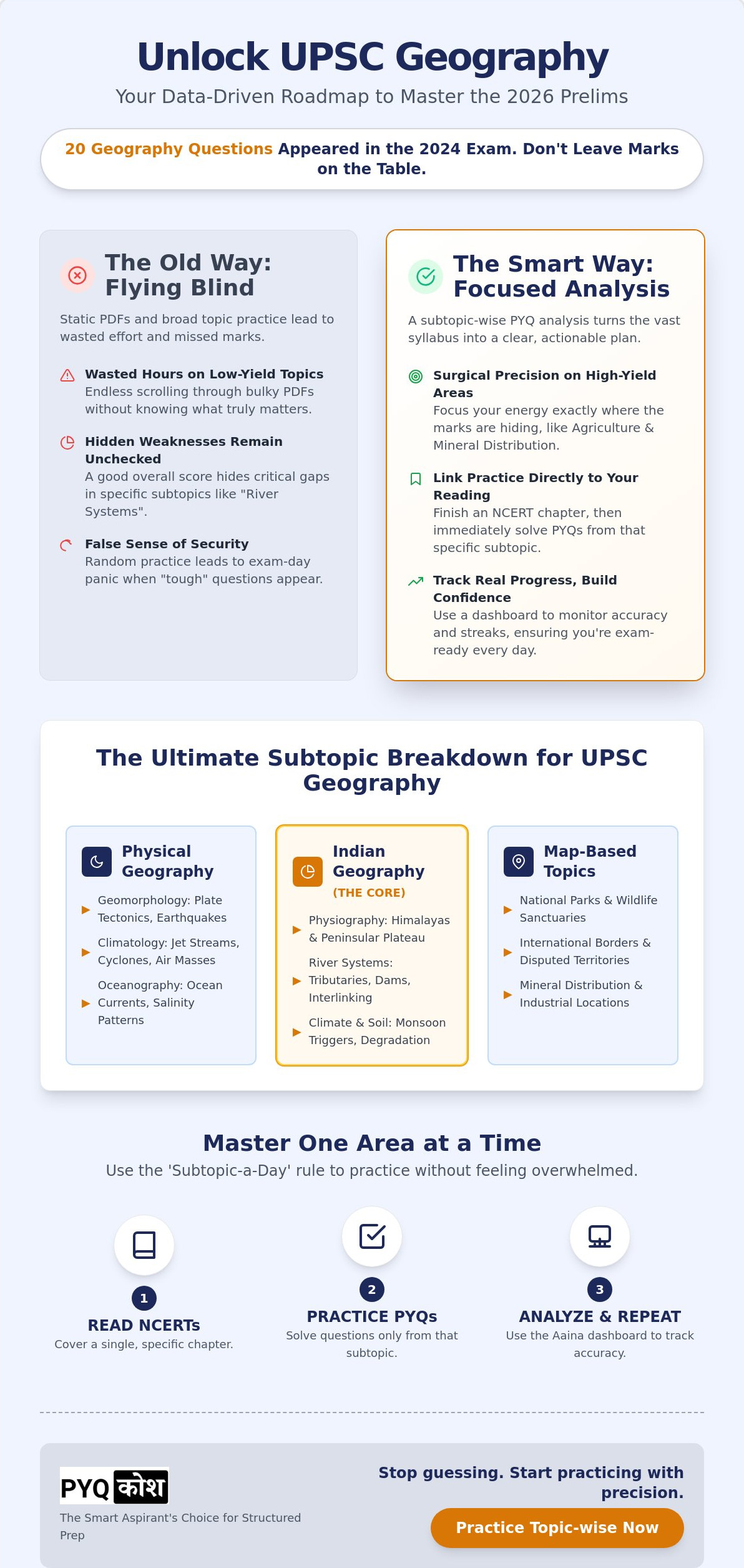
What if you could stop guessing which parts of the massive Geography syllabus actually matter for the 2026 Prelims? With 20 geography questions appearing in the 2024 exam, you can’t afford to waste time on low-yield topics that never show up. A detailed UPSC Geography subtopic wise PYQ analysis is the only way to avoid this trap and focus your energy where it counts.
I know how it feels to carry around heavy books and still feel completely lost. It’s exhausting to practice generic questions when you don’t even know if your weakness lies in Geomorphology or Indian Climate patterns. You deserve a preparation style that’s as sharp and focused as your ambition.
I promise to show you a data-driven roadmap to master every subtopic for the 2026 cycle. This guide breaks down exactly where the marks are hiding based on recent trends from 2024 and 2025. We’ll look at which sections are trending so you can walk into the exam on May 24, 2026, with total confidence.
Key Takeaways
- Stop wasting hours on bulky Geography PDFs that don’t show you which specific subtopics are actually pulling your score down.
- Identify high-yield themes like Agriculture and Mineral Distribution using a data-driven UPSC Geography subtopic wise PYQ analysis to beat the 2026 curve.
- Master one area at a time with the ‘Subtopic-a-Day’ rule by linking your NCERT readings directly to targeted practice sessions.
- Use the Aaina dashboard to track your accuracy and daily streaks, ensuring you remain consistent and exam-ready every single day.
- Focus on narrow, high-weightage sections like Drainage Systems and specific landforms instead of getting lost in broad, low-yield categories.
Why Static Geography PDFs are Wasting Your Time in 2026
Bhai, let’s be real. Solving a full 100-question mock test just to find 10 Geography questions is a massive waste of energy. You spend more time scrolling through pages than actually learning anything. Static PDFs are the silent killers of your 2026 preparation. They give you the questions, but they never give you the data. They won’t tell you that you’re failing specifically at “Ocean Currents” while being great at “Atmosphere.”
You’re basically flying blind. In 2026, you need a centralized library instead of 50 different browser tabs and half-downloaded files. A proper UPSC Geography subtopic wise PYQ analysis lets you see exactly where your marks are leaking. Without it, you’re just repeating what you already know and ignoring the gaps that will cost you your selection.
The Problem with Broad Topic Practice
Geography is far too vast to study as one single block anymore. When you practice “Indian Geography” as a whole, your specific weaknesses stay hidden. You might feel confident because you got 8 out of 10 right. But what if those two wrong questions were both from “River Systems”? That means you don’t actually know the drainage patterns of India, even if your overall score looks okay.
This broad approach creates a false sense of security. The UPSC Civil Services Examination structure is designed to test your depth and analytical skills. If you don’t know your specific weak spots, you’re walking into a trap on exam day. Random practice is just disorganized chaos that leads to panic in the exam hall when a “tough” question appears.
Why Subtopics are the Real Game Changers
Breaking things down changes your entire game. A solid UPSC Geography subtopic wise PYQ analysis turns a massive mountain of syllabus into small, manageable hills. You can master one micro-concept, like “Mineral Distribution,” and then move on to the next. This makes it so much easier to link your practice with your NCERT readings for a complete revision loop. You read a chapter, you solve that specific subtopic, and you’re done.
Working with subtopics helps you spot “confusion points” quickly. These are the specific areas where UPSC loves to trick you with similar-sounding options or tricky map locations. By focusing on one subtopic at a time, you build the surgical precision needed for Prelims 2026. You aren’t just reading; you are analyzing how the examiner thinks.
- Identify exactly which subtopic you are failing at in real-time.
- Stop wasting hours on generic “Physical Geography” questions.
- Practice only the sections where you are weak to save time.
- Use UPSC CSE subtopic-wise sorting to link every PYQ back to your static notes.
Don’t let disorganized PDFs hold you back, yaar. Use structured, analytical exam preparation to gain the clarity you need. It is time to stop the random effort and start being strategic with your time.
The Ultimate Subtopic Breakdown for UPSC Geography
Studying “Physical Geography” as one big block is a rookie mistake, yaar. UPSC doesn’t just ask broad questions; they want to see if you understand specific landforms.
A data-driven UPSC Geography subtopic wise PYQ analysis shows that the focus has shifted toward granular details. You need to know the “why” behind a jet stream or mineral distribution.
Physical Geography: Beyond the Basics
Geomorphology is more than just rocks. Focus on Plate Tectonics, Earthquakes, and landform evolution. These are your foundation.
In Climatology, high-yield areas are Jet Streams, Cyclones, and Air Masses. UPSC loves these because they link to current weather events.
Master Ocean Currents, Salinity patterns, and Ocean Floor mapping. These recurring themes appear often in the last five years of papers.
Indian Geography: The Core of Your Prep
This is where you’ll find the bulk of your questions. Break down Physiography into the Himalayas and the Peninsular Plateau.
For River Systems, don’t just memorize names. Learn the Tributaries, major Dams, and River Interlinking projects. This detail separates toppers from aspirants.
Identify specific triggers of the Monsoon and reasons for Soil degradation. Use topic-wise practice to test these subtopics right after reading your NCERTs.
Map-Based Subtopics: The Low-Hanging Fruit
Map questions are highly scoring if you prepare them subtopic-wise. National Parks and Wildlife Sanctuaries are mandatory.
Don’t just look at the map. Practice questions to see how UPSC tricks you with directions and nearby rivers.
Master International Borders and Disputed Territories in the news. Also, keep an eye on Major Ports and Indian Industrial Corridors.
Agriculture is also seeing a massive rise. Focus on crop patterns, irrigation, and energy resources from a geographical perspective to clear Prelims 2026.
Geography Weightage Analysis: High-Yield Themes (2021–2026)
Spending weeks on Geomorphology only to find zero questions on it is a nightmare. In 2024, Geography hit a peak with 20 questions, making it a make-or-break subject for your selection.
A UPSC Geography subtopic wise PYQ analysis shows Mapping jumped to 6-8 questions per year. Agriculture is another silent killer, shifting from Economy to purely geographical crop and soil patterns.
Evergreen subtopics like Indian Drainage and Climatology appear almost every single year. The trick is to identify these high-yield areas so you don’t waste months on low-yield topics UPSC has stopped caring about.
Recent Shifts in UPSC Patterns
Rote learning facts is over; conceptual Climatology is the new king. UPSC doesn’t care if you know atmospheric layers; they want you to apply Jet Stream logic to Monsoon shifts.
Questions are now application-based, testing real understanding instead of static definitions. UPSC wants to see if you can link geography to real-world events happening right now.
Use UPSC CSE PYQs to spot these shifts early. Looking at the evolution from 2021 to 2025 helps you stay ahead of the 2026 curve, yaar.
Top 5 Subtopics for Prelims 2026
- Agriculture: Master specific crops, irrigation methods, and recent tech.
- Mapping: Focus on West Asia, Ukraine, and the Red Sea.
- Indian Drainage: Give extra attention to Peninsular rivers and interlinking.
- Natural Vegetation: Study forest types and specific conservation acts.
- Atmosphere: Master the “why” behind cyclones and air masses.
Focusing on these five themes covers nearly 70 percent of recent Geography questions. Stop trying to memorize the whole world and start mastering what the examiner actually loves to test.
How to Practice Geography Subtopics Without Feeling Overwhelmed
Don’t try to finish every Geography PYQ in a single weekend. That is a recipe for burnout and zero retention. The secret to mastering this massive syllabus is the ‘Subtopic-a-Day’ rule. It is the ultimate topper banne ka shortcut because it builds deep memory without the stress of looking at a 500-page book.
Start by reading the theory from your NCERT for a very specific subtopic, like ‘Rocks’ or ‘Ocean Currents.’ Once the concept is fresh in your mind, jump straight into practice. Using a UPSC Geography subtopic wise PYQ analysis helps you see exactly how UPSC has tested that specific concept over the last decade. It connects your theory to the actual exam reality immediately.
After solving, don’t just check the score and move on. Read the in-depth explanations for both your right and wrong answers. Sometimes we get a question right by luck, and reading the explanation fixes that gap. Finally, use the bookmark tab to save ‘Confusion Points’ or tricky questions. This creates a personalized revision list that you can finish in minutes before the 2026 Prelims.
Creating a Daily Practice Routine
Dedicate just 30 minutes every day to one Geography subtopic. Switch to ‘Test Mode’ on your mobile to simulate real exam pressure. This builds your speed and teaches you how to handle tricky options when the clock is ticking. Consistency beats marathon study sessions every single time, yaar. If you practice one subtopic daily, you will finish the entire Geography PYQ bank with high accuracy in just a few weeks.
Tracking Progress with Data, Not Guesswork
Stop saying “My Geography is weak.” That is too vague and only increases your anxiety. You need to know if the real problem is ‘Indian Rivers’ or ‘World Mapping.’ Use the accuracy stats in your dashboard to find the truth. If your accuracy in ‘Climatology’ is 40% but ‘Physiography’ is 90%, you know exactly where to spend your next hour.
Your progress should be defined by numbers, not feelings. Check your Aaina dashboard every night to see your daily streaks and accuracy trends. Seeing that accuracy percentage climb from 50% to 80% gives you the kind of confidence that no motivational video can match. It proves you are actually getting better.
Start your topic-wise practice on PYQKosh today to see where you really stand and stop the guesswork.
Mastering Geography with PYQKosh: The Smart Aspirant’s Choice
Analysis is great, but execution is what gets you the “IAS” tag. You can’t just read about trends; you have to solve them. PYQKosh brings everything together in one place. It organizes over 1 lakh questions into a tight Subject, Topic, and Subtopic hierarchy. This is the centralized hub you need to move from disorganized chaos to total clarity.
A solid UPSC Geography subtopic wise PYQ analysis is only useful if you can practice those specific questions immediately. Why search through 10 different books? You can find every question on “Ocean Salinity” or “Himalayan Passes” in seconds. This is the smart way to build a memory that doesn’t fail under pressure.
You also get a massive edge by practicing Geography questions from CDS and CAPF. UPSC often repeats themes and logic across these exams. Solving them gives you extra practice on high-yield themes that other aspirants might miss entirely.
Your Progress Mirror: The Aaina Dashboard
The Aaina dashboard acts as a mirror for your preparation. It tracks your accuracy in Climatology versus Indian Geography separately. You don’t have to guess if you’re ready; the data tells you. Monitor your daily practice streaks to stay motivated, yaar. Seeing your peer rank helps you understand exactly where you stand in the UPSC race before you even reach the exam hall.
No More Repeated Mistakes
The Wrong Question tab is a total lifesaver for 2026 aspirants. It automatically saves every mistake you make while practicing. You can sort these mistakes by frequency to identify your biggest pain points. Instead of re-reading the whole chapter, just focus on what you don’t know. Use the ‘Exam Booster Tips’ in the explanations to clear up confusion between similar concepts like different types of jet streams.
Practice Anywhere, Anytime
The mobile-friendly interface lets you practice during your commute or library breaks. You don’t need to carry five heavy books or search through messy PDFs anymore. Everything you need is centralized and ready when you are. It is time to stop the random effort and start using structured, analytical exam preparation to reach your goal.
This approach of using digital platforms to navigate complex systems is a growing trend; for instance, CanadaPathway allows individuals to handle their own international residency applications with the same level of precision and independence.
Similarly, for developers, Siebly.io JavaScript SDKs provide a specialized way to handle complex technical integrations with professional-grade accuracy and efficiency.
Ready to stop guessing? Start your Geography subtopic-wise practice now!
Take Control of Your 2026 Geography Score Now
Stop the disorganized chaos of random practice. You’ve seen how the weightage is shifting toward specific areas like Agriculture and Mapping. Mastering micro-concepts through a solid UPSC Geography subtopic wise PYQ analysis is your only way to beat the competition on May 24, 2026. Don’t let bulky PDFs and generic mocks hide your weaknesses anymore, yaar.
You now have a centralized library with over 1 Lakh structured questions and a detailed subtopic-wise performance breakdown. Use your Aaina dashboard to track your daily progress and ensure those streaks never break. Fixing your mistakes with the wrong question tracker is the fastest way to turn your weak areas into your biggest strengths.
Success in Prelims isn’t about knowing everything; it’s about being precise with what you know. Start practicing UPSC Geography subtopic-wise today! Keep pushing, your IAS dream is closer than you think.
Frequently Asked Questions
Is subtopic-wise analysis really necessary for UPSC Geography?
Yes, it’s essential because broad topics like “Physical Geography” hide your actual weak spots. A subtopic analysis shows if you’re failing specifically at ‘Jet Streams’ while being good at the rest.
This precision saves you hundreds of hours by letting you focus only on gaps, yaar.
How many years of Geography PYQs should I solve for Prelims 2026?
Aim for at least the last 10 to 15 years, but focus most of your energy on the 2021 to 2025 period. Recent years show a shift toward application-based questions and Agriculture themes.
The latest papers show you the current examiner’s mindset and difficulty levels.
Can I rely only on PYQs for Geography preparation?
No, you must link your practice with standard NCERTs for the best results. PYQs show you the pattern, but your core concepts must come from the books.
Read a chapter and then immediately solve all related questions to lock the information in.
How does PYQKosh help in tracking my Geography performance?
It gives you a granular breakdown of your accuracy at the subtopic level. A UPSC Geography subtopic wise PYQ analysis on the platform shows your performance in ‘Indian Rivers’ versus ‘Climatology.’
This data helps you stop guessing and start fixing the specific sections pulling your score down.
Which Geography subtopic has the highest weightage in UPSC Prelims?
Indian Geography and Mapping currently hold the crown for the highest weightage. The 2024 Prelims had 20 Geography questions with a focus on places in the news and agricultural patterns.
These are high-yield areas where you can score maximum marks with subtopic-wise focus.
Are map-based questions covered in the subtopic analysis?
Yes, mapping is a high-yield subtopic that you can practice separately. Filter questions based on National Parks, Wildlife Sanctuaries, or International Borders.
This teaches you how UPSC actually asks questions rather than just staring at a wall map.
Can I practice Geography questions from other exams like CDS on PYQKosh?
Yes, you can practice Geography questions from CDS and CAPF on the same platform. UPSC often repeats themes and logic across these different examinations.
Practicing them gives you an edge and prepares you for the “bouncers” in the 2026 Prelims.
How do I use the ‘Aaina’ dashboard to improve my accuracy?
Check your Aaina dashboard every night to see your daily streaks and accuracy trends. If your accuracy in a specific subtopic is below 70%, stay on that topic for another day.
Use the wrong question tracker to re-solve mistakes until you reach a higher accuracy level.