

Article by
Aaisha
A passionate content writer at PYQKosh focused on simplifying Current Affairs and PYQs for competitive exam aspirants. I love turning complex topics into easy, student-friendly content that helps learners prepare smarter and stay consistent in their exam journey.
How many “ssc previous year question paper” PDFs are currently rotting in your Telegram ‘Saved Messages’ right now? If you’re like most aspirants, you have dozens of files but your mock scores are still stuck. It’s the classic trap of information overload. You spend hours scrolling through random questions, yet you keep making the same mistakes in every practice session. Collecting PDFs won’t get you a job, but a structured strategy will.
I know how it feels to work hard and see zero progress. It’s frustrating to solve hundreds of questions without knowing which specific subtopic is actually pulling your score down. You don’t need more files; you need a smarter way to organize the chaos. This is about moving from random effort to targeted action so you can secure one of those 12,256 vacancies announced for 2026.
In this guide, I’ll show you how to turn scattered PDFs into a guaranteed selection strategy. You’ll learn how subtopic-wise practice helps you master high-yield areas and track your accuracy with pinpoint precision. We will break down exactly how to identify your weak spots and use data-driven revision to fix them before the August-September Tier I exam.
Key Takeaways
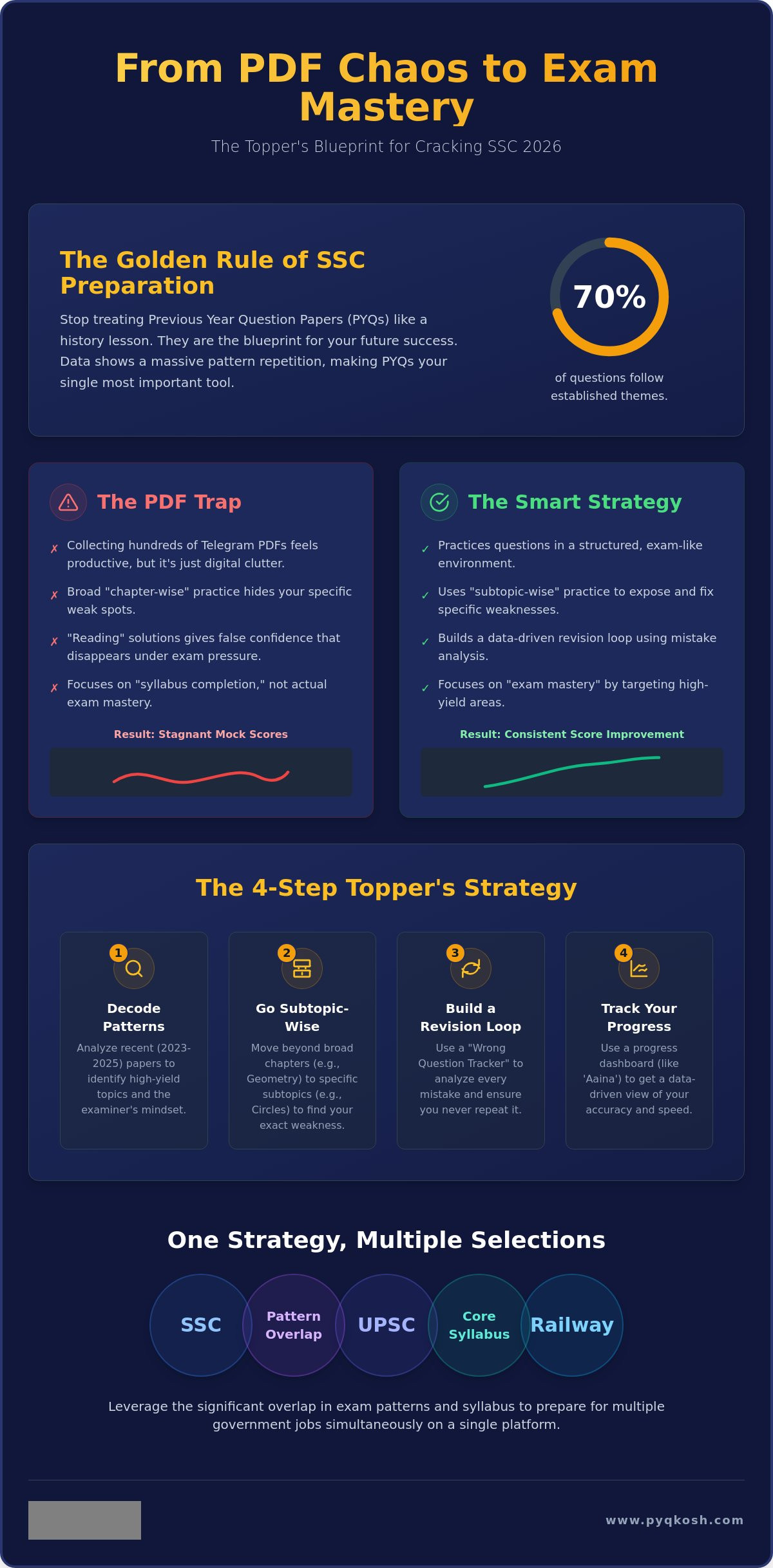
- Discover why 70% of the exam follows established themes and how to use the ssc previous year question paper to decode the examiner’s mindset.
- Stop wasting hours collecting random Telegram PDFs and start using subtopic-wise practice to see real progress in your accuracy.
- Learn to prioritize recent 2023-2025 patterns and sort topics by question count to focus on high-yield areas for 2026.
- Use the Aaina dashboard and Wrong Question tracker to build a data-driven revision loop that stops you from making the same mistakes twice.
- Leverage the pattern overlap between SSC, UPSC, and Railway exams to prepare for multiple selections simultaneously on one platform.
Why SSC Previous Year Question Papers are Your Only Reality Check
Stop treating an ssc previous year question paper like a history book. It’s not just a record of the past; it’s the blueprint for your future success. The Staff Selection Commission (SSC) doesn’t invent new logic every year. They just repackage old concepts into new formats.
Data shows that nearly 70% of the SSC CGL and CHSL papers follow themes established in previous years. If you master the core logic of a recent ssc previous year question paper, you’ve already cleared half the hurdle. The rest is just about your speed and accuracy on exam day.
Most aspirants make the mistake of “reading” solutions in random PDFs. That’s a trap, yaar. Reading a solution gives you a false sense of confidence that vanishes during the actual exam. You only truly learn when you solve a question in a timed, high-pressure environment.
PYQs also act as your ultimate garbage filter. The market is flooded with “tough” practice questions that SSC never actually asks. Don’t waste your energy on complex math or irrelevant logic that isn’t part of the SSC DNA. Stick to what actually appears in the exam.
The Reality of Selection: Topper vs. Average Aspirant
Average aspirants focus on “syllabus completion” and feel happy finishing a book. Toppers focus on “exam mastery” through targeted practice. The difference lies in how they analyze their mistakes. A topper doesn’t just see a “Wrong” mark; they find out exactly why they tripped.
If your mock scores are stuck, you’re likely missing this deep analysis. Move away from scattered study and use topic-wise practice to find your weak spots. It’s about fixing the specific leak in your boat rather than just rowing harder every day.
SSC Exam 2026: What’s Changing in the Question Patterns?
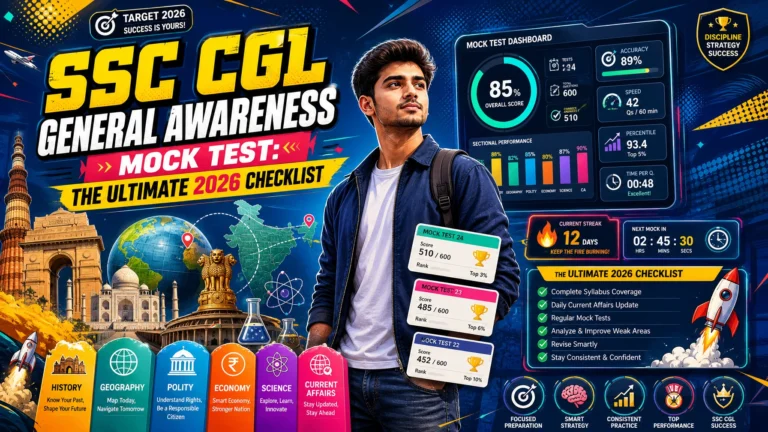
For 2026, the game is shifting slightly. Recent 2024-2025 papers show that General Awareness is becoming more analytical. You can’t just rote-learn facts anymore. You need to understand the context behind the questions to score high in the upcoming Tier I exam.
With 12,256 vacancies on the line for 2026, you can’t afford to guess. The Tier I exam in August-September 2026 will test your ability to handle sectional timing for the first time. Mastering high-yield topics is the only way to build that instinctive speed.
You can find more details in our guide on SSC Exam Questions and Answers 2026: Stop Wasting Time on Random Practice. Focus on the patterns that repeat every year to stay ahead of the competition.
The ‘PDF Trap’ vs. Smart Subtopic-Wise Practice
Downloading 100 PDFs feels like progress, but it’s actually a trap. Your phone storage is full of every ssc previous year question paper from the last decade, yet your score isn’t moving. This is the “Telegram Cycle” where you spend more time collecting files than actually solving them. Clutter doesn’t lead to selection; clarity does.
Most aspirants think chapter-wise practice is enough. It’s a good start, but it’s too broad. If you practice “Polity” as a whole, you might feel confident because you got 80% right. But what if that 20% you missed is always from “Fundamental Rights” and specifically “Article 14-18”? You’ll keep repeating that mistake in the real exam.
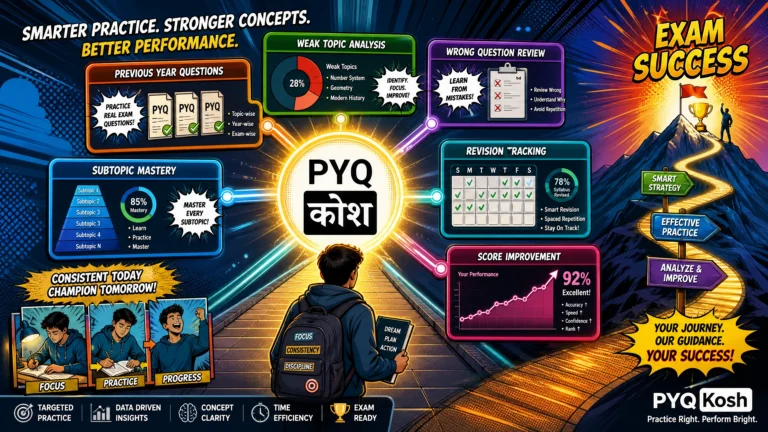
Selection happens when you break things down further. You need to move beyond chapters and attack specific subtopics. This is how you stop wasting time on what you already know and start fixing what’s actually pulling your score down. You can check the Official SSC Website for the latest syllabus, but the real secret is in how you slice that syllabus for practice.
Why Subtopics are the Secret Ingredient
Chapter-wise practice hides your weaknesses. Subtopic-wise practice exposes them. You might think you’re weak in “Geometry,” but after practicing subtopics, you realize you’re great at Triangles and only struggle with “Circles.” This insight saves you weeks of unnecessary study time.
When you sit down for your 11 PM study session, you shouldn’t be guessing what to solve. A data-driven approach tells you exactly which subtopic needs your attention. It’s about being surgical with your preparation. If you want to see how this works in action, start practicing subtopics today and watch your accuracy climb.
Mobile-Friendly Practice: No More Zooming into Tiny Text
Trying to solve a 50-page PDF on a 6-inch phone screen is a nightmare. You spend more time zooming and scrolling than thinking. This kills your focus and makes practice feel like a chore. Mobile-first aspirants need a structured interface that shows one question at a time without the clutter.
A clean interface helps you maintain the “exam mindset” even while traveling or taking a quick break. You don’t need a laptop to be serious about your prep. You just need a better way to engage with the material. For more on this, read our guide on SSC CGL Previous Year Paper: Why Topic-Wise Practice is the Game Changer.
How to Decipher the SSC Pattern for 2026
You can’t treat every ssc previous year question paper the same way. A paper from 2015 is practically ancient history. To clear the 2026 exam, you must focus on the 2023-2025 window. This is where the modern SSC mindset and latest difficulty levels live.
The Official SSC Previous Year Question Papers provide the raw data. But you need to be smarter than the average aspirant. Instead of just solving them blindly, sort topics by question count. This shows you exactly what the examiner is currently obsessed with.
Don’t just look for the right answer. Our ‘Exam Booster’ strategy involves reading detailed explanations for why the other three options are wrong. Often, a “wrong” option in this year’s paper becomes the “right” answer in next year’s exam. Knowing these confusion points is your secret weapon.
General Awareness: The Make-or-Break Section
Static GK is a nightmare if you study it randomly. Use subtopic-wise practice to master Temples, Folk Dances, and Festivals. Don’t just read about them; solve questions specifically on these subtopics to lock the facts in your memory. This is the only way to handle the high-yield areas effectively.
You’ll notice a massive overlap between Current Affairs and General Studies. A historical site in the news often triggers a History question in the next shift. For more on this, check out our RRB General Awareness Previous Year Questions: Your 2026 Guide to see how these patterns cross over across exams.
English Comprehension: Beyond Just Grammar Rules
Stop practicing English only by shifts. It’s better to attack ‘Sentence Improvement’ or ‘Error Spotting’ as subtopics. This helps you spot the specific grammar rules that SSC loves to test repeatedly. It’s much faster than reading a 500-page grammar book that covers everything but masters nothing.
Build your vocabulary directly from PYQ options. If you see a word you don’t know, use the ‘Bookmark’ feature. This creates a personalized list of tricky idioms and synonyms for your Sunday revision. It’s a much more efficient way to prepare for the 2026 challenge while others are still scrolling through PDFs.
Building a Foolproof Revision Loop with Your Mistake Tracker
How many times have you marked a question wrong in an ssc previous year question paper, promised to revise it, and then completely forgot? Keeping a manual “mistake diary” is a nightmare when you’re solving thousands of questions. You need a system that remembers your failures so you can turn them into wins.
The ‘Aaina’ Dashboard acts as your smart mentor. It shows your daily practice streaks and accuracy in one glance. You don’t have to guess if you’re improving; the data tells you the truth. Seeing that accuracy graph climb is the best motivation to keep going during those late-night sessions.
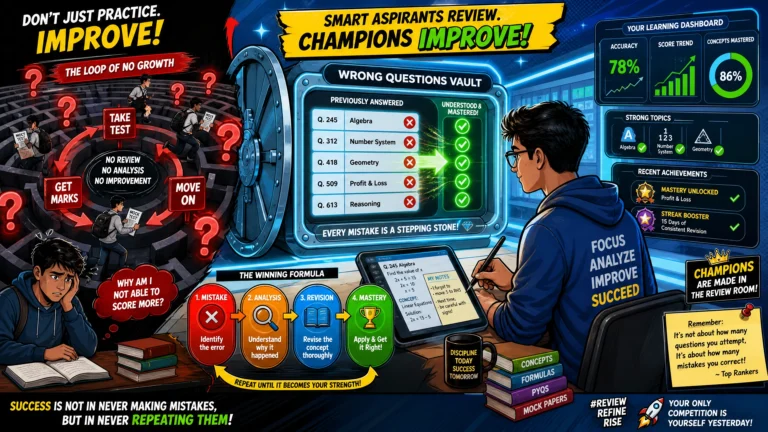
Your most powerful weapon against failure is the ‘Wrong Question Tab’. Every time you trip, the system automatically stores that question for you. You can sort them by how many times you’ve made the same mistake or by your most recent errors. This helps you focus on the “repeat offenders” that are actually killing your selection chances.
The goal is simple: reach a ‘Zero-Mistake’ state. You keep re-practicing those stored questions until your accuracy hits 100%. It’s the ultimate topper banne ka shortcut because you’re literally erasing your weaknesses one by one. Start tracking your mistakes to see where you’re actually losing marks.
Setting Up Your Daily Revision Habit
Don’t just solve questions aimlessly; follow a structured loop. Start by solving 50 subtopic questions in practice mode. Review the in-depth explanations immediately while the logic is still fresh in your mind. This helps you understand the “why” behind every right and wrong option.
- Solve 50 subtopic questions daily.
- Review explanations immediately to fix logic.
- Clear your ‘Wrong Question Tab’ every 3 days.
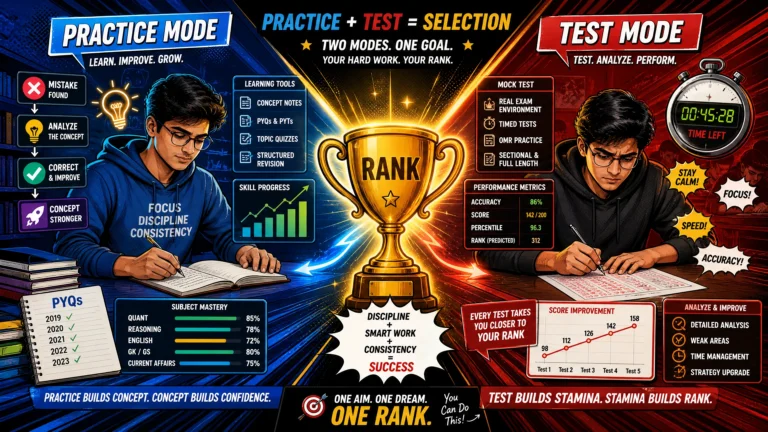
- Switch to ‘Test Mode’ once a week to simulate real exam pressure.
Tracking Progress at the Subtopic Level
Stop saying “I am good at History” and start being specific. You need to know if your accuracy in ‘Mughal Architecture’ is 90% while ‘Ancient Scripts’ is only 40%. This level of detail is what separates a serious aspirant from the crowd.
Use these data-driven insights to decide when to move to the next topic. If your accuracy is low, stay and practice more subtopics. Watching your progress bars turn green across different subjects gives you the confidence that no PDF ever could. It makes the path to 2026 feel manageable and within your reach.
Master Multiple Exams: One Platform for SSC, UPSC, and Railways
Why buy five different books when the logic remains the same? Analyzing an ssc previous year question paper isn’t just about SSC. It’s about mastering the core subjects that appear across all major central government exams like Railways and Defence.
There is a massive ‘Pattern Overlap’ in how questions are framed across different boards. A History question that appeared in a UPSC CDS paper often shows up in an SSC CGL shift the following year. Examiners frequently pull from the same pool of high-yield concepts across different exam categories.
Centralizing your prep is the smartest move you can make for 2026. Instead of jumping between different apps or scattered PDFs, you can filter across 130+ exam categories on one platform. This helps you see every possible variation of a question without wasting time on redundant resources.
The Multi-Exam Advantage for 2026
Aspirants today don’t just fill one form; they fill every form they are eligible for to increase their selection chances. Whether it’s SSC, Railway, or Defence, you need a way to switch between exams without losing your progress data or repeating the same basic questions.
You can track your accuracy across different exam types while keeping your subtopic mastery intact. This structured, analytical exam preparation ensures that your hard work in one exam helps you in another. To see how this works for higher-level exams, read our guide on Mastering the Prelims UPSC Question Paper: A Smart Guide for 2026.
PYQKosh: Made by an Aspirant, for Aspirants
We built this platform because we understand your 11 PM struggles. It’s not a corporate product; it’s a tool made with ❤️ by an aspirant who knows that a clean, no-nonsense interface is what you actually need. We focus only on practice and data because that’s what gets results.
Stop collecting random files and start solving. The examiner doesn’t care how many PDFs you have on your phone or how many Telegram groups you’ve joined. Selection toh practice se hi hogi, yaar! Use the topic-wise practice and Aaina dashboard to turn your efforts into a guaranteed selection.
Go ahead and solve your first set of subtopic questions now.
Your Path to Selection Starts with Action
Your 2026 selection won’t happen inside a dusty Telegram folder. It happens when you stop hoarding files and start solving questions with a clear plan. You now know that an ssc previous year question paper is your best guide, but only if you use it to attack specific subtopics instead of random shifts.
Don’t let your hard work go to waste by repeating the same errors in every mock test. Use the Aaina Progress Dashboard to keep yourself honest and the Wrong Question tracker to clear your path to success. With over 1 Lakh+ questions across 130+ exam categories, you finally have a centralized place to master every variation of a topic.
It’s time to transition from disorganized chaos to data-backed clarity. You have the ambition to clear the exam; now you have the strategy to make it happen. Success is just a matter of disciplined practice and fixing one subtopic at a time. Stop collecting PDFs and start your subtopic-wise practice on PYQKosh today!
Frequently Asked Questions
Is solving only the SSC CGL previous year question paper enough to clear the exam?
Solving the ssc previous year question paper is actually the most reliable way to clear, but “just solving” isn’t enough. You need to understand the logic behind every option to handle the 70% repeat themes. Deep subtopic-wise analysis is what turns a regular aspirant into a topper.
How many years of SSC previous year papers should I practice for 2026?
Focus on the last 3 to 4 years of papers for the 2026 exam. Specifically, papers from 2023 to 2025 are the most relevant because they reflect the current difficulty and analytical shift in General Awareness. Older papers from 2015 are too basic for today’s competition.
Should I practice shift-wise or topic-wise for better results?
Start with topic-wise practice to build your foundation and then switch to shift-wise tests. Topic-wise practice helps you identify specific weaknesses in subtopics like “Circles” or “Article 14-18.” Once you hit 90% accuracy there, use test mode to work on your sectional timing.
Can I find SSC previous year papers in Hindi on PYQKosh?
Yes, you can practice questions in both English and Hindi on our platform. We know many aspirants come from Hindi-medium backgrounds, so the interface and explanations are designed to be accessible. This helps you understand complex logic in your preferred language without any struggle.
What is the best way to handle the ‘General Awareness’ section using PYQs?
Use subtopic-wise practice for Static GK areas like Folk Dances, Festivals, and Temples. Don’t just memorize the answer; read the in-depth explanations to understand the context. This is the only way to handle the 2026 shift toward more analytical General Awareness questions.
Does SSC repeat questions from other exams like UPSC or Railways?
Yes, SSC often picks up themes from UPSC CDS or Railway exams. There is a significant pattern overlap because the core subjects remain the same. Centralizing your prep on one platform allows you to see these variations without buying five different books for five different exams.
How does the ‘Wrong Question Tab’ help in increasing my mock scores?
The Wrong Question Tab automatically stores every mistake you make so you don’t have to maintain a manual diary. You can re-solve these specific questions until your accuracy hits 100%. Clearing this backlog regularly is the fastest topper banne ka shortcut to jump your mock scores.
Is there a way to track my daily consistency during SSC preparation?
The Aaina dashboard tracks your daily streaks and practice consistency in one glance. It shows you exactly how many questions you solved today and how your accuracy is trending over the week. Seeing your progress bars turn green is the best way to stay motivated while practicing for the 2026 exam.