
Article by
Aaisha
A passionate content writer at PYQKosh focused on simplifying Current Affairs and PYQs for competitive exam aspirants. I love turning complex topics into easy, student-friendly content that helps learners prepare smarter and stay consistent in their exam journey.
What if those 500-page PDFs in your folders are actually slowing you down? You probably spend more time scrolling for a specific Science question than actually solving it.
Mastering railway topic wise previous year questions is the only way to stop the chaos. It is time to start seeing real results in your RRB 2026 preparation.
I know the frustration of giving mocks only to get stuck on the same history dates. It is hard when you do not know which subtopics carry the most weight.
This article will show you how to ditch random practice. You will learn to use a structured, analytical approach to clear your exam path with a high rank.
We will explain how to find high-yield questions instantly and use the Aaina dashboard to track your accuracy. You will also learn to fix mistakes using a dedicated tracker.
Key Takeaways
- Learn why hoarding random PDFs is a trap and how it wastes hours of your precious study time.
- Identify the high-yield topics in Science and General Awareness that actually decide your final RRB rank.
- Master the “work smarter” approach by using railway topic wise previous year questions to fix weak links before giving mock tests.
- Discover a simple two-step strategy to sort subtopics by weightage and recency for a data-driven study plan.
- Find out how to turn your mistakes into marks by tracking confusion points and wrong answers automatically.
Why Solving Random Railway Question Paper PDFs is Slowing You Down
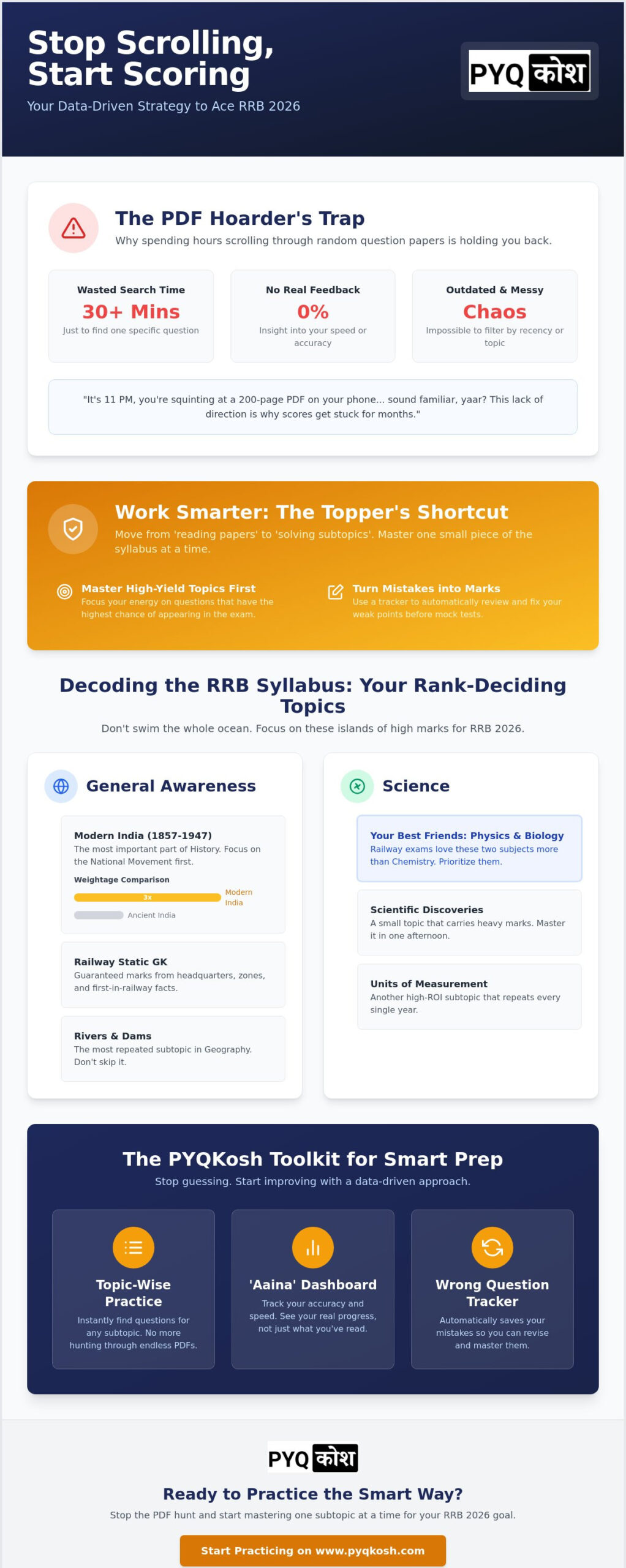
Most aspirants are “PDF hoarders.” You probably have 50 Telegram channels muted, each filled with “Mega PDFs” and “Syllabus Capsules.” But having 100 files on your phone won’t increase your score by even one mark.
It is a trap, yaar. You spend 30 minutes just finding one “Indian Rivers” question in a massive, unorganized file. Searching for railway topic wise previous year questions manually is a total waste of your study energy.
The Railway Recruitment Control Board (RRCB) designs these exams to test your speed. If you waste time just looking for what to study, you’ve already lost the race. PDFs are silent teachers that don’t give you any feedback.
They don’t tell you your accuracy. They don’t show your speed. You’re just ticking boxes in the dark without knowing if you’re actually getting better. Plus, these files are often outdated and messy.
It is nearly impossible to filter questions from the 2024-25 cycle versus something from ten years ago. You need the latest trends to win in RRB 2026. Random practice only leads to random results.
The struggle of the 11 PM aspirant
Picture this. It’s 11 PM. You’re lying in bed, squinting at a 200-page PDF on your mobile screen. You scroll endlessly, hoping to find a specific Science topic, but the text is tiny and the layout is chaotic.
It’s exhausting. You finish 20 questions but have no idea if your speed is enough for the real exam. This lack of direction is why many people get stuck at the same score for months.
Structured practice is the only solution
You need to move from “reading papers” to “solving subtopics.” This is the real topper banne ka shortcut. Centralized practice can save you at least 2 hours of wasted searching every single day.
Using railway topic wise previous year questions allows you to master one small piece of the syllabus at a time. It turns a mountain of data into small, reachable goals that you can actually track.
Think of PYQKosh as your personal library for this structured prep. It stops the PDF hunt and lets you start the actual work. Master one subtopic, see your accuracy, and move on to the next one with confidence.
Decoding the Railway Syllabus: High-Yield Topics You Can’t Ignore
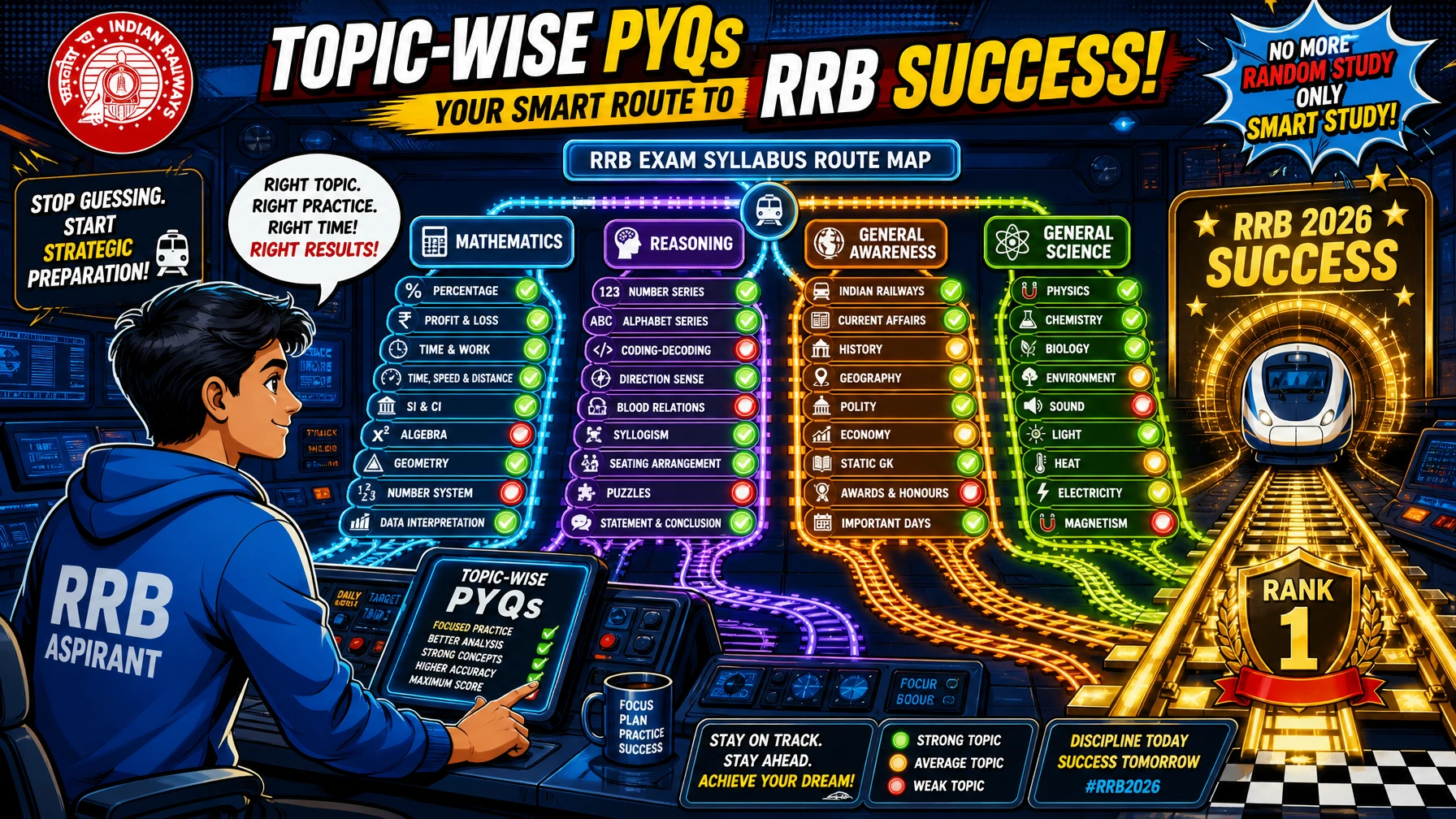
The Railway syllabus looks like a massive ocean, but you don’t need to swim across the whole thing. You just need to know where the islands of high marks are. General Awareness is the make-or-break section that decides your rank in RRB 2026.
Physics and Biology are your best friends in the Science section. Railway exams love these two subjects more than Chemistry. If you focus on railway topic wise previous year questions, you will see that certain concepts like Optics or Human Anatomy repeat every single year.
Static GK is another goldmine, specifically Indian Railways history and current data. Don’t just read random facts; focus on what the boards actually ask. History and Geography also have “safe” zones like Modern India and Indian River systems that provide guaranteed marks.
Subtopic-wise weightage for 2026
Stop wasting days on Ancient India. If you analyze the data, Modern India has three times the weightage. Solve questions on the Indian National Movement first. It is the real topper banne ka shortcut for the History section.
- Scientific Discoveries: A must-solve subtopic in the Science section.
- Modern India: Focus on 1857 to 1947 for maximum ROI.
- Railway Static GK: Headquarters, zones, and first-in-railway facts.
- Rivers and Dams: The most repeated Geography subtopic.
In the Science section, “Scientific Discoveries” and “Units of Measurement” are small topics but they carry heavy marks. You can finish these in one afternoon if you have a structured plan.
Identifying repeat patterns across exams
There is a secret cross-exam benefit most aspirants miss. Many General Awareness questions from SSC CGL or CHSL often show up in Railway exams a year later. Practicing RRB NTPC subtopic-wise questions helps you catch these patterns early.
Use recency filters to see what RRB asked in the 2024-25 cycle. The exam pattern shifts every few years, so questions from 2015 might not be as relevant as those from the last two years. Focus on “High-Yield” tags to ensure you are spending your time on topics that actually appear in the CBT.
With over 63 lakh candidates appearing for RRB NTPC Undergraduate posts alone, you cannot afford to be a generalist. Every mark counts when the competition is this high. Use a data-driven approach to pick your battles wisely and master one subtopic at a time.
Structured Practice vs. Mock Tests: Which One Actually Boosts Scores?
Stop giving full-length mock tests if you haven’t mastered the basics. It’s like trying to run a marathon when you can’t walk yet. Giving 100 mocks won’t help if you keep making the same mistakes in the Science section every single time.
This is the “Mock Test Fallacy.” Mocks are great for testing your nerves, but they are terrible for learning new concepts. Real growth happens when you solve railway topic wise previous year questions to fix your weak links before the final battle.
Toppers know a secret strategy: they spend 70% of their time on PYQs and only 30% on full mocks. They use structured practice to master one subtopic at a time. If you’re weak in “Modern History,” solve 100 questions of that specific subtopic first.
This analytical approach ensures you don’t repeat mistakes. You move to the next topic only when your accuracy hits a high level. It’s about working smarter, not just harder, to clear the RRB 2026 exam.
The power of the Aaina Dashboard
You need to see your progress to stay motivated during long study hours. The Aaina dashboard tracks your daily practice streaks and accuracy. It is like looking in a mirror; it shows you exactly where you stand without any filter.
It also compares your speed and accuracy with other aspirants through peer ranking. Knowing where you stand in the national competition keeps the fire alive. You stop guessing and start using data to drive your prep.
Mastering the ‘Practice Mode’ flow
Don’t wait until the end of a 90-minute test to see why you were wrong. Use “Practice Mode” to get instant, in-depth explanations for every question. It covers right and wrong answers plus confusion points for each option.
If you find a “tough but important” question, use the bookmark tab. You can sort these by subject or subtopic later for quick revision before the exam. It keeps your preparation uncluttered and highly focused.
Ready to start? Check RRB NTPC specific practice plans to begin your structured journey today.
Your 2026 Railway Exam Strategy: Master One Subtopic at a Time
Topper banne ka shortcut is not about reading more; it is about reading right. Most aspirants fail because they try to finish the whole syllabus in one go. Instead, you should break the mountain into small rocks.
A winning strategy for RRB 2026 requires a data-driven plan. You cannot afford to guess which topics are important when railway topic wise previous year questions can give you the exact answer. Follow these four steps to build your rank.
- Step 1: Pick a subject like Science and sort the topics by “Number of Questions” to find the high-yield areas first.
- Step 2: Solve exactly 50 questions of a single subtopic in “Test Mode” to simulate the real CBT pressure.
- Step 3: Analyze only your “Wrong Questions” immediately after the test to understand your logic gaps.
- Step 4: Repeat this cycle for the same subtopic until your accuracy consistently hits the 90% mark.
Stop ignoring your weak areas
We all have that one topic we hate, yaar. Maybe it is “Plant Kingdom” or “Indian Railways History.” Most people just skip these, but that is where you lose the competition. You need a way to face these mistakes without feeling overwhelmed.
The “Wrong Question Tab” is your secret weapon here. It stores every mistake you make automatically. You don’t need to circle questions with a red pen in a heavy book anymore. It organizes your errors so you can fix them in minutes.
You can even sort these mistakes by frequency. If you’ve made the same error three times, the platform highlights it. Use the “Exam Booster Tips” in the explanations to clear confusion points and ensure you never make that mistake again.
Managing time on mobile
You don’t need a study desk to get ahead. Use your commute time or a quick 10-minute break to solve 10 questions. Micro-learning on your mobile is much more effective than carrying heavy books that you never open.
A structured library of railway topic wise previous year questions is always in your pocket. It turns “wasted time” into “study time.” This consistency is what builds the streaks you see on your dashboard and leads to a high rank.
If you want to master the GA section specifically, read our RRB General Awareness Previous Year Questions: Your 2026 Guide. It will help you apply this strategy to the most scoring part of the exam.
Stop practicing randomly and start your subtopic mastery now to see your accuracy climb.
How PYQKosh Turns Your Mistakes into Marks
Knowing the right answer is only half the battle, yaar. In a real CBT, the Railway board doesn’t just test your knowledge; it tests your ability to avoid traps. Most books give you a one-line solution, but they never explain why the other three options were included.
When you solve railway topic wise previous year questions on this platform, you get in-depth explanations for every choice. We specifically address the “Confusion Points” that usually trip up aspirants. This helps you understand the logic behind the question so you don’t fall for the same trap twice.
The best part is centralization. You get multi-exam access to SSC and UPSC questions alongside Railway ones. If you see a pattern in an SSC History question, you can check if it appeared in RRB too. It is all about building a winner’s habit through daily practice streaks.
A structured approach using railway topic wise previous year questions ensures you don’t just memorize answers. You learn the “why” behind every concept. This deep understanding is what helps you score high even when the question is slightly twisted in the 2026 exam.
The Aaina of your preparation
Stop lying to yourself about how much you’ve studied. The Aaina dashboard acts as a mirror for your prep. It shows your accuracy and weekly graphs, visualizing your journey from a shaky 50% to a confident 95% accuracy level.
Setting daily practice goals helps you stay consistent. These small wins build up over time. Before you know it, you’re not just practicing; you’re mastering the syllabus one subtopic at a time. This is how you secure that dream Railway job.
Weekly graphs show your progress clearly. You can see your accuracy rising as you finish more subtopics. It’s not about being perfect from day one; it’s about getting better every single day through structured, analytical exam preparation.
Smart revision with the Bookmark Tab
The last 10 days before the exam are always chaotic. You shouldn’t be searching through old notes or messy PDFs then. Use the bookmark tab to create a “High-Priority” list of questions you found tough during your practice sessions.
You can sort these bookmarks by subtopic for a lightning-fast final revision. It keeps your mind calm and focused. If you’re ready to upgrade your strategy, explore our affordable pricing plans to get full access to these features.
Sorting bookmarks helps you focus on exactly what you need. Instead of re-solving everything, you only target the tricky parts. This saves time and boosts your confidence right before you enter the exam center for your RRB 2026 shift.
Start practicing today and turn your weak points into your biggest strengths.
Start Your RRB 2026 Success Story Today
You’ve seen how random PDFs can eat up your time. To win in RRB 2026, you need a sharp, data-driven plan. Mastering railway topic wise previous year questions is the most direct path to a high rank.
It’s about fixing your weak subtopics before they cost you marks in the CBT. With over 1 Lakh+ structured questions and coverage of 130+ exams, you have everything you need in one place.
Use the Aaina progress dashboard to keep yourself honest. Let the dedicated Wrong Question tracker handle your mistakes while you focus on building your accuracy. Don’t let another day go by just scrolling through messy files.
Take control of your preparation and start moving toward that Railway job. Success is just a matter of disciplined, smart practice. You have the potential to clear this exam, so go for it.
Start practicing Railway subtopic-wise questions today!
Frequently Asked Questions
Are topic-wise PYQs enough to clear RRB NTPC 2026?
Topic-wise PYQs are the backbone of your preparation because RRB repeats core concepts frequently. While they cover a major portion of the syllabus, you must use them to master the logic behind each answer. Using railway topic wise previous year questions helps you identify high-yield subtopics. This prevents you from wasting time on low-weightage areas and ensures your preparation is laser-focused for the CBT.
How can I find subtopic-wise questions for Railway exams for free?
Finding well-organized, error-free questions for free is very difficult and time-consuming. Most free PDFs are messy and lack proper subtopic divisions. PYQKosh offers a structured library where you can practice in both Practice and Test modes. Having everything sorted and centralized saves you hours of manual searching. It is a much smarter alternative to scrolling through random Telegram channels or unverified websites.
Why should I practice Railway questions from SSC or UPSC exams?
Practicing questions from other exams gives you a massive edge because patterns often overlap. The Railway board frequently picks General Awareness questions that appeared in recent SSC CGL or CHSL papers. By solving railway topic wise previous year questions alongside SSC or UPSC sets on one platform, you catch these trends early. This cross-exam strategy is a proven topper banne ka shortcut for RRB 2026.
What is the best way to use the Aaina dashboard for Railway prep?
Use the Aaina dashboard to track your daily practice streaks and accuracy levels. It is best to check your weekly graph every Sunday to see if your performance is moving upward. If your accuracy in a specific subtopic is below 80%, stay on that topic until you improve. The peer rank feature also tells you exactly where you stand in the national competition compared to other aspirants.
How does the ‘Wrong Question’ tab help in reducing negative marking?
The Wrong Question tab reduces negative marking by automatically storing every mistake you make. You can sort these errors by frequency to see which “trap” options you fall for most often. Facing these mistakes repeatedly ensures you don’t repeat them in the actual exam. Fixing these specific logic gaps is the only way to save that 1/3 mark deduction for every wrong answer.
Can I sort Railway questions by the latest year (2025-26) on PYQKosh?
Yes, you can easily sort questions by recency to focus on the latest exam trends. This allows you to prioritize questions from the 2024-25 cycle which reflect the current difficulty level. While older questions are good for building basics, the latest ones are better for understanding the current pattern. Use the sorting feature to ensure you are not practicing outdated content for your 2026 attempt.
What are ‘Exam Booster Tips’ and how do they help in General Awareness?
Exam Booster Tips are special notes included in our in-depth explanations to highlight “confusion points.” These tips explain why certain options are traps and provide extra facts related to the subtopic. In General Awareness, these boosters help you remember connected data without needing extra study notes. They turn every question into a mini-lesson, helping you build a strong knowledge base very quickly.
How many years of previous year questions should I solve for Railways?
Focus on the last 5 to 7 years of questions to cover the syllabus effectively. However, you must prioritize the most recent papers from 2024-25 first. Solving railway topic wise previous year questions from the last few years is enough to understand the TCS pattern. Don’t go too far back into the past because the exam style and difficulty have changed significantly over the last decade.