
Article by
Aaisha
A passionate content writer at PYQKosh focused on simplifying Current Affairs and PYQs for competitive exam aspirants. I love turning complex topics into easy, student-friendly content that helps learners prepare smarter and stay consistent in their exam journey.
You’ve just spent three hours reading about the Governor in Laxmikanth, but when you solve a random mock test, you still get the questions wrong. It feels like you’re pouring water into a leaking bucket, doesn’t it? Many aspirants struggle because they treat the massive UPSC syllabus like a giant mountain instead of a series of small, manageable steps.
We all know that feeling of being overwhelmed by 1000-page books and static PDFs that don’t tell you where you’re failing. That’s why you need a solid upsc subtopic-wise practice plan to turn your preparation from random guessing into a data-driven strategy. It’s about working smarter, not just harder, to stay ahead of the competition.
In this guide, you’ll learn how to break down subjects like Modern History and Polity into tiny chunks. This approach helps you track your weak areas automatically and ensures you’re ready for the 933 vacancies in the UPSC 2026 exam. Let’s fix your practice routine and start seeing real progress on your dashboard.
Key Takeaways
- Stop drowning in thick textbooks and learn to master the syllabus by focusing on micro-topics for better retention.
- Discover how a structured upsc subtopic-wise practice plan helps you identify specific weak spots that full-length mocks often miss.
- Find out why practicing 15-20 questions daily on a specific subtopic creates a faster feedback loop than solving random PDFs.
- Use tools like the Aaina dashboard to track your progress and the wrong questions tracker to ensure you never repeat the same mistake.
- Get a clear roadmap to allocate just 45 minutes a day for high-yield PYQ practice that actually boosts your Prelims score.
Why Your Current UPSC Strategy Might Be Failing You
So, you’ve finished Laxmikanth for the third time and think you’re ready for 2026? Think again. Reading a book cover to cover is the biggest ‘Syllabus Trap’ in the Civil Services Examination (CSE) world. It gives you a false sense of security. You feel like a scholar, but when a specific question on the ‘Discretionary Powers of the Governor’ pops up, you’re suddenly confused between two options.
That’s because UPSC isn’t just about reading anymore; it’s about precision. If you wait until March to solve random mock tests, you’ll find out your scores are low when it’s too late to change your habits. Finishing a 500-page book without testing yourself daily is like trying to learn swimming by reading a manual. You’ll likely drown when you hit the actual water, yaar.
We’ve all been there. You finish a heavy subject like Geography and feel like a king. But a week later, you can’t remember the difference between a cirque and a drumlin. This ‘forgetting curve’ is real and it’s brutal for aspirants. Your brain needs active recall, not just passive reading. Random mocks don’t help with this. They just tell you that you’re failing, without showing you exactly where the leak is.
The difference between finishing a subject and mastering a subtopic
Stop saying ‘I’ve finished Modern History.’ That’s way too broad for the current exam pattern. Instead, aim to master ‘Tribal Revolts’ or ‘Press Regulations under British Rule.’ When you break it down this way, the syllabus stops looking like a monster and starts looking like a checklist.
Mastering these tiny chunks builds instant confidence. You aren’t just reading pages; you’re ticking off specific areas where you know you can’t be beaten. Subtopic mastery is the bridge between theory and marks.
Why 2026 Prelims requires data over guesswork
The competition is too high for guesswork. You need to know exactly which sub-themes are pulling your score down. If your accuracy in ‘Fundamental Rights’ is 90% but only 40% in ‘Local Government,’ why are you still spending equal time on both? It makes no sense, bhai.
A smart upsc subtopic-wise practice plan uses your own performance data to guide you. It tells you to skip what you already know and hammer the areas where you’re failing. This structured, analytical exam preparation is the only way to handle the 933 vacancies available this year. Without a tracker, you’re just shooting in the dark and hoping to hit the target.
What Exactly is a UPSC Subtopic-Wise Practice Plan?
Most aspirants have a “History month” or a “Polity week” in their calendar. That’s too vague, yaar. A real upsc subtopic-wise practice plan is all about precision. It means breaking every General Studies subject into 15 to 20 micro-subtopics for daily solving. Instead of just “solving Polity,” you’re tackling 20 questions specifically on “Constitutional Bodies” today. It’s about depth, not just distance.
This approach mimics exactly how the UPSC examiner thinks. They don’t just pick a random page from a book; they look for specific themes like “Monetary Policy” or “The Preamble” to test your conceptual clarity. By practicing at this level, you’re training your brain to recognize the specific traps examiners set within those themes. It’s the difference between a general overview and a surgical strike.
Remember, Previous Year Questions (PYQs) are your only true north. Mock tests from coaching centers are okay, but they often miss the actual “flavor” of UPSC. Real PYQs show you exactly how the language of a question is twisted. Whether you are in a 6-month sprint or a 1-year marathon, this micro-level practice keeps you grounded in what actually matters. You can start this journey by exploring topic-wise practice sessions to see where you stand.
Breaking down high-yield subjects into micro-topics
Take Polity as an example. “Fundamental Rights” is a huge chapter. But if you focus on “Articles 14 to 18” specifically, you master the nuances of equality before you even move to freedom of speech. In Economy, don’t just “study Banking.” Spend one session on “RBI’s Quantitative Tools” and another on “Inflation indices.” This makes the massive syllabus feel much smaller and masterable.
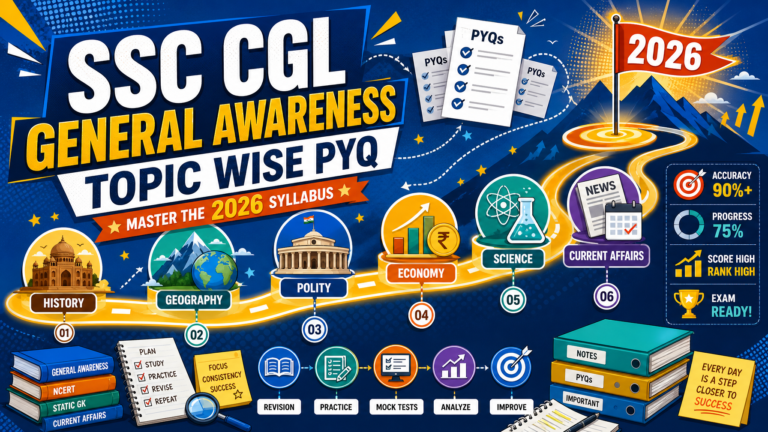
To really nail this, you can follow a UPSC prelims pyq practice plan to identify which themes have appeared most in the last 25 years. This isn’t just studying; it’s strategic mapping that saves you hundreds of hours of useless reading.
How subtopics help you spot repeating UPSC themes
Have you noticed how “Buddhism and Jainism” appear almost every single year? Or how “National Parks” are a permanent fixture? These are micro-trends. Even when the question changes, the core theme stays the same. If you’ve practiced 50 questions on Buddhism subtopics, you’ll likely spot the pattern in the next one.
Your goal should be to create a “Hit List” of about 50 high-yield subtopics. If you master these, you’ve already covered nearly 70% of the potential Prelims paper. It turns the exam from a game of luck into a game of data. This structured, analytical exam preparation ensures you spend your energy where the marks are.
Subtopic Practice vs. Full-Length Mocks: Which Wins?
Many coaching institutes tell you to solve 100 full-length mocks. But solving 100 random questions for 2 hours just to find out you’re weak in ‘Ancient History’ is exhausting. By the time you reach the analysis, you’re often too tired to actually learn from your mistakes. It’s a recipe for burnout, yaar.
Subtopic practice gives you an instant feedback loop. You solve 15 questions on the ‘Gupta Empire’ and immediately know if you’ve missed the details. This is ‘learning mode.’ Full-length mocks are for ‘testing mode’ once you’ve built that foundation. You don’t run a marathon without training your legs on shorter sprints first.
Most toppers follow an 80/20 rule. They spend 80% of their time on a structured upsc subtopic-wise practice plan to master micro-themes. The remaining 20% goes to full-length mocks to build exam-day stamina. This balance keeps you sharp and ensures you’re actually improving your accuracy every single day.
When to stop reading and start solving
Don’t wait to finish the whole book before touching PYQs. Use the ‘1-Hour Rule.’ For every 2 hours of reading, spend at least 1 hour solving. It keeps your brain active and prevents that heavy, sleepy feeling you get after reading long chapters in Spectrum or Laxmikanth.
Try solving subtopic PYQs *before* you even start reading a new chapter. It shows you exactly what the examiner cares about. You’ll stop highlighting every second line in your book and focus only on high-yield facts. It’s like having the cheat codes to the syllabus before you even start the game.
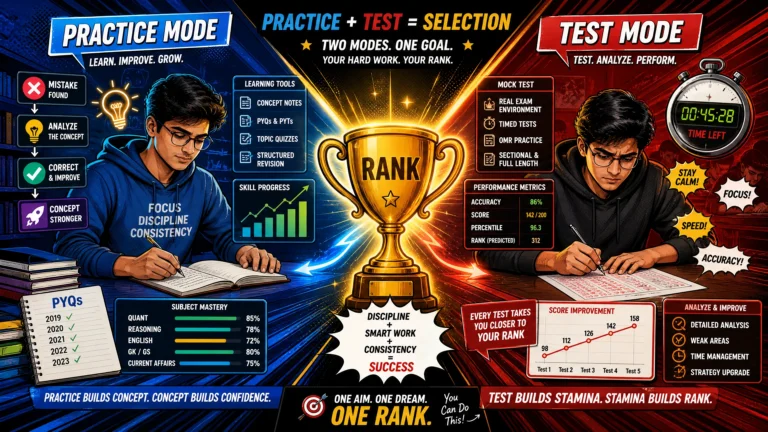
Start your session in ‘Practice Mode’ with in-depth explanations to understand the ‘why’ behind right and wrong answers. Once you’re confident, switch to ‘Test Mode’ to handle the pressure of the clock. This transition is key to building real exam speed and reducing silly mistakes under pressure.
The danger of “Passive Reading” in UPSC prep
Reading the same page five times doesn’t mean you’ve learned it. Your brain tricks you into feeling familiar with the text, but familiarity isn’t the same as recall. This ‘Passive Reading’ is a silent killer that makes you feel prepared when you’re actually not.
Wrong answers in subtopic practice are your best teachers. They show you exactly where your logic failed or where you lacked clarity. Instead of feeling bad about a low score, use these mistakes to refine your upsc pyq prelims strategy and fill those gaps immediately.
Every wrong question is a valuable data point. Tracking these through a wrong questions tracker helps you fix gaps before the actual May 24, 2026 exam date. It’s about being honest with your progress instead of just ‘finishing’ books to satisfy your ego.
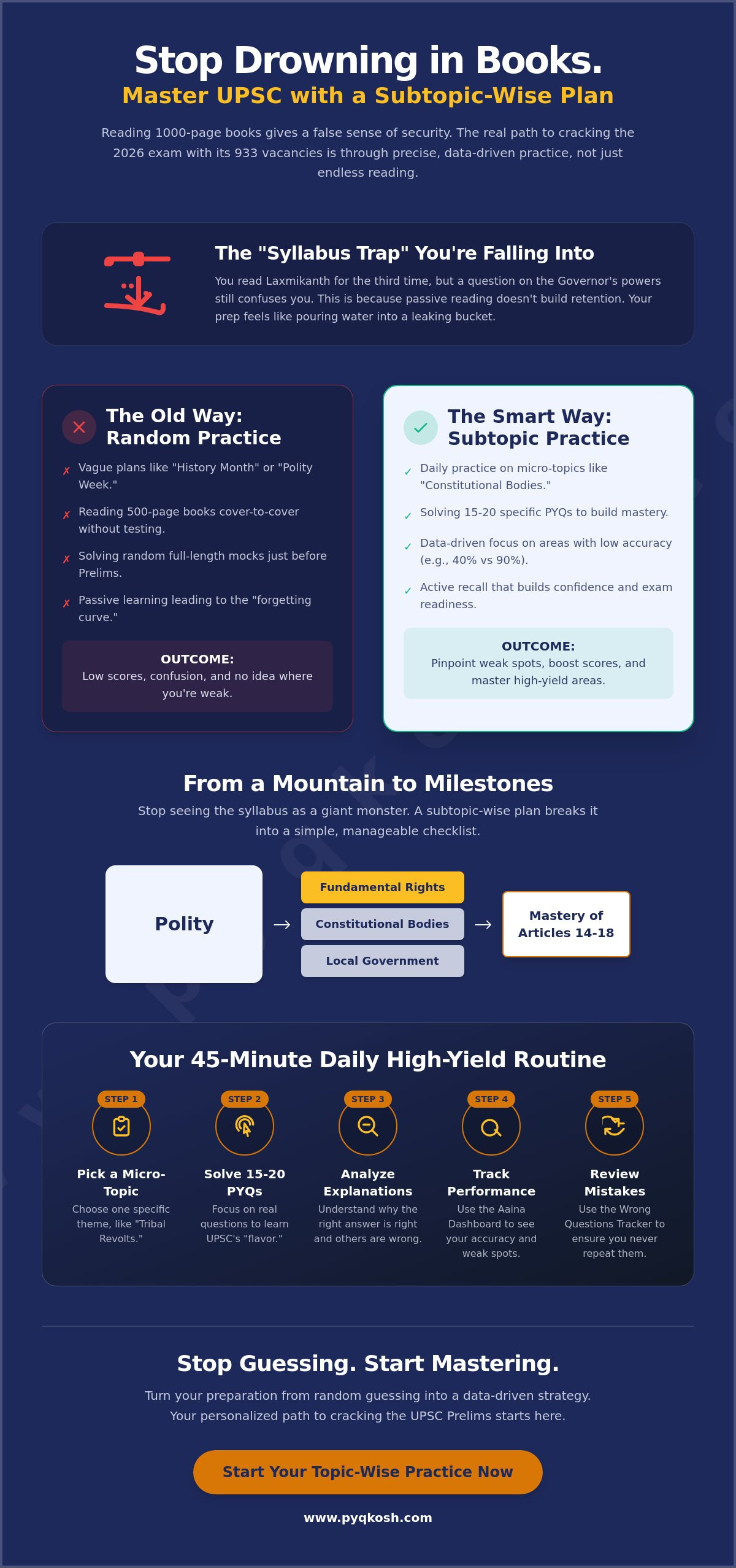
5 Steps to Build Your Own Subtopic Practice Routine
Knowing you need a plan is one thing, but actually building it is where most aspirants get stuck. You don’t need a fancy timetable that you’ll stop following after two days. You need a simple, repeatable system that turns your upsc subtopic-wise practice plan into a daily habit. Follow these five steps to get started.
- Step 1: Map the entire UPSC syllabus to at least 150 micro-subtopics. Don’t just write “Polity”; write “Emergency Provisions” or “Panchayati Raj.”
- Step 2: Allocate exactly 45 minutes every evening to solve one specific subtopic PYQ set. Consistency beats intensity every single time, yaar.
- Step 3: Always start in “Practice Mode.” This allows you to read in-depth explanations for every single option, even the ones you got right.
- Step 4: Use a progress dashboard to track your accuracy. If a subtopic shows less than 60% accuracy, it stays on your “weak” list for next week.
- Step 5: Keep Sundays strictly for re-solving. Don’t touch new topics; just clear out your wrong questions tracker to ensure those mistakes don’t repeat.
Identifying the “Big 4” subjects and their micro-topics
Focus your energy on the “Big 4” first: Polity, Economy, Geography, and Modern History. These subjects form the core of your Prelims score. For example, instead of broad Geography, focus on “Indian River Systems” or “Pressure Belts” as individual sessions. This makes the mountain feel like a series of small hills.
Subjects like Environment and S&T are a bit different because they link heavily with current affairs. Your subtopic plan here should focus on static themes like “Pollutants” or “Biotechnology” while keeping an eye on recent news. You can use a UPSC pyq analysis tool to quickly see which micro-themes are currently trending.
Setting daily targets and tracking accuracy
Solving 20 high-quality subtopic PYQs with full analysis is much better than rushing through 100 random questions. In the early stages, prioritize accuracy over speed. Once you understand the examiner’s trap in a specific subtopic, the speed will come naturally. Don’t rush the process, bhai.
Stay consistent by focusing on daily goals rather than the final result. Use a “Streaks” mindset to keep yourself motivated. When you see your accuracy climbing from 40% to 80% on the Aaina dashboard, that’s the real dopamine hit you need to keep going. Ready to start? You can build your subtopic routine on PYQKosh right now.
Mastering the UPSC Prelims with PYQKosh’s Structured Tools
You don’t need to waste weeks manually mapping out 150 subtopics in a notebook. PYQKosh gives you the ultimate upsc subtopic-wise practice plan right out of the box. Every GS subject is already broken down into micro-themes, so you can start solving from day one. It’s about moving from disorganized chaos to a state of focused, data-backed clarity.
The platform isn’t just a question bank; it’s a mirror for your preparation. By using structured, analytical exam preparation, you stop guessing and start knowing. You can sort topics by recency to see how the UPSC examiner’s mindset changed in 2024 and 2025. This ensures your practice stays relevant to the current trend instead of getting stuck in the past, yaar.
Centralizing your practice on one platform eliminates the need for scattered PDFs and confusing mock tests. Whether you’re at home or commuting, you can finish a subtopic set in 20 minutes. It turns every free moment into a productive step toward the 933 vacancies available this year. Consistency becomes easy when the roadmap is already laid out for you.
Using the Aaina dashboard to see your real rank
The “Aaina” dashboard shows you exactly where you stand compared to thousands of other aspirants. It uses weekly graphs and streaks to keep your motivation high. If you see a “Red Zone” next to ‘Ancient History,’ you know exactly what needs your attention before it costs you a year. It’s better to face the truth now than on exam day.
Tracking your “Daily Practice Streak” helps you build the discipline of a topper. When you see your accuracy percentage climb across different subjects, your anxiety naturally goes down. You aren’t just working hard; you’re working smart. This data-driven approach ensures that every minute you spend studying actually translates into marks.
Fixing mistakes with the Wrong Question Tracker
Re-solving your mistakes is the single fastest way to jump from a score of 80 to 110. The Wrong Question Tab automatically stores every question you get wrong. You can sort these by frequency to see which specific concepts you keep failing. It’s like having a personalized list of your own weak spots, ready for review every Sunday.
Don’t just see the right answer and move on. Use the in-depth explanations to understand the confusion points and exam booster tips provided for every question. This turns a “Wrong” into a “Permanent Memory.” By the time May 24, 2026 arrives, you’ll have fixed every leak in your bucket. Start your first subtopic session today and see the difference in your accuracy.
Turn Your UPSC Preparation Into a Scoring Machine
Mastering the UPSC syllabus isn’t about how many hours you spend reading; it’s about how many specific themes you’ve actually conquered. By shifting to a structured upsc subtopic-wise practice plan, you choose precision over confusion. You now have the roadmap to fix that “forgetting curve” and turn your theory into solid marks.
It’s time to stop drowning in static PDFs and start using a system that shows you the truth. With over 100,000 questions practiced by aspirants like you, the data is clear. Use the Aaina Progress Dashboard to spot your red zones and subtopic-level test analysis to refine your logic before the May 2026 exam date arrives.
Don’t let another day go by just passively highlighting pages in a textbook. Stop wasting time on random mocks and start your subtopic-wise practice on PYQKosh today! You’ve got the potential to be a topper, so give yourself the right tools to make it happen. Keep practicing, stay consistent, and we’ll see you on the final list.
Frequently Asked Questions
Is subtopic-wise practice enough to clear UPSC Prelims 2026?
Subtopic-wise practice is the most effective way to master the static syllabus, but you must combine it with a solid current affairs routine. While books give you knowledge, a upsc subtopic-wise practice plan gives you the ability to apply that knowledge under pressure. It ensures you don’t miss the micro-details that UPSC often uses to trap aspirants in the Prelims.
How many subtopics should I cover in a single day?
Aim for one or two high-yield subtopics per day to maintain deep focus. Solving 20 questions with full analysis on ‘Fundamental Rights’ is better than rushing through 100 random questions. This approach keeps your daily targets manageable and prevents the burnout that comes from trying to finish too much at once. Consistency is your best friend here, yaar.
Should I solve PYQs before or after reading the textbook?
Solve a few PYQs before reading to understand what the examiner focuses on, then solve the full set after you finish the chapter. This “sandwich” method helps you filter out irrelevant information while reading heavy books like Laxmikanth. It turns passive reading into an active search for answers, which makes your study sessions much more productive and targeted.
How does the Aaina dashboard help in UPSC preparation?
The Aaina dashboard acts as a mirror for your preparation by showing your real-time accuracy and peer rank. It tracks your daily streaks and weekly progress, helping you identify ‘Red Zones’ where you need more work. Instead of guessing your level, you get a data-driven breakdown of your performance across every subject and subtopic.
Can I practice for other exams like CAPF or CDS on the same plan?
Yes, you can practice for CAPF, CDS, and other government exams on the same platform. PYQKosh offers multi-exam support, allowing you to see how similar themes are tested across different UPSC-conducted exams. This broadens your perspective and gives you a larger pool of high-quality questions to practice, especially for subjects like Science and Geography.
What is the best way to use the Wrong Question Tab for revision?
Use the Wrong Question Tab to re-solve your mistakes every Sunday without looking at the explanations first. You can sort these questions by frequency to see which concepts you keep getting wrong. This targeted revision ensures that you actually learn from your errors instead of just moving on to the next topic and repeating the same mistakes later.
Is it better to practice on a mobile app or a laptop for UPSC?
Mobile apps are perfect for quick sessions during commutes or breaks, while a laptop is better for full-length tests in a simulated exam environment. Since most aspirants read on mobile devices late at night, having a upsc subtopic-wise practice plan on your phone ensures you never miss a day. It’s about using whichever device helps you stay consistent with your practice.
How many years of PYQs should be included in a subtopic-wise plan?
Your plan should include at least the last 15 years of questions to capture the changing trends in the UPSC exam. While older questions help build basic concepts, the recent papers from 2024 and 2025 show you the current level of difficulty and statement-based patterns. Sorting by recency helps you prioritize the most relevant questions first.