
Article by
Aaisha
A passionate content writer at PYQKosh focused on simplifying Current Affairs and PYQs for competitive exam aspirants. I love turning complex topics into easy, student-friendly content that helps learners prepare smarter and stay consistent in their exam journey.
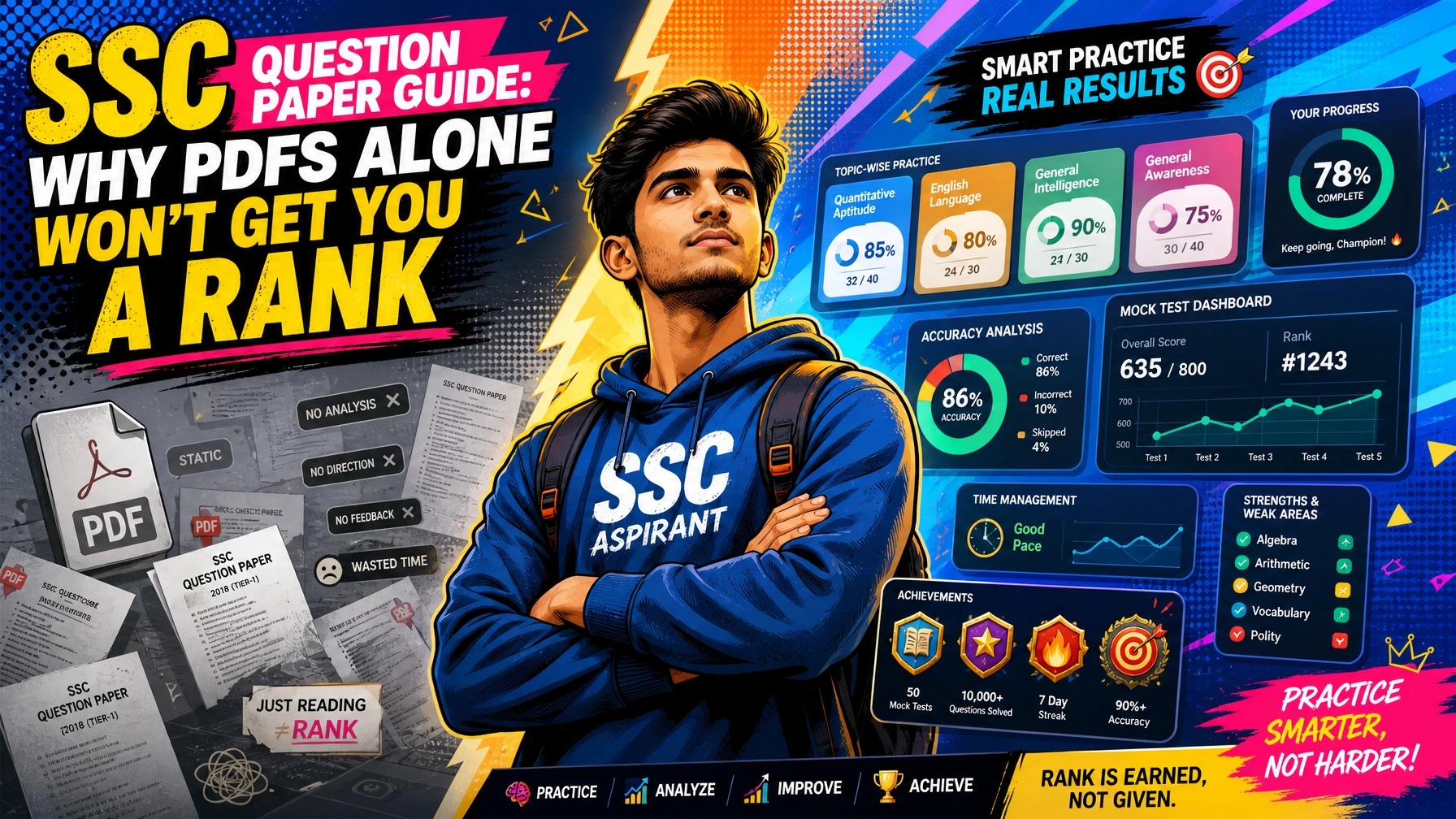
Your phone is probably filled with hundreds of Telegram PDFs you never open. You think having every ssc question paper since 2018 makes you prepared. But hoarding files is just a distraction that keeps you from actually learning.
We know how it feels to solve a mock and see the same mistakes in every single result. It's exhausting to study hard but not see your score move. This guide will show you how to swap random practice for topic-wise mastery and data-driven analysis.
We'll explore how to identify high-weightage subtopics and use tools like the Aaina progress dashboard to see exactly where you stand. You'll learn to track your errors and focus on the most repeated questions for the 2026 exams. Let's turn that digital clutter into a real rank.
Key Takeaways
- Understand why hoarding every ssc question paper in PDF format creates a false sense of progress and how to fix it.
- Learn to prioritize topic-wise drills over full-length mocks to build a solid foundation during your daily study hours.
- Master the "Aaina" technique to get a real-time view of your accuracy and peer ranking.
- Identify and fix recurring mistakes using a dedicated tracker instead of just glancing at answer keys.
- Get a clear 30-day roadmap designed to help you tackle high-weightage subtopics with precision.
The PDF Trap: Why downloading 100 ssc question papers isn't enough
Let's be real, yaar: your phone is probably full of 'SSC 2025 PYQ' PDFs you never open. You join ten Telegram groups and download every file labeled 'important.' It feels like you're studying, but hoarding files isn't the same as preparing for a rank.
Static PDFs are great for viewing, but they are terrible for tracking your accuracy. When you solve a random ssc question paper from a file, you spend half your time scrolling for the answer key. This friction breaks your focus. It prevents you from entering that 'flow state' needed for deep learning.
This is why many aspirants hit a plateau. You solve paper after paper, but your score stays stuck at a certain level. You aren't identifying the specific subtopics that pull you down. Reading a question paper is passive. Mastering it requires active, data-driven practice.
The Staff Selection Commission (SSC) updates its question patterns frequently. If you just glance at old PDFs, you miss the subtle shifts in weightage. You need to know which chapters are trending in 2025–26 and which ones are fading out.
The hidden cost of free Telegram PDFs
PDFs are disorganized by nature. There is no easy way to sort questions by subtopic or difficulty level. You might spend an hour solving easy questions while your actual weak areas remain untouched. It's a massive waste of time.
Searching for a specific ssc question paper solution in a separate 500-page document is frustrating. You lose the momentum of your practice session. Plus, these files don't tell you how you compare to other aspirants. You are practicing in a vacuum without any peer rank or accuracy data.
Why your brain needs structured practice
Human memory works better when you solve similar patterns together. This is the logic behind topic-wise practice. When you solve fifty questions on 'Ancient History' back-to-back, your brain starts recognizing the examiner's favorite traps. You move from chaos to clarity.
Using a structured plan helps you see exactly where you are losing marks. Instead of guessing why your score is low, you use tools like the Aaina dashboard on PYQKosh. It acts as a performance mirror, showing your accuracy and daily progress streaks.
Stop being a "PDF collector" and start being a "topic master." Swap the messy folders for a wrong questions tracker that stores your mistakes automatically. This shift from random solving to analytical practice is the only way to clear the 2026 cutoff. Practice with purpose and watch your marks jump.
Breaking down the SSC Question Paper: Topic-wise vs. Full-length drills
You finish your syllabus, jump into a full-length mock, and see a score that makes you want to quit. It happens to everyone. The problem isn't your brain. It's your method.
Should you solve a full 100-question set or focus on one chapter? Let's compare. Full-length mocks are for the final month. They are like a final rehearsal. Topic-wise practice is your daily workout. It builds the muscle you need to win.
Most beginners make the mistake of solving a complete ssc question paper too early. You need to identify 'high-yield' subtopics that the commission repeats every single year. Sort your practice by recency. Focus on 2025-26 papers first to see the latest patterns and trends on the Official SSC Website.
The power of subtopic-wise practice
Don't just practice 'History.' That's too vague. You need to master 'Buddhism & Jainism' or 'The Revolt of 1857' specifically. When you solve 30 questions on one tiny subtopic, you start seeing the patterns. You learn exactly which traps the examiner sets in every SSC CGL topic-wise previous year questions set.
This subtopic practice builds confidence faster than failing a full mock. Mastering one small area at a time ensures you don't leave any gaps. It's the ultimate topper banne ka shortcut. By the time you reach the exam hall, you've already seen every possible variation of a question.
Transitioning to full-length mocks
Once you've covered 80% of your syllabus through topic-wise drills, it's time to shift gears. This is when you start solving a complete ssc exam model question paper. Use 'Test Mode' to simulate that 11 PM exam pressure at home. It trains your mind to stay calm when the clock is ticking.
Full mocks help you manage your time. You learn which questions to skip and which to attempt. It's about strategy now, not just knowledge. Track your speed vs. accuracy using a centralized dashboard to see your peer rank. This data tells you if you're ready for the real deal.
Don't let a low mock score scare you. Use it as a roadmap. If you're consistently failing in 'Polity,' go back to subtopic-wise practice for two days. This back-and-forth movement is how you master the ssc question paper and secure your rank. Start small, stay consistent, and watch your accuracy climb.
How to analyze your SSC paper solution like a topper
Most aspirants check the answer, say 'oh, okay,' and forget it. Don't be that guy. If you spend one hour solving an ssc question paper, you must spend at least two hours analyzing it. Analysis is where the real learning happens.
The 'Aaina' approach is about looking at your performance mirror every single day. It isn't just about the marks you got. It's about seeing where you fumbled. Did you miss a concept, or did you just rush through the question? A topper knows exactly why they missed a mark.
In-depth explanations should cover both right and wrong options. You need to know why Option B was the trap. Look for 'Confusion Points' and 'Exam Booster' tips to stay ahead. This helps you identify your 'silly mistake' patterns before the actual exam day arrives.
The 'Wrong Question' tab: Your secret weapon
Forget manual note-making. It's too slow and messy. A smart system automatically stores every mistake you make in a dedicated tab. This is your personal hit-list for revision. No more flipping through old notebooks to find that one tricky math problem.
Sort your mistakes by frequency. Which subtopic is making you its 'shikaar' repeatedly? If you keep getting 'Percentage' questions wrong, you know exactly where to focus. Re-solving these specific questions is the fastest way to jump from 130 to 160+ marks. It turns your weaknesses into strengths.
Using data-driven analytics to predict readiness
Check your peer rank to see where you stand in the national competition. It's easy to feel like a king in your room, but the real fight is on a national level. Use the weekly graph to see if you are actually improving or just staying busy with random tasks.
Analyze your subtopic-wise accuracy. If your accuracy in 'Indian Polity' is below 70%, you aren't ready for that section yet. Use structured, analytical exam preparation on PYQKosh to fix these gaps. This data tells you when you are truly ready to face the real exam.
Practice makes perfect, but only if you learn from the mistakes you made in your last ssc question paper. Don't just solve questions; analyze them like a topper to ensure you never repeat the same error twice. This is how you secure your rank.
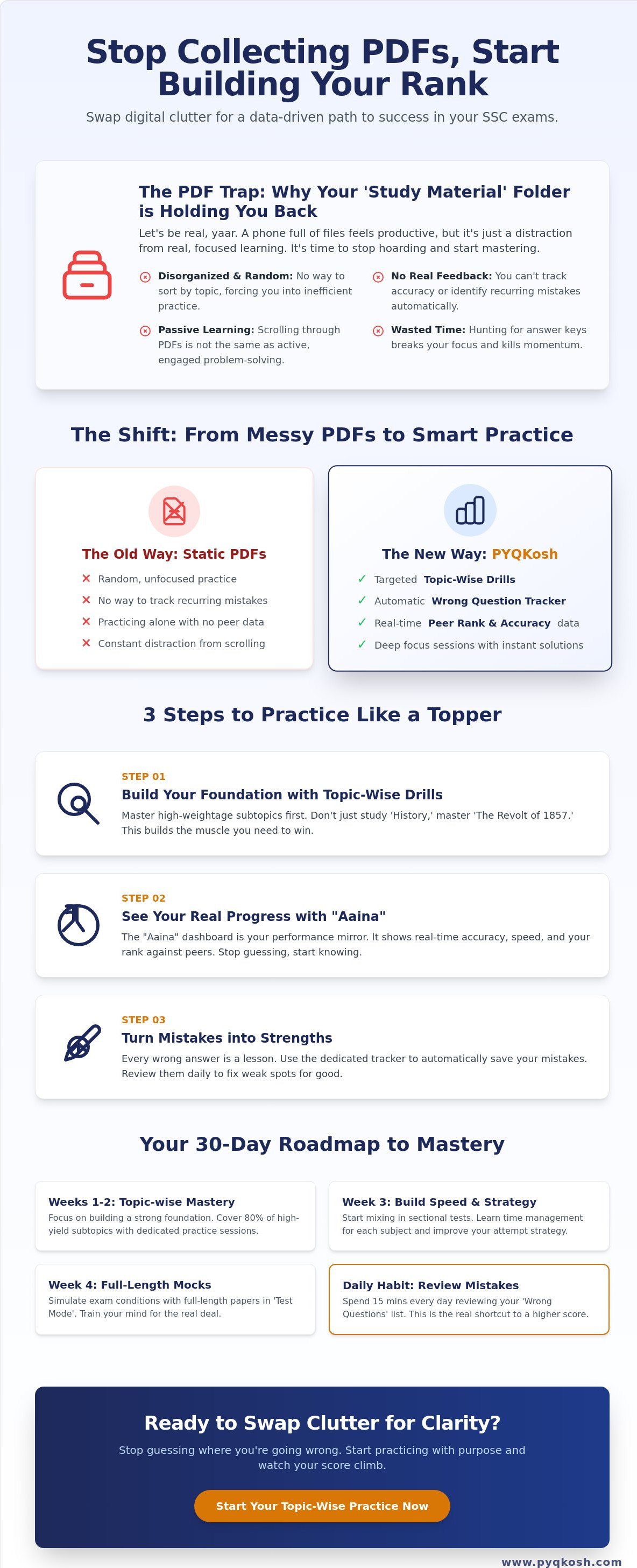
Static PDFs vs. PYQKosh: Which one will help you clear the 2026 cutoff?
You probably have a folder named 'SSC' on your phone that looks like a digital graveyard. It is full of every ssc question paper you could find. But when was the last time you actually analyzed one of them?
Let's compare the traditional 'PDF way' with the modern PYQKosh way. PDFs are free, but they cost you something more valuable: your time. A structured plan might cost a little, but it saves your attempt by removing the friction of searching for answers.
One hidden advantage of a centralized platform is multi-exam support. Sometimes, practicing UPSC or Railway PYQs helps your SSC GK because themes often overlap. You get all these exams in one place without downloading fifty separate, messy files.
The 'Aaina' dashboard gives you a clear weekly graph of your progress. Compare that to a messy folder of downloads where you don't even know which papers you've already solved. Clarity always wins over chaos when the exam is near.
Feature Showdown: Why structure wins
Use the Bookmark tab to save tough questions subject-wise. It is perfect for a quick revision two days before the exam. You won't have to hunt through hundreds of pages to find that one tricky geometry concept.
No more searching for separate answer keys. Every ssc exam questions and answers set is available in one place. You get in-depth explanations that clarify exactly why you fell for a trap option.
Daily streaks and accuracy tracking keep your motivation high. Seeing a 10-day streak feels much better than just closing a random PDF. It turns the boring daily grind into a game you actually want to win.
Is it worth the switch?
Think about the cost of another year of preparation. Compare a small investment in 'smart' tools to the lost salary of a missed selection. It is a no-brainer for aspirants who are tired of being "almost" qualified.
Thousands of students are moving away from random mocks to subtopic-wise mastery. They want structured, analytical exam preparation, not just more digital clutter. Check out the SSC CGL specific plans to see how the dashboard transforms your daily routine.
If you want to stop guessing and start tracking your real growth, start your practice on PYQKosh today and see the difference in your accuracy.
Your 30-day roadmap to mastering ssc question papers
Stop making elaborate timetables you'll never follow. It's time to stop planning and start doing. Here is your actionable 4-week strategy to master the ssc question paper once and for all.
Weeks 1 and 2 are for building your foundation. Focus on high-weightage subtopics using topic-wise practice. Don't waste time on easy chapters you already know. Use your dashboard to find the topics where your accuracy is low and hit them hard.
Week 3 is the pivot. Start re-solving everything in your wrong questions tracker. This is where most aspirants fail. They solve new questions but never fix their old mistakes. If you don't clear your backlog of errors, they will follow you into the exam hall.
Week 4 is about speed and simulation. Mix your subtopic drills with full-length test mode drills. You need to get used to the timer. Use the in-depth test analysis to see if your speed is improving without hurting your accuracy.
Daily habits for the smart aspirant
Success isn't about one big day; it's about small daily wins. Spend 30 minutes every morning on your wrong questions list. Re-solving a mistake is more valuable than solving five new questions. It stops the leak in your score.
Use the Bookmark tab to revise 'Confusion Points' during your commute. Whether you're on a bus or waiting for a friend, open your phone and review a few saved questions. These small gaps in your day are perfect for quick revision.
Keep your streak alive on the Aaina dashboard. Even 10 questions on a busy day counts, yaar. Consistency builds momentum. Once you see that streak growing, you won't want to break it. This is the real topper banne ka shortcut.
Final checklist before the exam
As the exam date gets closer, focus on recency. Have you covered the 2024 and 2025 papers? These are the most relevant for understanding the current mindset of the examiner. Don't get stuck on outdated patterns from a decade ago.
- Is your accuracy in your 'weak topics' consistently above 80%?
- Have you re-solved every question you got wrong in your last five mocks?
- Are you comfortable with the 'Test Mode' interface and timer?
If you can check these boxes, you are ready to see your name in the final merit list. You've moved from disorganized chaos to structured, analytical exam preparation. Now, it's just about execution. Let's get to work and claim that rank.
Start your 30-day challenge by practicing your first subtopic on PYQKosh now.
Turn your PDF collection into a final merit list rank
You have enough files on your phone to open a library. But a library doesn't get you a government job. Strategy does. Stop treating every ssc question paper like a reading assignment and start using it as a data point for your success.
Move beyond static PDFs and embrace a system that actually tracks your growth. With 100,000+ Topic-wise PYQs at your fingertips, you can master one subtopic at a time. Use the Aaina Progress Dashboard to see your real accuracy and the Wrong Question Tracker to kill your recurring errors.
The 2026 cutoff won't wait for you to get organized. Take control of your preparation now and make this attempt your last one. You've got this, yaar.
Start your structured SSC practice today on PYQKosh
Frequently Asked Questions
Is it enough to solve only ssc question papers from the last 5 years?
Yes, the last 5 years are the most relevant for your preparation. These papers reflect the current TCS pattern and difficulty levels that you'll face in 2026. Focusing on recent years ensures you aren't wasting time on outdated question types that the commission no longer uses.
How many years of previous year papers should I solve for SSC CGL 2026?
You should focus on papers from 2018 onwards. This period covers the entire shift to the current vendor pattern and online testing standards. Start with the most recent 2024 and 2025 papers to understand the latest trends before moving back to older sets.
Can I clear SSC CGL without coaching by just using PYQs?
Yes, you can definitely clear it through self-study. Many toppers rely on structured PYQ practice to understand the exam's DNA. If you master every concept hidden in an ssc question paper and use a dashboard to track your accuracy, you don't need expensive live classes.
What is the difference between practice mode and test mode on PYQKosh?
Practice mode is for learning because it lets you see in-depth explanations immediately after each question. Test mode is for the final rehearsal. It hides answers until the end and includes a timer to simulate the actual pressure you'll feel on exam day.
Why is my score not increasing even after solving many SSC old question papers?
You're likely solving questions passively without fixing your mistakes. If you don't use a wrong questions tracker to re-solve your errors, you'll keep making them. Use the Aaina dashboard to identify which specific subtopics are pulling your total score down.
Does SSC repeat questions from other exams like Railway or UPSC?
Yes, especially in the General Awareness section. Themes and specific facts often overlap between SSC, Railway, and CDS exams. Using a platform with multi-exam support helps you catch these repeating patterns that others might miss by only looking at one exam.
How can I track my progress if I am solving papers from different sources?
Tracking progress across scattered PDFs and books is nearly impossible, yaar. You need to centralize your practice on a platform that offers per-topic progress tracking. This gives you a clear accuracy percentage and a weekly graph to see if you're actually improving.