
Article by
Aaisha
A passionate content writer at PYQKosh focused on simplifying Current Affairs and PYQs for competitive exam aspirants. I love turning complex topics into easy, student-friendly content that helps learners prepare smarter and stay consistent in their exam journey.
What if I told you that scoring high in RRB General Awareness isn't about memorizing every history book, but about spotting the patterns the board has used for years? It's a strategy game, not a memory test.
I know the struggle. You open a massive Static GK PDF late at night, and by page ten, your head is spinning. It feels like an endless ocean of facts that just won't stick.
The secret is that toppers don't try to learn everything. They master rrb general awareness previous year questions by breaking them down into small, manageable subtopics that actually repeat in the exam.
In this guide, you'll learn how to stop wasting time on low-yield topics. I'll show you a clear plan to finish the GA section faster while boosting your accuracy in Science and Static GK.
We will look at how to identify high-yield questions and use structured practice to track your daily progress. Let’s turn that unpredictable syllabus into a clear, winning roadmap for your 2026 railway exams.
Key Takeaways
- Learn why the Railway Board repeats specific themes in Science and Static GK, turning a massive syllabus into a predictable pattern.
- Stop wasting time on boring, static PDFs and switch to a subtopic-wise approach to finish the General Awareness syllabus in half the time.
- Master rrb general awareness previous year questions by solving 30-50 questions per high-weightage subtopic to build real exam-day accuracy.
- Use the "Aaina" dashboard to track your accuracy and streaks so you know exactly where you stand against other 2026 aspirants.
- Fix your mistakes automatically by using a dedicated tracker for wrong questions, ensuring you never repeat the same error in the actual exam.
Why RRB General Awareness PYQs are Your Secret Weapon for 2026
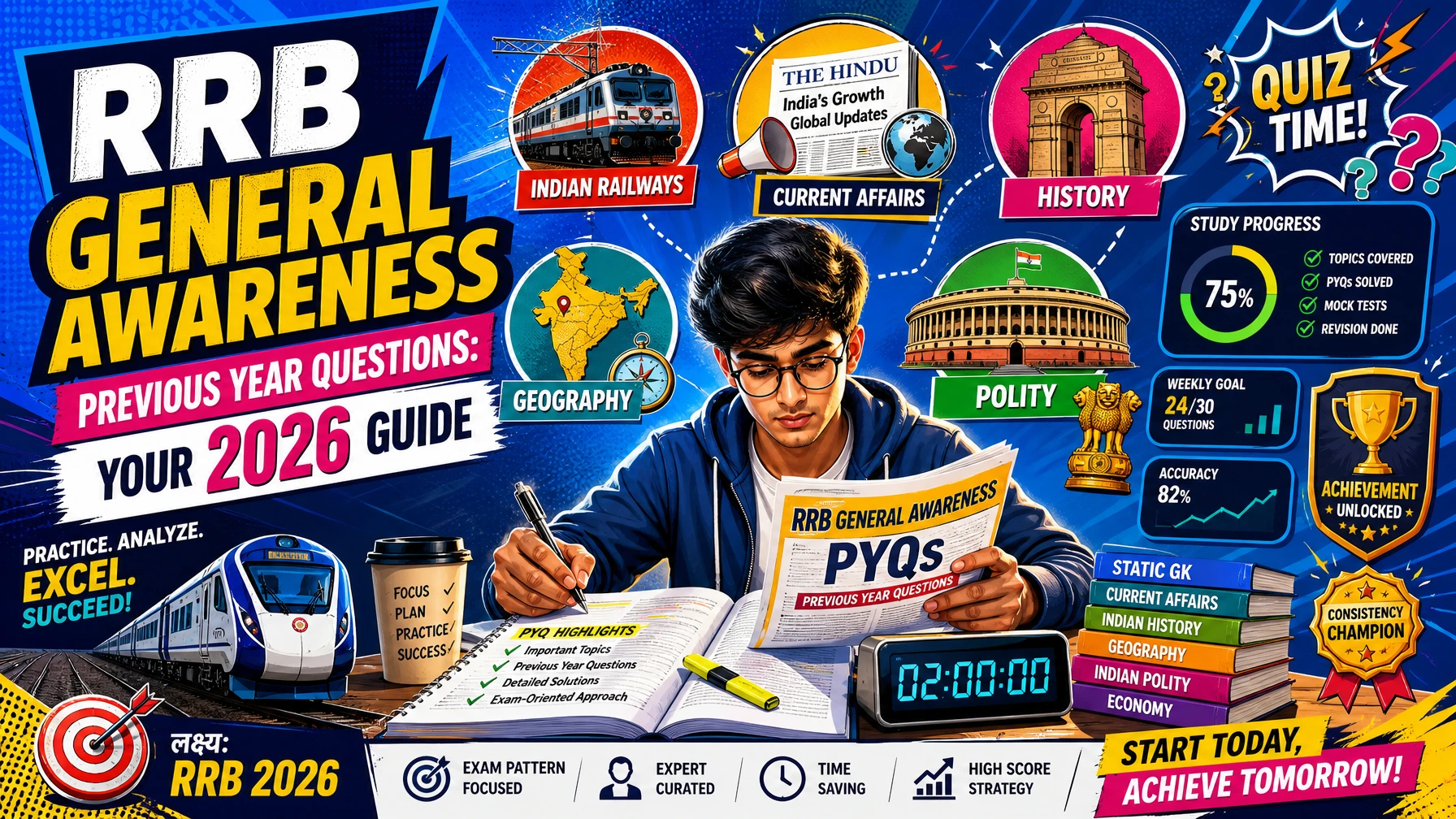
If you're aiming for a permanent seat in the Indian Railways, GA is your best friend. In exams like RRB NTPC, GA accounts for a huge chunk of marks.
The Railway Recruitment Control Board (RRCB) loves repeating themes. They often stick to predictable patterns in Science and Static GK.
Practicing rrb general awareness previous year questions shows you the exact depth of a topic. It stops you from over-studying things that never show up.
Real exam questions help you handle the specific language RRB uses. This familiarity gives you an edge during those high-pressure 60 minutes.
The difference between reading and practicing
Many think reading a GK book cover-to-cover is a topper banne ka shortcut. Yaar, let's be real; that rarely works for anyone.
Reading is passive, but solving is active. Active recall forces your brain to pull facts from memory. This is how facts actually stick.
PYQs act as a precision filter that removes textbook filler. They highlight the high-yield facts you actually need to win.
Mapping the 2026 RRB exam pattern
Don't just rely on very old papers from 2018. Recent trends show the board is moving towards conceptual Science questions.
Prioritize 2025-26 questions to see the current difficulty level. This helps you stay ahead of competitors stuck on outdated patterns.
Focus on recent Science developments and updated Static GK. This targeted effort turns random study into a data-backed strategy.
High-Yield Subtopics: Where the Questions Actually Come From
Most websites give you a generic list like History or Geography. That's too broad and honestly quite useless. You need to know exactly which subtopics the board picks.
The secret is to break the syllabus into smaller pieces. When you look at rrb general awareness previous year questions, the high-yield areas stand out clearly.
You don't need to be a scholar. You just need to be a specialist in what the Railway Board actually asks.
General Science: The make-or-break section
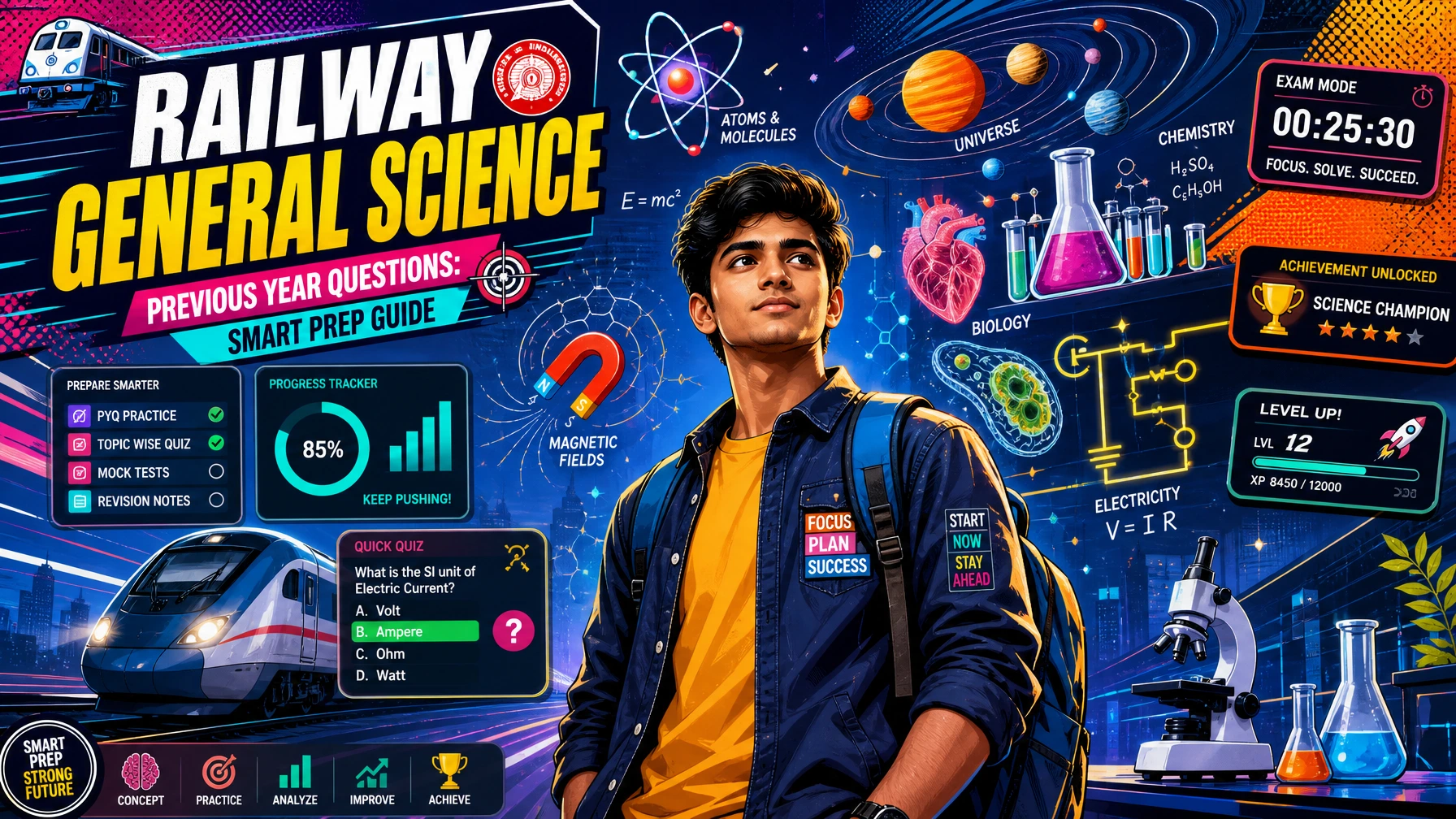
General Science carries the most weight. In Physics, the board loves Units, Light, and Electricity. For Biology, master Human Anatomy and Vitamins.
Subtopic-wise practice is crucial here to avoid confusion. Solving 30-50 questions just on Vitamins makes that knowledge permanent.
This is your topper banne ka real secret. It helps your brain categorize facts properly before the exam day.
Static GK and Current Affairs
Static GK offers easy, fast marks. Focus on Indian Railways history, National Parks, and Folk Dances. These are evergreen topics that rarely change.
Yaar, a smart mentor's trick is to link Current Affairs with Static GK. If a state is in the news, check its Folk Dances immediately.
Find these facts organized for you on the current affairs topics page. It helps you stay updated without the news clutter.
For Indian Polity, focus on Key Articles and Amendments. In History, the Indian National Movement is the most important area. Ancient India also sees regular questions.
Stop trying to finish the whole book. Focus on high-return subtopics first. Start topic-wise practice today to see where you stand.
The Problem with Random PDFs (And the Subtopic Solution)
Most of us have a folder on our phones filled with "important" PDFs. You know the ones. They have names like "Top 500 Science Questions" or "History Mega Bank." But let's be honest; scrolling through a 500-page dead file on a small mobile screen at 11 PM is a total nightmare.
PDFs are "dead" files because they don't give you any feedback. You read a question, look at the answer, and move on. You have no idea if you're actually improving or just wasting time. This is the biggest mistake aspirants make when solving rrb general awareness previous year questions.
Random practice leads to massive "blind spots." When you solve a mixed bag of questions, you naturally focus on the easy ones. You end up skipping the hard topics like "Plant Kingdom" or "Specific Heat" without even realizing it. This leaves you half-prepared and anxious on exam day.
Why subtopic-wise practice beats the mix-bag approach
Mastering one theme at a time is the only way to build real confidence. Imagine spending an hour just on "Indian Rivers." By the end of that hour, you've seen every possible way the Railway Board can ask about the Ganga or the Brahmaputra. You move from "I think I know this" to "I am an expert on this."
This structured approach ensures 100% syllabus coverage. You don't leave anything to chance. You can improving speed in railway exams by mastering these subtopics first. When you know a topic inside out, you don't hesitate. You mark the answer and move to the next question in seconds.
Tracking your daily streaks
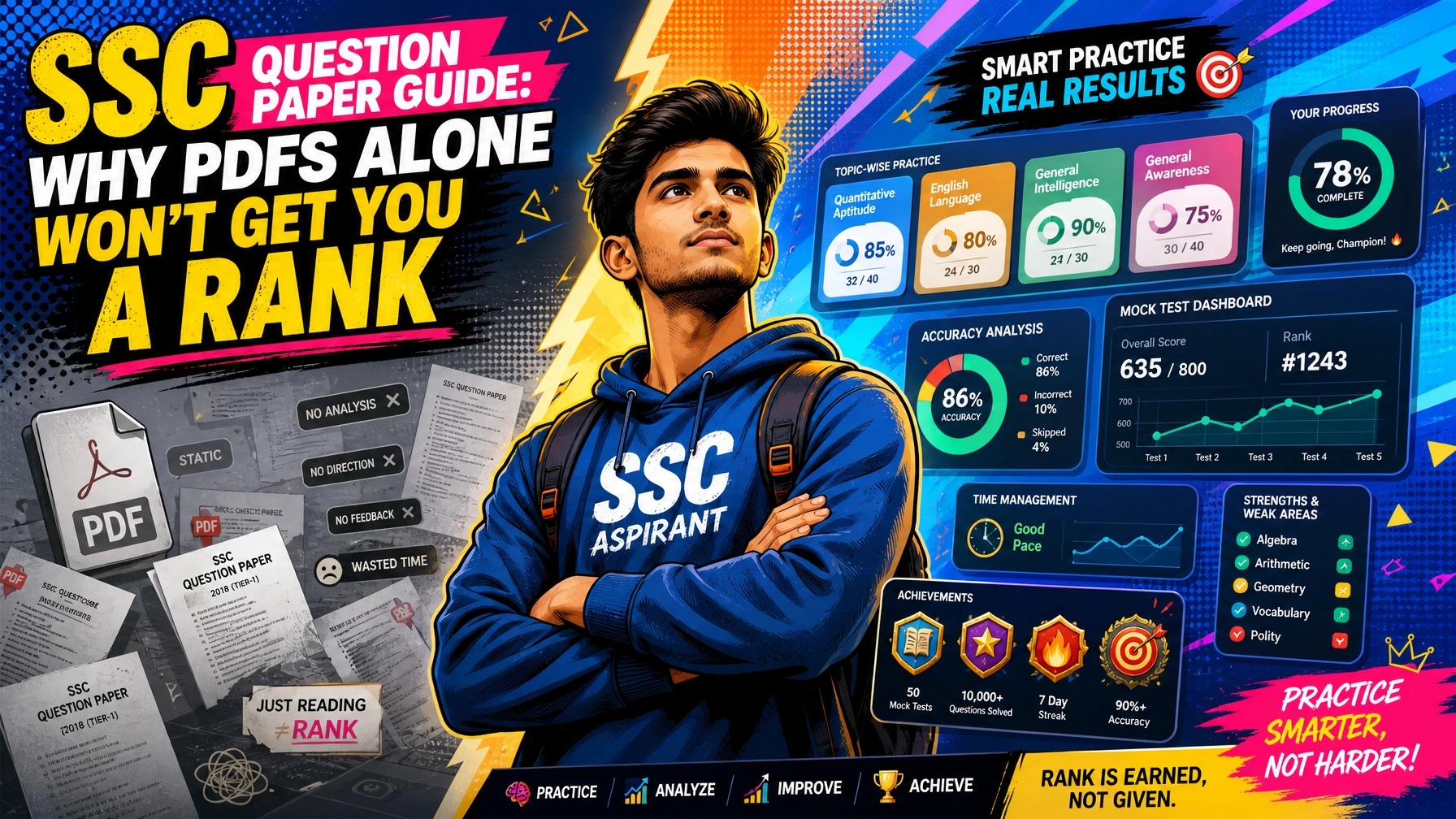
There is a massive psychological benefit to seeing your progress grow every day. In the "Aaina" dashboard, you can see your daily practice streaks. This simple feature keeps you motivated even when you're tired after a long day of classes. Seeing that streak count go up feels like a small win.
Yaar, don't just "read" GK. Solve it. Move from the vague feeling of "I've seen this before" to the concrete reality of "I have solved 50 questions on this subtopic and my accuracy is 90%." This data-backed clarity is what separates winners from the crowd.
A structured, analytical exam preparation plan replaces confusion with organized clarity. It turns a disorganized pile of rrb general awareness previous year questions into a clear roadmap to success. Stop scrolling through dead PDFs and start practicing with purpose.
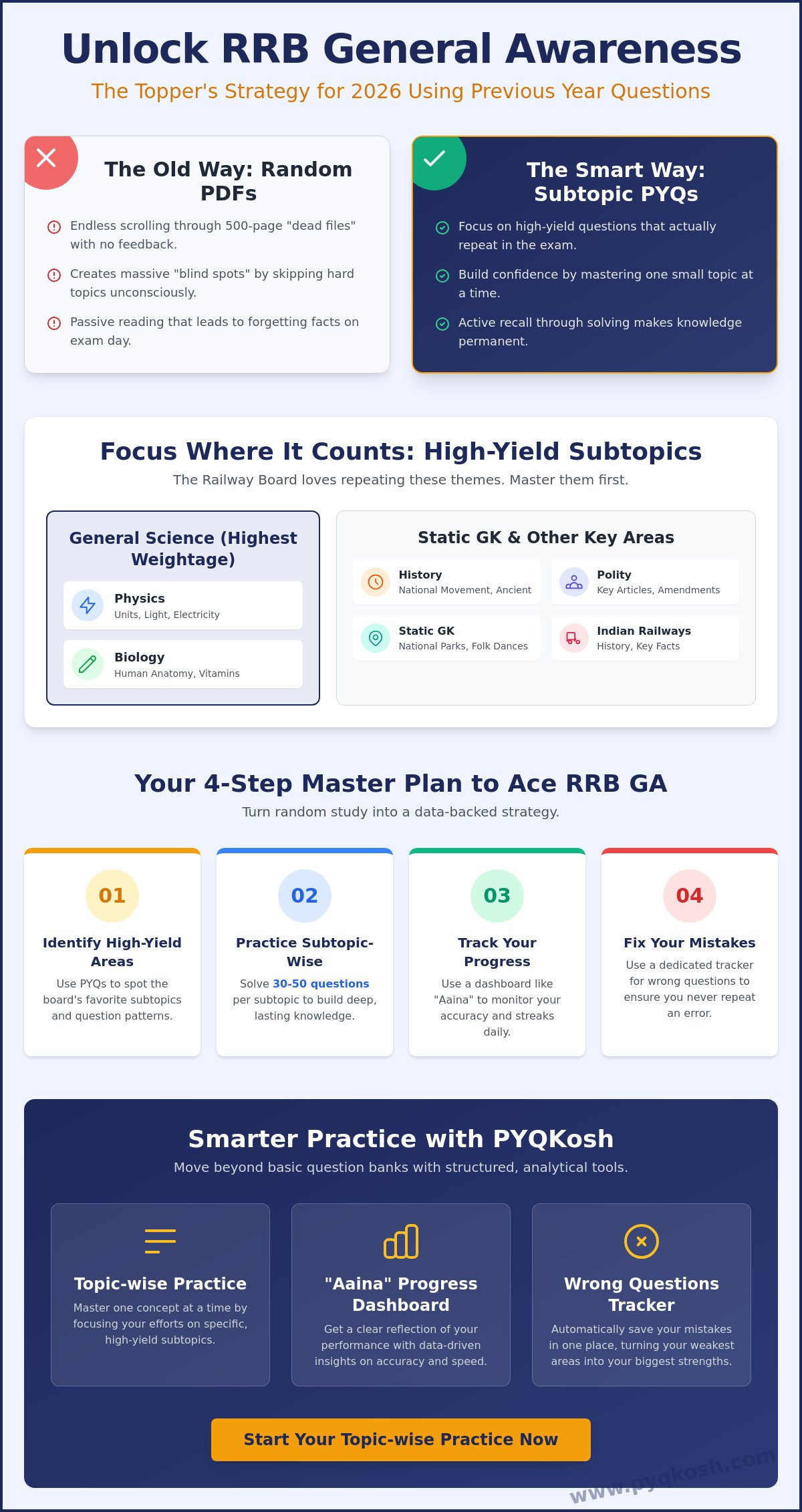
How to Master RRB General Awareness in 4 Simple Steps
Generic tips like "practice hard" won't get you a job in the Railways. You need a clear, actionable workflow that removes the guesswork from your study sessions. Follow these four steps to dominate rrb general awareness previous year questions and secure your 2026 selection.
Step 1: Pick a high-weightage subtopic. Start with areas like General Science or Indian Polity. Use the sorting feature to find topics with the highest question counts from recent years first.
Step 2: Solve 30-50 PYQs. Don't just do five questions and stop. Solving a larger batch for a specific subtopic helps you see the repeating patterns and the exact language the board uses.
Step 3: Analyze every wrong answer. This is where most aspirants fail. Read the in-depth explanations to understand the logic and the "why" behind the answer, not just the fact itself.
Step 4: Re-solve your mistakes after 48 hours. Use the specialized tracker to revisit only the ones you missed. This locks the information into your long-term memory so it sticks on exam day.
Analyzing your mistakes like a topper
Toppers don't just check the right answer; they figure out why they were tricked in the first place. Look for the "Confusion Points" in the explanations. These highlight common traps that the examiner sets to catch unprepared candidates.
Using data-driven insights helps you find your weakest areas automatically. If you keep making mistakes in "Electricity," your dashboard will show you the dip in accuracy. You can then start topic-wise practice for that specific area to fix the gap immediately.
The 48-hour revision rule
Scientific studies show that you forget most of what you learn within 24 hours. The first revision at the 48-hour mark is the most important for building long-term memory. Yaar, stop wasting time writing long, messy notes in your register.
Use the "Wrong Question Tab" instead. It automatically stores every question you get wrong so you can review them in seconds. Sorting mistakes by frequency helps you attack the topics that cost you the most marks and ensures you never repeat the same error twice.
This system turns your phone from a distraction into a high-speed learning tool. By focusing on your errors, you move from disorganized chaos to a state of data-backed clarity. Start your RRB PYQ practice now and follow this workflow to see immediate results.
Smarter Practice with PYQKosh: Move Beyond Basic Question Banks
Most websites show you static lists buried under ads. This chaos wastes your time and slows your progress. You need a tool that works as hard as you do.
PYQKosh centralizes over 100,000 subtopic-wise questions in one place. You master rrb general awareness previous year questions for RRB NTPC and other exams without switching apps.
This tool fits the modern aspirant's mobile study habits perfectly. It tracks every click and turns your practice into a structured, analytical preparation journey.
Aaina: Your personal progress mirror
The Aaina dashboard acts as your secret weapon for 2026. It tracks your subject-wise accuracy in real-time so you know exactly where you stand.
The peer ranking feature helps you understand the real competition. It pushes you to improve your speed every day until you reach the top of the leaderboard.
In-depth explanations and exam boosters
Stop settling for simple answer keys. Our explanations provide context-rich details that cover both right and wrong options.
Every question includes Exam Booster tips and Confusion Points. These nuggets of wisdom help you spot common examiner traps before they cost you marks.
The Wrong Question tracker stores every mistake you make automatically. You can sort these by frequency to conquer your biggest weaknesses once and for all.
Ready to turn your preparation into a winning strategy? Choose your exam and start practicing today to see the difference.
Turn Your Railway Dreams into Reality for 2026
Yaar, the days of getting lost in 500-page PDFs are over. You now have a clear roadmap to conquer the General Awareness section by focusing on what actually repeats. It's time to stop guessing and start practicing with precision.
Mastering rrb general awareness previous year questions is much easier when you break them down into subtopics. You've learned how to identify high-yield areas and why active recall is your best friend for long-term memory.
With over 100,000 subtopic-wise PYQs and in-depth explanations, you can build real accuracy. Use the Aaina dashboard to track your daily streaks and watch your confidence grow as you fix every mistake in the wrong question tracker.
You have the strategy and the tools to stay ahead of the competition. Believe in your progress and keep pushing forward every single day to secure your seat in the Indian Railways.
Start your structured RRB GA practice on PYQKosh today
Frequently Asked Questions
Are RRB General Awareness questions repeated from previous years?
Yes, the themes and concepts repeat in almost every shift. While the exact wording might change, the core concept stays the same. Mastering rrb general awareness previous year questions is the best way to spot these recurring topics before they appear in your 2026 paper.
Which subject has the highest weightage in RRB General Awareness?
General Science is the king of the RRB GA section. Physics, Chemistry, and Biology usually make up the largest portion of the marks. You should prioritize these subtopics first to build a solid score foundation and save time during the actual exam.
How many years of PYQs should I solve for RRB NTPC 2026?
Focus on the last five years of papers to stay updated with the latest trends. Questions from 2020 to 2025 reflect the current difficulty level and the shifting focus of the board. Older papers are okay for basics, but recent ones are much more relevant for 2026.
Is General Science different for RRB Group D and NTPC?
The syllabus is mostly the same, but NTPC often asks more conceptual questions compared to the direct facts found in Group D. However, practicing both helps you build a deeper understanding of Science subtopics. It's better to be over-prepared by solving rrb general awareness previous year questions from across different Railway exams.
Can I clear RRB GA just by practicing questions without reading books?
You can definitely clear it if you analyze every question properly. Don't just tick the right answer; read the in-depth explanations to learn the theory behind the question. This turns your practice sessions into a powerful learning tool without needing heavy textbooks that are hard to finish.
How do I handle the "Wrong Questions" I keep making during practice?
Use a dedicated wrong questions tracker to store your mistakes automatically. Re-solving these specific questions after 48 hours is the best way to lock the correct facts into your memory. This stops you from repeating silly mistakes during the actual high-stakes exam.
How much time should I spend on GA practice daily?
Spend about 60 to 90 minutes on GA practice every single day. Consistency is more important than long, exhausting sessions that lead to burnout. Use the Aaina dashboard to track your daily streaks and ensure you are making steady progress even on your busiest days.
Is current affairs from 2024 still relevant for 2026 exams?
Yes, major events like national awards, government schemes, and international treaties from 2024 remain important. Many Railway exams ask about "Static" current affairs that happened a year or two ago. Keep an eye on these evergreen topics while focusing on the most recent updates for 2026.