

Article by
Aaisha
A passionate content writer at PYQKosh focused on simplifying Current Affairs and PYQs for competitive exam aspirants. I love turning complex topics into easy, student-friendly content that helps learners prepare smarter and stay consistent in their exam journey.
Ever wondered why some aspirants clear the Railway exams in their first attempt while others keep struggling with the same Physics numericals for years? It's usually because the toppers don't try to memorize every single fact in a textbook. Instead, they focus on railway general science previous year questions to spot the specific patterns that the RRB loves to repeat.
I get it, yaar. The science syllabus feels like an endless ocean, and those Physics numericals can give anyone anxiety. Plus, keeping track of a hundred different PDFs on your phone is a nightmare. You feel like you're working hard, but your scores just aren't moving.
This guide will help you stop memorizing random facts and show you how to master Science subtopics using a data-driven strategy. We'll explore how to identify high-yield topics and use tools like the Aaina dashboard and wrong questions tracker to turn your preparation into a winning streak.
Key Takeaways
- Learn why 10th-level clarity is more important than high-level theory for mastering the 25-30% weightage Science holds in RRB exams.
- Identify high-yield subtopics like Units, Light, and Electricity by analyzing railway general science previous year questions from recent years.
- Discover why solving random questions is a trap and how to use subtopic-wise diagnostic tests to find your weak 'Red Zones.'
- Master data-driven prep by tracking your accuracy and progress streaks through a centralized dashboard like Aaina.
- Stop repeating the same mistakes by using a dedicated tracker to automatically organize and revisit your errors before exam day.
Why Railway General Science Previous Year Questions are Your Secret Weapon
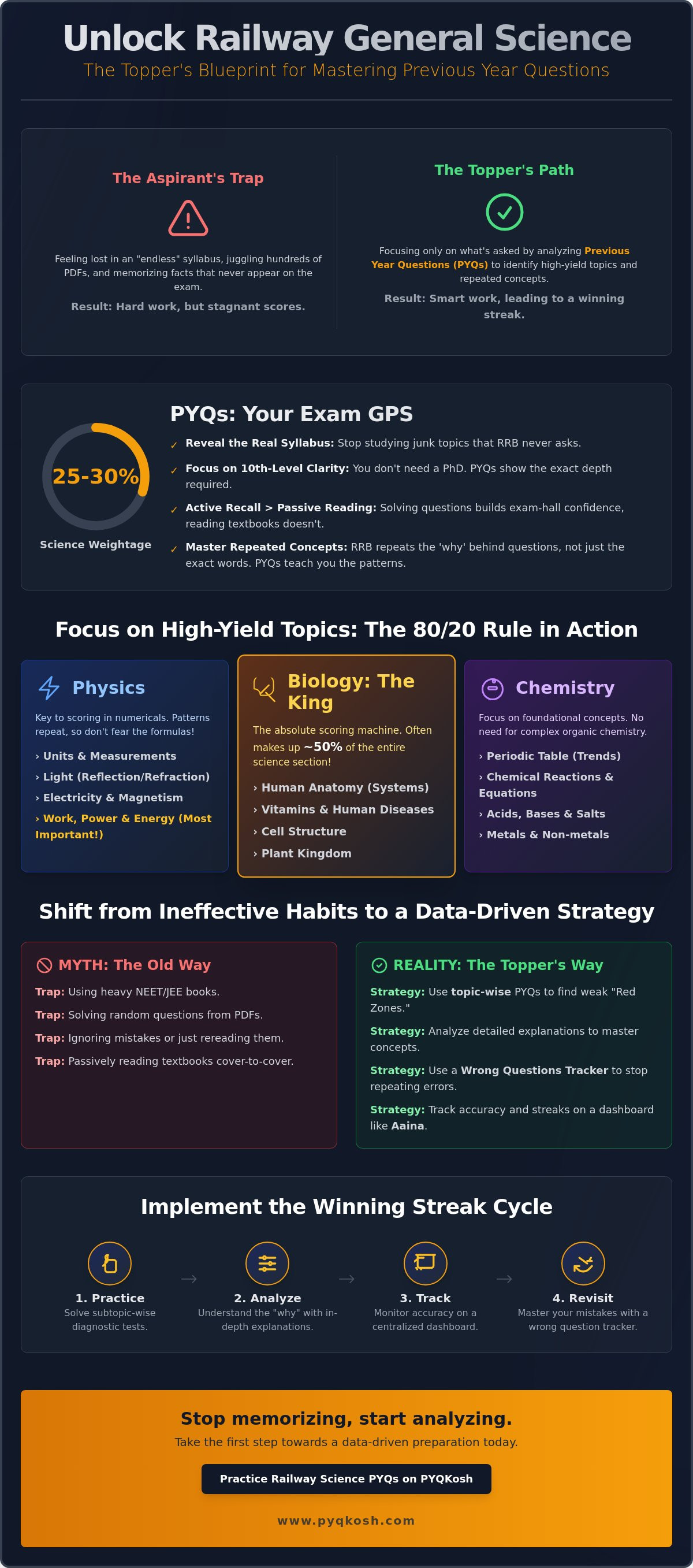
Science is the kingmaker in Railway exams. With a weightage of nearly 25-30% in exams like RRB NTPC and Group D, you simply can't ignore it. The Railway Recruitment Control Board (RRCB) designs these papers to test your basic understanding of the world around you, not your ability to solve complex equations.
Many aspirants waste months buying heavy Science books meant for NEET or JEE. Let's be real, yaar. You don't need a PhD to clear this; you need solid 10th-level clarity. Solving railway general science previous year questions is your secret weapon because it reveals the actual boundary of the syllabus and stops you from over-studying.
Reading a textbook is a passive activity. It makes you feel like you know the material until you see the options in the exam hall. Solving a PYQ is active. It forces your brain to recall information under pressure, which is the only way to build real confidence before the big day.
The 'Unlimited Syllabus' Myth
It feels like the syllabus is an endless ocean, right? That's a common fear, but it is actually a myth. The syllabus is finite if you look at it through the lens of specific subtopics. Toppers use a smart strategy to filter out almost 40% of the junk found in standard Science books that RRCB never touches.
They don't study everything from cover to cover. They study what actually appears in the paper. The 80/20 rule in Railway Science is simple: 80% of your marks will come from just 20% of the core subtopics like Light, Electricity, and Human Anatomy.
Why RRB Repeats Concepts, Not Just Questions
Railway job patterns repeat much more frequently than SSC or UPSC. But don't get complacent. RRB doesn't always copy-paste the exact same question. Instead, they repeat the underlying concept using different values or phrasing.
For instance, a question on Ohm's Law can be asked in five different ways. One year might be a direct definition, while the next might be a small numerical on resistance. If you only memorize the answer, you'll walk straight into a negative marking trap during the actual test.
This is why you must check in-depth explanations for every PYQ you solve. Understanding the "why" helps you tackle any twist the examiner throws at you. It turns a random fact into a permanent concept in your head. Start practicing these patterns today to see the difference in your mock scores.
Breaking Down High-Yield Science Subtopics (Physics, Chemistry, Biology)
Staring at a 500-page Science book at 11 PM feels like a punishment. I've been there, yaar. The trick is to stop treating every page as equally important. You need to focus on the high-yield areas that actually show up on the screen.
Data from recent years shows that railway general science previous year questions follow a very specific map. If you follow this map, you can ignore almost half the textbook. Here is how the big three subjects usually break down:
- Physics: Focus on Units, Light, and Electricity.
- Chemistry: Master the Periodic Table and Chemical Reactions.
- Biology: Prioritize Human Anatomy and the Plant Kingdom.
Physics: Beyond Just Units and Measurements
RRB loves Physics, but they have favorites. While everyone memorizes basic units, the real marks are in 'Work, Power, and Energy.' This subtopic appears in almost every shift. If you're scared of numericals, don't worry. The secret is simple: patterns repeat.
When you use topic-wise practice, you start seeing that the same few formulas solve 90% of the questions. You don't need to be a math genius. You just need to recognize which formula to plug in. Practicing these specifically helps you lose that "formula fear" and improves your speed.
You can start testing your formula recall with RRB NTPC subtopic-wise questions to see where you stand.
Biology: The King of Railway Science
In many RRB shifts, nearly 50% of the Science section comes from Biology alone. If you're short on time, start here. You must master Vitamins, Human Diseases, and the Cell structure. These aren't just random facts; they are the backbone of the paper.
The Plant Kingdom is another area where students lose marks because of confusing names. Don't let that happen to you. Use the bookmark tab to save those difficult biological terms or confusing classifications. This way, you can revise them in seconds while traveling or during a tea break without flipping through heavy notes.
Biology is a scoring machine if you know the right terms. Chemistry follows a similar logic with the Periodic Table. Focus on the atomic numbers and properties of the first 20 elements. This targeted approach ensures you aren't just studying hard, but studying smart for the railway general science previous year questions that matter most.
Myth vs. Reality: Why Your Current PYQ Practice is Failing You
Many aspirants think that solving 1,000 random questions is the topper banne ka shortcut. They spend hours on random telegram quizzes or mixed mock tests. But at the end of the day, they still feel confused. Why? Because random practice only builds familiarity, not mastery.
If you're just clicking through mixed quizzes, you're guessing more than you're learning. Real growth happens when you stop treating railway general science previous year questions like a memory game. You need a structured, analytical approach to see where you're actually failing.
This is where the Aaina progress dashboard changes the game. Instead of wondering if you're ready, you can see your accuracy, daily practice streaks, and peer rank in one place. It turns your disorganized effort into a clear, data-driven map of your progress.
The PDF Trap: Why Static Files Waste Your Time
I know you have dozens of 500-page PDFs saved on your phone. But let's be honest, yaar. Searching for a specific railway job question in a massive static file is a nightmare. Plus, using outdated 2018-2021 files in 2026 is risky because the exam level has shifted significantly.
PDFs are a graveyard of information. They don't tell you which topics you're failing or how much time you're wasting. You need to shift from passive scrolling to active testing. Subtopic-wise practice allows you to attack your weak points directly rather than wasting time on things you already know.
The 'Numerical' Fear: Do You Really Need High-Level Math?
Physics numericals cause so much unnecessary anxiety. Many students think they need high-level math, but that's a myth. Railway numericals are strictly 9th and 10th-grade level. They test your concept, not your ability to solve complex calculus.
If you keep making calculation errors, use the wrong question tracker. It automatically stores every mistake you make. You can sort these by frequency to see which specific formula is tripping you up. This helps you fix the root cause of your 'Numerical Fear' once and for all.
To get faster at these calculations, check out these tips on Improving Speed in Railway Exams. Stop letting railway general science previous year questions intimidate you and start using them as data to build your strategy.
Smart Strategy: How to Analyze Railway Job Questions Like a Topper
Toppers don't just solve questions; they dissect them. They treat every set of railway general science previous year questions like a diagnostic report for their brain. If you want to jump from the 'struggling' list to the 'selected' list, you need to stop guessing and start measuring your performance like a pro.
Following a structured, analytical exam preparation plan is the only topper banne ka shortcut. Instead of running after new study material, follow these four actionable steps to master the Science section:
- Step 1: Start with a subtopic-wise diagnostic test to find your baseline. Don't solve mixed mocks yet.
- Step 2: Identify 'Red Zones' using your accuracy data. If accuracy is below 60%, that topic needs immediate attention.
- Step 3: Use the wrong question tracker to revise your mistakes every single day.
- Step 4: Re-test the same subtopic until your accuracy consistently hits 90% to beat negative marking.
Using the Aaina Dashboard for Data-Driven Prep
The Aaina dashboard is your command center for success. It was made with love by an aspirant who understood the struggle of staying motivated. It tracks your daily practice streaks and goals so you never lose your momentum during long study hours.
In a high-stakes exam like RRB NTPC, competition is fierce. Seeing your peer rank on the dashboard helps you stay grounded and hungry for improvement. It visualizes your progress through weekly graphs, making it easier to see if your hard work is actually paying off.
Mastering the Art of the Wrong Question Tracker
Your mistakes are actually your best teachers, yaar. Most students ignore their wrong answers and move to the next set, but toppers obsess over them. The wrong question tracker automatically stores every slip-up you make during your railway general science previous year questions practice sessions.
You can sort these questions by 'frequency of mistakes' to focus your energy on the concepts that trip you up the most. Make it a habit to revise these specific questions every Sunday morning with a fresh mind. This ensures you never commit the same mistake twice in the actual exam hall.
Ready to see your own Red Zones and fix them? Start your subtopic-wise practice today and turn your weaknesses into your greatest strengths.
How to Practice Railway General Science Questions on PYQKosh
Stop jumping between ten different apps and telegram channels. PYQKosh centralizes your entire preparation. Whether you're targeting RRB NTPC or ALP, the 'Exam Selection' feature lets you switch your focus in just one click.
With over 100,000 questions from SSC, UPSC, and Railway exams, you have every railway general science previous year questions set you'll ever need. This is the real topper banne ka shortcut. It moves you from disorganized chaos to structured, analytical exam preparation.
The platform supports multi-exam PYQs. This means if a Science concept was asked in an SSC CGL paper, you can practice it here too. RRCB often picks patterns from other major government exams, so having everything in one place gives you a massive edge.
Topic-Wise and Subtopic-Wise Drills
Head over to the Railway category and select 'General Science.' You won't see a messy list of random questions. Instead, you get specific subtopics. This allows you to go deep into areas where you feel weak.
Imagine practicing 50 questions just on 'The Periodic Table' until you can't get them wrong. This level of focus is impossible with traditional books or PDFs. You can sort these topics by question count or recency to ensure you're practicing the most relevant railway general science previous year questions first.
Check out the RRB NTPC Exam Page to start these drills immediately and see how your accuracy improves with every set.
Getting In-Depth Explanations for Every Mistake
Don't just see the right answer and move on. Our explanations break down why the other three options were wrong. This builds a 360-degree understanding of the concept so you're ready for any variation of the question.
Our 'Exam Booster Tips' are designed to help you remember facts longer. They highlight common confusion points that RRCB often uses to trick students. Every railway job question you master brings you one step closer to your dream station.
Remember, yaar, consistency is better than intensity. Use the bookmark tab to save tricky questions and revisit them during your daily commute. This disciplined approach is what separates the toppers from the crowd.
Start practicing your first subtopic today and see your Aaina dashboard come to life.
Ready to Turn Your Science Fear into Your Strength?
You've seen the map now, yaar. Success in the Science section isn't about studying harder; it's about being more precise with your effort. By focusing on high-yield subtopics and analyzing railway general science previous year questions, you're already ahead of the crowd who are still lost in thick textbooks.
Mastering Physics numericals and Biology terms becomes easy when you have a structured plan. Use the Aaina Progress Dashboard to keep yourself accountable and let the Wrong Question Tracker clean up your mistakes before the real exam. With over 100,000+ topic-wise PYQs at your fingertips, you have every tool you need to build your confidence.
Start your data-driven practice on PYQKosh today!
Believe in your progress and keep pushing. Every subtopic you master today is a major step closer to your dream railway job. You've got this!
Frequently Asked Questions
Is 10th-level NCERT enough for Railway General Science?
Yes, 10th-level NCERT is the gold standard for these exams. Most questions come from basic school concepts. However, don't just read the chapters; solve railway general science previous year questions to see how these concepts are applied in the actual paper.
How many years of previous year questions should I solve for RRB?
Focusing on the last 5 years of papers is ideal. Railway patterns have evolved, so questions from 2021 onwards are much more relevant than very old ones. Practicing recent shifts helps you understand the current difficulty level and the type of conceptual twists the RRCB uses lately.
Which is the most important subtopic in Railway Physics?
'Work, Power, and Energy' and 'Light' are the most frequent subtopics. RRB loves asking about lens formulas and energy conversions. Instead of studying the whole book, use topic-wise practice to master these high-yield areas first to secure easy marks.
Can I clear Railway exams if my Science background is weak?
You can definitely clear it even with a weak Science background, yaar. The key is to stop trying to become a scientist and start being a smart aspirant. Focus on repeating patterns and high-yield topics. Use in-depth explanations to understand the 'why' behind every answer.
How does the wrong question tracker help in Science prep?
The wrong question tracker is a lifesaver for Science prep. It automatically saves every question you get wrong. By revisiting these regularly, you stop making the same calculation errors in Physics or forgetting the same chemical formulas in Chemistry.
Are numerical questions common in RRB Group D and NTPC?
Yes, numericals are common, especially in Group D and ALP shifts. But don't worry; they are basic 9th-10th grade level. If you practice railway general science previous year questions subtopic-wise, you'll see the same formulas repeating over and over.
What is the best way to remember Biology terms for Railway exams?
The best way is to use the bookmark tab for confusing terms like plant classifications or disease names. Revision is the only topper banne ka shortcut here. Revisit your bookmarked questions during your commute to keep them fresh in your mind.
How do I use the Aaina dashboard to track my Science progress?
The Aaina dashboard shows you exactly where you stand. It tracks your daily practice streaks and accuracy at a subtopic level. If your accuracy in 'Electricity' is low, the dashboard highlights it, telling you exactly where to put more effort before the exam day.