
Article by
Aaisha
A passionate content writer at PYQKosh focused on simplifying Current Affairs and PYQs for competitive exam aspirants. I love turning complex topics into easy, student-friendly content that helps learners prepare smarter and stay consistent in their exam journey.
What if I told you that solving 25 years of UPSC papers back-to-back is actually a waste of your time? You’ve likely spent weeks downloading random PDFs and finishing full-length mocks, yet your accuracy stays stuck in the same range.
I get it. It feels productive to finish a paper, but it’s frustrating when you realize you’re still making the same mistakes in Fundamental Rights or Mughal Architecture. You’re working hard, but you don’t know which specific subtopics are failing you.
To hit that 2026 cutoff, you need a structured upsc prelims pyq practice plan that moves away from random solving. This guide will show you how to break down 25 years of trends into manageable, subtopic-wise daily targets.
We’ll explain how to use the Aaina progress dashboard to spot your mistakes and how subtopic-wise tracking can save your prep. You’ll learn how to stop guessing and start practicing with the precision of a topper.
Key Takeaways
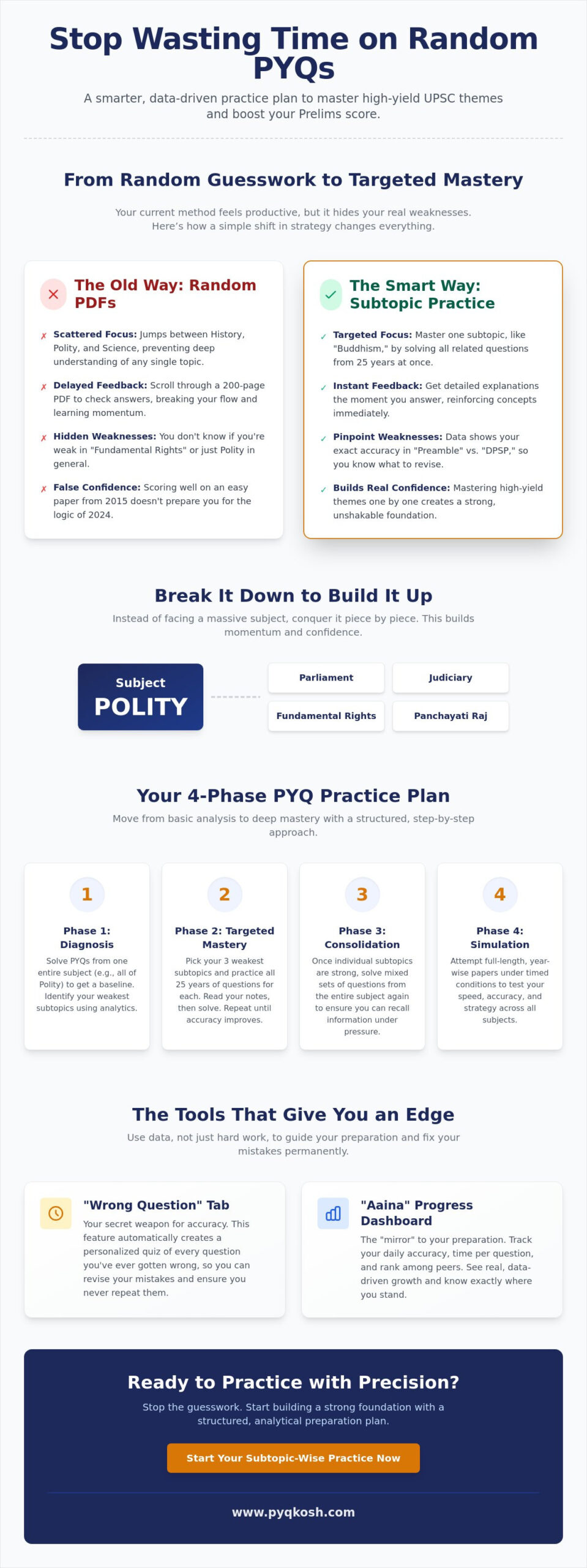
- Stop wasting time on random PDFs and year-wise papers that hide your real weaknesses.
- Learn how to break down massive subjects like Polity into tiny subtopics to master high-yield themes effectively.
- Build a 4-phase upsc prelims pyq practice plan that moves you from basic diagnosis to deep-dive mastery of every subject.
- Use the “Wrong Question” tab to automatically track your blunders and ensure you never repeat the same mistake twice.
- Monitor your daily accuracy and peer rank through the Aaina dashboard to see real, data-driven growth in your preparation.
Why Your Current UPSC Prelims PYQ Practice Plan Might Fail
Most aspirants start their preparation by downloading a “25 Years Solved Papers” PDF from a random Telegram channel. It feels like a win, but it’s usually the start of a failing strategy. Your upsc prelims pyq practice plan shouldn’t just be about “finishing” papers like a task. It should be about mastering the logic and the recurring themes that the commission loves to test.
When you solve year-wise papers, you jump from History to Science to Polity in a matter of minutes. This makes you feel busy, but it doesn’t help you spot the subtle “trap” patterns. To truly clear the Civil Services Examination (CSE), you need to see how a single theme like “Panchayati Raj” has evolved over two decades. Solving 2015 then 2016 is like reading a story out of order; you miss the connection.
The Danger of Random Paper Solving
Solving random papers creates a false sense of security. You might score 110 in a 2017 paper because you remembered some answers from a mock test, but you’ll fail the 2023 logic. Your brain fails to connect dots when information is scattered. For example, if you solve a “Money Bill” question from 2015 today and another from 2021 next week, you’ll miss the shift in how the Speaker’s power is questioned. Let’s be honest, yaar, random solving is just “guessing” with extra steps.
Static PDFs vs. Interactive Subtopic Practice
Static PDFs are where dreams go to die. You solve ten questions, scroll to the end of a 200-page file to check the key, and lose your focus immediately. This passive reading is a huge time-killer. You need instant feedback to build that “exam-hall” muscle memory. If you don’t know why an option is wrong the moment you mark it, you’re not learning; you’re just reading.
A smart upsc prelims pyq practice plan uses data to show you the mirror. Instead of the “PDF trap,” you need a structured, analytical exam preparation. Transitioning to active solving means you get an in-depth explanation the moment you click an answer. Tools like PYQKosh help you move away from this chaos. By using topic-wise practice, you can finish all “Fundamental Rights” questions from the last 25 years in one sitting. This builds a conceptual flow that no random PDF can offer. You start seeing the “booster tips” and “confusion points” that actually save marks on D-day.
The Subtopic-Wise Strategy: A Smarter Way to Revise
Most aspirants think they’ve “finished” History because they read a textbook once. But UPSC doesn’t ask generic “History” questions; it asks about specific themes like Buddhism or Tribal Revolts. This is where a broad upsc prelims pyq practice plan often fails. You need to go deeper to see the real patterns.
Subtopic-wise practice is the most efficient way to utilize 25 years of data by dissecting broad subjects into manageable units like Parliament, Judiciary, or Local Bodies. It’s the secret “jugaad” that helps toppers finish the syllabus 2x faster. They aren’t wasting time on low-yield fluff; they’re mastering the exact areas that carry the most weight.
Finishing “Parliament” in two hours gives you a massive dopamine hit. It’s a micro-win that keeps you motivated. Compare that to feeling overwhelmed by a 500-page subject. When you break it down, you gain a sense of control that random paper solving can never give you.
Identifying High-Yield UPSC Themes
UPSC is obsessed with specific areas. If you look at UPSC’s official Annual Report, you’ll see how the exam’s complexity has shifted over the years. Subtopic counts show you exactly where that focus lies today. For instance, in Environment, the commission repeats themes around international conventions almost every year.
By focusing on these “Evergreen” topics rather than one-off random facts, you can predict nearly 60-70% of the paper’s core themes. You don’t need to know everything. You just need to know what the examiner loves to ask. This targeted approach ensures your energy goes where the marks are.
Building Subject-Specific Confidence
Take Geography as an example. It’s huge and often scary. But if you master “Indian Rivers” and “Mapping” as separate subtopics, the subject suddenly feels manageable. This approach makes UPSC CSE prep feel like a series of small, winnable battles rather than a mountain you can’t climb.
When you use subtopic-wise analytics, you stop lying to yourself. You can see your accuracy in “Preamble” vs “Fundamental Rights” with total clarity. If you want to see where you actually stand, try checking your topic-wise progress today to find your real weak zones. It’s better to face the truth now than in the exam hall, yaar.
Your 4-Phase UPSC Prelims PYQ Practice Plan for 2026
You can’t just wing the 2026 Prelims by solving random papers. With the exam set for May 24, 2026, you need a system that tracks every single mark. A solid upsc prelims pyq practice plan moves you from guessing to knowing. It’s about building a data-backed routine that identifies your weak zones before the examiner does.
This plan isn’t about working harder; it’s about working smarter. We break your preparation into four clear phases. Each phase uses specific tools to ensure you aren’t just “reading” but actually “mastering” the syllabus. Let’s get started, yaar.
Phase 1 & 2: Building the Foundation
Start with the Diagnostic Phase. Pick your strongest subject and solve the last 10 years of PYQs. But here is the catch: solve them using topic-wise practice. If you are doing Polity, finish every question on “Fundamental Rights” in one go. This helps you see the recurring logic UPSC uses to frame options.
Move into the Deep-Dive Phase by spending 70% of your time on your mistakes. Most aspirants ignore their blunders, but you won’t. Use the “Wrong Question” tab in PYQKosh to revisit every question you missed. It automatically stores your mistakes so you can sort them by frequency. If you’ve missed a “Money Bill” question three times, that’s your signal to stop and re-read the chapter.
You should also integrate current affairs here. When a specific topic like “Governor’s Powers” is in the news, jump into that subtopic’s PYQs immediately. This connects static knowledge with dynamic trends, making your revision twice as effective.
Phase 3 & 4: Mastering the Exam Mindset
Phase 3 is the Test Mode Transition. Stop using “Practice Mode” where you see answers immediately. Switch to “Test Mode” to simulate the 2-hour pressure. This builds the “exam-hall” muscle memory needed to handle tricky 50-50 questions. You need to know how it feels to manage time when the clock is ticking.
Finally, use the Aaina review phase for final polishing. Check your “Aaina” progress dashboard every night before bed. It shows your daily practice streaks and subject-wise accuracy. If your accuracy in “Ancient History” is dipping, the data will tell you exactly where to focus tomorrow. Plus, keep an eye on your peer rank. Knowing you are in the top 10% of aspirants practicing on PYQKosh gives you the confidence to face the actual paper. Start your first diagnostic test today to see where you really stand.
The “Wrong Question” Tab: Your Secret Weapon for Accuracy
Ever noticed you get the same “Local Bodies” or “Buddhism” question wrong every single time? It’s the silent killer of your UPSC dreams. Most aspirants repeat mistakes simply because they don’t have a system to track them.
A generic upsc prelims pyq practice plan often ignores the data behind your failures. You solve 100 questions, see the score, and move on. That’s a recipe for disaster. You need to know exactly why you failed to hit the mark.
The “Wrong Question” tab is your automated mistake diary. It automatically stores every blunder you make across different subjects. No more manually writing down mistakes in a spiral notebook at 11 PM, yaar. It’s all in one place.
You can sort these mistakes by frequency. If you’ve missed a specific theme three times, you’ve found your real “weak zone.” This helps you build a customized revision list that targets your actual gaps instead of general topics.
Analyzing Why You Got It Wrong
Was it a conceptual error or just a silly mistake? You need to know the difference. Use the in-depth explanations to understand the “Confusion Points” that UPSC loves to hide in its options. These details often save you from traps.
These explanations cover both right and wrong answers. Use the bookmark feature to save these “Booster Tips” for the last week of your prep. It’s the fastest way to polish your accuracy without re-reading entire textbooks again.
The 24-Hour Revision Rule
Revisit your “Wrong Question” tab within 24 hours of a test. This simple habit moves the logic from your short-term to long-term memory. Make this a non-negotiable part of your upsc prelims pyq practice plan to ensure you are actually improving.
Check out our pricing to see how this feature fits your budget. It’s a small investment to stop the cycle of repeating the same blunders every year. You deserve a plan that works as hard as you do.
Start tracking your mistakes now to see your accuracy climb before the 2026 Prelims. Stop guessing and start mastering the themes that matter.
Executing Your Plan with PYQKosh: From Chaos to Clarity
You have the strategy. You have the phases. Now you just need the right tool to bring your upsc prelims pyq practice plan to life. Stop jumping between five different apps and ten Telegram channels just to find quality questions.
Preparation should feel organized, not like a second job. PYQKosh centralizes everything. Whether you are focusing on UPSC or also keeping an eye on other goals, you can manage it all from one dashboard. It is designed to replace your disorganized folders with structured, analytical exam preparation.
This platform works because it was “Made with ❤️ by an Aspirant.” We know exactly where the frustration lies. We know how it feels to solve a paper and still not know if you are actually improving. That is why every feature focuses on giving you clarity instead of just more content.
Centralizing Your Preparation
The “Aaina” dashboard is the heart of your progress. It shows you exactly how many questions you’ve practiced and your accuracy at both the subject and subtopic levels. You can see your daily streaks and peer rank, which keeps you moving even on days when you feel like quitting.
If you are a multi-exam aspirant, the “Exam Selection” feature is a lifesaver. You can toggle between UPSC, SSC, and Railways without losing your data. For those looking at other opportunities, check out our SSC exam strategy to see how to balance different goals effectively.
Use “Practice Mode” when you are learning a new subtopic. It gives you in-depth explanations immediately. When you feel ready, switch to “Test Mode” to evaluate your speed and accuracy under pressure. This dual approach is the core of a successful upsc prelims pyq practice plan.
Getting Started Today
Don’t wait for the “perfect” Monday to start. Set a simple daily target: 50 questions a day. This habit keeps you ahead of 90% of the competition who only start practicing in the last two months. Consistency is the only way to build real exam-hall confidence.
You can sort topics by question count or recency. If you want to see the latest trends, sort by 2025-26 questions first. This ensures you are always aligned with the current mindset of the commission. It is time to move from random effort to targeted action.
Remember yaar, topper banne ka shortcut mehnat hai, par “smart” mehnat! Use the data to find your weak spots, fix them using topic-wise practice, and watch your accuracy climb. Your journey from chaos to clarity starts with a single subtopic.
Go to PYQKosh and start your first subtopic test today.
Master the 2026 Prelims with Data, Not Guesswork
Clearing the cutoff isn’t about how many books you read. It’s about how many “trap” patterns you recognize before the examiner sets them. By shifting to a subtopic-wise upsc prelims pyq practice plan, you turn 25 years of chaos into a clear roadmap. You’ve learned how to break down subjects, track your blunders in the Wrong Question tab, and use the Aaina dashboard to see real growth every night.
With over 100,000 questions across exams and detailed explanations for every option, you’ll never have to guess why you got an answer wrong. You have the tools to move from a confused aspirant to a confident candidate. Don’t let another attempt slip away due to disorganized prep, yaar. The 2026 exam is waiting, and your structured journey starts right now.
Stop wasting time and start your subtopic-wise UPSC practice on PYQKosh today!
Frequently Asked Questions
Is a UPSC prelims pyq practice plan really necessary for 2026?
Yes, a upsc prelims pyq practice plan is essential because UPSC repeats themes, not just questions. It helps you move away from random PDF solving and gives you a structured way to track your daily progress. Without it, you’ll likely repeat the same mistakes that thousands of others make every year.
How many years of PYQs should I include in my UPSC practice plan?
You should ideally cover 25 years of papers for static subjects like Polity, History, and Geography. The core themes in these areas remain consistent over decades. For dynamic subjects like Science and Tech or Economy, focus more on the last 10 years to understand the modern shift in the commission’s mindset.
Can I rely only on PYQs to clear UPSC Prelims?
No, PYQs are your guide, not the entire syllabus. While they help you predict many core themes, you still need your standard textbooks for the base. Think of PYQs as the topper banne ka shortcut to knowing exactly what to read and what to skip in those heavy books, yaar.
How is subtopic-wise practice better than year-wise paper solving?
Subtopic-wise practice is better because it builds deep mastery of specific themes. When you solve all “Preamble” questions from 25 years at once, you see the pattern. Year-wise solving is too scattered. It’s hard for your brain to connect a 2015 question with a 2021 one when they are days apart.
What is the “Aaina” dashboard in PYQKosh and how does it help?
The Aaina dashboard is a progress tracker that shows your accuracy and daily practice streaks. It helps you see your subject-wise and subtopic-wise performance breakdown using real data. By seeing your peer rank, you stay motivated and know exactly how much more effort you need to put in to clear the cutoff.
How do I handle “Wrong Questions” during my UPSC revision?
Don’t just read the right answer and move on. Use the “Wrong Question” tab to revisit your mistakes within 24 hours. Sorting them by frequency helps you identify “silent killer” topics that are consistently dragging your score down. This targeted revision is the best way to ensure high accuracy on exam day.
Is it possible to practice for SSC and UPSC together on one platform?
You can easily manage both using the Exam Selection feature. It centralizes your preparation for UPSC, SSC, and even Railways on one dashboard. This prevents you from wasting time jumping between different apps and keeps all your subtopic-wise progress data in one single place for better analysis.
How much time should I spend daily on PYQ practice?
Spending 60 to 90 minutes daily is enough if you are consistent. Try to solve at least 50 questions every day as part of your upsc prelims pyq practice plan. This builds the necessary muscle memory and ensures you aren’t overwhelmed during the final months before the May 24, 2026 exam.