
Article by
Aaisha
A passionate content writer at PYQKosh focused on simplifying Current Affairs and PYQs for competitive exam aspirants. I love turning complex topics into easy, student-friendly content that helps learners prepare smarter and stay consistent in their exam journey.
What if I told you that solving 10 years of upsc pyq papers randomly is actually a waste of your time? It sounds harsh, but it is the truth most mentors won’t tell you.
You probably spend hours scrolling through massive 100-page PDFs. You solve a question, check the answer, and move on. Yet, when the next mock test comes, you make the same silly mistakes. It feels like you are running on a treadmill and going nowhere.
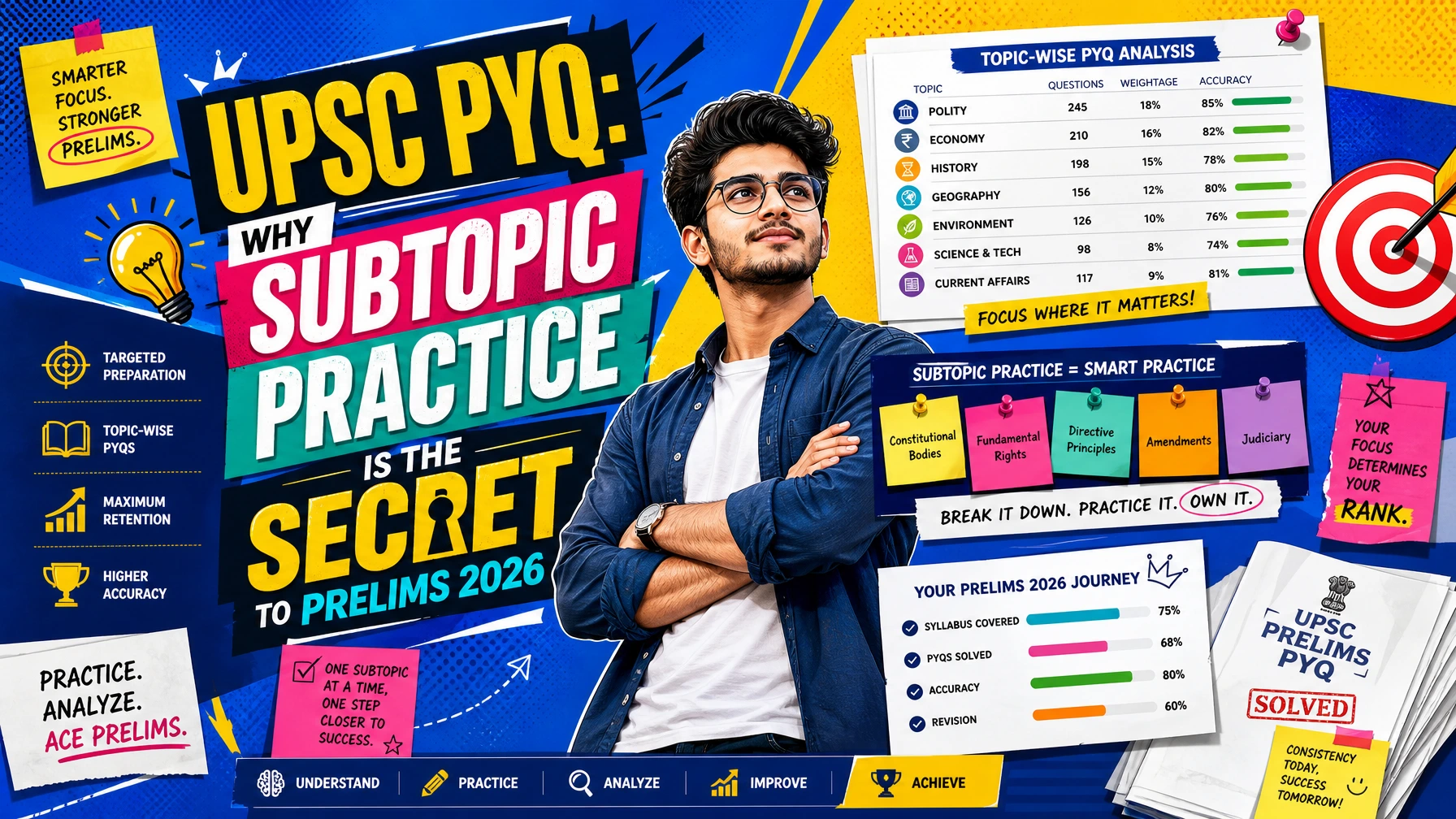
The secret to clearing Prelims 2026 isn’t just doing more questions. It is about decoding the exam DNA through structured subtopic practice. You need to know exactly which themes repeat and where your logic fails.
In this article, you will learn how to stop wasting time on random practice. I will show you a better way to track your weak areas automatically and identify high-yield topics. Let’s turn that confusion into the confidence you need to clear the cutoff.
Key Takeaways
- Stop reading PDFs like a novel and treat the upsc pyq as your actual syllabus map to avoid the passive learning trap.
- Focus on subtopic-level practice to master high-yield themes like the Preamble or Fundamental Rights instead of getting lost in broad subjects.
- Follow the Note-Solve-Analyze loop to fill knowledge gaps immediately using detailed explanations and exam booster tips.
- Switch from clunky static files to mobile-friendly structured practice that lets you track your accuracy and progress on the go.
- Use the Aaina dashboard and the Wrong Question Tab to monitor your peer rank and ensure you never repeat the same mistake twice.
The UPSC PYQ Trap: Why Just Reading Papers is Not Enough
You have probably downloaded dozens of PDFs from official websites. You sit down, scroll through 100 questions, and think you are preparing. But let’s be real, yaar. Just reading a question and its answer key won’t get you through the UPSC Civil Services Examination.
The upsc pyq is more than just a list of old questions. It is the only official syllabus guide you have. While the notification syllabus is vague, the papers show you exactly what the examiner wants. Most aspirants fall into the “Passive Reading” trap, scrolling through files on their phones at 11 PM. They think they’ve covered “History,” but they’ve only looked at pages. This is the topper banne ka shortcut that leads straight to failure.
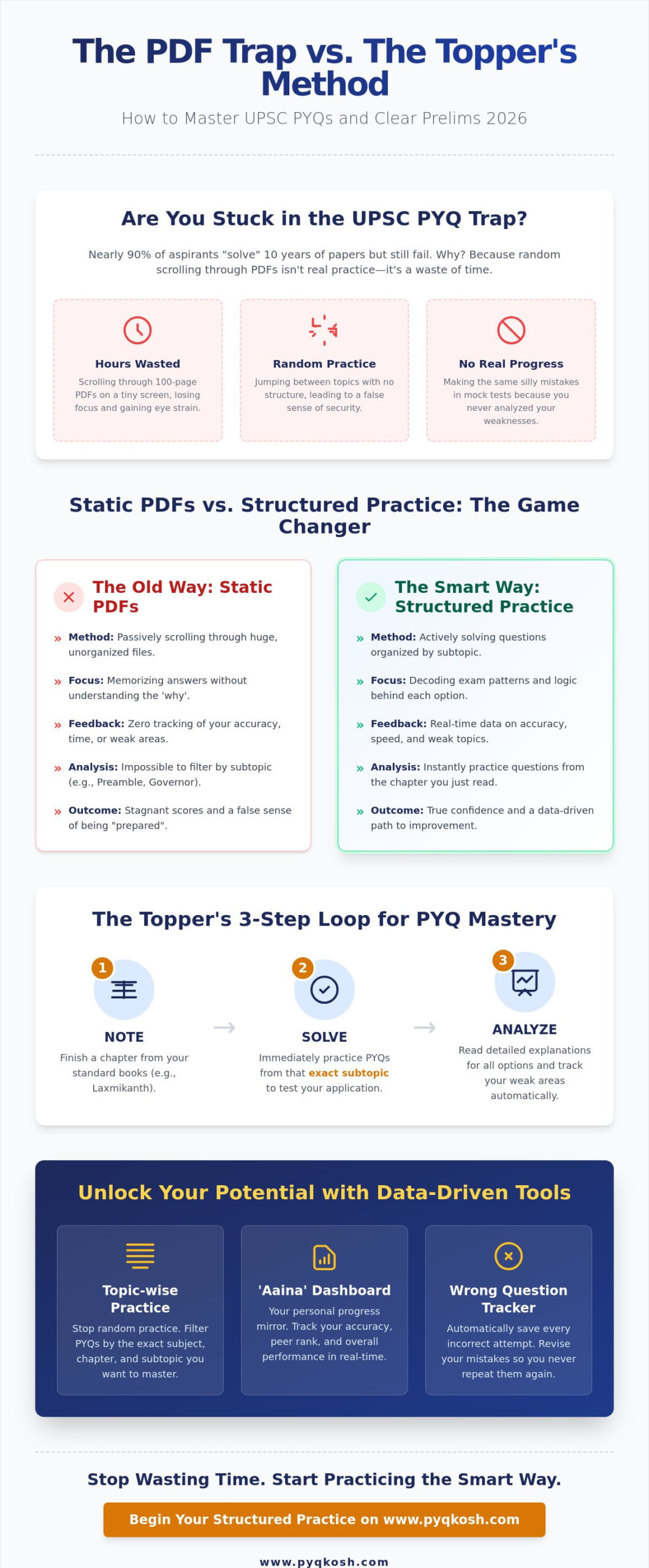
Nearly 90% of aspirants fail despite “solving” 10 years of papers. Why? Because they focus on the answer, not the logic. If you don’t know why the other three options are wrong, you haven’t solved the question. You’ve just memorized a fact that might never repeat in the same way.
The Problem with Static PDFs
Scrolling through a 100-page PDF on a small mobile screen is a nightmare for your brain. Your eyes hurt, and your focus breaks after the tenth page. You can’t filter questions by the topic you just studied, like “Preamble” or “Governor.” This makes your practice feel random and disorganized.
Random practice gives you a false sense of security. You feel like you’ve “seen” the questions, but you haven’t mastered the core concepts. When a similar theme appears in 2026 with a slight twist, you will likely freeze because you lacked structured analysis. Static files don’t allow you to track your mistakes or see your accuracy in real-time.
UPSC is Not About Memory, It is About Patterns
UPSC rarely repeats a question word-for-word. Instead, they repeat themes and patterns. If they asked about “Right to Privacy” in 2017, they might ask about “Data Protection” or “Article 21” in 2026. Decoding the “DNA” of a question helps you eliminate wrong options even when you aren’t 100% sure of the answer.
Actionable Tip: After finishing a chapter in your standard books, don’t move on immediately. Filter that specific subtopic’s questions on PYQKosh to see if you can actually apply what you read. The upsc pyq is your personalized blueprint for 2026 success, not just a memory test.
Decoding the UPSC DNA: What Toppers Look for in Every Question
Ever wondered why some people clear Prelims with just three months of prep while others struggle for years? The secret isn’t in how many books they read. It’s in how they look at an upsc pyq. A beginner sees a question about “Polity,” but a topper sees a specific subtopic like “Preamble” or “Judicial Review.”
Studying broad subjects is a recipe for overwhelm. You can’t master “History” in a week, but you can master “Bhakti Movement” in two hours. Toppers identify high-yield areas that UPSC loves. For example, themes like Buddhism, Jainism, and National Parks appear almost every year. If you focus your energy here, you’re already ahead of the crowd.
You must also learn to spot examiner traps. Watch out for extreme words like “Only,” “All,” or “Always.” These are often red flags. When you analyze a question, don’t just look for the right answer. Read the explanations for every single option. Often, a wrong option in 2024 becomes the main question in 2026. This is how you decode the exam’s DNA.
Focus on Subtopic-Wise Weightage
If you have limited time, you must prioritize. Modern History usually carries more weight than Ancient History. Using topic-wise practice helps you see exactly which areas need more “revision ka tadka.” It shows you where your accuracy is low so you can fix it before the actual exam.
The real topper banne ka shortcut is knowing what to skip. You don’t need to be an expert in everything. You just need to be a master of the topics that UPSC actually asks. Structured practice lets you see these patterns clearly, moving you away from random guessing toward calculated precision.
The Art of Option Elimination
The Prelims 2026 exam won’t just test your memory; it will test your “examiner mindset.” By solving an upsc pyq subtopic-wise, you start to see how traps are built. You’ll notice how one option is always “too good to be true” while another is a subtle distractor.
Use data-driven insights to understand common pitfalls. Instead of just “guessing,” you’ll start eliminating options based on logic and past trends. This shift from random effort to targeted action is what builds true confidence. If you want to start analyzing like a pro, you can explore structured practice tools that organize these questions for you.
- Track which subtopics have the highest question count.
- Analyze why you fell for a specific trap in a “Wrong Question.”
- Compare your accuracy with peers to stay competitive.
Static PDFs vs. Structured Practice: Which One Wins for Prelims 2026?
Let’s be honest, yaar. That 200-page upsc pyq PDF sitting in your “Study Material” folder is probably never going to be finished. Static PDFs are where motivation goes to die. They are clunky, hard to navigate on a phone, and they don’t give you any feedback. You just scroll, read, and forget.
The smart aspirant for 2026 has moved past the old-school PDF method. Structured, analytical exam preparation is the only way to stay ahead. Instead of a never-ending file, you need a system that breaks the syllabus into bite-sized subtopics. Seeing a progress bar move from 10% to 90% gives you a psychological win that a static document never can. It turns a boring task into a mission.
Random guessing during practice is a trap. When you use a structured platform, you stop “feeling” ready and start “knowing” you are ready. Data doesn’t lie. If your accuracy in “Fundamental Rights” is 85%, you can breathe easy. If it’s 40%, you know exactly where to put in more effort.
The Mobile-First Advantage
Most Hindi-medium aspirants don’t have the luxury of sitting at a library desk for 12 hours straight. You might be studying while traveling, during a job break, or late at night in your room. A clean, mobile-friendly interface reduces that 11 PM exam anxiety. You can finish a quick 10-question set on your phone while waiting for your tea to boil.
Short, punchy practice sessions are scientifically better for retention than marathon reading. If you want a clear path, check out this UPSC PYQ Prelims roadmap for 2026. It helps you stay focused on what actually matters without getting lost in the “PDF jungle.”
Tracking Your Mistakes Automatically
Manually marking wrong answers on a physical paper is a waste of your precious time. By the time you finish the paper, you’ve forgotten why you chose option B over option C. The “Wrong Question Tab” is a total game-changer. It automatically stores every mistake you make, so you can review them in seconds.
Seeing your “Daily Streak” keeps your motivation high, even on days when you feel like quitting. It’s about building a habit. When you see that you’ve practiced for 15 days straight, you won’t want to break that chain. This data-driven tracking replaces vague “preparation” with real, measurable progress. You stop repeating the same errors because the system keeps them right in front of you until you master them.
- Switch from “scrolling” to “solving” to improve active recall.
- Use the “Aaina” dashboard to see your peer rank in real-time.
- Focus on your “Wrong Question Tab” every Sunday for a quick revision.
The 3-Step Strategy to Master UPSC PYQs Without Overwhelm
Feeling overwhelmed is normal, yaar. When you look at the upsc pyq as one giant mountain of papers, it’s scary. But if you break it into small pebbles, it becomes easy. This strategy is about creating a feedback loop that makes your preparation bulletproof and your revision effortless.
Step 1: Topic-to-Practice Synergy
Most aspirants make the mistake of finishing an entire subject before touching old papers. Don’t do that. If you finished the “Governor” chapter today, solve its specific questions today. This immediate application stops the “Syllabus is too big” panic because you’re winning small battles every single day.
It helps you see if you actually understood the chapter or just read the words. This method builds your confidence bit by bit. To stay ahead of the game, you can use this UPSC PYQ analysis tool to see which subtopics are trending before you even start reading your heavy textbooks.
Step 2: Deep Dive into Explanations
Getting a question right is good, but understanding the logic is better. The real gold is in the explanations. You need to know why the other three options were there in the first place. Often, UPSC picks a wrong option from an old paper and makes it the main question the next year. This is the ultimate topper banne ka shortcut.
Use “Exam Booster Tips” to find these hidden connections. These tips often contain those “extra” facts that your standard books might miss. Treat every wrong answer as a lesson in disguise. It’s much better to make a mistake on your phone now than in the exam hall in 2026. Your notes should constantly evolve based on these explanations.
Step 3: The 7-Day Revision Rule
Don’t let your mistakes vanish into thin air. Re-solve your “Wrong Questions” exactly one week later. Your brain needs time to process logic. If you solve a mistake immediately, you’re just using short-term memory. If you solve it after seven days and get it right, you’ve truly mastered the concept.
This 3-step loop creates a “Success Cycle” that keeps you moving forward without stress:
- Finish a specific subtopic in your notes or book.
- Solve 10 to 15 relevant questions immediately on your phone.
- Analyze every explanation to fill your knowledge gaps.
- Re-solve your mistakes after 7 days to ensure long-term retention.
This method builds the “Exam Temperament” required for the 2026 attempt. You will learn to stay calm even when a question looks unfamiliar because you’ve practiced the art of logical elimination. Start your structured practice now and build your daily streak.
Master the Prelims with PYQKosh: Your Personal Practice Partner
You have spent months reading heavy books and making detailed notes. But when you sit down to solve an upsc pyq, do you still feel that sudden pang of doubt? Most aspirants lose their confidence because they don’t have a way to measure their growth. You need a partner that turns your hard work into a clear, winning strategy.
PYQKosh is built to be that smart mentor for you. We have organized over 100,000 questions into a subtopic-wise structure. This means you don’t have to hunt through messy folders to find what you need. Whether you want to master the “Bhakti Movement” or “Climate Change,” everything is just one tap away on your mobile screen.
You can choose between “Practice Mode” to learn at your own pace with in-depth explanations or “Test Mode” to build your speed. This flexibility helps you transition from a student who knows the facts to a candidate who can handle the pressure of the exam hall. It is about working smarter, not just harder, yaar.
Aaina: Your Progress Mirror
The “Aaina” progress dashboard is a total game-changer for your discipline. It doesn’t just show you numbers; it shows you the truth about your preparation. You can see your accuracy at a subtopic level, your daily practice streaks, and even your peer rank in real-time. This data-driven approach removes the guesswork from your study plan.
Watching your weekly graph go up is the best motivation you can get. It keeps you grounded and focused on your weak areas. If your accuracy in “Polity” is high but “Economy” is lagging, Aaina tells you exactly where to put your “revision ka tadka.” It turns your daily practice into a disciplined habit that leads straight to success.
Everything in One Place
Why jump between different apps and websites? From UPSC CSE to CAPF and CDS, you can practice across multiple exams on one platform. This multi-exam support ensures you are ready for any challenge the commission throws at you in 2026.
The Wrong Question Tab automatically stores every mistake you make so you can fix them later. Use the Bookmark tab to save the toughest questions for the final 10 days before Prelims. This centralization saves you hours of time and keeps your mind uncluttered. Stop wasting time on random effort and start your journey toward the cutoff today.
Go ahead and start your daily practice streak right now.
Build Your Success Strategy for Prelims 2026
Transitioning from random effort to targeted, strategic action is the only way to beat the competition. You now understand why static PDFs are a trap and how decoding the upsc pyq through subtopic practice gives you an unfair advantage. It’s time to stop guessing and start measuring your progress with precision.
Consistency is your biggest strength. By focusing on high-yield themes and analyzing every explanation, you turn your preparation into a success cycle. Don’t let your hard work go to waste by repeating the same mistakes in the final exam hall. You need a system that keeps you disciplined and highlights your weak areas before they become a problem.
With over 100,000 questions, the Aaina progress dashboard, and an automatic wrong question tracker, you have everything you need in one place. Start your subtopic-wise UPSC practice on PYQKosh today! You have the roadmap and the tools to succeed, so keep pushing forward. Your dream of clearing the cutoff is well within reach.
Frequently Asked Questions
How many years of UPSC PYQs should I solve for Prelims 2026?
You should aim for at least 10 to 15 years of the upsc pyq. While the last 10 years give you the most relevant trends for Prelims 2026, older questions are gold for static subjects like History and Geography. Solving these helps you understand how the examiner’s mindset has evolved over time.
Don’t just solve them randomly; analyze them subtopic-wise to see which areas are evergreen. This helps you prioritize your revision and focus on themes that UPSC loves to repeat.
Is it enough to only solve UPSC PYQs to clear the Prelims?
No, solving the upsc pyq is the foundation, but it isn’t the whole building. You still need your standard NCERTs and reference books for theory and current affairs for the dynamic portions. Use PYQs to learn how to apply that theory and to identify which parts of the news are actually important for the exam.
Think of PYQs as your compass. They show you the direction, but you still have to do the walking by reading your core subjects. It’s about combining your knowledge with the right exam temperament.
How can I practice UPSC PYQs subtopic-wise for free?
You can find many year-wise PDFs online for free, but they are a nightmare to organize. Scrolling through 100-page files on your phone wastes too much time. The best way to practice subtopic-wise is by using a structured tool like PYQKosh.
It saves you from the “PDF jungle” and lets you jump straight into the topics you just finished reading in your notes. This way, you spend more time solving and less time searching, which is the real topper banne ka shortcut.
Why does UPSC repeat themes instead of direct questions?
UPSC repeats themes because it wants to test your conceptual clarity, not just your memory. If they asked about the “Preamble” last year, they might ask about “Sovereignty” or “Republic” this year. They want to see if you actually understand the depth of the topic.
By repeating themes, they ensure that only candidates who have deeply understood the core syllabus make it through. Decoding the DNA of these themes helps you eliminate wrong options even in new questions.
Can I use UPSC PYQs for CSAT preparation as well?
Yes, you definitely should. CSAT has become a major hurdle recently, and practicing past papers is the only way to get comfortable with the difficulty level. It helps you time your Comprehension and Logical Reasoning sets properly so you don’t panic on exam day.
Don’t leave it for the last month, yaar. Solve a few questions every weekend to stay in touch with the patterns. It builds the confidence you need to clear the qualifying marks without stress.
What is the best way to track my performance in PYQs?
The most efficient way is using a data-driven dashboard like Aaina. It automatically tracks your accuracy and peer rank, replacing vague feelings with hard data. You can see exactly which subtopics are pulling your score down and need more “revision ka tadka.”
This structured, analytical exam preparation helps you focus your energy on fixing weaknesses rather than repeating what you already know. It turns your daily practice into a measurable habit that leads to the cutoff.
How often should I re-solve my wrong questions?
You should follow the 7-day rule for the best results. Re-solve your mistakes exactly one week after you first made them. This ensures that you’ve actually learned the logic and aren’t just remembering the answer from short-term memory.
Use the Wrong Question Tab to keep these filtered and ready for your Sunday revision sessions. Mastering your past mistakes is the fastest way to improve your accuracy and stop repeating the same errors in mock tests.
Are old UPSC questions (from the 90s) still relevant today?
They are still very relevant for the static portions of the syllabus. Topics like the Indian National Movement, Map-pointing, and basic Economics concepts don’t change much. UPSC often picks up core themes from the 90s and presents them with a modern twist.
Solving them gives you a deeper pool of practice and builds extra confidence. It helps you realize that the core DNA of the exam remains the same, even if the language of the questions becomes more complex.