
Article by
Aaisha
A passionate content writer at PYQKosh focused on simplifying Current Affairs and PYQs for competitive exam aspirants. I love turning complex topics into easy, student-friendly content that helps learners prepare smarter and stay consistent in their exam journey.
Spending three weeks memorizing every minor king in Ancient History might feel productive, but it's often the quickest way to miss the May 24, 2026 cutoff. It's frustrating to realize you've spent days on a topic that might only see one or two questions on exam day. Most aspirants struggle with massive information overload, constantly worrying they're ignoring the high-yield subjects that actually decide their rank.
We've all felt that crushing anxiety while staring at a mountain of books and wondering where to start. Understanding the upsc prelims subject wise weightage is the only way to replace that confusion with a clear, data-driven plan. It's the secret to moving away from random effort and toward the targeted, strategic action that toppers use to stay ahead of the curve.
This guide will show you exactly which subjects carry the most marks and how to prioritize your limited study hours. You'll get a breakdown of the core subjects like Polity and Economy that dominate the paper and a practical strategy to use this data for your daily practice. We'll show you how topic-wise practice and tracking your accuracy can turn your preparation into a winning strategy for 2026.
Key Takeaways
- Learn why random reading is a trap and how to prioritize subjects that actually appear on the paper to avoid information overload.
- Identify the high-yield "Core Four" subjects using the latest upsc prelims subject wise weightage to secure your cutoff with less effort.
- Discover why the "Dynamic Trio" of Environment, S&T, and Geography is the secret to scoring high in a current affairs-heavy exam.
- Stop guessing your progress and start using topic-wise practice to fix weak areas and track your daily improvement.
- Understand the silent impact of CSAT and Current Affairs to avoid the common mistakes that stop even the most hardworking aspirants.
UPSC Prelims Subject Wise Weightage: Why Random Study Fails
Let's be real, yaar. Most of us start our journey by buying the thickest books like Laxmikanth or Spectrum and reading them cover to cover. But if you don't know the upsc prelims subject wise weightage, you're basically shooting in the dark. UPSC isn't just a test of knowledge; it's an elimination game designed to filter out those who can't prioritize.
Randomly finishing chapters won't help if you're ignoring the trends. For example, if you spend three weeks on Ancient History but only two days on Environment, you're set for a heartbreak. Understanding the weightage tells you exactly where the "easy marks" are hiding. It helps you decide whether a topic needs a deep dive or just a quick scan.
The Civil Services Examination (CSE) is structured to test your decision making long before you become an officer. That starts with how you spend your study hours today. If you aren't using data to drive your schedule, you're just working hard without working smart.
The Reality of UPSC Prelims Subjects
Paper 1 (General Studies) is the only thing that decides your merit for the next stage. You can't afford to have a "Subject Bias" where you keep reading History because you love the stories while failing Economy because it feels tough. The 100 questions are distributed across seven major pillars, and each has its own personality.
- Polity and Economy usually provide a solid 25 to 30 questions.
- Environment and Geography are now huge due to the common prelims with Forest Services.
- History and Science & Tech can be unpredictable, so you need a backup plan.
You can see how you're doing in each of these pillars using the Aaina dashboard on PYQKosh. It shows your accuracy for each subject so you know exactly which "pillar" is leaning and needs more support.
Static vs Dynamic: The 2026 Shift
Static subjects like Polity and History provide your foundation. They don't change much, so they're your "safety net." However, dynamic subjects like Environment and Science & Technology are the real tie-breakers now. For 2026, the shift is moving toward questions that link static concepts to current events.
To hit that 100 plus score mark, you need a perfect balance. You can't just rely on textbooks anymore. You need to see how a news item from six months ago turns into a tricky question. Using topic-wise practice helps you bridge this gap. It lets you practice questions from specific subtopics so you can see the pattern of how static and dynamic info mix together.
Don't just read; analyze your progress. Check your wrong questions tracker daily to see if you're making the same mistakes in high-weightage areas. This is the only way to move from "random study" to a guaranteed selection strategy.
Core GS Subjects: The Pillars of Your Prelims Score
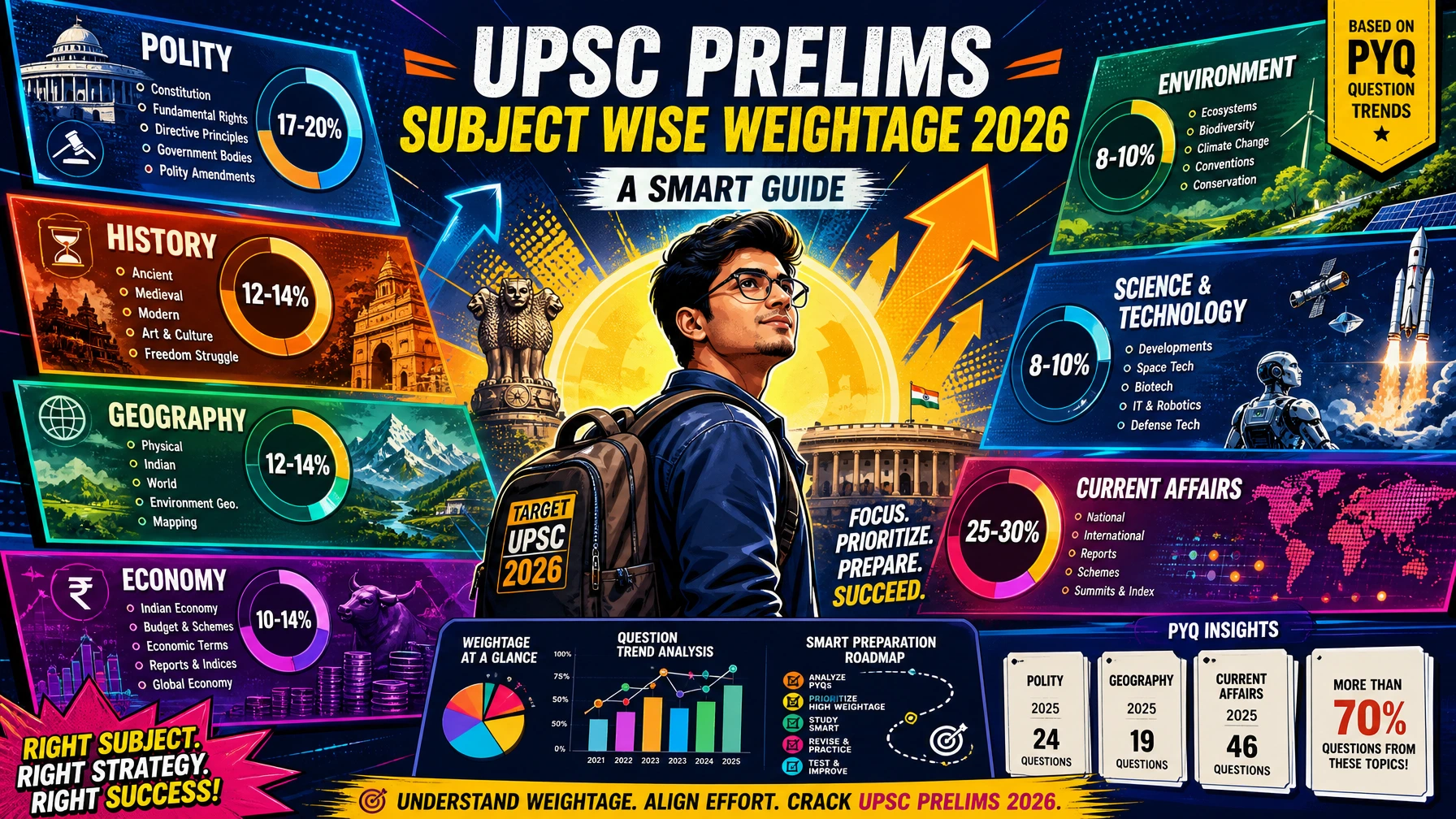
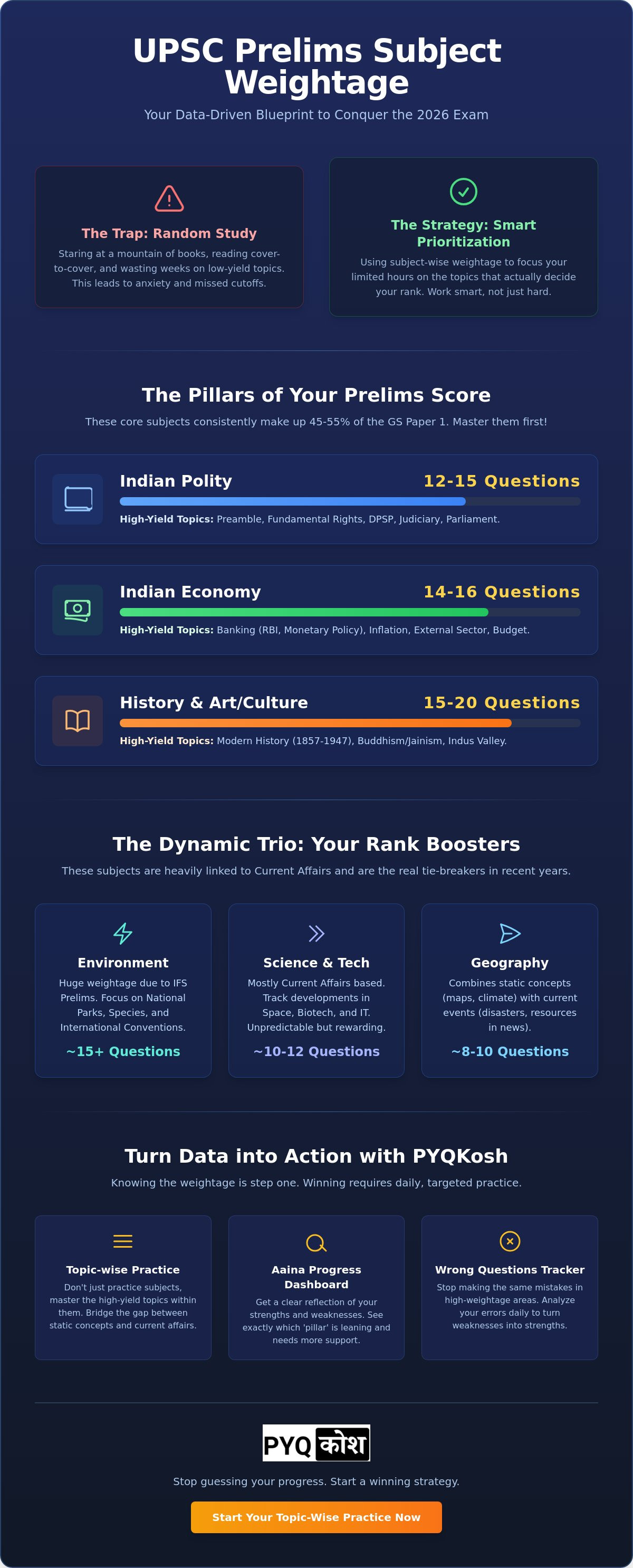
If you're feeling overwhelmed by the massive syllabus, focus on the "Core Three" first. Polity, Economy, and History usually cover 45-55% of the entire paper. This is where you build your score, yaar. A Data-driven PYQ analysis shows that these subjects are the most reliable pillars year after year. For 2026, we expect Indian Polity to carry 12-15 questions, while Indian Economy will likely hit 14-16 questions.
History remains the unpredictable giant of the group. It spans from Ancient and Medieval to Modern and Art & Culture. While it feels vast, understanding the upsc prelims subject wise weightage helps you see which parts actually pay off. You don't need to know everything. You just need to know what UPSC loves to ask.
Polity and Economy: The Scoring Duo
Polity and Economy are your best friends for clearing the cutoff. In Polity, don't just read the whole book. Master the Preamble, Fundamental Rights (FRs), DPSP, and the Judiciary first. These chapters are high-yield and appear almost every year. For Economy, focus heavily on conceptual clarity in Banking, Inflation, and the External Sector. These are absolute goldmines for marks.
The trick is to move beyond just reading. You should practice these upsc prelims subjects topic-wise to see the patterns. When you solve questions specifically on the Judiciary or Banking, you start to see how UPSC twists the same concepts in different ways. It's the fastest topper banne ka shortcut.
History: Modern vs the Rest
Modern History remains the most rewarding subtopic for any aspirant. It’s more structured and the sources are clear. However, don't get stuck only in dates and names. Focus on the administrative and social changes during the British era. UPSC has shifted its focus toward how the society and economy changed, rather than just who fought which battle.
Art & Culture is now merging with Ancient and Medieval trends. You'll notice questions that link a specific dynasty to its architectural style or social reforms. Use the Aaina dashboard to track your accuracy in History. If you're consistently getting Medieval questions wrong, it’s a sign to stop memorizing kings and start focusing on their administrative systems instead.
The Dynamic Trio: Environment, S&T, and Geography
These three subjects are where the real competition happens, yaar. While everyone studies Polity and Economy, many aspirants ignore the "Dynamic Trio" because they feel "tough" or unpredictable. But if you look at the upsc prelims subject wise weightage, you'll see these subjects actually decide the cutoff. Environment alone brings 15 to 18 questions because the prelims is common for the Indian Forest Service (IFoS).
Science and Technology adds another 8 to 12 questions, while Geography contributes 10 to 12. Most of these questions are no longer just from textbooks; they are linked to what’s happening in the news right now. If you master this trio, you aren't just struggling to pass; you're building a massive lead over the rest of the crowd.
Environment and Geography Overlap
The line between Environment and Geography is blurring every year. You must know your National Parks, Wetlands, and Biosphere Reserves inside out. UPSC isn't just asking for names anymore. They want to know which rivers flow through these parks or the specific type of vegetation found there. This overlap is where most students lose easy marks.
Mapping is your secret weapon here. You should practice locations that stay in the news daily, especially those related to climate change or international treaties. Check out this upsc prelims pyq practice plan for specific mapping tips that actually work on exam day. Don't just look at a map; understand why that place is relevant right now.
Science & Technology: Beyond the Basics
Stop wasting time on thick S&T textbooks that get outdated every month. UPSC loves asking about the "Applications" of new tech like AI, Space Tech, Biotech, and Defense. They want to know how these technologies change our lives, not just the technical definitions. If you see a new satellite launch or a breakthrough in gene editing, that's your potential question.
The best way to stay relevant is to track subtopics through upsc pyq analysis. This helps you understand the upsc prelims subject wise weightage at a deeper level. Use the wrong questions tracker on PYQKosh to see if you're failing in conceptual S&T questions or just missing the current affairs link. This structured, analytical exam preparation ensures you’re studying exactly what matters for 2026.
Focus on Space Tech, AI, and Biotech as these are current affair goldmines. UPSC often asks "Which of the following can be done using X technology?" to test your practical understanding. Use the Aaina dashboard to see if your accuracy in these dynamic areas is improving or if you need to change your source.
CSAT and Current Affairs: The Silent Cutoff Makers
You could score 120 in GS Paper 1 and still fail if you ignore CSAT. It's happening to toppers every year, yaar. The 33% qualifying mark sounds easy until you're facing tricky Quant and abstract Reading Comprehension. Don't let a qualifying paper be the reason you miss your 2026 Mains.
Then there's Current Affairs. It usually brings 15 to 20 direct questions. But the real impact is hidden. It changes the upsc prelims subject wise weightage of every other subject by making static topics dynamic. If a specific river or a new technology is in the news, its importance for your exam triples instantly.
Current Affairs: The Thread that Binds
International Relations (IR) weightage is growing fast. Focus on "Places in News" and global treaties. For Government Schemes, don't just look at the latest ones. Focus on schemes that have been in the news for over 12 months. UPSC loves asking about the ministry involved or the specific target group, so pay attention to the details.
Government schemes often follow a pattern. UPSC focuses on social sectors like Health, Education, and Agriculture. Instead of reading a 500-page compilation, look for themes. If a scheme is mentioned in the Economic Survey or Budget, it's a high-priority topic for your 2026 attempt.
You can use current affairs topics to link these news items with your static subjects. This way, you aren't just memorizing facts; you're understanding why they matter for your exam. It makes your preparation feel less like a chore and more like a strategy.
Solving the CSAT Fear
If your Math is weak, don't panic. Reading Comprehension and Logical Reasoning are your best bets. Identify high-yield subtopics in Logic like Syllogisms or Seating Arrangements. These are more predictable than complex Number System questions. You only need 66.67 marks, but don't take it lightly because the difficulty level is rising every year.
Leaving CSAT for the last month is a recipe for disaster. Start practicing at least 6 months early. Understanding the upsc prelims subject wise weightage for CSAT topics like Reading Comprehension is just as important as your GS prep. Look at the prelims upsc question paper trends to see how the pattern is shifting.
Use the wrong questions tracker on PYQKosh to see where you're losing marks in CSAT tests. It's better to fail 100 times in practice than once on May 24. Start your structured, analytical exam preparation today to stay ahead. Remember, CSAT is a test of temperament, so build your confidence through regular practice.
Mastering UPSC Prelims with Data-Driven PYQ Practice
Stop wasting your time on random mock tests that don't match the UPSC standard. Most mocks are either too easy or unnecessarily tough, which just messes with your confidence. If you want to clear the 2026 cutoff, Previous Year Questions (PYQs) are the only real deal, yaar.
By analyzing the upsc prelims subject wise weightage, you can see that UPSC has a specific "DNA" that random tests often miss. You need to align your brain with the actual examiner's mindset. The best way to do this is through topic-wise practice that lets you conquer one subject at a time.
Instead of guessing where you stand, use the Aaina dashboard to see your real-time progress. It shows you exactly where you are lagging and which subjects need more work. This structured, analytical exam preparation turns your hard work into a data-backed strategy for success.
Why Subtopic-Wise Beats PDF Practice
Static PDFs are fine for a quick look, but they are a nightmare to solve on a mobile screen at 11 PM. More importantly, solving a full 100-question paper doesn't tell you if you are weak in "Mughal Architecture" or just "History" in general. You need to be more surgical with your prep.
Subtopic practice is structured and analytical. It helps you identify the exact "pain points" in your knowledge. Read why the upsc subtopic-wise practice plan is the ultimate game changer for 2026. It lets you fix small gaps before they become big mistakes on exam day.
- Identify if you're struggling with concepts or just factual memory.
- Track your accuracy for every single subtopic like "Banking" or "Climate Change".
- Sort topics by question count to focus on high-yield areas first.
Using the Wrong Question Tracker
The biggest mistake aspirants make is solving a question, seeing the wrong answer, and then forgetting about it. On PYQKosh, the wrong questions tracker automatically stores every mistake you make. You don't have to manually maintain a "mistake notebook" anymore.
You can sort these mistakes by frequency to see which topics keep tripping you up. If you've made the same mistake in "Panchayati Raj" three times, it’s a clear sign you need to revisit the basics. Turn your mistakes into marks by revising this tab every Sunday morning.
This is the real topper banne ka shortcut. By fixing your weak spots at the subtopic level, you ensure that no question from the high-weightage areas catches you off guard. Master the upsc prelims subject wise weightage by making your practice as precise as the exam itself.
Start your daily practice on PYQKosh today and watch your accuracy climb.
Your Roadmap to the 2026 Prelims Cutoff
Success in UPSC isn't about reading everything under the sun, yaar. It's about being smart enough to know where to focus your energy. By mastering the upsc prelims subject wise weightage, you've already taken the first step toward a more organized and stress-free preparation.
The core subjects build your foundation, but the dynamic ones like Environment and S&T are what get you across the finish line. Don't let CSAT be an afterthought; start early and track your accuracy daily to avoid any last-minute panic.
Now, it's time to move from planning to action. Stop guessing your progress and start using structured data to guide your path. With over 100,000 subtopic-wise questions, the Aaina Progress Dashboard, and a dedicated Wrong Question Tracker for targeted revision, you have everything you need to succeed in one place.
Start your subtopic-wise UPSC practice on PYQKosh today!
Frequently Asked Questions
Which subject has the highest weightage in UPSC Prelims?
Indian Polity and Indian Economy are usually the most consistent high-yield subjects. However, the upsc prelims subject wise weightage shows that Current Affairs often touches over 20 questions directly or indirectly. Focus on these core pillars to build a safe score for 2026.
Is 1 year of current affairs enough for UPSC 2026?
While 12 months is the standard, 15 to 18 months of coverage is much safer for the 2026 attempt. Many questions now link current events to static concepts from over a year ago. Use the Aaina dashboard to track how well you're retaining these topics over time.
How many questions come from Indian Polity every year?
Indian Polity usually brings between 12 to 15 questions every year. It’s one of the most rewarding subjects because the syllabus is defined and questions are often direct. Master Fundamental Rights and the Parliament to secure these marks easily, yaar.
Can I skip Ancient and Medieval History for Prelims?
Skipping them entirely is risky because UPSC has increased their weightage recently. Instead of reading everything, focus on high-yield subtopics like Buddhism, Jainism, and Mughal administration. This is the real topper banne ka shortcut to save time without losing marks.
What is the weightage of Environment in UPSC Prelims?
Environment and Ecology is a massive pillar, usually carrying 15 to 18 questions. This high upsc prelims subject wise weightage is due to the common prelims exam for the Indian Forest Service. You can't clear the cutoff without a strong command over this subject.
Is CSAT becoming tougher in the recent UPSC trends?
Yes, CSAT has become significantly tougher over the last few years, especially the Quant section. Many aspirants fail despite scoring high in GS Paper 1. Start your CSAT practice at least 6 months before the exam to build the required speed and accuracy.
How many questions should I attempt to clear the UPSC cutoff?
Most toppers attempt between 80 to 90 questions to stay safe from negative marking. However, this depends on your personal accuracy levels. Use the wrong questions tracker to understand your mistakes and decide your own optimal attempt range during practice.
How to use subject weightage to create a study timetable?
Allocate more hours to subjects like Polity, Economy, and Environment that carry the most marks. Use the weightage data to decide which subjects get your morning "focus hours." This ensures you aren't wasting your best energy on low-yield topics that rarely appear.