

Article by
Aaisha
A passionate content writer at PYQKosh focused on simplifying Current Affairs and PYQs for competitive exam aspirants. I love turning complex topics into easy, student-friendly content that helps learners prepare smarter and stay consistent in their exam journey.
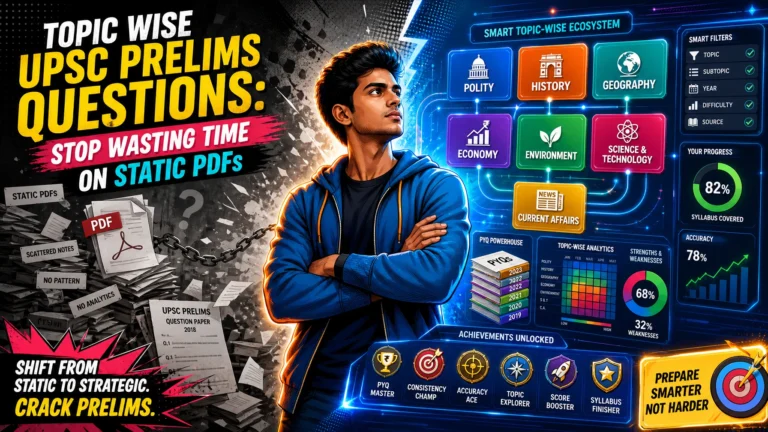
What if the hundreds of PDFs sitting in your Telegram folder are actually the reason you’re feeling stuck? It’s easy to collect every prelims upsc question paper from the last decade, but it’s much harder to actually learn from them.
I know the frustration of scrolling through endless pages and not knowing which topics are truly high-yield. You practice for hours, yet you keep making the same mistakes in every mock test you take.
This guide will show you how to stop hoarding files and start using a smart, subtopic-wise strategy to crack the code. I’ll help you move from disorganized chaos to a focused, data-backed plan for the 2026 exam.
We’ll walk through a clear method to finish your PYQs, identify your weak subtopics instantly, and build the accuracy you need for May 24, 2026. It’s time to work smarter, not harder.
Key Takeaways
- Ditch the PDF hoarding habit and move to active solving to make sure your hard work actually translates into marks.
- Identify high-yield themes in subjects like Polity and Economy where UPSC consistently repeats subtopics year after year.
- Learn why a subtopic-wise strategy for the prelims upsc question paper is the fastest way to find and fix your weak spots.
- Move beyond just finding the right answer by analyzing all four options to build the deep conceptual clarity toppers use.
- Switch to a structured, analytical exam preparation plan to stop wasting time on disorganized folders and scattered notes.
Why hoarding prelims upsc question paper PDFs won’t get you a rank
Yaar, let’s be honest. Your phone is probably screaming for storage because of those 500 PDFs you downloaded from Telegram. We’ve all been there, thinking that collecting material is the same as studying it.
Having every prelims upsc question paper from the last 20 years on your device doesn’t mean you’re prepared. It just means you’re a great collector. Rankers don’t hoard files; they solve them with a plan.
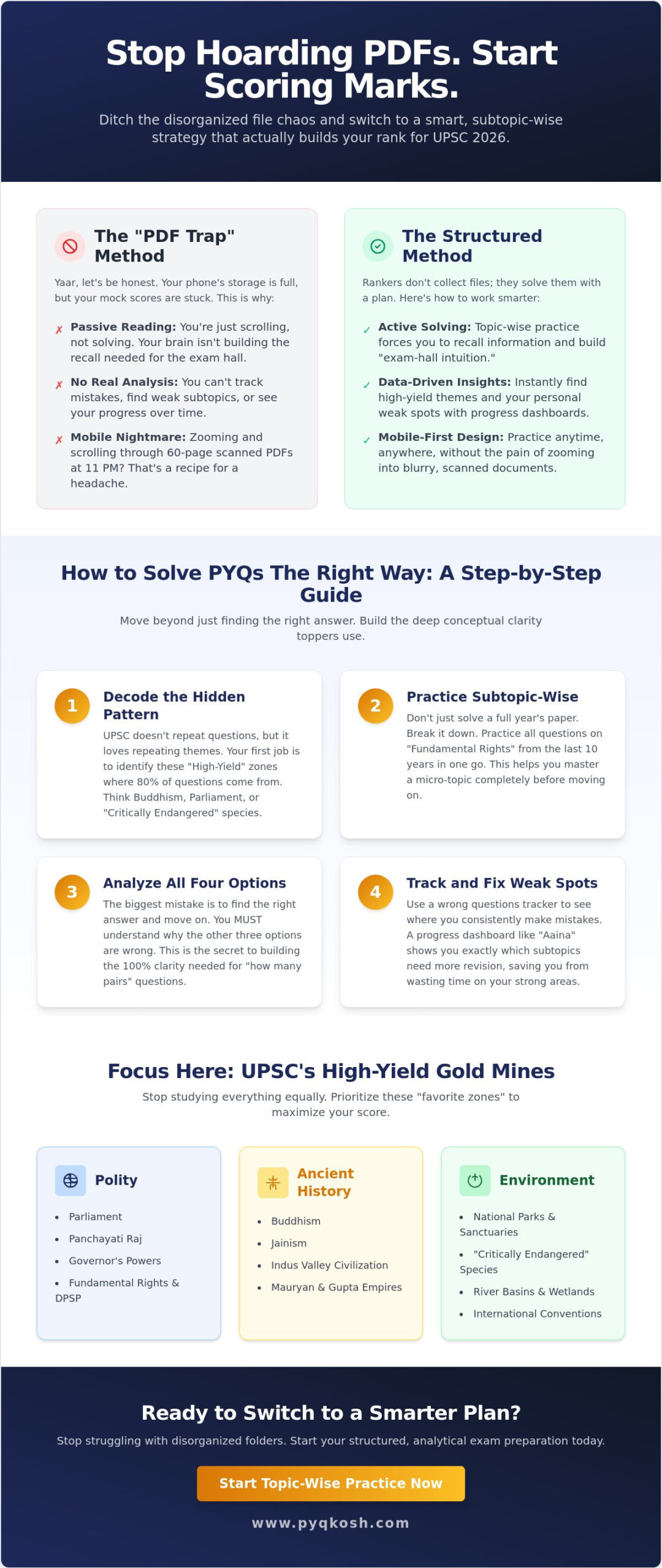
The “PDF Trap” is a dangerous cycle. You spend hours “reading” solved papers, thinking you’ve covered the syllabus. But passive reading is why you forget everything the moment you face a new question. Solving a prelims upsc question paper is the only way to test your actual recall.
The difference between reading and solving
Reading a solution feels easy because your brain isn’t doing the heavy lifting. Solving a question forces you to eliminate options. This skill is the backbone of the UPSC Civil Services Examination structure.
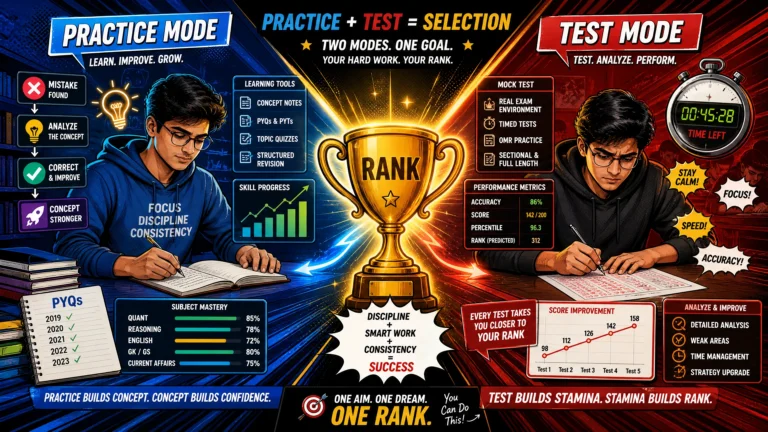
When you solve, you build “exam-hall intuition.” You learn to spot the traps UPSC sets in its statements. You need to move between Practice mode to learn concepts and Test mode to build your exam speed.
Toppers don’t just read; they dissect. They want to know why one option is right and exactly why the other three are wrong. A static PDF simply cannot help you do that effectively during your daily prep sessions.
Why static PDFs are a nightmare for mobile users
Try zooming into a 2018 paper on a small mobile screen at 11 PM. It’s a recipe for a massive headache. Most aspirants study on their phones, and scanned documents are just not built for that.
Scrolling through 60 pages just to find an answer key at the very end is a total waste of your precious time. Every minute you spend scrolling is a minute you aren’t learning a new concept or fixing a mistake.
Plus, you can’t bookmark a tricky “Confusion Point” in a basic PDF. You find a great explanation, but it’s lost forever the moment you close the app. You need a centralized destination for your entire preparation journey.
Instead of fighting with disorganized folders, switch to topic-wise practice. This structured, analytical exam preparation plan helps you focus on what actually matters for the 2026 attempt without the digital clutter.
Decoding the DNA of the UPSC Prelims question paper
Everyone says UPSC is unpredictable. But if you look closely at any prelims upsc question paper, you’ll see a hidden pattern. UPSC doesn’t repeat questions, but it loves repeating themes.
Think about it. Why does Buddhism appear almost every year? Why is the Governor’s power always in the news and then in the paper? It’s because some areas are “High-Yield” zones where 80% of questions live.
The 2024 and 2025 papers changed the game with “How many pairs” options. This killed the old elimination technique for many aspirants. Now, you need 100% clarity on every single statement to score well.
Identifying high-yield subtopics
Stop wasting time on every tiny detail of Ancient India. Focus your energy on Buddhism and Jainism instead. In Polity, Parliament and Panchayati Raj are absolute gold mines that you can’t ignore.
Use this UPSC Prelims Topic Wise Weightage 2026 to prioritize your study schedule. Don’t just study hard; study exactly where the marks are hidden.
In Geography and Environment, watch out for keywords like “Critically Endangered” or specific river basins. UPSC has favorites. Identifying these keywords is your “topper banne ka shortcut” for 2026.
The shift in UPSC question patterns
Your old “rattamar” style won’t work anymore. The commission is moving from simple facts to deep concepts. If you don’t understand the “why” behind a law, you’ll struggle when the prelims upsc question paper hits your desk.
The 2024 attempt taught us that structured, analytical exam preparation is the only way forward. You must analyze UPSC PT Question Trends 2026 before you even open a new textbook.
To stay ahead of the curve, you should try topic-wise practice to see how these trends actually look in real questions. It’s much better to make mistakes during practice than in the actual exam hall.
Subject-wise weightage: What the last 10 years tell us
Ever felt like you’re studying 12 hours a day but your mock scores are stuck? It’s likely because you’re treating every subject the same. In reality, some subjects are your “bread and butter” while others are “wildcards.”
Looking at any prelims upsc question paper from the last decade reveals a clear trend. Polity and Economy usually account for 30-35% of the paper. These are your “Safe” subjects because the questions often come from standard sources you already have on your desk.
On the other hand, Environment and Science & Tech have become the “Dynamic Duo.” These subjects now decide the cutoff because they link static concepts with current events. If you ignore these, you’re basically gambling with your 2026 attempt.
History and Culture remain tricky. With a weightage of 15-20%, the syllabus is huge. The ROI here is lower unless you target specific high-yield subtopics we discussed earlier. Don’t get lost in the dates; look for the themes.
Polity and Economy: The non-negotiables
You can’t afford to get these wrong. Most questions come straight from sources like Laxmikanth or the Economic Survey. But reading isn’t enough. You need to see how UPSC twists simple statements in a prelims upsc question paper to confuse you.
- Focus on the logic of the Constitution, not just the articles.
- Use subtopic-wise practice to master Parliament, Judiciary, and Banking.
- Practice at least 15 years of papers to understand the “UPSC mindset.”
When you solve by subtopic, you’ll realize that UPSC asks about the “Preamble” or “Fundamental Rights” in very specific ways. This helps you build that “exam-day intuition” we keep talking about. It’s the only way to ensure your accuracy stays above 90% in these core areas.
Environment and S&T: The dynamic shift
This is where the game changes. Questions here are rarely direct. They’re heavily linked to what’s happening globally. Instead of just reading 365-day compilations, you should practice UPSC CSE specific themes like Climate Change and Biotechnology.
- Track how international treaties are tested over time.
- Identify recurring species or conservation zones in Geography.
- Solve questions immediately after reading a current affairs topic.
Subtopic practice is much better than passive reading. It forces you to apply what you’ve learned. You can track your progress on these dynamic subjects using the Aaina dashboard to see if your accuracy is actually improving over time. Don’t just hope for the best; use data to confirm your prep is on track.
How to solve UPSC PYQs the right way (Step-by-Step)
Most aspirants make the mistake of solving a full prelims upsc question paper only in the last two months. By then, it’s often too late to fix deep conceptual gaps. If you want to stay ahead, you need a different approach.
Solving papers isn’t just about checking your score and feeling happy or sad. It’s about training your brain to think like the paper-setter. You need to move from random guessing to logical elimination.
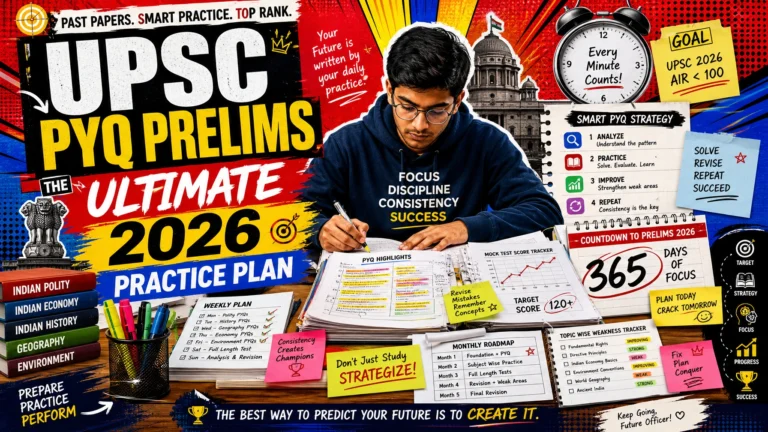
Don’t just collect answers; collect insights. Every time you face a prelims upsc question paper, follow this four-step method to ensure you’re actually learning, not just passing time.
- Step 1: The First Pass. Solve by subtopic immediately after finishing a chapter.
- Step 2: The ‘Why’ Analysis. Find out why the right answer is right and why the other three are wrong.
- Step 3: The Revision Loop. Re-solve your mistakes every Sunday using a dedicated wrong questions tracker.
- Step 4: Speed Drills. Set a timer to mimic the pressure of the actual exam hall.
Phase 1: Topic-wise mastery
Just finished reading about ‘Fundamental Rights’? Don’t move to ‘Directive Principles’ yet. Solve every related question from 2011 to 2025 right now. This cements the concept in your mind instantly.
Waiting for the full syllabus to finish is a trap. That day never comes, yaar. Topic-wise practice shows you exactly how UPSC twists the language of the same chapter in different years.
This method helps you identify your weak subtopics before they become a problem. You can track your accuracy for each specific area on your Aaina dashboard to see where you need more work.
Phase 2: Analyzing the ‘Why’ behind wrong answers
UPSC is famous for picking options from previous years and turning them into new questions. If you only focus on the correct answer, you’re missing 75% of the potential learning material.
Use in-depth explanations to understand the context of every single option. This builds a “360-degree” understanding of the topic. It’s the best way to handle those tricky conceptual statements.
Identify your ‘Confusion Points.’ Are you getting it wrong because you didn’t know the fact, or because you misread the statement? Once you know the reason, you can stop making the same silly mistakes.
Ready to stop guessing and start solving? You can start your topic-wise practice today and build the confidence you need for 2026.
Stop struggling with PDFs: Switch to structured PYQ practice
Still hunting through scattered folders for that one specific prelims upsc question paper? It’s time to stop. A phone full of PDFs is just digital clutter that slows you down and kills your focus.
You need a structured, analytical exam preparation plan that brings Geography, History, and Polity into one place. Centralization is the only way to stay organized and calm for the 2026 attempt.
When your prep is organized, you don’t waste time searching. You spend every second solving and improving your score. It’s the ultimate “topper banne ka shortcut” for busy aspirants.
Using the Aaina dashboard for real progress
The Aaina dashboard changes how you see your preparation. It tracks your daily streaks and peer rank to keep you motivated even on those low-energy days when you don’t feel like studying.
You can see exactly which subtopic is pulling your score down. Stop guessing and start using data-driven insights for your UPSC PT Question prep. It’s much better than flying blind.
Knowing your accuracy at a subtopic level helps you fix weak spots before they hurt you in the actual exam. You’ll know exactly when you’re ready to move from one chapter to the next.
Mastering subtopics with the Wrong Question tracker
The Wrong Question tracker automatically stores every mistake you make in a dedicated tab. No more marking PDFs with red pens or maintaining heavy manual registers, yaar. It’s all done for you.
You can sort these questions by “Frequency” to see which concepts you keep getting wrong. This helps you identify deep-rooted confusion points that need your immediate attention before May 2026.
This one-click revision feature can slash your revision time by 50%. It’s the best tool to ensure you never repeat the same mistake on a prelims upsc question paper ever again. Discipline becomes easy when the system works for you.
Ready to turn your hard work into a rank?
You’ve seen why the old way of studying doesn’t work anymore. Sticking to static PDFs and passive reading is a trap that keeps your scores stuck year after year.
To crack the 2026 attempt, you need a structured, analytical exam preparation plan. Master every prelims upsc question paper by solving it subtopic by subtopic and tracking every single mistake you make.
Join thousands of aspirants who have already practiced over 100,000 questions on our platform. Use the Aaina progress dashboard for real-time tracking and the dedicated Wrong Question tracker to slash your revision time.
Stop guessing and start solving with precision. Practice UPSC Prelims subtopic-wise questions on PYQKosh today!
You’ve got the potential to be a topper, yaar. Now just use the right tools to reach the finish line. Keep practicing!
Frequently Asked Questions
Are prelims upsc question papers repeated in the actual exam?
UPSC rarely repeats the exact question word for word. However, they repeat themes and subtopics almost every year. Concepts like Buddhism, Jainism, and Parliamentary Committees are favorites that appear frequently.
Instead of looking for repeats, use the papers to understand the logic UPSC uses to trap you. Mastering these recurring themes is your real topper banne ka shortcut for the 2026 attempt.
How many years of UPSC Prelims PYQs should I solve for 2026?
You should solve at least 15 years of papers to get a full grip on the trends. Focus most of your energy on the prelims upsc question paper sets from 2011 onwards.
This is because the pattern changed significantly after 2011. Going back further is helpful for static subjects like History, but the more recent papers show you the current conceptual depth required.
Is it better to solve UPSC papers year-wise or topic-wise?
Topic-wise solving is much better when you are still finishing your syllabus. It helps you see how UPSC tests a specific chapter like “Preamble” or “Banking” over many different years.
Year-wise solving is best kept for the final two months before the exam. Use it then to build your speed and practice managing the pressure of the full two hour prelims upsc question paper.
Can I rely only on PYQs to clear the UPSC Prelims?
PYQs are the foundation of your prep, but they aren’t enough on their own. You must link them with standard textbooks and daily current affairs to cover the full syllabus.
Think of PYQs as a compass that shows you where to focus your reading. They tell you which parts of the newspaper or Laxmikanth are actually important for the exam.
How do I handle the CSAT prelims upsc question paper?
Don’t take CSAT lightly just because it is qualifying, yaar. The math and logic levels have become much tougher in the last three years, making it a major hurdle for many.
Solve at least 10 years of CSAT papers to get comfortable with the reading comprehension and reasoning patterns. Dedicated practice is the only way to ensure you don’t get stuck at the first stage.
Where can I find subtopic-wise UPSC previous year questions with explanations?
You can find structured, subtopic-wise questions on platforms like PYQKosh. They offer in-depth explanations that cover both the right and wrong options to build your conceptual clarity.
This is much better than basic PDFs because you can track your progress instantly. It helps you move from disorganized reading to a focused, data-backed study plan for 2026.
What is the best way to revise wrong answers from previous year papers?
The best way is to use a dedicated wrong questions tracker that stores your mistakes automatically. This saves you from the headache of marking old books or searching through messy notes.
Revision becomes 50% faster when you only focus on your weak points. Sort your mistakes by frequency to see which concepts you keep getting wrong and fix them before exam day.
How has the pattern of the UPSC Prelims question paper changed in recent years?
The pattern has shifted from direct factual recall to deep, analytical thinking. The introduction of “How many pairs” options in 2024 and 2025 has made elimination techniques much harder to use.
Now, you need 100% clarity on every statement in a question. This shift means you must focus on structured, analytical exam preparation rather than just rote learning facts from a book.