
Article by
Aaisha
A passionate content writer at PYQKosh focused on simplifying Current Affairs and PYQs for competitive exam aspirants. I love turning complex topics into easy, student-friendly content that helps learners prepare smarter and stay consistent in their exam journey.
What if solving 50 full-length mock tests is actually the reason your score is stuck? You spend hours grinding through random papers, yet the same subtopics trip you up every single time. You need a structured railway exam pyq practice plan that stops the guesswork and focuses on patterns that actually repeat.
It's exhausting to forget a concept you practiced just a week ago or feel lost about which topics have the highest weightage. I've seen so many aspirants lose hope because they don't have a clear way to track their weak areas. This guide will replace that confusion with a data-driven strategy for the 2026-27 recruitment cycle.
We'll break down how to use subtopic-wise practice to gain the speed and accuracy needed for the CBT. You'll learn to build a daily routine using the Aaina progress dashboard and a wrong question tracker to ensure you never make the same mistake twice.
Key Takeaways
- Stop drowning in a mess of question paper PDFs and switch to structured practice to see your scores actually move.
- Focus on small wins by mastering one subtopic at a time, which is far more effective than hours of random, unfocused study.
- Implement a strategic railway exam pyq practice plan that uses data to highlight high-weightage patterns you can't afford to miss.
- Turn your mistakes into strengths by using a dedicated wrong question tracker that keeps your weak areas front and center.
- Get a clear picture of your preparation level with the Aaina dashboard, helping you stay consistent and confident for the 2026 exams.
Why your current Railway prep feels like a mess
Be honest, yaar. How many "Railway PYQ" PDFs are sitting in your phone's download folder right now? You probably have hundreds of them from various Telegram groups. This is the "PDF Trap." You spend more time collecting papers than actually solving them.
Hoarding PDFs gives you a false sense of security. You feel like you're preparing, but your scores haven't moved in weeks. Randomly solving a paper from 2018 one day and a mock test from 2024 the next day is just chaotic. It doesn't help you spot the patterns that the Railway Recruitment Control Board (RRCB) repeats every year.
A real railway exam pyq practice plan isn't about how many hours you sit at your desk. It's about how many specific subtopics you've mastered. If you keep missing questions on "Indian Railways Zones" or "Fundamental Rights," solving more full-length mocks won't fix the problem. You need to stop the random grinding and start structured practice.
The problem with 'Full Mock' obsession
Most aspirants jump into full 100-question mocks way too early. When you see a low score, your confidence takes a hit. You feel overwhelmed because you can't tell if the problem is your General Awareness or your speed. Full mocks are great for testing, but they're terrible for learning.
In a mixed set, your weak subtopics stay hidden. You might get a "Rivers of India" question right by luck and miss it in the actual exam. Topper logic is simple: master the small units first. Use the railway exam pyq practice plan to conquer one subtopic at a time before you even touch a full-length paper.
Why 2026 requires a data-driven approach
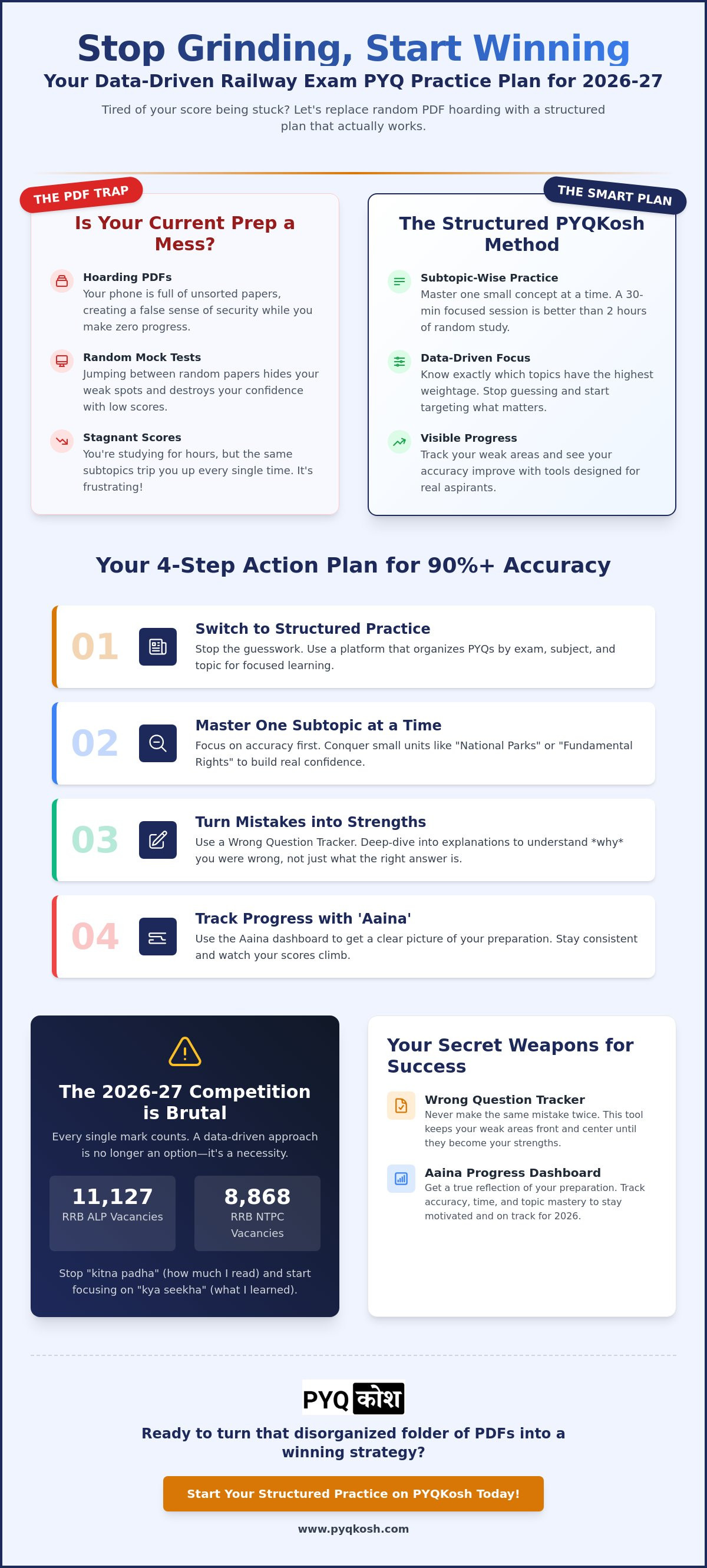
The competition for the 2026-27 cycle is going to be brutal. With 11,127 vacancies announced for RRB ALP and 8,868 for RRB NTPC, every single mark counts. You can't afford to guess which topics are important anymore.
You need to move from "kitna padha" (how much I read) to "kya seekha" (what I actually learned). A data-driven approach tells you exactly which subtopics have the highest weightage right now. Instead of reading a whole history book, you focus on the specific dates and events that Railway exams actually ask about. This is how you work smarter, not harder.
Stop wasting energy on outdated methods. Start using topic-wise practice on PYQKosh to see where you actually stand. It's time to turn that disorganized folder of PDFs into a winning strategy.
The Subtopic-Wise approach: Why small wins lead to big scores
Ever felt like you've read the whole history book but still can't answer a specific question on Buddhism? That's because you're looking at the forest and missing the trees. Breaking down General Awareness into bite-sized subtopics like Rivers, Awards, or Constitutional Articles is the real game-changer for your preparation.
A 30-minute session focused only on "National Parks" is worth more than a 2-hour random study session. It builds muscle memory. When you see a specific pattern repeat five times in a row, your brain locks it in. This targeted focus is the heart of a solid railway exam pyq practice plan that actually produces results.
Don't forget to link your science prep to this strategy too. Using a railway general science previous year questions guide helps you see which physics or chemistry topics actually matter. You'll stop wasting time on complex theory that never shows up on the official RRB websites or in actual CBT papers.
The 'Deep Dive' technique for General Awareness
Reading the explanation of a wrong answer is where the real learning happens. Don't just see the correct option and move on. You need to identify "Confusion Points" in the PYQs. Ask yourself why you picked 'B' when the answer was actually 'C'. Was it a lack of data or a trick in the wording?
Use the Bookmark feature in PYQKosh to save these tricky questions for later. Instead of re-reading a whole textbook chapter, just revise your bookmarked subtopics on Sundays. It keeps your preparation sharp and ensures you don't repeat the same mistakes in the next mock. This is how you move from being a confused aspirant to a confident topper.
Accuracy over speed (at first)
There's a common myth that you must be lightning-fast from Day 1. That's wrong, yaar. If you're fast but wrong, you're just failing quicker. Focus on getting 100% accuracy in one subtopic first. Once you know the content inside out, the speed will follow on its own.
As you master these small units, improving speed in railway exams happens naturally. You won't have to think twice; you'll recognize the pattern and mark the answer instantly. Aim for a "Zero-Mistake" goal in your favorite topics to build that unstoppable momentum. You can start topic-wise practice today to experience this shift in your performance.
Your 4-Step Railway exam PYQ practice plan for 2026
You don't need a 15-hour study schedule to clear the Railway exams. You just need a strategy that doesn't waste your time. This 4-step railway exam pyq practice plan is designed to move you from confusion to a 90+ accuracy score by focusing on what actually matters.
- Step 1: Identify high-weightage topics. Use the trend analysis on PYQKosh to sort subtopics by question count. Focus on the "hot" topics first so you're not studying irrelevant data.
- Step 2: Practice in 'Test Mode'. Don't just read questions like a storybook. Use Test Mode to simulate the real CBT pressure and see how you perform under a ticking clock.
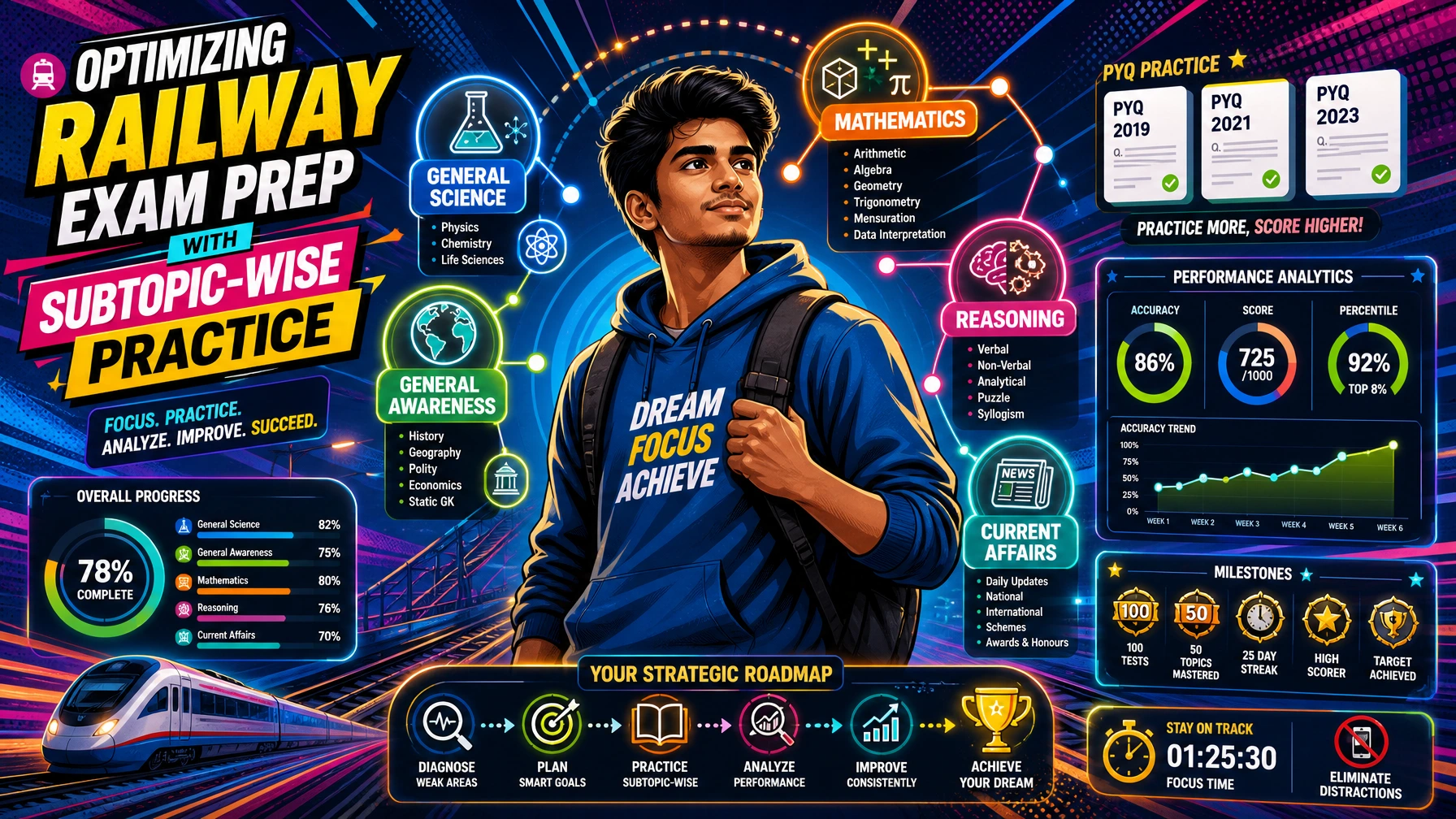
- Step 3: Analyze your 'Aaina' dashboard. Your Aaina is your mirror. Check your daily practice streak, accuracy levels, and peer rank to see where you stand in the competition.
- Step 4: Attack the 'Wrong Question' tab. This is your secret weapon. Every 48 hours, revisit the questions you missed. If you can't solve them correctly the second time, you haven't mastered the topic yet.
Morning vs. Night: Structuring your day
Your brain is freshest in the morning. Use this time for new subtopic practice, especially for high-level RRB NTPC questions. Tackle the tough General Awareness sections when your focus is at its peak.
Save your night sessions for revision and "Wrong Question" cleanup. It's much easier to review mistakes when you're tired than to learn a brand new concept. Maintaining a daily practice streak on your dashboard will keep you motivated even on days when you feel like quitting.
Balancing multiple Railway exams
The beauty of Railway exams is the overlap. Whether it's RRB ALP, Technician, or Group D, the core patterns remain similar. Use the multi-exam support to see how a single subtopic is asked across different levels of the exam.
Always sort your practice by recency. Focus on the 2024-25 trends to understand the current mindset of the examiners. One pro-tip: don't ignore the "Easy" questions. Losing marks on a simple question is a crime in a high-competition environment; accuracy there is a must for your selection.
Ready to see your progress in real-time? Start your daily streak by jumping into topic-wise practice right now.
Tracking your 'Wrong Questions'—The real secret to 90+ accuracy
Most aspirants make a huge mistake. They solve a paper, check their score, and immediately close the app. If you got 70/100, you focus on the 70 you got right. But the secret to selection lies in the 30 you got wrong. Your railway exam pyq practice plan is incomplete if you don't hunt down your errors.
The Wrong Question tab is your best friend here. It automatically stores every mistake you make during practice or test mode. You don't have to waste time maintaining a physical "mistake notebook" anymore. Everything is centralized in one place, ready for you to attack.
You can even sort these mistakes by frequency. If you've made the same mistake on "Indian Railways History" three times, the platform will highlight it. This tells you exactly where your concept is weak. I suggest running a "Mistake Marathon" every Sunday. Spend the whole day re-solving only your wrong questions until your accuracy hits 100%.
Turning weaknesses into strengths
Use subtopic-wise test analysis to find your "Danger Zones." These are the specific areas where you consistently lose marks under pressure. A wrong question is actually a gift for your 2026 prep. It's a clear signal of what you need to fix before the actual CBT.
Breaking the habit of wrong guessing is a psychological battle. When you see your "Mistake Frequency" rising in a particular subtopic, it forces you to stop and re-learn the concept. This level of structured, analytical exam preparation turns your biggest weaknesses into your strongest scoring areas.
Using 'Aaina' as your progress mirror
The Aaina dashboard acts as your progress mirror. It visualizes your accuracy graph over the last 7 days. If that line isn't moving up, you need to change your approach. Seeing your daily progress in black and white keeps you grounded and focused on the goal.
You can also compare your Peer Rank to see where you stand in the national race. It's a great reality check. The "Streak" effect is another powerful motivator. Once you see a 10-day green line on your dashboard, you won't want to break it. You can start building your winning streak by using the wrong question tracker today.
Centralizing your Railway prep with PYQKosh
Why are you still jumping between 50 different Telegram groups and apps, yaar? It's time to stop the chaos. Centralizing your railway exam pyq practice plan on one platform is the only way to stay organized and focused.
With 100,000+ questions in one place, you don't need to search for missing PDFs or outdated books anymore. PYQKosh is "Made by an Aspirant," which means every feature solves a real struggle you face daily. We've removed all the common distractions found in other apps.
There are zero video lessons and zero live classes here because we want you to focus 100% on active practice. This structured, analytical exam preparation ensures you spend your time solving, not just watching. You can start your Railway PYQ journey today and experience this clarity for yourself.
Everything in one dashboard
A single plan gives you access to SSC, UPSC, and Railway PYQs. This multi-exam support is crucial because many General Awareness patterns overlap across different exam boards. You'll start seeing questions in a new light when you see them repeat across different exam levels.
Our in-depth explanations are more than just answers. They include "Exam Booster" tips that highlight why an option is correct and where aspirants usually get confused. You can also use the "Year-wise Sorting" to see exactly how the language of Railway exams has evolved up to 2025.
This feature allows you to prioritize recent questions over outdated patterns from a decade ago. By sorting topics by question count, you focus on the highest weightage areas first. It's a much smarter way to manage your limited study time while reading on your mobile.
Your 2026 target starts here
Selection isn't about some secret topper banne ka shortcut. It's about setting a subtopic goal every week and actually hitting it. Pick a "Danger Zone" topic today and master it through focused, topic-wise practice until your accuracy graph in Aaina turns green.
Using a smart Railway General Awareness guide will help you handle the vast syllabus without feeling overwhelmed. It's your best friend for staying on track during the long 2026-27 recruitment cycle announced by the ministry.
Final word: don't just study hard, yaar. Practice smart and let your progress dashboard show you the way to your dream railway job. Success is just a few focused subtopics away if you stay disciplined.
Pick one subtopic and start your practice session right now.
Your path to a Railway seat starts with one subtopic
You've seen why the old way of solving random mocks doesn't work. To beat the 2026 competition, you need to stop guessing and start measuring your progress. Mastering one subtopic at a time builds the accuracy that full-length papers just can't give you early on.
Your railway exam pyq practice plan is your roadmap to selection. With over 100,000 subtopic-wise questions at your fingertips, you can target your weak areas immediately. Use the Aaina progress dashboard to keep your streaks alive and the wrong question tracker to ensure you never repeat a mistake.
Don't let another day go by in disorganized chaos. You have the tools and the strategy to succeed. It's time to work smarter and finally claim your place in the Indian Railways.
Start your Railway subtopic practice today on PYQKosh
Frequently Asked Questions
Is solving PYQs alone enough to clear Railway exams in 2026?
PYQs are the most critical part of your prep, but you must use them strategically. A solid railway exam pyq practice plan helps you understand the depth of each subtopic. You should first clear your basic concepts and then use previous year questions to master the specific patterns that the exam board repeats every year.
How many years of previous year questions should I practice for RRB NTPC?
Focus on the last 5 to 7 years, specifically questions from 2018 onwards. The exam difficulty and TCS pattern changed significantly during this time. Practicing older questions might give you a false sense of security, so prioritize the most recent papers to stay aligned with current competition levels.
What is the difference between Practice Mode and Test Mode on PYQKosh?
Practice Mode lets you see in-depth explanations immediately after each question, which is perfect for learning new subtopics. Test Mode hides the answers and starts a timer to simulate the actual CBT environment. Use Test Mode once you feel confident in a subtopic to check your speed and accuracy under pressure.
How do I use the Aaina dashboard to improve my Railway exam score?
Check your Aaina dashboard every night to review your accuracy graph and daily streaks. If your accuracy in a specific subtopic like "Current Affairs" is dipping, it's a signal to stop and revise. Use the peer rank feature to see where you stand compared to thousands of other serious aspirants across India.
Can I practice for RPF and Group D on the same platform?
Yes, you can access multiple exams like RPF, Group D, and RRB NTPC on a single platform. This multi-exam support is a huge advantage. It allows you to see how a single subtopic, such as "General Science," is asked across different levels of Railway recruitments.
What should I do if I keep getting the same subtopic questions wrong?
Don't panic, just head to your Wrong Question tab and sort your mistakes by frequency. This highlights the specific questions that trip you up repeatedly. Re-solve these questions every 48 hours until you can answer them correctly without looking at the explanation. This is the fastest way to turn a weakness into a strength.
How does subtopic-wise practice help with time management in CBT?
It creates instant recognition of question patterns. When you've practiced 100 questions on a specific subtopic like "Indian Rivers," you won't need to think twice during the exam. You'll mark the answer in seconds, saving precious time for more difficult calculation-based sections in the CBT.
Is there a way to sort Railway questions by the most recent years like 2025?
Yes, you can easily sort subtopics by year to focus on the latest 2024 and 2025 questions. This is a vital part of your railway exam pyq practice plan because it keeps your preparation relevant. Focusing on recent trends ensures you aren't wasting time on outdated question formats that are no longer asked.