

Article by
Aaisha
A passionate content writer at PYQKosh focused on simplifying Current Affairs and PYQs for competitive exam aspirants. I love turning complex topics into easy, student-friendly content that helps learners prepare smarter and stay consistent in their exam journey.
Solving thousands of random questions won’t get you a seat in the Indian Railways; mastering the specific patterns that repeat every year will. You’re likely drowning in endless Telegram PDFs and seeing your mock scores plateau while the timer runs out during practice. It’s frustrating to study for ten hours a day only to forget the logic behind a “Time and Work” problem when the pressure is actually on.
I know that feeling of staring at a CBT screen, knowing the concept but lacking the speed to finish. That’s why we’re shifting your strategy from “volume” to “precision.” In this guide, I’ll show you how to use railway exam subtopic wise questions to build the surgical accuracy needed for CBT-1 and CBT-2. You’ll learn how to stop guessing and start solving with the speed of a pro.
We’re going to break down a clear, daily roadmap that fixes your weak spots in Maths and Reasoning. I’ll explain how to master the syllabus subtopic by subtopic to ensure you’re ready for the 2026 recruitment cycle. Get ready to turn your preparation from a disorganized mess into a high-speed selection machine.
Key Takeaways
- Stop the “PDF hoarding” trap and understand why collecting random practice papers is actually keeping your scores stuck below the cutoff.
- Master the “Micro-Mastery” effect by using railway exam subtopic wise questions to build permanent memory and surgical accuracy in every chapter.
- Learn why jumping into full-length mocks too early can hurt your morale and how to build your “problem-solving muscle” first.
- Identify the high-yield subtopics in Maths and Reasoning, like Syllogism and Data Interpretation, that carry the most weight in RRB exams.
- Get a clear, daily roadmap to use PYQKosh for targeted practice, ensuring you move from disorganized chaos to a selection-ready mindset.
Why Random Practice is Keeping Your Railway Exam Score Stuck
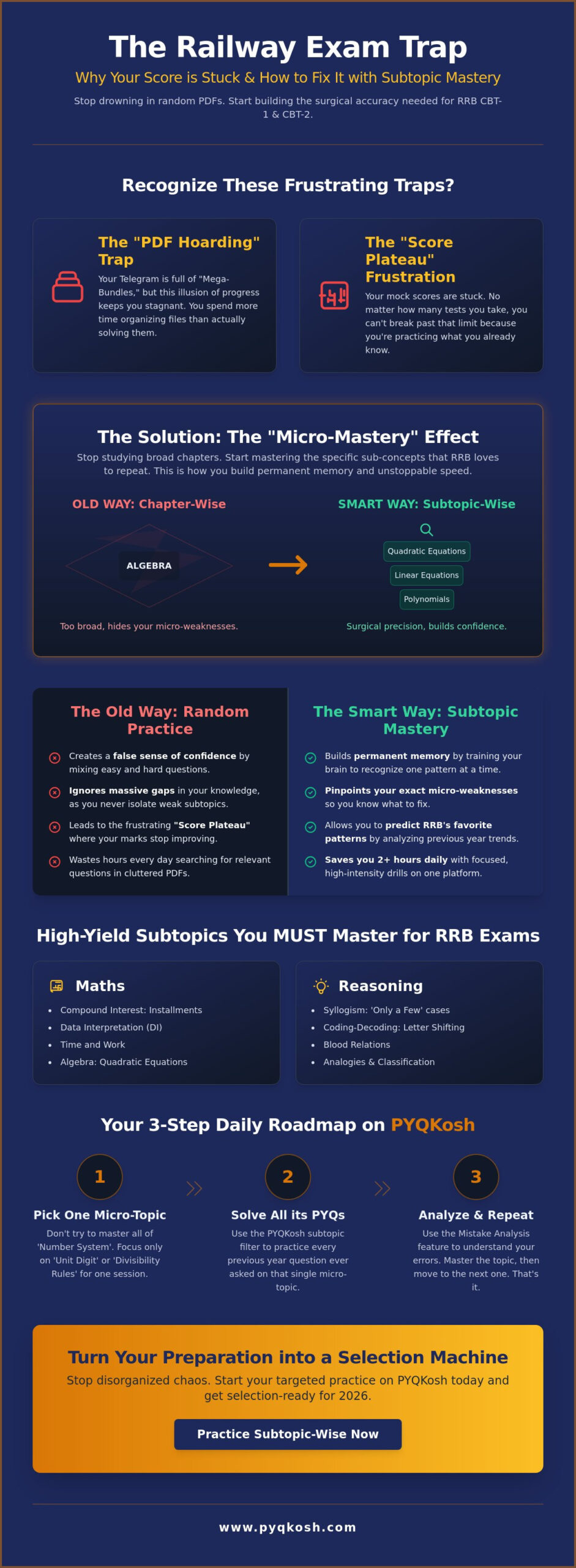
Collecting PDFs is the new-age distraction for aspirants. You probably have fifty Telegram channels muted, each filled with “Most Important 1000 Questions” or “Previous Year Mega-Bundles.” This is the PDF Hoarding trap. It feels like progress, but it’s actually keeping you stagnant. You’re spending more time organizing files than actually mastering the logic required to clear the cutoff.
Random practice creates a dangerous illusion of confidence. You solve a mixed set of fifty questions, get forty right, and feel like you’re ready. But what about the ten you missed? If those ten questions all belong to a specific subtopic like “Syllogism” or “Compound Interest,” you’ve just ignored a massive gap in your knowledge. For the 2026 Railway exams, where competition for the 22,195 RRB Group D vacancies is fierce, a shotgun approach won’t work. You need a sniper’s precision.
The “Score Plateau” is the ultimate frustration. It’s that point where your mock test marks hit a certain number and simply refuse to budge. No matter how many full-length tests you take, you’re stuck. This happens because you’re practicing what you already know while avoiding the specific sub-concepts that actually challenge you. Moving from a score of 70 to 85 requires a surgical strategy, not just more of the same random effort.
The Struggle of the Senior Aspirant
If you’ve been preparing for a couple of years, the daily grind can feel soul-crushing. You’ve “finished the syllabus” three times over, yet the speed isn’t there. “Finishing the syllabus” is a myth that keeps many students in a loop of failure. In reality, the exam isn’t about knowing everything; it’s about being fast and accurate in what matters. It’s painful to see peers clear the RRB NTPC CBT-1 while you’re still struggling with the same old math shortcuts. The emotional toll of being “almost there” is heavy, but the fix is usually simpler than you think.
Why Chapter-Wise Practice is No Longer Enough
A chapter like Algebra is way too broad. RRB examiners are smart; they target specific sub-types to filter out average candidates. They might skip general questions and focus heavily on “Quadratic Equations” or “Linear Equations with two variables.” If you only practice at the chapter level, you’ll never spot your micro-weaknesses. This is why using railway exam subtopic wise questions is the only way to see a real jump in your scores.
By narrowing your focus to the smallest possible unit of the syllabus, you force your brain to master one specific logic at a time. The Science of Railway Exam Subtopic Wise Questions proves that active retrieval through targeted testing is the most effective way to build long-term memory. Instead of being “okay” at a whole chapter, you become “unbeatable” at every single sub-concept within it. This is how you build the confidence to face any question the 2026 exams throw at you.
The Science of Railway Exam Subtopic Wise Questions
Subtopic-wise practice means breaking the massive RRB syllabus into its smallest, most manageable atoms. Instead of looking at “General Intelligence” as one giant mountain, you look at “Coding-Decoding: Letter Shifting” as a single step. It’s about moving from broad, vague study sessions to targeted, high-intensity drills that actually stick.
This creates what I call the “Micro-Mastery” effect. When you focus on one specific question type for an hour, you build permanent memory. You aren’t just memorizing formulas; you’re training your brain to recognize patterns instantly. The Science of Focused Practice shows that organizing study material into specific problem-based modules leads to much faster retrieval during a high-pressure CBT.
Railway recruitment boards are famous for repeating specific sub-concepts across different shifts. By analyzing railway exam subtopic wise questions, you can actually predict the patterns RRB loves. You’ll notice they have a clear preference for “Compound Interest: Installments” or “Syllogism: Only a Few” in almost every exam cycle. Master these micro-patterns, and you’ve mastered the paper.
This method saves you at least 2 hours of study time every single day. You don’t waste energy flipping through 500-page books or scrolling through chaotic Telegram groups to find “relevant” questions. You simply pick a subtopic, solve the previous year questions, and move on. It turns your preparation into a streamlined assembly line of success.
Building a Foundation that Never Shakes
Mastering one subtopic at a time ensures you never lose “easy marks” because of a minor conceptual gap. There’s a massive psychological boost in ticking off five small subtopics by lunchtime. It keeps your motivation high and your anxiety low. It’s the most effective way to bridge the gap between reading a theory and actually applying it in under 30 seconds during the exam.
Identifying Your “Weak Links” Before Exam Day
Don’t wait for a full-length mock test to realize you’re slow at “Trigonometric Identities.” That’s a recipe for heartbreak. Use subtopic questions as a diagnostic tool today. If you can’t solve ten questions of the same type in a row, your logic is failing. You need to catch these “micro-weaknesses” now so they don’t haunt you on the actual exam day.
Mistake analysis is much easier at the subtopic level. You can pinpoint exactly why you’re failing-is it a calculation error or a lack of conceptual clarity? Fixing these small leaks prevents recurring errors that drain your marks. If you’re ready to stop guessing and start mastering, you can dive into RRB NTPC subtopic practice to see exactly where your logic needs a tune-up.
Subtopic Practice vs. Traditional Mock Tests: Which Wins?
Many aspirants believe that solving 50 full-length mocks is the secret to clearing the RRB Group D or NTPC. It isn’t. In fact, jumping into mocks before you’re conceptualy ready is a morale killer. I call this the “Mock Test Illusion.” You see a low score, get depressed, and stop studying for two days. You aren’t failing; you’re just testing yourself on things you haven’t mastered yet.
Think of your preparation like a workout. Subtopic practice is the heavy lifting that builds the muscle. Mock tests are just the mirror to see the results. You should spend 80% of your time drilling down into specific subtopics and only 20% on full-length papers. Mocks tell you where you are; subtopic practice gets you where you want to be. For the 2026 recruitment cycle, where every mark counts, you can’t afford to waste time on “testing” when you should be “building.”
Why Mocks Can Hide Your Real Weaknesses
In a standard 100-question mock, you might only encounter one question on “Pipes and Cisterns.” If you get it right by a lucky guess, you’ll think you’ve mastered the chapter. That’s dangerous. When you solve railway exam subtopic wise questions, you face 30 or 40 questions of the same type in a single sitting. There’s no room for luck here. You either know the logic, or you don’t. It forces you to look at your “fear topics” instead of hiding behind a decent overall mock score.
The AI Advantage: Beyond Just Correct and Incorrect
Static PDFs are dead weight. They can’t tell you if you’re getting faster or if your accuracy is dropping under pressure. This is where PYQKosh changes the game. Our AI-powered analytics don’t just tell you if an answer is correct. They show you exactly which subtopic is pulling your rank down. You get a clear picture of your performance that no Telegram PDF can ever provide.
In Railway exams, speed is king. You have 90 minutes for 100 questions. If you’re taking 2 minutes to solve a “Coding-Decoding” question, you’re losing even if the answer is right. We track your speed for every subtopic. You move from the vague feeling of “I think I know this” to the absolute certainty of “The data proves I can solve this in 30 seconds.” It turns your practice from a guessing game into a scientific mission for selection.
High-Yield Railway Subtopics You Must Master Right Now
You can’t treat every chapter with the same level of priority. If you do, you’ll run out of time before you even reach the high-weightage sections. Success in RRB exams comes from knowing exactly where the examiners hide the easy marks. By using railway exam subtopic wise questions, you can filter out the noise and focus on the 20% of the syllabus that provides 80% of the results.
Mathematics is the backbone of your selection. Don’t waste weeks on complex geometry until you’ve mastered “Data Interpretation” and “Simplification.” These subtopics are the low-hanging fruit. They appear in almost every shift and are designed to test your calculation speed rather than just your knowledge of formulas. Mastering these ensures you don’t lose time on the basic sections.
General Intelligence and Reasoning separate the toppers from the average crowd. While everyone can solve basic analogy questions, topics like “Syllogism” and “Coding-Decoding” require a specific logic. If you practice these subtopic-wise, you’ll start seeing the patterns that RRB repeats. This allows you to solve them in seconds without even picking up a pen during the actual CBT.
Mathematics: Moving Beyond Basic Arithmetic
The “Number System” is arguably the most repeated subtopic in Railway history. It’s the foundation for everything else. You also need to master “Speed, Distance, and Time,” but don’t just solve general problems. Drill down into specific variations like “Problems on Trains,” “Boats and Streams,” and “Races.” Arithmetic accounts for nearly 60% of the Math section in RRB CBT-1, making it your highest priority for a quick score boost.
Reasoning: The Logic Behind the Marks
Many students panic when they see “Puzzles and Seating Arrangement.” The trick is to break them down into smaller types, like linear versus circular arrangements. Practicing these individually stops you from feeling overwhelmed. For “Statement and Assumption,” the key is to understand the examiner’s perspective, which only comes after solving at least 50 subtopic-specific questions from previous years.
Don’t ignore “Non-Verbal Reasoning.” It’s the easiest way to boost your score because it relies on visual recognition. If you practice this subtopic-wise, you can secure 4 to 5 marks in just a few minutes. If you want to see exactly which subtopics you’re missing, you can start practicing RRB subtopic-wise PYQs right now to identify your gaps and fix them before the exam date.
General Science is the silent killer in RRB Group D and ALP exams. You must focus on NCERT-based subtopics from Class 9 and 10. Instead of reading a whole Physics book, master “Light: Reflection and Refraction” or “Electricity” individually. For General Awareness, stop trying to learn everything. Focus on high-weightage themes like “Articles of the Constitution” or “Rivers of India” to keep your preparation manageable and effective.
How to Use PYQKosh to Dominate Railway Exam Subtopics
You’ve seen why random practice fails and which subtopics carry the most weight. Now, let’s get practical. You don’t need a dozen different books or a messy collection of PDFs to clear the 2026 Railway exams. You need a centralized system that tracks your growth. Here is your five-step roadmap to mastering the syllabus using the PYQKosh dashboard.
Step 1: Choose your target. Whether you’re eyeing the 8,868 vacancies in RRB NTPC or the massive Group D recruitment, select your specific exam on the dashboard. This filters the database to show only the most relevant previous year questions for your shift.
Step 2: Drill down into subtopics. Don’t just click on “Mathematics.” Select a specific subject and then choose the exact sub-concept you want to tackle. This is where you access railway exam subtopic wise questions that help you master one logic at a time without getting overwhelmed by the entire chapter.
Step 3: Choose your mode. Switch to “Practice Mode” when you’re learning a new concept to see immediate explanations. When you feel confident, flip to “Test Mode.” This adds a real-time clock, simulating the high-pressure environment of a real Railway CBT.
Step 4: Consult the AI Analytics. After every session, review your performance data. Our AI doesn’t just show your score; it highlights your speed per question. If you’re accurate but slow, you’ll see exactly which subtopic is draining your time.
Step 5: Turn your tracker “Green.” Re-attempt your mistakes until you can solve them with 100% accuracy and speed. Your goal is to see every subtopic on your tracker turn green, signaling that you’re selection-ready.
Setting Up Your Personalized Practice Plan
A random schedule leads to random results. Align your daily routine with the PYQKosh Railway Practice Plan to ensure you cover the entire syllabus systematically. I always tell my students to start with their weakest subtopic first thing in the morning. It’s the fastest way to see a jump in your rank. Use the “Test Mode” every evening to build the mental stamina needed for the actual 90-minute exam.
The Roadmap to Selection
Consistent subtopic practice is the only way to clear the cutoff with a massive margin. By focusing on “Micro-Mastery,” you join a community of smart aspirants who value strategy over mindless hard work. Stop being a PDF hoarder and start being a data-driven performer. The 2026 vacancies won’t wait for anyone. Start your subtopic-wise journey on PYQKosh today!
Take Control of Your Railway Selection Today
You’ve spent enough time collecting messy PDFs and feeling stuck at the same mock score. The difference between a candidate who just “appears” for the exam and one who actually clears the cutoff is a surgical strategy. By switching to railway exam subtopic wise questions, you’re choosing precision over luck. You’re building the raw speed that the 2026 competitive landscape demands.
Don’t let another attempt slip away because of a few missed marks in a “fear topic.” Whether it’s tricky Syllogisms or complex DI sets, you now have the roadmap to fix every leak in your preparation. With our database of 100,000+ verified questions and AI-powered performance insights, you’ll always know exactly how close you are to your dream job.
This platform was made with ❤️ by an aspirant for aspirants; we’ve walked this path and know exactly where it gets tough. It’s time to stop the random effort and start following a data-driven plan that guarantees results. Master Railway Subtopics Now – Get Your PYQKosh Practice Plan! You have the potential; now get the strategy to match it. See you on the merit list!
Frequently Asked Questions
Are subtopic-wise questions really better than solving full previous year papers?
Subtopic practice is superior because it allows you to fix specific logic gaps before they hurt your score. Full papers often hide your weaknesses behind a decent total marks. By focusing on railway exam subtopic wise questions, you master the “Micro-Mastery” required to handle any variation the RRB throws at you in the actual CBT.
How many years of Railway PYQs should I practice for the 2026 exam?
You should prioritize the last 5 to 7 years of questions. The exam pattern and difficulty levels shifted significantly after 2018, so practicing older sets might waste your time on outdated formats. Stick to recent papers from 2018 to 2025 to stay perfectly aligned with the current TCS exam trends.
Can I use PYQKosh for both RRB NTPC and RRB Group D exams?
Yes, the platform is built to handle all major Railway recruitment categories. You can switch between RRB NTPC, Group D, ALP, and Technician on your dashboard. This centralization ensures you don’t need to scatter your resources across different websites for every new notification.
What is the difference between Practice Mode and Test Mode on PYQKosh?
Practice Mode is for learning, while Test Mode is for performing. In Practice Mode, you get immediate feedback and solutions to understand the logic. Test Mode adds a real-time clock to simulate the actual exam pressure, helping you build the speed needed to solve 100 questions in 90 minutes.
Does the platform provide solutions for the Railway exam subtopic wise questions?
Detailed explanations are provided for every single question on the platform. We don’t just give you a simple answer key; we break down the logic step-by-step. This ensures you understand the “how” and “why” behind the railway exam subtopic wise questions so you can solve similar problems faster next time.
How does the AI-powered analytics help in improving my score?
Our AI identifies your “silent killers,” which are the topics where you are accurate but too slow. It compares your solving speed against the average topper’s time for specific subtopics. This data-driven approach tells you exactly which chapter needs more drill sessions to save those precious seconds during the final exam.
Is it necessary to buy a practice plan, or are free PDFs enough?
Free PDFs often lead to “PDF hoarding” without any real progress tracking. They lack the interactive testing, mistake analysis, and speed tracking of a professional practice plan. Investing in a plan turns your preparation into a structured roadmap rather than a disorganized mess of downloaded files.
Can I track my progress across different Railway recruitment boards?
Your progress is tracked centrally across the entire Railway syllabus regardless of which recruitment board you choose. The core topics for all Railway exams remain consistent across different boards. The platform monitors your mastery of each sub-concept, which is the only metric that guarantees selection across any zone.