

Article by
Aaisha
A passionate content writer at PYQKosh focused on simplifying Current Affairs and PYQs for competitive exam aspirants. I love turning complex topics into easy, student-friendly content that helps learners prepare smarter and stay consistent in their exam journey.
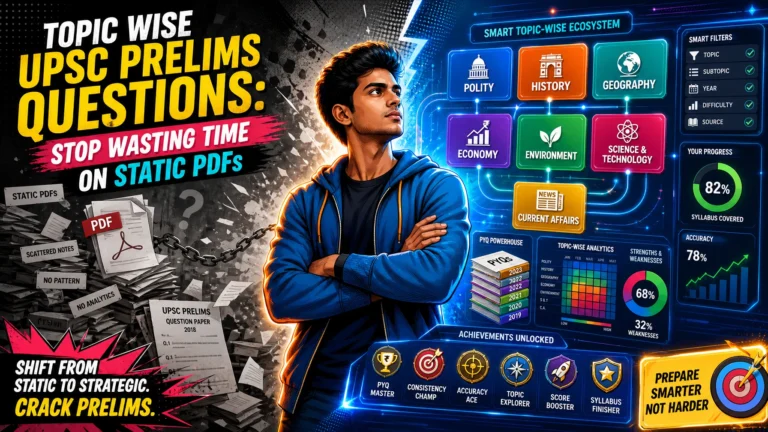
That 50-page “Must-Read” PDF you just downloaded is likely going to sit in your mobile storage until the May 24 exam day, completely unread. Let’s be honest, yaaar. We’ve all spent hours collecting random files, but when you actually sit down to solve a upsc pt question, the chaotic mix of topics just leaves you more anxious than before.
It’s exhausting to feel like you’re drowning in data while your actual conceptual clarity stays at zero. You’re likely worried about the shifting weightage of Polity and Environment, and honestly, static papers won’t give you the edge you need to handle the analytical focus of the 2026 cycle. You need a way to see through the noise and focus on what actually repeats.
The good news is that there’s a topper banne ka shortcut that doesn’t involve more reading. In this guide, I’ll show you how to use subtopic-wise PYQ analysis to stop wasting time and start mastering the specific patterns UPSC loves. We’ll look at how tracking your accuracy and focusing on structured, analytical exam preparation can turn your daily practice into a winning strategy.
Key Takeaways
- Stop hoarding 50-page PDFs and switch to subtopic-wise practice to build the muscle memory needed for 2026.
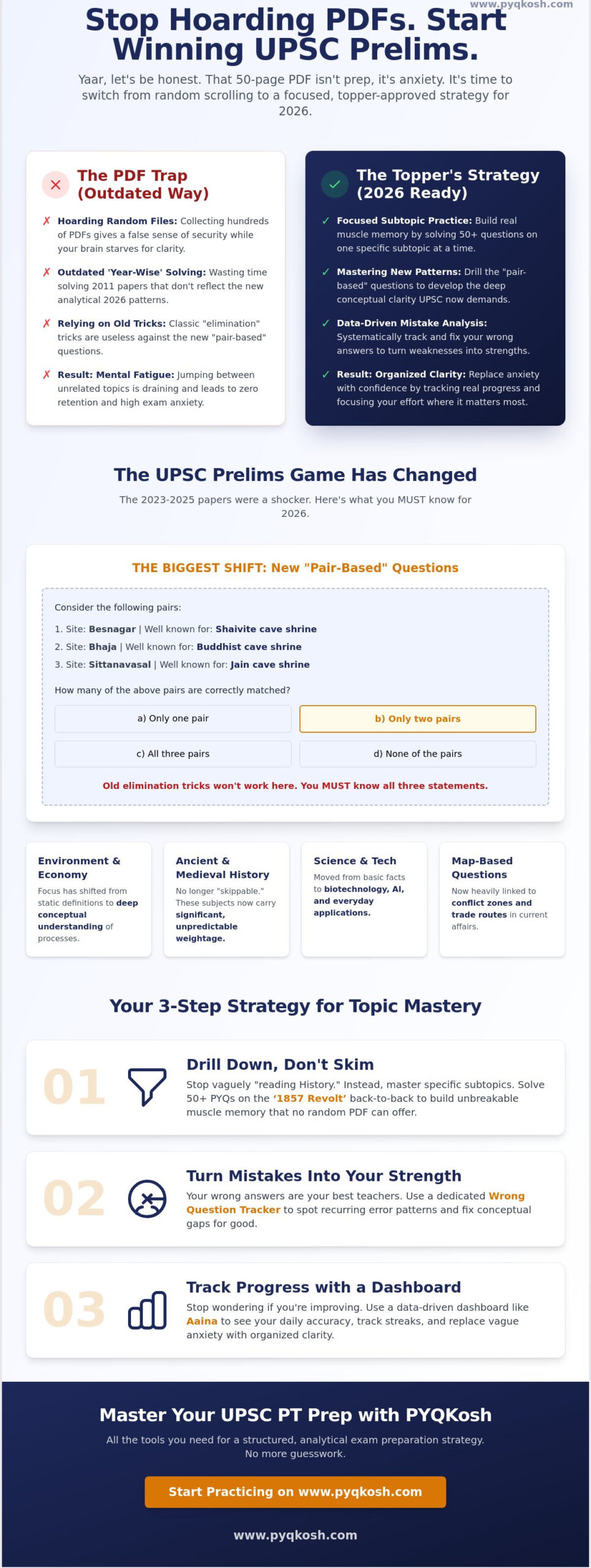
- Understand the shift from old elimination tricks to the new “pair-based” upsc pt question patterns seen in recent years.
- Focus on drilling down into specific subtopics like the 1857 Revolt rather than wasting time on broad, vague subject reading.
- Turn your mistakes into your biggest strength by using a dedicated wrong question tracker to fix recurring errors.
- Use a data-driven dashboard like Aaina to track your daily accuracy and streaks, replacing exam anxiety with organized clarity.
The Harsh Reality of Solving Random UPSC PT Questions
It’s 11 PM, and you’re staring at your phone screen with blurry eyes. You’ve just scrolled through a massive PDF, trying to solve a random upsc pt question from a 2016 paper. You get it right, feel a tiny spark of joy, and then move to a Science question from 2021. But let’s be real, yaar, are you actually learning anything?
Most of us fall into the ‘PDF Trap.’ We hoard hundreds of files, thinking that “collecting” is the same as “preparing.” This hoarding gives you a false sense of security. You feel safe because your Telegram is full of resources, but your brain is actually starving for organized clarity. A smart strategy isn’t about knowing the answer to one random question; it’s about spotting the themes that UPSC repeats year after year.
When you understand the UPSC Civil Services Examination structure, you realize the Preliminary Test (PT) is designed to filter out those who rely on rote memorization. If your practice session only involves a scrolling thumb and a disorganized mind, you’re just wasting your precious time. You need a data-driven approach that turns random effort into targeted action.
Why ‘Year-Wise’ Solving is Outdated
The exam has evolved. Solving a paper from 2011 won’t help you much for 2026 because the themes have shifted drastically. Back then, elimination was king; today, conceptual depth is the only way out. If you’re solving year-wise, you spend more time hunting for specific Geography questions in a 100-question GS paper than actually solving them.
- Themes change every few years; older papers don’t reflect the 2026 reality.
- Hunting for topics in a mixed paper ruins your study momentum.
- You can’t see the “depth” of a topic like Buddhism unless you see all related questions in one go.
The Mental Fatigue of Disorganized Prep
Jumping from a History question to a Science question in the same sitting breaks your focus. It’s mentally draining. This is why you feel exhausted after an hour but can’t recall a single concept the next morning. It’s frustrating when you don’t know if you’re actually improving in a specific subject or just getting lucky with the upsc pt question you picked.
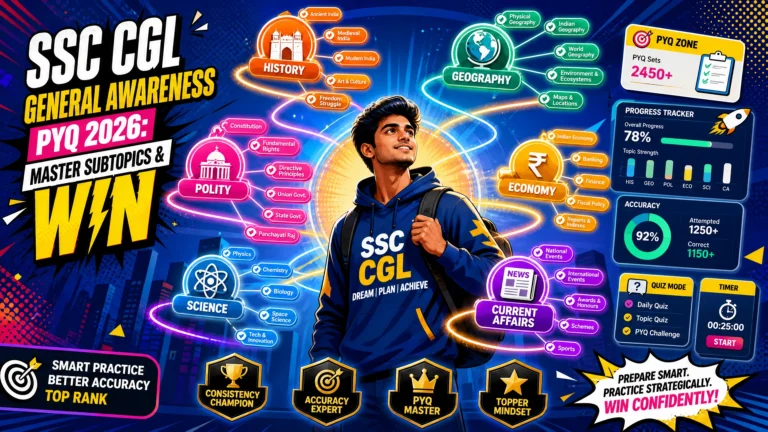
Toppers don’t just solve papers; they achieve topic mastery. They use tools like PYQKosh to practice subtopic-wise. By solving 50 questions on the ‘1857 Revolt’ back-to-back, you build muscle memory that no random PDF can give you. This organized approach is the only way to replace anxiety with confidence before the May 24 exam.
Deciphering the 2023-2025 Trend: What Changed in Prelims?
The 2023 paper was a total shocker, yaar. It felt like UPSC personally attacked everyone who spent years mastering “elimination tricks.” If you’re still relying on those old YouTube videos that teach you to “guess the wrong statement,” you’re in trouble for 2026. The game has changed completely.
The most brutal change is the rise of “Only one pair” or “Only two pairs” options. This format makes a single upsc pt question much harder because you can’t just find one error and solve the whole thing. You now have to know the truth about every single statement. There’s no room for half-baked knowledge anymore.
Environment and Economy have also shifted. UPSC is moving away from generic facts toward deep conceptual clarity. You’ll see questions where the answer depends on your understanding of how a specific ecological process works, not just a definition you memorized. Also, Map-based questions are now heavily linked to conflict zones and trade routes mentioned in current affairs.
The Shift in Question Phrasing
UPSC is now testing your patience along with your knowledge. The questions are wordier, and the options are designed to confuse a tired mind. Interestingly, the 2024 paper saw a subtle comeback of direct questions, but don’t let that fool you. The logic remains analytical.
You need to know which areas to hit hardest. Check our UPSC Prelims Topic Wise Weightage 2026 guide to see exactly where the Commission is focusing its energy lately. This helps you avoid wasting weeks on low-priority subtopics.
Subject-Wise Weightage Surprises
Ancient and Medieval History are no longer “skippable” topics. In the 2025 paper, these subjects carried significant weight, catching many aspirants off guard. You can’t just read Modern History and hope for the best anymore. Every subject requires a dedicated deep-dive.
- Science & Tech has moved from basic space facts to biotechnology and everyday applications.
- Polity now focuses more on the “spirit” of the Constitution rather than just Article numbers.
- Geography is becoming increasingly integrated with environmental changes.
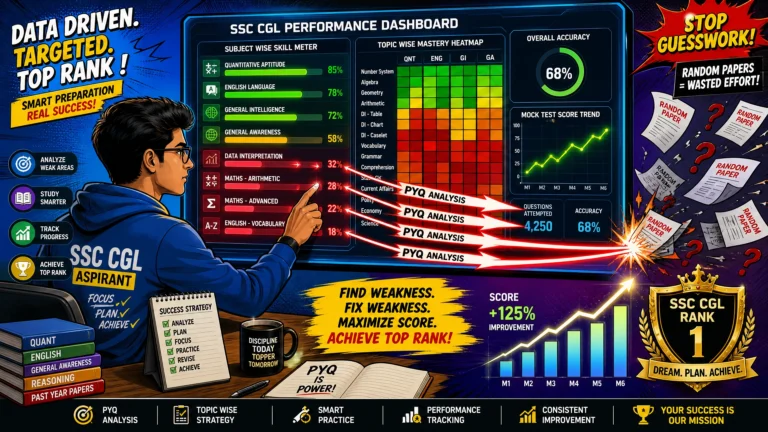
To stay ahead, you must use data-driven insights to prioritize your revision. Stop guessing and start using structured, analytical exam preparation to see where your accuracy actually stands. Knowing your weak spots now is better than finding them out in the exam hall on May 24.
Subtopic-Wise Practice: The Topper’s Secret for 2026
You’ve just finished reading 50 pages of Modern History and feel like you’ve conquered the world. But then, you face a specific upsc pt question on the 1857 Revolt and suddenly, everything feels blurry. This is the “Broad Subject Trap,” and it’s where most aspirants lose their way. Practicing an entire subject at once is like trying to learn to cook by reading an entire encyclopedia; it’s too much, too fast.
Topper banne ka shortcut isn’t about doing more; it’s about doing it smarter. When you solve 50 questions specifically on the 1857 Revolt back-to-back, you build muscle memory. You start seeing the patterns in how the Commission asks about leaders, regions, and causes. This deep-dive helps you identify your blind spots instantly. You might know the causes, but do you know the specific leaders in each region? Subtopic practice forces you to transition from passive reading to active solving without losing your momentum.
Mastering Subtopics with PYQKosh
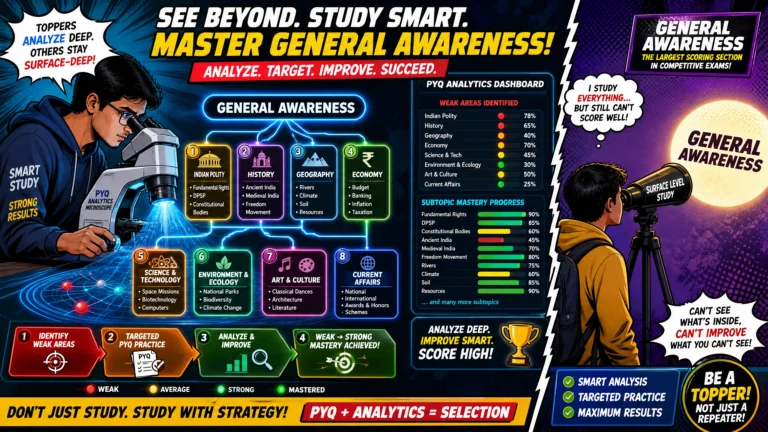
In PYQKosh, you can sort topics by question count to see exactly what UPSC loves the most. Don’t waste time on low-yield areas when you haven’t mastered the big ones. Use the Aaina dashboard to see your accuracy in ‘Parliament’ versus ‘Judiciary.’ Seeing your daily streaks on the dashboard keeps you motivated when the syllabus feels like an unscalable mountain. It turns your disorganized chaos into a focused, data-backed plan.
The Power of In-depth Explanations
Don’t just look at the right answer and move on, yaar. That’s a rookie mistake. You need to understand why the other three options were wrong. Our in-depth explanations include “Exam Booster Tips” to help you catch common traps set by examiners. This way, one well-analyzed upsc pt question becomes a mini-revision note for that entire subtopic. It’s about building a foundation that won’t crumble on exam day.
Start your journey toward topic mastery and stop guessing your way through the syllabus.
Avoiding the ‘Wrong Question’ Trap: A Step-by-Step Strategy
You finally finished a test, saw your score, and immediately closed the app. We’ve all done it, yaar. But ignoring your mistakes is the fastest way to fail the 2026 Prelims. It’s a painful habit that keeps you stuck in the same score range for months.
The biggest mistake aspirants make isn’t getting a upsc pt question wrong; it’s never looking at that mistake again. Your ‘Wrong Question’ list is actually your most important study material. It highlights exactly where your logic failed or where your conceptual clarity is thin. This is the real topper banne ka shortcut.
Instead of hoarding new PDFs, spend 15 minutes every morning in your ‘Wrong Question’ tab. Use frequency-based sorting to find errors you’ve made multiple times. If you keep getting the same concept wrong, that’s a red flag you can’t ignore. Fixing these repeated mistakes is how you actually jump from 80 to 110 marks.
Step 1: The First Attempt
Start by solving a subtopic-wise set in ‘Test Mode.’ This simulates the real pressure of the May 24 exam day. Don’t worry about the score right now. Focus on the logic behind your guesses and the speed of your decision-making.
If you find a question that makes you hesitate, use the bookmark feature immediately. Tagging questions you were ‘confused’ about helps you revisit them later. This ensures you don’t overlook a lucky guess that you didn’t actually understand.
Step 2: The Post-Test Analysis
Once the test is over, look at the subtopic-wise analysis. Did you lose marks in ‘Basic Structure’ or ‘Emergency Provisions’? Read the ‘Confusion Points’ in the explanation to clear your head. This structured, analytical exam preparation is what builds true confidence.
Start your UPSC CSE Practice to see how these detailed breakdowns turn a mistake into a lesson. You’ll understand why the other options were wrong, which is just as important as knowing the right one.
Step 3: The ‘Aaina’ Review
Check your weekly graph on the Aaina dashboard. It shows if your accuracy is actually going up or if you’re just spinning your wheels. Compare your rank with peers to stay grounded. It’s a healthy way to keep that fire burning without getting overwhelmed.
Re-solve your ‘Wrong Questions’ after exactly 3 days. This checks your retention and ensures the concept is actually locked in. If you get it right this time, you’ve officially turned a weakness into a strength. Practice your wrong questions now and stop the cycle of repeated mistakes.
Master Your UPSC PT Prep with PYQKosh
Still refreshing that Telegram group for the latest “secret” PDF? Let’s stop the cycle, yaar. You don’t need more files; you need a better way to solve them. Centralization is the only way to save your sanity when the syllabus feels like it’s exploding.
PYQKosh brings UPSC, SSC, and Railway questions together on one platform. This matters because many themes overlap across different government exams. Instead of hunting through messy folders, you get one-tap access to over 100,000 questions. It’s built by someone who understands the struggle, ensuring the features actually solve your daily problems.
You can easily fit a quick session into your day. Whether you’re waiting for your chai or sitting on a bus, the mobile-friendly UI makes it easy. You can solve a upsc pt question during your lunch break and see your accuracy instantly. This turns “dead time” into high-yield study time.
Practice Plans for Every Stage
Whether you’re a beginner starting from scratch or a veteran looking for that 10-mark jump, there’s a plan for you. You can use the sorting feature to focus on the most recent 2025-26 questions first. This ensures you’re always aligned with the latest Commission trends.
- Use ‘Practice Mode’ for casual learning when you want to read explanations.
- Switch to ‘Test Mode’ to build your speed and handle exam-day pressure.
- Track your progress at the subtopic level to see exactly where you stand.
- Sort topics by question count to prioritize high-yield areas first.
Your Path to the Final List Starts Here
It’s time to stop being a “collector” of study material and start being a “solver” of questions. Hoarding PDFs only gives you a false sense of progress. Real confidence comes from seeing your accuracy graph climb on the Aaina dashboard day after day.
Data-driven prep replaces your anxiety with organized clarity. When you know your accuracy in ‘Inflation’ is 85 percent but ‘Biotechnology’ is only 40 percent, you know exactly what to do next. You’re no longer guessing; you’re strategizing. This is how you work smarter, not harder, to make it to the final list.
Join thousands of aspirants who have traded disorganized chaos for structured, analytical exam preparation. Your 2026 attempt deserves more than just random guesses and static files. Take control of your preparation and start seeing real improvement in your scores today.
Go ahead and start your topic-wise practice now to see the difference for yourself.
Your 2026 Rank is Built on Today’s Practice
The May 24 exam is closer than it looks, yaar. You can either keep scrolling through endless Telegram folders or start building the surgical accuracy needed to clear the cutoff. Mastering every upsc pt question through subtopic-wise practice is worth more than reading ten generic PDFs that you’ll likely forget by tomorrow.
Success in 2026 requires moving beyond old elimination tricks. You must embrace a data-driven approach by focusing on your Wrong Question list and using the Aaina dashboard to track your weekly growth. With over 100,000 topic-wise questions and no-nonsense explanations for every right and wrong answer, you finally have a way to turn confusion into clarity.
Stop guessing your way through the syllabus and start solving with a strategy that actually works. You have the potential to see your name on that final list if you choose to work smarter starting today. Your future self will thank you for the discipline you show right now.
Start your subtopic-wise UPSC PT practice today on PYQKosh!
Frequently Asked Questions
Is it enough to solve only UPSC PT questions from the last 10 years?
No, solving only the last 10 years isn’t enough because the Commission changes themes every few years. While older papers help with basics, you need to focus on the 2023-2025 shift in every upsc pt question to understand the new analytical phrasing. Use a platform that lets you sort by year so you can prioritize the most recent patterns before the May 24 exam.
How can I find UPSC prelims questions categorized by subtopics?
You can find them on PYQKosh, where we’ve broken down broad subjects into tiny, manageable subtopics. Instead of just “Modern History,” you can practice “Governor Generals” or “Tribal Revolts” specifically. This level of detail helps you master one concept at a time rather than getting lost in a massive, disorganized GS paper.
What is the best way to use the ‘Aaina’ dashboard for UPSC prep?
Use it to replace your anxiety with data-driven clarity. The Aaina dashboard shows your accuracy in specific subtopics like “Parliament” versus “Judiciary.” If your weekly graph shows a dip in Science & Tech, you know exactly where to spend your next two hours. It’s about working smarter, not just harder, yaar.
Are the explanations on PYQKosh enough for conceptual clarity?
Yes, because we don’t just give you the right answer; we explain why the other three are wrong. Our in-depth explanations include “Exam Booster Tips” and “Confusion Points” to help you avoid common traps. This turns every upsc pt question into a mini-revision note that builds deep conceptual clarity for 2026.
Can I practice for both UPSC and SSC on the same platform?
Yes, centralization is a major feature of PYQKosh. You can switch between UPSC, SSC, and Railway exams with just one tap. Since many themes like Indian Polity or Geography overlap across different government exams, having everything in one place saves you from the frustration of Telegram hunting and messy PDFs.
How does the ‘Wrong Question’ tracker help in reducing negative marking?
It helps by forcing you to confront your repeated mistakes. The Wrong Question tracker automatically stores every error, letting you sort them by frequency or recency. By re-solving these specific questions every 3 days, you fix the conceptual gaps that usually lead to negative marking on the big day.
Why should I prefer subtopic-wise practice over full-length mock tests?
Subtopic-wise practice builds muscle memory that full mocks can’t give you. If you solve 50 questions on “Inflation” in one sitting, you’ll master the logic behind it forever. Full-length mocks are great for timing, but subtopic mastery is the real topper banne ka shortcut to ensure you don’t miss easy marks.
Is there a way to see which UPSC PT questions are most frequently repeated?
Yes, you can use our sorting feature to see topics organized by question count. This highlights what the Commission loves the most. By focusing on these high-yield subtopics from 2025-26 papers, you align your preparation with actual trends rather than just guessing what might come next.