
Article by
Aaisha
A passionate content writer at PYQKosh focused on simplifying Current Affairs and PYQs for competitive exam aspirants. I love turning complex topics into easy, student-friendly content that helps learners prepare smarter and stay consistent in their exam journey.
Why are you spending three weeks memorizing every minor medieval battle when Environment and Ecology could net you triple the marks in half the time? It’s a common trap that leads to massive syllabus paralysis. You feel like you’ve got to know everything, yet the clock is always ticking against you.
Most aspirants treat every subject as equal, but the data tells a different story. Understanding the upsc prelims topic wise weightage is the only way to escape the cycle of “hard work” that doesn’t yield results. You don’t need to study more; you need to study what actually appears on the paper.
This guide will show you exactly which high-yield topics deserve your focus for 2026. You’ll get a clear, data-driven plan to prioritize your studies. We’ll also show you how to use tools like topic-wise practice and the Aaina dashboard to track your progress and stop the guesswork for good.
Key Takeaways
- Master the “Power Couple” of Economy and Environment that consistently accounts for over 35 questions in the paper.
- Use our analysis of upsc prelims topic wise weightage to stop guessing and start focusing on what actually gets you marks.
- Identify the specific high-yield subtopics within Polity and History so you don’t get lost in massive textbooks.
- Build a data-driven revision plan by solving subtopic-wise PYQs that reveal your real preparation level.
- Track your accuracy and daily streaks with the Aaina dashboard to ensure you’re ready for the 2026 exam.
Why UPSC Prelims Weightage Analysis is Your Secret Weapon
Staring at a 1000-page Laxmikanth for the fifth time today? You aren’t alone, yaar. Most aspirants think finishing the book is the ultimate goal. But the real goal is clearing the cutoff. UPSC Prelims isn’t about reading everything. It’s about reading what actually matters.
Understanding the upsc prelims topic wise weightage acts like a high-performance filter for your brain. It helps you ignore the noise and focus on the signals. Instead of drowning in endless dates or obscure names, you focus on the themes that repeat year after year.
Smart aspirants use data to decide where to spend their precious 8 hours of daily study. They don’t treat every subject as a priority. They know that missing a minor detail in Ancient History won’t hurt as much as missing a core concept in the Economy. It’s about maximizing your return on investment for every hour you sit at your desk.
Subject vs. Topic: What the Toppers Know
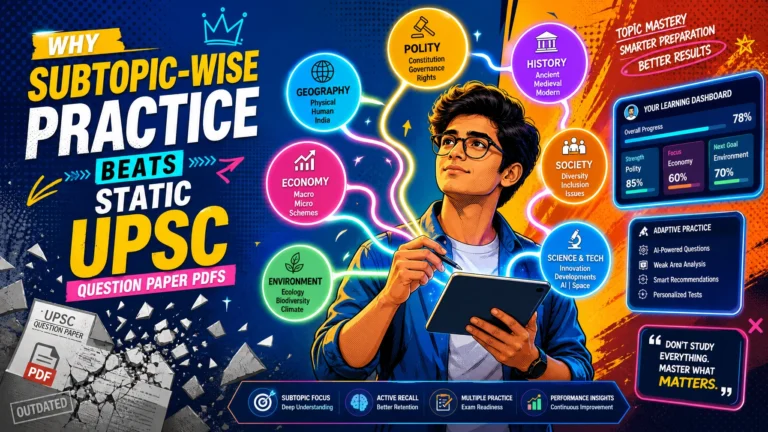
Everyone knows Polity is important. That’s basic knowledge. But toppers know that Preamble, Fundamental Rights, and the Parliament are absolute goldmines. They spend more time on these few subtopics than on all minor constitutional bodies combined.
Most aspirants fail because they focus on the wrong subtopics. They waste months on Medieval History while Environment carries double the marks. You need to shift from random reading to targeted, strategic action. Using topic-wise practice on PYQKosh helps you see these patterns instantly.
Don’t just read a chapter and move on. Solve the subtopic-wise PYQs to see if you actually understand the theme. If you can’t solve the questions, you haven’t mastered the topic, no matter how many times you read the book.
The ‘Unpredictable’ Myth of UPSC
People love to call UPSC “unpredictable.” They think it’s a gamble or a matter of luck. But if you look at the UPSC Civil Services Examination structure and the last 10 years of papers, the “unpredictability” starts to fade away.
Certain themes like Economy and Environment consistently carry the heavy lifting. They aren’t random occurrences. Using data-driven insights reduces your exam-day anxiety significantly. When you master the upsc prelims topic wise weightage, you walk into the exam hall with a clear plan.
You aren’t guessing anymore. You are executing a strategy based on facts. Use the Aaina dashboard to track your accuracy in these high-weightage zones. If your accuracy is low in a high-yield area, you know exactly where to fix your preparation before the big day. Structured, analytical exam preparation beats “hard work” every single time.
UPSC Prelims Subject Wise Marks Distribution: 10-Year Trends
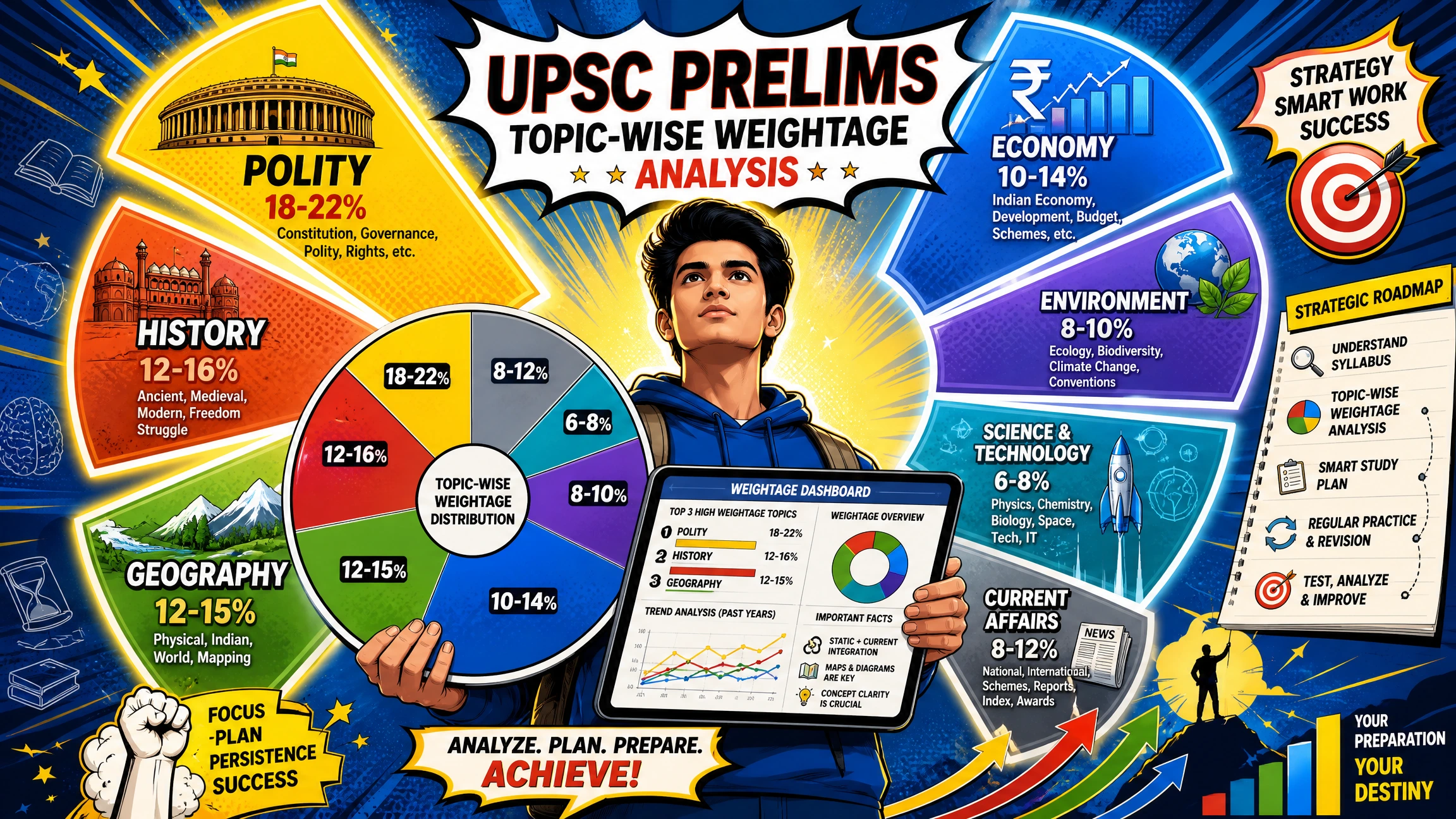
If you look at the data from 2016 to 2025, the pattern is clear. UPSC isn’t throwing darts at a board. They follow a logic that most people miss because they are too busy reading thick books. The real story lies in the upsc prelims topic wise weightage of the last decade.
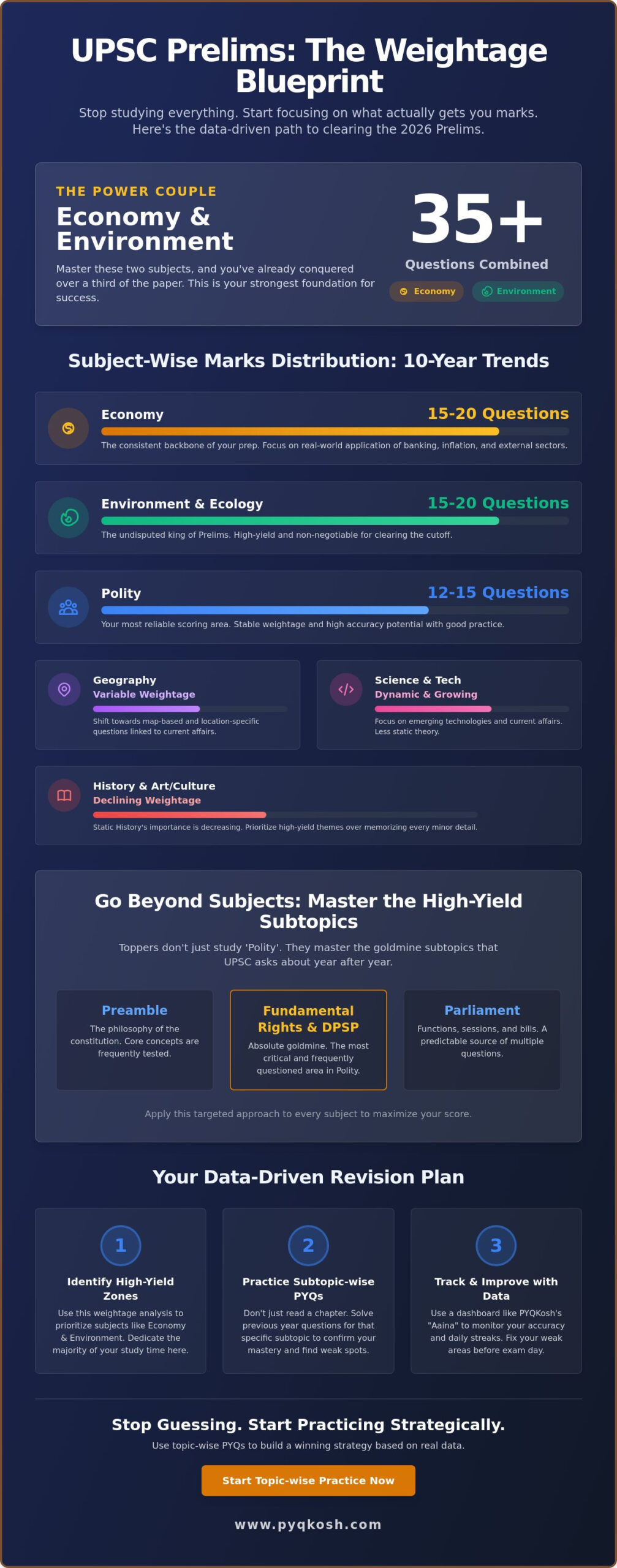
Economy and Environment have become the ‘Power Couple’ of Prelims. Together, they usually cross 35+ questions. If you master these two, you’ve already covered more than a third of the paper. Meanwhile, traditional ‘Static History’ is slowly declining in favor of more dynamic subjects like Science & Tech.
Polity remains the most reliable subject for any smart aspirant. While other subjects might throw bouncers, Polity stays stable. If you practice well, your accuracy here can easily reach 90%. You can verify the latest requirements on the Official UPSC Syllabus to stay aligned with the commission’s expectations.
The Core Subjects: Economy, Polity, and Geography
Economy is the backbone of your prep. You can almost guarantee 15-20 questions every year. It’s not just about theory anymore. UPSC wants to see if you understand how banking, inflation, and external sectors work in the real world.
- Polity: Expect 12-15 questions. The weightage is stable, making it the best subject to build your confidence and score high marks.
- Geography: The days of simple physical geography are gone. UPSC now focuses heavily on map-based and location-specific questions that test your awareness of current events.
To see how these subjects break down further, check out the topic-wise analysis on PYQKosh to focus your energy on the right chapters.
The Dynamic Subjects: Environment and Science & Tech
Environment is now the undisputed king of Prelims. Since the Preliminary exam is common for the Indian Forest Service (IFoS), the number of questions has stayed high, often hitting 15-20. It’s a high-yield area you cannot ignore if you want to clear the cutoff.
Science & Tech has also shifted gears. UPSC has moved away from basic school-level biology. Now, they want to know if you understand emerging tech, space missions, and biotechnology. It’s less about the textbook and more about what’s happening in the news today.
Current Affairs isn’t a separate subject anymore. It overlaps with everything. A question on the Economy is often just a Current Affairs question in disguise. Focus on the themes that have been trending over the last 10 years to stay ahead of the curve and avoid surprise on exam day.
High-Yield Subtopics: Where the Questions Actually Come From
Most websites tell you to “study History” or “focus on Polity.” That’s too broad, yaar. Toppers don’t just study subjects; they master specific subtopics. If you want to beat the competition, you need to know exactly which chapters carry the maximum weight.
Understanding the upsc prelims topic wise weightage at a subtopic level changes everything. It turns your 12-hour study sessions into high-impact missions. You stop reading 100 pages of fluff and start focusing on the 10 pages that actually appear on the OMR sheet.
In Polity, Fundamental Rights, DPSP, and the Parliament are your non-negotiables. If you haven’t mastered these, you aren’t ready. In Economy, the “repeat offenders” are Banking, Inflation, and the External Sector. These themes show up year after year without fail.
The History Trap: Ancient vs. Medieval vs. Modern
Don’t spend 2 months on Medieval History for just 2 questions, yaar. It’s a classic trap that drains your energy. Modern India (1857-1947) is still the king of History. It consistently offers the highest return on investment for your time.
- Modern History: Focus heavily on the Freedom Struggle and the various acts from 1773 to 1947.
- Art and Culture: Don’t read everything. Stick to Buddhism, Jainism, and Temple Architecture.
- Ancient History: Focus on the Indus Valley Civilization and the Gupta period.
You can use the topic-wise practice on PYQKosh to filter questions by these specific eras. This helps you see how the same themes keep coming back in different forms.
Geography and Environment: The Map Advantage
Mapping is the ultimate shortcut to 4-6 marks every year. You don’t need a PhD in Geography; you just need to know your way around a map. Focus on major rivers, mountain ranges, and volatile regions like West Asia.
Environment is equally predictable if you follow the news. ‘Species in News’ is the most consistent subtopic here. Keep an eye on Government of India announcements for new National Parks, Wildlife Sanctuaries, or International Conventions.
Environment is no longer just about definitions. It’s about how those definitions apply to the real world. Use the bookmark tab in PYQKosh to save tricky questions about National Parks or species. Revisiting these specific subtopics before the exam will give you a massive edge over those who just read textbooks.
How to Build Your Data-Driven Revision Plan
You’ve seen the upsc prelims topic wise weightage and you know the high-yield subtopics. Now what? Most aspirants just start re-reading their underlined notes. That’s a trap, yaar.
Real revision is data-driven. You need to identify your weak areas in high-weightage subjects like Economy and Polity immediately. Don’t just ‘feel’ like you know a topic. Prove it by solving subtopic-wise PYQs.
If your accuracy in ‘Fundamental Rights’ is below 80%, you don’t move on. You stay, you analyze the in-depth explanations, and you re-solve your mistakes. This is the only way to bridge the gap between studying and scoring.
Why Static PDFs are Killing Your Progress
Scrolling through a 100-page PDF is a waste of time. You can’t search, you can’t sort, and you definitely can’t track your progress. Structured, analytical exam preparation requires more than a static document.
You need to sort topics by question count and recency. Why waste time on a theme from 2012 when you could master a topic that appeared every year since 2021? Precision is the key to a 2026 success story.
Using a platform that lets you sort by year helps you stay relevant. Focus on the 2024 and 2025 trends first. This ensures your brain is tuned to the current “language” of UPSC rather than outdated patterns.
Tracking Your ‘Aaina’: The Mirror of Truth
You need a progress dashboard to see your streaks and weekly growth. Stop guessing your preparation level. The Aaina dashboard acts as the mirror of truth for your prep, showing you exactly where you stand.
Accuracy matters far more than the volume of questions you solve. If you’re hitting 50% accuracy in Environment, you’re in the danger zone. Use subtopic analysis to find exactly where you’re tripping up.
- Identify your ‘silly mistake’ patterns through subtopic-wise test analysis.
- Use the wrong questions tracker to automatically store and re-solve your errors.
- Focus on your weekly graph to ensure you’re actually improving over time.
Don’t just practice; practice with a purpose. Start building your data-driven study plan on PYQKosh to turn your weak areas into scoring zones and stop the cycle of random reading.
Master UPSC Prelims with PYQKosh Topic-Wise Practice
Still solving random mixed bags of questions from random Telegram groups? That’s the fastest way to stay confused, yaar. You’ve already seen the upsc prelims topic wise weightage, so your practice must match those priorities. PYQKosh gives you access to over 100,000 questions across UPSC, SSC, and other major exams.
Stop scrolling through unorganized PDFs that lead nowhere. Use the ‘Wrong Question’ tab to automatically track every mistake you make. You don’t have to manually note down errors anymore. Our Aaina dashboard shows you exactly where you stand among your peers, turning your anxiety into organized clarity.
Practice subtopic-wise to align your prep with the weightage we just discussed. If the data says ‘External Sector’ is high-yield, you should be solving those specific questions until you can’t get them wrong. This isn’t just about hard work; it’s about the topper banne ka shortcut through structured, analytical exam preparation.
The Power of Subtopic-Wise PYQs
Don’t just solve ‘Polity’ for three hours and call it a day. Solve ‘Parliament’ specifically to build real mastery. When you practice at the subtopic level, you start seeing the patterns that UPSC uses to frame questions. It’s about depth, not just finishing a subject.
Every question on our platform comes with in-depth explanations. We don’t just tell you the right answer; we explain why the other three options are wrong. You’ll find exam booster tips and confusion points for every high-yield topic to ensure you don’t fall for common traps on exam day.
- Focus on specific themes like ‘Buddhism’ or ‘Inflation’ to bridge your knowledge gaps.
- Track your accuracy at the subtopic level to see where you actually need to improve.
- Use bookmarks to save tricky questions and revisit them during your final revision.
Multi-Exam Support for the Versatile Aspirant
Are you preparing for UPSC CSE and CAPF together? We’ve got you covered. You can switch between exams easily and track your progress for each without losing your momentum or your data.
Using the upsc prelims topic wise weightage as your roadmap, you can prioritize the most relevant questions from our massive database. This multi-exam support ensures you don’t waste time looking for scattered resources across different websites.
Stay updated on high-weightage dynamic topics with our Current Affairs section. It’s designed to complement your static prep, ensuring you’re ready for the maps, species, and reports that UPSC loves. Stop guessing and start scoring by making data your best friend in this journey.
Go to PYQKosh and solve 20 questions on your weakest high-weightage subtopic right now.
Take Control of Your 2026 Attempt
You’ve got the roadmap now. You know that mastering the upsc prelims topic wise weightage isn’t about luck; it’s about strategy. Stop getting lost in 1,000-page textbooks and start focusing on the specific high-yield subtopics that actually show up on the OMR sheet. You don’t need to know everything; you just need to know what matters.
It’s time to move away from random reading and switch to structured, analytical exam preparation. With over 100,000+ Questions and subtopic-wise test analysis at your fingertips, you can identify exactly where you’re losing marks before it’s too late. This data-driven approach turns your hard work into actual scores that clear the cutoff.
Don’t let another day go by just ‘feeling’ prepared. Check your Aaina progress dashboard to see your real accuracy and rank among your peers. You’ve got the potential to clear this exam, yaar; you just need the right strategy and the right tools to make it happen.
Stop wasting time and start practicing UPSC subtopic-wise PYQs now!
Keep pushing forward, stay focused on the data, and make every study hour count toward your success.
Frequently Asked Questions
Which subject has the highest weightage in UPSC Prelims?
Economy and Environment currently carry the highest weightage in the exam. These two subjects combined often account for 35 to 40 questions every year, making them the most critical areas for your preparation. If you master these two, you’ve already covered a huge chunk of the marks needed to clear the cutoff. don’t waste time on low-yield areas until these are solid, yaar.
Is the weightage of CSAT increasing in UPSC Prelims?
The number of questions in CSAT stays at 80, but the difficulty level is definitely increasing. You still only need 33% to qualify, but the math and logic parts are getting trickier every year. Don’t leave it for the last month. Practice regularly to avoid a last-minute panic, as failing CSAT while clearing GS is a common heartbreak for many aspirants.
How many years of PYQs should I solve for UPSC Prelims 2026?
You should solve at least the last 10 years of PYQs to understand the current trends. Focus heavily on the papers from 2016 to 2025 as they reflect the modern upsc prelims topic wise weightage accurately. You can use PYQKosh to sort these questions by recency and count to ensure you are studying the most relevant themes first.
Can I clear UPSC Prelims by only focusing on high-weightage topics?
Focusing on high-weightage topics is the best way to build a strong foundation, but you shouldn’t ignore the rest completely. Use weightage as a guide to decide how much time to spend on each chapter. It’s a topper banne ka shortcut to ensure you don’t miss the high-scoring zones while still maintaining a basic understanding of other subjects.
What are the most important subtopics in Indian Economy for UPSC?
Banking, Inflation, and the External Sector are the most important subtopics in the Indian Economy. UPSC consistently asks about monetary policy, exchange rates, and balance of payments. Practice these subtopics specifically on PYQKosh to see how the questions are framed year after year and use the in-depth explanations to clear your concepts.
How does weightage help in prioritizing current affairs?
Understanding the upsc prelims topic wise weightage helps you filter the massive amount of daily news into manageable bits. If you know Environment has a high weightage, you’ll naturally pay more attention to news about National Parks or new species. This data-driven approach prevents you from wasting hours on random news that UPSC rarely touches.
Does UPSC repeat questions from previous years?
Exact questions are rarely repeated, but the themes and concepts are repeated very often. UPSC loves to ask about the same core ideas in different ways across different years. By using the wrong questions tracker, you can master these recurring themes and ensure you don’t make the same mistake twice when a familiar concept appears.
Is it better to study subject-wise or topic-wise?
Topic-wise study is far more effective than broad subject-wise reading for high-stakes exams. When you break a subject down into subtopics, you build deeper mastery and can track your progress more accurately. Use the Aaina dashboard to see your performance at the subtopic level and fix your weak spots before the actual exam day.