
Article by
Aaisha
A passionate content writer at PYQKosh focused on simplifying Current Affairs and PYQs for competitive exam aspirants. I love turning complex topics into easy, student-friendly content that helps learners prepare smarter and stay consistent in their exam journey.
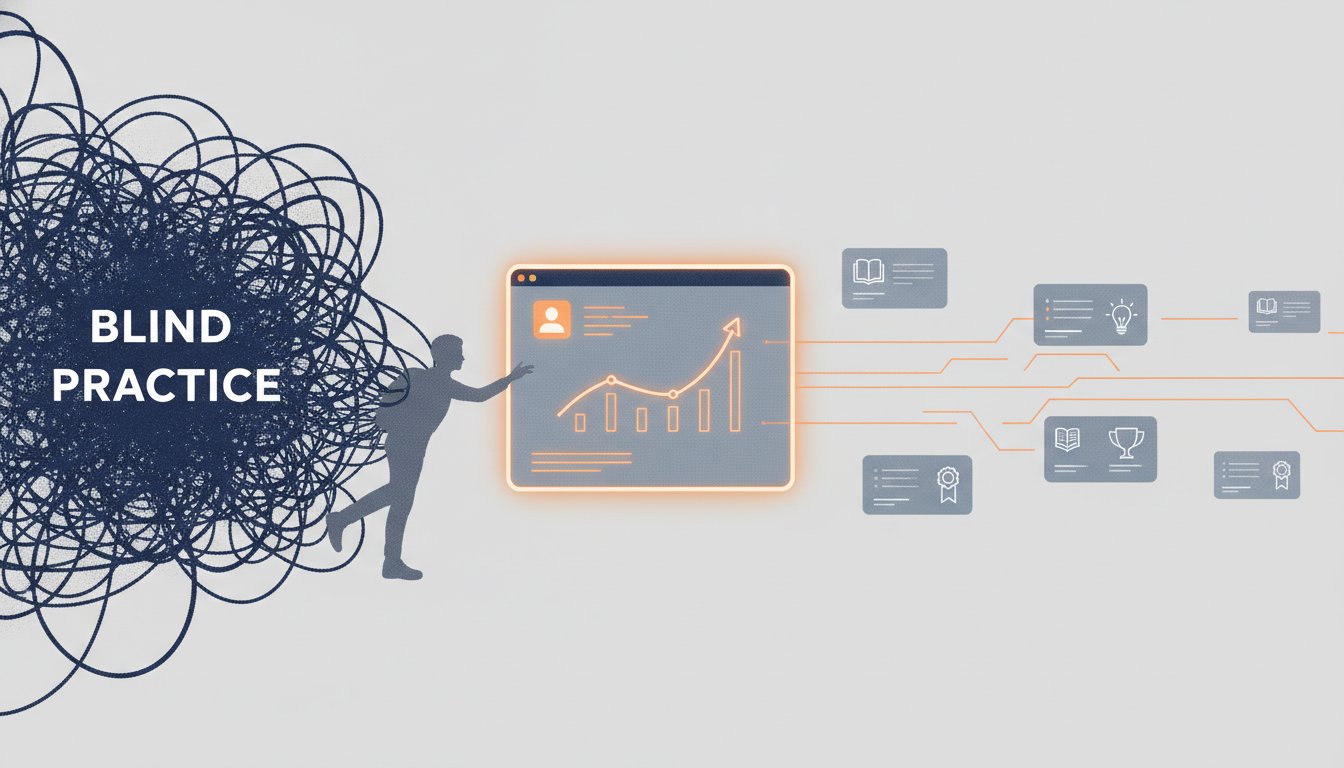
You have been sitting at your desk for six hours, surrounded by a mountain of Telegram PDFs and messy notebooks, yet your mock scores haven’t budged in weeks. It’s frustrating, yaar. You feel like you’re grinding every single day, but you have no clue which specific subtopic is actually pulling your rank down. This “blind practice” is exactly why many hardworking aspirants get stuck in the cycle of near-misses.
Using a dedicated exam performance tracking tool is the only way to stop the guesswork and start seeing a real mirror of your progress. We’ve all felt that anxiety of not knowing if our preparation is actually moving forward or just spinning in circles. It’s time to stop wasting hours on topics you already know and start fixing the gaps that matter.
In this guide, you’ll learn how to use data-driven tracking to pinpoint subtopic weaknesses and boost your accuracy for SSC, UPSC, and Railway exams. We will show you how to turn your disorganized practice into a structured, rank-clinching strategy for 2026. It is time to stop running in the dark and start practicing with a clear map to success.
Key Takeaways
- Stop wasting months on random PDFs and learn why “blind practice” keeps your scores stuck at a plateau.
- Discover how a subtopic-level exam performance tracking tool helps you identify the exact weak areas that pull down your rank.
- See how the “Aaina” dashboard acts as a real-time mirror, showing your accuracy and daily streaks without any sugarcoating.
- Learn a structured revision strategy to target subtopics where your accuracy is below 50% using automated mistake tracking.
- Find out how to save two hours of study time every day by centralizing your PYQ practice and analysis in one place.
The ‘Blind Practice’ Trap: Why Hard Work Isn’t Reflecting in Your Scores
You’ve solved 5,000 questions from various Telegram groups, but your mock scores are still stuck at 70%. It feels like hitting a brick wall. This is the “Plateau Effect,” where your progress stops because you’re practicing what you already know, not what you actually need to fix.
Solving random PDFs is like running in the dark without a map. You’re doing the mehnat, but it’s disorganized. Without a proper exam performance tracking tool, you can’t see the specific subtopics that are quietly killing your rank. Hard work without data is just a gamble, yaar.
A data-driven exam performance tracking tool is more than just a score calculator. It acts as a digital mentor, replacing “topper logic” with actual evidence of your strengths and weaknesses. It follows the principles of formative assessment, where you use ongoing feedback to improve while you’re still in the learning phase.
The Problem with Traditional PDF Practice
PDFs are static and they don’t talk back. They won’t tell you that you’ve missed the same “Governor General” subtopic three times this week. Manual tracking in a notebook is an even bigger headache. It takes more time than the actual study session, which is a total waste of your energy.
- PDFs lack peer context, so you don’t know if a question was actually tough or if you were just slow.
- Manual logs are hard to analyze over a long period.
- Searching through old papers to find mistakes is frustrating.
What Your Brain Can’t Track (But a Tool Can)
Your brain is great at learning, but it’s terrible at keeping a precise log of every mistake. You might think you’re good at History, but data might show your accuracy in “Ancient India” is only 40%. An exam performance tracking tool highlights these hidden metrics that decide your final selection.
Speed and accuracy are the two pillars of success. If you’re fast but inaccurate, you lose marks to negatives. If you’re accurate but slow, you never finish the paper. Tools like the PYQKosh Aaina dashboard track your consistency streaks and subtopic weightage, showing you exactly where to focus your limited time. Start practicing with a plan today.
Anatomy of a High-Yield Exam Performance Tracking Tool
A high-yield exam performance tracking tool isn’t just a fancy stopwatch or a simple score calculator. It’s a system that breaks down your entire preparation into the smallest possible pieces. Most aspirants think in terms of “Subjects,” but the real selection happens at the “Subtopic” level. If you don’t know exactly where you are losing marks, you are just practicing for the sake of it, yaar.
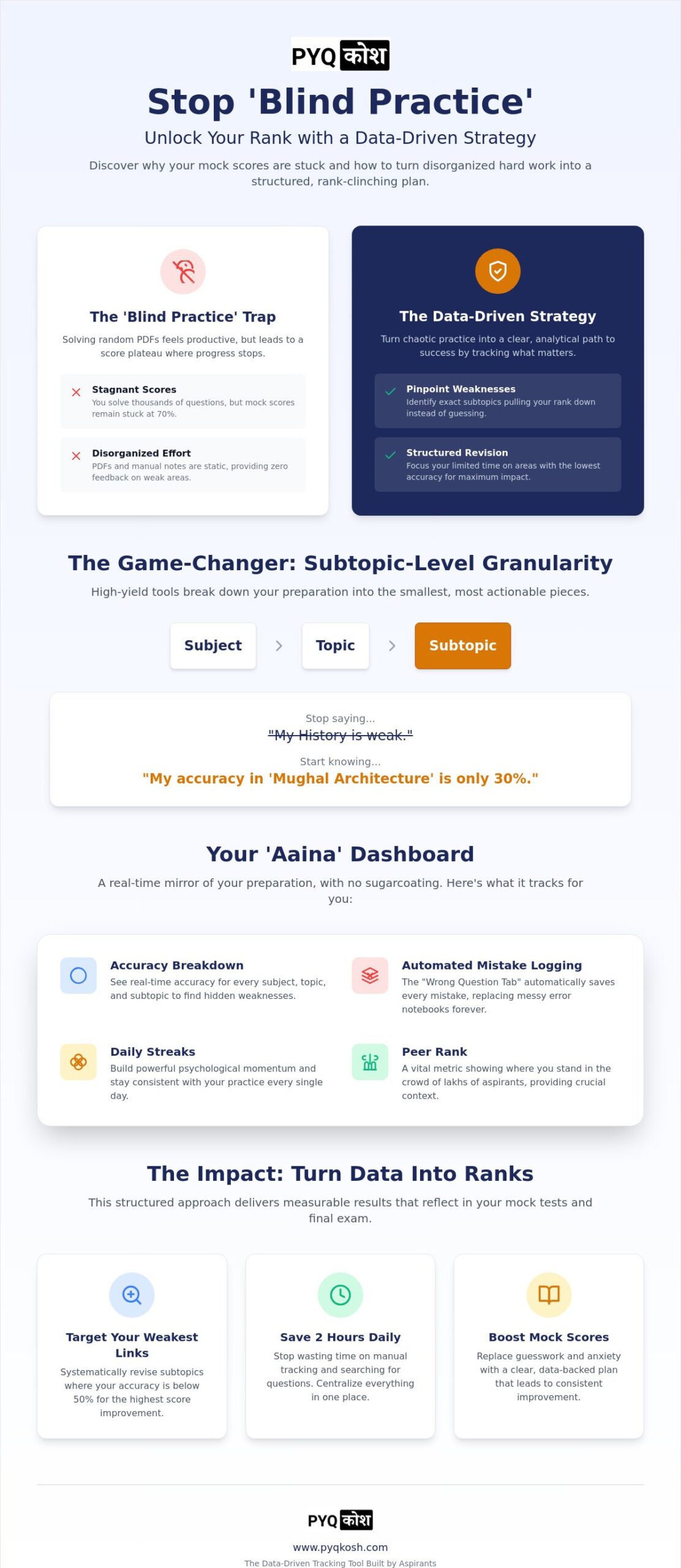
The gold standard of tracking follows a clear hierarchy: Subject > Topic > Subtopic. This structure allows for data-driven performance analysis that stops you from fighting invisible ghosts. Instead of feeling overwhelmed by a whole subject, you get a clear list of specific areas to attack. It turns your chaotic preparation into a structured, rank-clinching strategy.
Subtopic-Level Granularity: The Real Game Changer
Saying “My History is weak” is too broad and honestly quite scary. But if your tracking tool shows that “Mughal Architecture” is where your accuracy drops to 30%, you have a specific target. This granularity helps you identify “Confusion Points”—those tricky areas where you always pick the wrong option among two close choices.
In 2026, exam patterns are shifting fast. You need to sort your practice by recency to see 2025-26 question trends. This ensures you aren’t wasting time on outdated patterns while the actual exam has moved on. Focusing on these high-yield subtopics is the real topper banne ka secret.
Visualizing Progress with Dashboards
The “Aaina” dashboard acts as your daily mirror. It uses weekly graphs to show if you’re actually improving or just repeating the same mistakes. Seeing your accuracy breakdown in real-time gives you a reality check that no PDF can ever provide. It’s about seeing the truth of your preparation, no sugarcoating allowed.
- Daily streaks: These use psychological momentum to keep you consistent every single day.
- Peer rank: A vital metric that shows where you stand in the bheed of 10 lakh aspirants.
- Automated mistake logging: The “Wrong Question Tab” replaces those messy, manual error notebooks forever.
Stop guessing which topics to study next and let the data guide your schedule. You can explore how structured tracking works to see your own progress mirror today. By automating your mistake tracking, you save at least an hour of manual work every day, giving you more time to actually learn and clear the cut-off.
Manual Tracking vs. Structured Dashboards: Why You Need an ‘Aaina’
Think about that fat “Error Notebook” you started with so much hope. You probably haven’t opened it in weeks because it’s a mess, yaar. Manual tracking is slow and painful. A digital exam performance tracking tool acts as an “Aaina” (Mirror) that shows your preparation exactly as it is. It gives you a real-time view of your status without any sugarcoating.
Centralization is the real game changer here. Most aspirants waste time juggling 50 different Telegram PDFs and heavy books. When you have everything on one dashboard, you save at least two extra hours of study time every day. You can see your accuracy and daily practice streaks in one glance. You aren’t just practicing; you are managing your time like a topper.
The Notebook Method fails because it lacks a search function. You can’t filter your mistakes by “most frequent” or “most recent” in a physical diary. A digital dashboard does this automatically in the Wrong Question Tab. It organizes your chaos so you can focus on learning instead of bookkeeping. This shift from manual to digital is the first step toward a smarter 2026 preparation.
The Efficiency Factor
Finding specific SSC CGL topic wise previous year questions takes seconds. You get instant explanations for every question, covering both right and wrong options plus confusion points. This eliminates the need for bulky physical books and dusty stacks of paper. Your entire study material lives right on your phone.
You can sort topics by question count or recency, like focusing on 2025-26 patterns. This keeps your practice relevant to the current exam climate. You don’t have to manually count how many times a topic appeared; the exam performance tracking tool does the heavy lifting for you. This speed allows you to finish your revision cycles much faster than your competitors.
Psychological Benefits of Data-Driven Prep
Exam anxiety usually comes from the “unknown.” When you don’t know why your scores are low, you panic. But when you see your strong subtopics marked in “Green” on your dashboard, your confidence builds naturally. You know exactly which areas need a little more push. It replaces fear with a clear, actionable plan.
Daily streaks and weekly graphs provide a sense of momentum. Seeing your peer rank move up acts as a healthy reality check. Data turns your daily grind into a clear, winning strategy for 2026. It makes the massive syllabus feel manageable and less intimidating for every serious aspirant. You stop feeling like a victim of the syllabus and start feeling like the master of your data.
Strategic Revision: Using Performance Data to Kill Your Weaknesses
Most aspirants think revision means rereading the same thick books from page one. That’s a trap, yaar. You end up wasting time on things you already know while your actual weaknesses stay hidden. A smart exam performance tracking tool turns revision into a targeted strike against your mistakes.
The secret to a topper’s rank isn’t studying more; it’s studying what they missed. By using the data from your practice sessions, you can stop the “hit and trial” method. Follow these four steps to clean up your preparation before the 2026 exams arrive.
- Identify subtopics with less than 50% accuracy on your Aaina dashboard.
- Use the Wrong Question Tab to re-attempt specific mistakes until they click.
- Bookmark Exam Booster Tips and Confusion Points for your final 7-day revision.
- Monitor your Peer Rank to see how your standing improves as you fix weak areas.
The Power of the Wrong Question Tracker
Your mistakes are actually your best teachers if you track them properly. In the Wrong Question Tab, you can sort your errors by frequency. If you see a question you’ve fumbled three times, you know exactly where your concept is weak. It’s better to fix it now than in the exam hall.
The “Recently Committed” filter is another life-saver. It lets you correct errors while the logic is still fresh in your mind. Instead of just seeing a red cross, read the in-depth explanations to understand why the other options were wrong. This is how you turn a “Wrong” into a permanent “Right.”
Bookmarking for Last-Minute Success
When the exam is only a week away, you can’t afford to scroll through thousands of questions. This is where the Bookmark Tab becomes your personalized study material. You can save questions by subject, topic, or even subtopic to create a high-speed revision list.
Saving “Confusion Points” helps you avoid those silly mistakes that usually happen under pressure. You can even check out UPSC PYQ strategies for better subtopic-wise practice. Having these bookmarks ready means you won’t have to hunt through dusty PDFs at the last minute.
Stop repeating the same old mistakes and start your data-driven revision on PYQKosh today to see the difference in your next mock test. Targeted revision is the only shortcut to clearing the cut-off in one go.
PYQKosh: The Data-Driven Tracking Tool Built by Aspirants
PYQKosh isn’t just another app built by a corporate team. It’s a platform made with love by people who have actually faced the same struggle as you. We know how it feels to drown in PDFs and lose track of which topic needs more work. That’s why we organized over 1 lakh questions exactly the way an aspirant thinks.
The Aaina Dashboard becomes your daily partner in this journey. It doesn’t just show a score; it shows your accuracy, daily streaks, and peer rank. Whether you are preparing for SSC, UPSC, or Railway exams, you can track everything in one place. No more jumping between different books or apps for different exams, yaar.
This tool provides a structured, analytical exam preparation experience that replaces random effort with precision. You get to see your progress at a subtopic level, which is the real secret to clearing the cut-off. It’s about working smarter, not just harder, to ensure your name is on the final list. No fluff, just results.
Everything You Need in One Place
You can switch between Practice and Test modes for every single subtopic. Practice mode lets you learn at your own pace, while Test mode gives you a real exam-like feel. This flexibility is essential for building both concepts and speed simultaneously.
We’ve also included Exam Booster Tips in the explanations. These act like a senior’s secret notes, highlighting exactly where aspirants usually make mistakes. You can explore SSC CGL specific practice to start your tracking journey and see these tips in action.
The Wrong Question Tab automatically stores your fumbles so you don’t have to. You can sort them by recency or frequency to make your revision sessions super productive. It’s the ultimate topper banne ka shortcut that saves you hours of manual work every week.
Join the Smart Prep Revolution
Stop wasting your precious time on random practice that doesn’t show results. It is time to start using a structured exam performance tracking tool to take control of your preparation. Data doesn’t lie, and your Aaina will show you the exact path to success.
Getting started is easy. Pick one subtopic you find difficult and attempt a small test today. See your accuracy, read the explanations, and watch your progress graph move. This small habit of data-driven tracking will be the biggest difference in your 2026 results.
Just try one subtopic test and see your Aaina today.
Take Control of Your 2026 Selection Today
You’ve seen how random practice leads to a score plateau. It’s time to stop the guesswork and start using a strategy that actually works. By focusing on subtopic-level weaknesses, you turn your preparation into a rank-clinching machine.
A dedicated exam performance tracking tool isn’t just a luxury. It’s a necessity for anyone serious about clearing the cut-off. With 100,000+ subtopic-wise PYQs, you can target the exact areas that need more work.
The Aaina Dashboard gives you a clear mirror of your progress. Peer ranking shows exactly where you stand in the bheed. Whether you’re aiming for SSC, UPSC, or Railways, centralization is the real topper banne ka secret, yaar.
Don’t let another month pass by in disorganized chaos. Use the data to kill your weaknesses and build the confidence you need for exam day. You have the potential to clear this; you just need the right mirror to see your path clearly.
Start tracking your subtopic-wise progress on PYQKosh today!
Frequently Asked Questions
What is an exam performance tracking tool and how does it help?
An exam performance tracking tool is a digital mentor that monitors your practice and test attempts. It helps by replacing “topper logic” with actual data, showing you exactly which subtopics are pulling your rank down so you can fix them before exam day.
Can I track my performance for multiple exams like SSC and UPSC together?
Yes, you can track your preparation for SSC, UPSC, Railway, and other government exams on a single dashboard. This centralization stops you from juggling different apps and keeps your data-driven progress organized in one place, yaar.
Is it better to track progress by topic or by subtopic?
Tracking by subtopic is the gold standard for serious selection. While a broad topic like “Polity” might look okay, subtopic tracking reveals if you’re specifically fumbling in “Fundamental Rights,” allowing for a much more targeted and effective revision strike.
How does the Aaina dashboard help in daily consistency?
The Aaina dashboard acts as your daily mirror by showing your practice streaks and accuracy graphs. Seeing your daily chain grow creates psychological momentum that keeps you consistent, making the massive syllabus feel manageable and less intimidating every single night.
What should I do with the ‘Wrong Question’ data provided by the tool?
Use the Wrong Question tab to sort your mistakes by frequency or recency. Re-attempt these specific questions and read the in-depth explanations to clear your confusion points, ensuring you turn those “red” marks into permanent “green” ones in your next test.
Do I still need to maintain a separate notebook for my mistakes?
You don’t need to waste time on manual error notebooks anymore. The exam performance tracking tool automatically logs every mistake and lets you bookmark tough questions, saving you at least two hours of manual work every day that you can use for actual study.
How can I compare my performance with other toppers?
You can use the Peer Rank feature to see exactly where you stand in the bheed of 10 lakh+ aspirants. This real-time reality check shows your standing in terms of accuracy and speed, motivating you to push harder to reach the top of the leaderboard.
Is a performance tracking tool useful for the final 30 days of preparation?
It is most critical during the final 30 days for high-speed, targeted revision. Instead of rereading entire books, you focus only on subtopics where your accuracy is below 50% and review your bookmarked questions to boost your final score quickly.