
Article by
Aaisha
A passionate content writer at PYQKosh focused on simplifying Current Affairs and PYQs for competitive exam aspirants. I love turning complex topics into easy, student-friendly content that helps learners prepare smarter and stay consistent in their exam journey.
Most aspirants think reading a textbook five times is the secret to clearing the May 24, 2026 exam. It isn’t. You can memorize every fact in a bulky PDF and still fail because you haven’t mastered the upsc pyq prelims patterns.
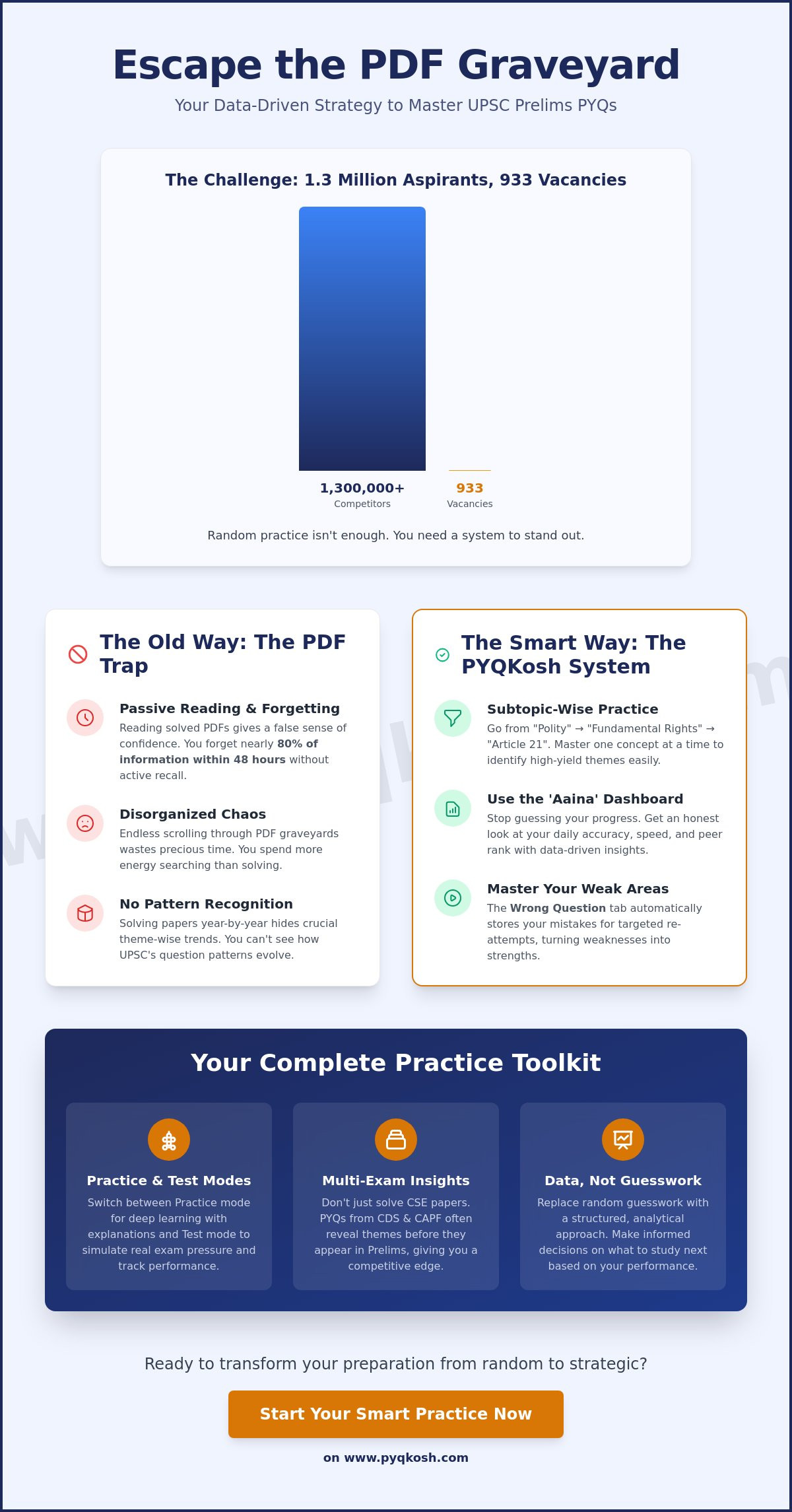
It’s exhausting to repeat the same mistakes in every mock test. You feel the pressure of 1.3 million competitors and 933 vacancies, but your scores won’t budge. I’ve been there, and I know that drowning in unorganized data is the fastest way to burnout.
I promise you don’t need more notes. You need a better system. This plan will teach you how to use subtopic-wise upsc pyq prelims analysis to find high-yield themes and stop wasting time on irrelevant, old patterns.
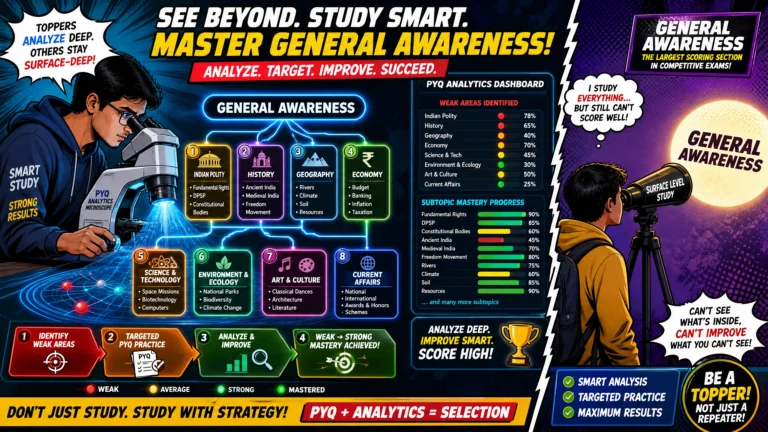
We’ll look at how to track your daily accuracy with the Aaina dashboard and use the Wrong Question tab to fix your weak areas. Let’s turn your preparation from random guesswork into a data-driven strategy that actually works.
Key Takeaways
- Stop scrolling through disorganized PDFs and start focusing on high-yield themes using a structured, subtopic-wise approach.
- Identify shifting exam patterns by filtering 2024-25 upsc pyq prelims to see exactly how question language has evolved.
- Use the Aaina dashboard to get an honest look at your daily accuracy and peer rank so you can stop guessing your progress.
- Master your weak areas automatically with the Wrong Question tab, which stores your mistakes for targeted re-attempts.
- Build exam-day stamina by switching between Practice mode for deep learning and Test mode for real-time performance tracking.
The UPSC PYQ Prelims Trap: Why PDFs Are Killing Your Rank
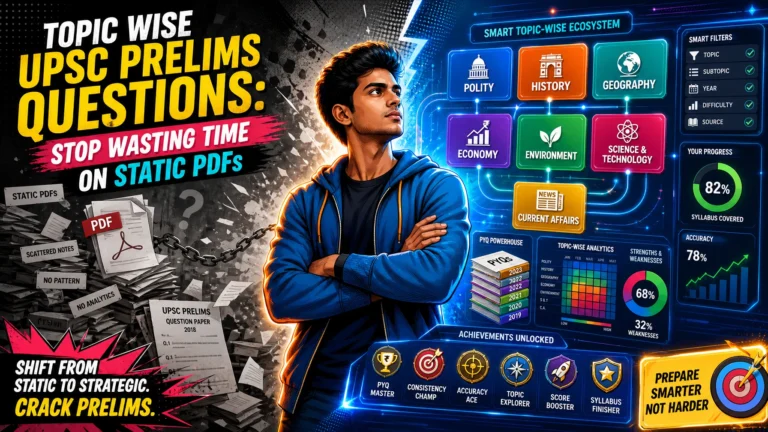
Open your laptop right now. You probably have a folder titled “UPSC Materials” that is actually a PDF graveyard. It’s filled with hundreds of “Solved upsc pyq prelims” files you downloaded in a burst of motivation but never actually finished. This digital clutter is the biggest hurdle between you and the cutoff.
Scrolling through 25 years of raw papers without any structure is a massive waste of time. You spend more time looking for the right page than actually solving questions. This disorganized mess takes a heavy psychological toll. You feel like you’re working hard, yet you still freeze when a mock test throws a tricky “Statement 1 and 2” question at you.
The UPSC Civil Services Examination isn’t a test of how much you can read. It’s a test of how quickly you can recall and apply facts under pressure. You need to stop “reading” and start “solving.” Transitioning to a timed environment is the only way to build the reflexes needed for the May 24 exam. If you don’t practice like it’s the real day, you’re just daydreaming with a PDF open.
Passive Reading vs. Active Solving
Reading a solved PDF is a dangerous trap. Your brain sees the correct answer in bold and tricks you into thinking, “I already knew that.” This is a false sense of confidence. Research shows you forget nearly 80% of what you read passively within 48 hours. You aren’t building neural paths; you’re just looking at words.
Active recall is the topper banne ka shortcut. When you use practice mode on a platform like PYQKosh, your brain has to work to find the answer. This struggle is what builds permanent memory. It turns a vague concept into a solid fact you can rely on during those two intense hours in the exam hall. Don’t just consume data; force your brain to produce answers.
The Mess of Unorganized Data
UPSC doesn’t ask questions year-wise. It asks them theme-wise. If you’re practicing the 2015 paper today and the 2019 paper tomorrow, you’ll never spot the trends. You need to see every Preamble question from the last 30 years in one sitting. This is how you recognize the examiner’s favorite trap doors and “only/always” word patterns.
Random practice leads to zero pattern recognition. You might solve 100 questions but learn nothing about how UPSC’s language has shifted in 2024 and 2025. By using topic-wise practice, you centralize your effort. You master one subtopic, track your accuracy, and move on. This structured approach replaces disorganized chaos with data-backed clarity, making the path to the cutoff feel manageable rather than impossible.
What Makes a Perfect UPSC Prelims PYQ Practice Plan?
Toppers always say “analyze PYQs,” but they rarely give you the actual roadmap. It feels like a secret club where you don’t have the password. A perfect plan for 2026 isn’t about solving 10,000 random questions. It’s about being a “Smart Aspirant” who follows a framework of structure, analysis, and repetition. Without these three pillars, you’re just guessing.
Your upsc pyq prelims strategy should treat every question like a mini-lesson. It isn’t just about finding the right option. You need to know exactly why the other three are wrong. That’s where the real learning happens. If you only look at the correct answer, you’re missing 75% of the value. A structured plan helps you spot the recurring traps UPSC sets, turning you from a nervous candidate into a confident solver.
Topic-Wise vs. Subtopic-Wise Granularity
Studying “Polity” is too vague. You can’t just sit down and say “I’ll do Polity today.” That’s how you get overwhelmed and quit after an hour. A smart plan breaks it down further. You move from Polity to Fundamental Rights, and then specifically to Article 21. This level of granularity is the only way to master tough sections like Environment or Science and Tech.
When you focus on subtopics, you see how UPSC has asked about “Wetlands” or “National Parks” across different years. You start to notice they love certain keywords. This is why UPSC CSE practice on PYQKosh is designed with this specific depth in mind. It helps you build a mental map of what’s actually high-yield so you don’t waste time on filler content.
The Power of Multi-Exam Insights
Many aspirants make the mistake of only looking at CSE papers. Big mistake, yaar. UPSC often tests themes in CDS or CAPF before they appear in the Civil Services prelims. The examiner’s mind works similarly across these exams, especially for History and Geography. If you ignore these, you’re leaving marks on the table.
Your practice plan must include these overlapping questions. If a specific map-based theme appears in CDS 2025, it’s a huge hint for your 2026 prelims. By using a platform that offers multi-exam upsc pyq prelims support, you get a 360-degree view of the examiner’s favorite topics. It’s like getting a sneak peek at the question bank before the big day. You can easily switch between these exams on PYQKosh to ensure your preparation is truly comprehensive.
Mastering Subtopic Trends for 2026
Ever felt like you’re studying for an exam that doesn’t exist? You spend weeks on a minor topic, only to find zero questions on it in the actual paper. It’s frustrating, yaar. The truth is, UPSC has “crushes”—specific subtopics they return to year after year. To clear the May 24, 2026 Prelims, you need to know exactly where the examiner is looking.
Mastering the upsc pyq prelims isn’t about doing every question with the same intensity. It’s about spotting the high-yield themes that give you the maximum return on your time. Why waste five days on a niche topic that appears once a decade when Mapping or Buddhism and Jainism show up almost every time? Stop guessing and start using structured, analytical exam preparation to find these patterns.
Instead of relying on luck, use data. Sort your practice by question frequency. This ensures your study schedule prioritizes the areas that actually matter. It’s the difference between working hard and working smart. When you see a subtopic with 20 questions from the last few years, you know it’s a goldmine. Focus your energy there and watch your confidence grow.
Identifying High-Yield Themes
High-yield themes are those specific subtopics that appear in at least 3 out of 5 years of the exam. You can use PYQKosh to sort topics by frequency, making your revision incredibly efficient. This helps you ignore the noise and focus on what’s proven to repeat. Check out this guide on Analyzing 25 Years of UPSC Prelims Trends with Subtopic Practice to see how to build your own priority list.
Recency vs. Historical Patterns
The massive pattern shifts in 2023 and 2024 changed everything. Old questions are still great for static facts, but the language of the exam has evolved. You need to see how questions are framed now. Use the recency filters to focus on 2024 and 2025 papers first to understand the new logic.
This helps you stay ahead of the curve for the 2026 cycle. Balance your prep by solving historical questions for conceptual depth and recent ones for strategy. It’s about matching the examiner’s current mindset while keeping your foundations strong. Don’t get stuck in 2015; the upsc pyq prelims trends of today are your best guide for tomorrow.
The ‘Aaina’ of Your Prep: Tracking Accuracy and Fixing Mistakes
Ever finished a long study session and wondered if you actually improved? Most aspirants just keep solving new questions without ever looking back. It’s a trap, yaar. You think you’re making progress, but you’re likely repeating the same conceptual errors over and over.
To clear the cutoff, you need a mirror that shows you the hard truth about your preparation. Your scores in the upsc pyq prelims practice sessions are the only data that matters. Stop guessing and start tracking. If you don’t know your weak spots today, the exam hall will reveal them when it’s too late.
Consistency is built through small, daily wins. Use streaks and daily practice goals to keep your momentum high. When you see your progress visualized, it stops being a chore and starts being a game you want to win. This organized clarity is what separates the serious candidates from the crowd.
Using the Aaina Dashboard
The Aaina dashboard is your central hub for performance data. It tracks your accuracy subject-wise so you can find your weakest link instantly. Are you hitting 80% in Polity but struggling at 40% in Economy? Aaina tells you exactly where to put your extra hours.
Peer ranking is the topper banne ka shortcut you’ve been looking for. It shows where you stand compared to thousands of other serious aspirants. Use your weekly graph to predict your exam readiness. If your accuracy is trending upward, you’re on the right path for 2026.
The Wrong Question Strategy
Stop making the same mistake twice. The automatic wrong question tracker stores every slip-up you make during practice. Instead of hunting through old notebooks, you have a personalized list of your pitfalls ready for review. This is where the real growth happens.
Sort your mistakes by frequency to identify your “silly mistake” patterns. Do you always miss “Not Correct” questions? Or do you struggle with specific subtopics in Science? Mastering your mistakes is the fastest way to increase your Prelims score. Re-attempting these questions is actually more valuable than solving 100 new ones because it fixes the holes in your knowledge. Track your progress on the Aaina dashboard and turn your mistakes into your strengths.
How to Start Your Smart UPSC PYQ Practice Today
Printing stacks of papers is old school and messy. You can’t carry 20 years of printouts in your bag, and you definitely can’t track your accuracy on paper without wasting hours. It’s time to digitize your upsc pyq prelims strategy and make it mobile-friendly.
The best time to start was yesterday. The second best time is today. Don’t wait until you “finish the syllabus” because that day never comes. Start with UPSC subtopic-wise practice from day one to see how every chapter you read actually appears in the exam.
Make it a non-negotiable 30-minute habit. Right after you read a topic in your standard books, solve its PYQs. This anchors the information in your brain. You can even integrate this with your current affairs revision by solving static questions related to news themes like “Inflation” or “Parliamentary Committees.”
Practice Mode vs. Test Mode
Use Practice mode when you’re in the learning phase. It gives you in-depth explanations that clear up confusion points immediately. You’ll understand why option B was a trap and why option C is the winner. This builds your conceptual foundation without the stress of a ticking clock.
Switch to Test mode for evaluation once you feel confident. This simulates real exam-hall pressure with a timer. It’s the only way to test your reflexes and see if you can handle the stress of the actual upsc pyq prelims environment. You need to know if you can think clearly when the clock is running out.
Your 30-Day PYQ Roadmap
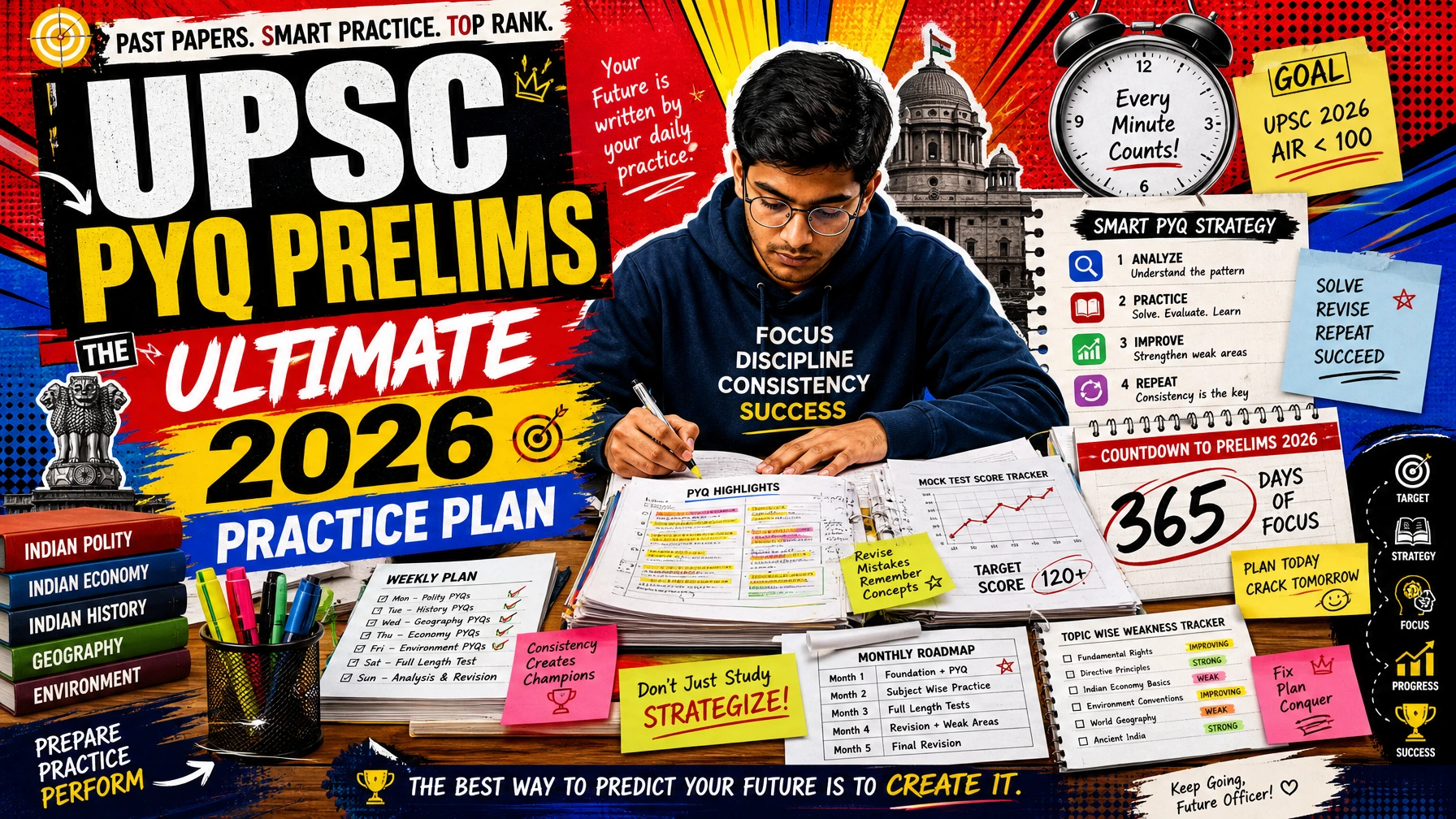
Don’t try to solve everything at once, yaar. Follow a simple 30-day flow to build momentum:
- Week 1-2: Master high-weightage subjects. Focus on Polity and Economy subtopics.
- Week 3-4: Move to dynamic sections. Tackle Environment and Science and Tech themes.
- Daily: Spend 5 minutes reviewing your Wrong Question tab from the previous day.
Use the UPSC PYQ Analysis Tool: Stop Guessing and Start Scoring to see which themes need your attention first. This 30-day sprint will put you miles ahead of the competition. It’s about building a rhythm that makes the May 24 exam feel like just another practice session.
Your Road to the 2026 Cutoff Starts Now
Success in the May 24 exam isn’t about luck; it’s about preparation that is structured and analytical. You’ve seen why the PDF graveyard is a trap and how subtopic granularity gives you an edge. Now, it’s time to put these insights into action. Stop guessing your readiness and let the data guide you toward the cutoff.
Mastering the upsc pyq prelims is the most reliable way to understand the examiner’s mindset. By using the Aaina progress dashboard and the dedicated Wrong Question tracker, you can turn every mistake into a stepping stone. With over 100,000 topic-wise questions available, you have everything you need to build exam-day confidence. Don’t let your topper banne ka sapna stay just a dream, yaar.
Take control of your preparation and start seeing real results today. Start your structured UPSC PYQ practice on PYQKosh today. You have the potential to clear this exam; you just need the right system to unlock it. Let’s get to work!
Frequently Asked Questions
Is solving only UPSC prelims PYQs enough to clear the exam?
Solving only PYQs isn’t enough; you must combine them with standard books. Think of the upsc pyq prelims as your compass. They show you which parts of the syllabus are high-yield. While books give you the knowledge, PYQs give you the strategy to handle tricky options. It’s about knowing how to apply what you’ve read under pressure.
How many years of UPSC PYQs should I practice for Prelims 2026?
You should practice at least 25 years of papers for static subjects like History or Geography. For dynamic areas like Science and Tech, focus heavily on the 2015 to 2025 period. This helps you understand how the question language has changed recently. Using the recency filter on your practice platform makes it easy to prioritize the latest trends for the 2026 cycle.
Are PYQs repeated in the UPSC Prelims exam?
Exact questions rarely repeat, but themes repeat constantly. For instance, UPSC loves asking about the Indus Valley Civilization or Constitutional bodies almost every year. Understanding these repeating themes is the topper banne ka shortcut. If you master the logic behind previous questions, you’ll find the 2026 paper much more predictable and manageable, yaar.
How should I use the ‘Wrong Question’ tracker effectively?
You should review your Wrong Question tracker every single morning. Don’t let mistakes pile up. Sort them by frequency to identify your silly mistake patterns. Re-solving a question you got wrong is twice as valuable as solving a new one. It fixes the gaps in your concepts so you don’t lose marks on the same topic twice in the real exam.
Can I practice CSAT PYQs on PYQKosh as well?
Yes, you can practice all UPSC CSE subtopics, including CSAT, on the platform. The topic-wise breakdown helps you master specific areas like Number Systems or Reading Comprehension. Since CSAT is becoming tougher, practicing these as subtopics is much better than solving random papers. It builds your speed and accuracy where you need it most for the 2026 attempt.
What is the benefit of subtopic-wise practice over year-wise papers?
Subtopic-wise practice lets you master one theme at a time instead of jumping randomly between subjects. When you solve all Preamble questions together, you spot the examiner’s favorite trap words easily. Year-wise papers are good for final testing, but for learning, subtopic granularity is the only way to build deep conceptual clarity and strong pattern recognition.
How does the Aaina dashboard help in predicting my rank?
The Aaina dashboard tracks your accuracy and peer rank to show exactly where you stand compared to others. It doesn’t give a literal rank, but it predicts your readiness by analyzing your performance across different subjects. If your accuracy is consistently high in difficult subtopics, you’re on the right track to clear the 2026 prelims cutoff with confidence.
Is it necessary to solve CDS and CAPF questions for UPSC CSE Prelims?
It’s highly recommended because UPSC often tests similar themes across these exams. A geography theme that appears in CDS 2025 might show up in your CSE 2026 paper. Solving multi-exam upsc pyq prelims gives you a wider perspective on the examiner’s mind. It’s a smart way to cover more ground and stay ahead of the competition without extra effort.