
Article by
Aaisha
A passionate content writer at PYQKosh focused on simplifying Current Affairs and PYQs for competitive exam aspirants. I love turning complex topics into easy, student-friendly content that helps learners prepare smarter and stay consistent in their exam journey.
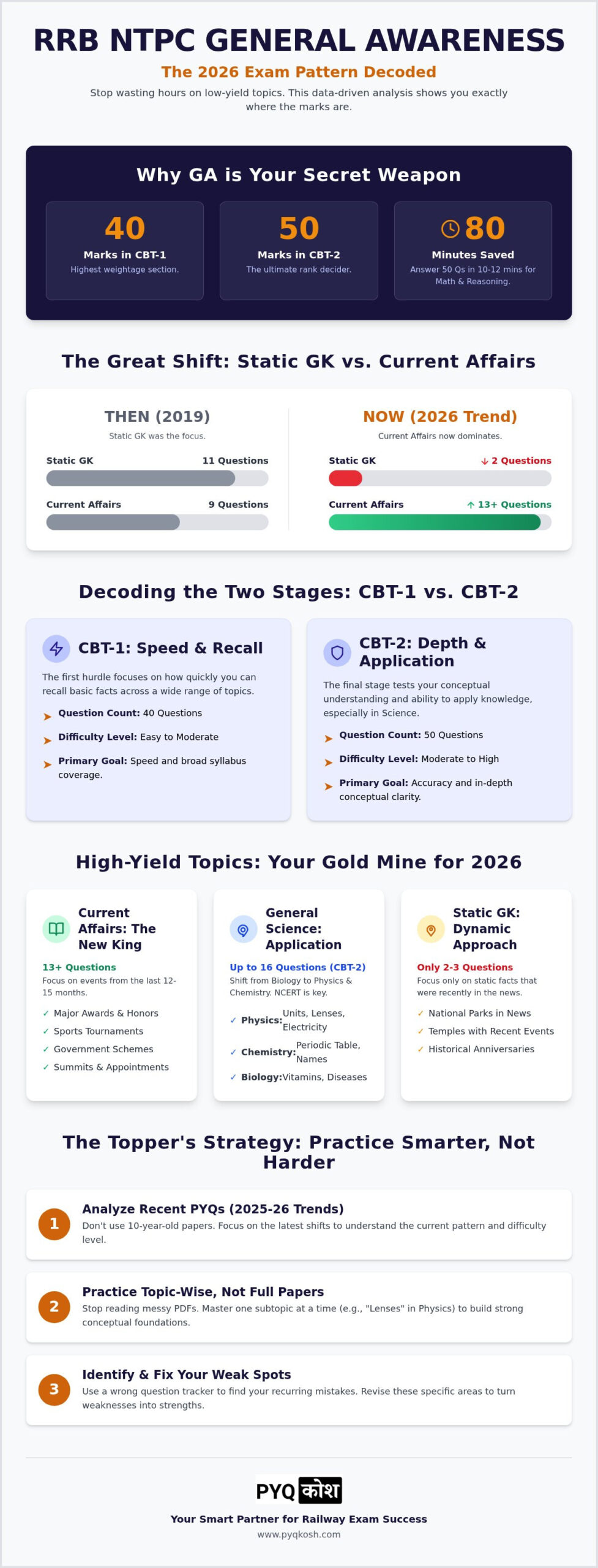
Did you know that Static GK questions in the RRB NTPC CBT 1 dropped from 11 in 2019 to just 2 in 2025? This massive shift is why a proper RRB NTPC general awareness pyq analysis is your only real shortcut to success. You likely feel like the syllabus is a never-ending ocean, and reading from random, messy PDFs only makes you forget facts faster.
You don’t need to read everything to score 35 plus in this section. We’ve decoded the latest shift data so you can stop wasting hours on low-weightage topics and start focusing on what gets you the green signal. Our analysis reveals the specific high-yield subtopics that examiners are actually targeting for the 2026 exams.
We’re going to give you a clear list of must-study subtopics and a structured practice plan. You’ll finally have the confidence that you aren’t missing important trends or falling for old patterns. It’s time to move from disorganized chaos to a state of focused, data-backed clarity that puts you ahead of the competition.
Key Takeaways
- Learn why General Awareness is your secret weapon to save time, helping you finish 40 to 50 questions in just 10 minutes.
- Discover how our RRB NTPC general awareness pyq analysis identifies the “Gold Mine” subtopics that actually repeat in 2026.
- Stop reading random PDFs and adopt the topper banne ka shortcut by practicing subtopic-wise rather than full-length papers.
- Find out how to use the Aaina dashboard and wrong question tracker to fix your weak spots before the actual exam.
- Master the shift from Static GK to Current Affairs and Modern History to secure a score of 35 plus with ease.
Why General Awareness is the Game Changer in RRB NTPC 2026
General Awareness (GA) isn’t just another subject; it’s the kingmaker for your selection. While everyone else grinds through Math and Reasoning, the real game happens here. GA carries the highest weightage with 40 marks in CBT-1 and a massive 50 marks in CBT-2. If you master this section, you don’t just pass; you dominate the merit list.
Think about your exam strategy. You can finish 50 GA questions in just 10 to 12 minutes. This saves nearly 80 minutes for those time consuming calculations in other sections. This is exactly why a solid RRB NTPC general awareness pyq analysis is your best friend. It stops you from falling into the “unlimited syllabus” trap where you try to read every book but remember nothing.
The Railway Recruitment Control Board (RRCB) sets a standard that rewards precision over bulk reading. Most aspirants fail because they treat GA like a never ending history class. In reality, it is a test of how well you can target high yield topics. Don’t be the person who reads 500 pages only to see zero questions from them in the exam.
The Reality of the RRB NTPC GA Section
GA is a wild mix of General Science, Current Events, and Social Sciences. It is not just about memorizing dates anymore. The biggest hurdle you’ll face is the 1/3 negative marking. Accuracy is what separates a topper from a dreamer. One wrong guess can push your rank down by thousands.
PYQs are the only reliable map to understand the examiner’s mind. They show you the exact depth required for each topic. Instead of reading random PDFs, you should focus on topic-wise practice. This helps you identify which specific subtopics are actually worth your time and which ones you can safely skip.
Why 2025-26 Trends Matter More Than Ever
Patterns have changed significantly since the 2019 exams. Questions are now more application based rather than just rote static facts. TCS, the conducting agency, loves asking about the “why” and “how” of scientific concepts and current events. They are testing your awareness, not just your memory.
Yaar, don’t rely on 10 year old papers. Recency is the key to success in 2026. Our RRB NTPC general awareness pyq analysis for recent shifts shows a clear move toward dynamic content. If you want that dream post, you must adapt to these 2025-26 trends. Focus on recent papers to see how the difficulty level has evolved over time.
CBT-1 vs CBT-2: Decoding the GA Weightage Shift
Don’t make the mistake of thinking CBT-1 and CBT-2 are identical just because the syllabus looks the same. While CBT-1 has 40 GA questions, CBT-2 jumps to 50. This isn’t just about 10 extra questions; it’s about a massive shift in depth and difficulty. If you want to clear the final merit list, your RRB NTPC general awareness pyq analysis must account for these two different stages.
In CBT-1, the goal is speed and basic recall. But in CBT-2, the examiner tests your ability to apply concepts. For example, while CBT-1 might ask for a simple unit of power, CBT-2 will likely give you a numerical problem based on electricity or lenses. You need to adjust your preparation level as you move from one stage to the next.
Our recent data shows that Static GK is no longer a standalone subject. It has become “Dynamic GK.” This means questions about a national park or a temple usually pop up because they were in the news recently. If you only study old books, you’ll miss these marks. Focus on news linked static facts to stay ahead of the crowd.
Current Affairs: The Deciding Factor
Current Affairs is the new king of the GA section. In 2019, we saw around 9 questions in CBT-1, but by 2025, that number rose to 13. This trend will likely continue in 2026. You should focus on the last 12 to 15 months of events, especially sports, major awards, and new government schemes.
Reading thick monthly magazines is a waste of time. Instead, use Current Affairs Topics to practice specific areas like “Appointments” or “Summits” separately. This structured approach helps you retain facts much better than reading a 100 page PDF in one go. It’s the ultimate topper banne ka shortcut for the GA section.
General Science: From Basics to Application
The focus in General Science has shifted away from pure Biology toward Physics and Chemistry. In CBT-2, we’ve seen as many as 16 science questions in a single shift. Most of these are now NCERT based and focus on real world applications rather than just definitions.
- Physics: Master units, lenses, and electricity; these are the most repeated subtopics.
- Chemistry: The periodic table and chemical names are non negotiable.
- Biology: Stick to human anatomy and plant diseases as they carry the most weight.
Yaar, don’t just read theory; start solving. You can practice topic-wise PYQs to see exactly how these science concepts are turned into tricky questions. This will help you build the accuracy needed to avoid that dreaded negative marking.
Subtopic-Wise Breakdown: Where the Questions Actually Come From
Most websites give you generic lists like “History” or “Polity.” That’s useless advice, yaar. You need to know which specific subtopics are the real gold mines. Our RRB NTPC general awareness pyq analysis shows that examiners have clear favorites. If you target these, you save hundreds of hours of useless reading.
You don’t need to be a scholar in every subject to score 35 plus. Success comes from knowing what to skip. While your competitors are busy memorizing ancient dynasties, you should focus on the high frequency areas that actually appear on the screen. Let’s break down these “Gold Mine” subtopics one by one.
History & Polity: High-Yield Themes
Don’t waste time on every king from the medieval era. Modern History dominates the paper, accounting for nearly 70% of history questions. Focus heavily on the Freedom Struggle, the Gandhian Era, and important Indian National Congress (INC) sessions. These are the topics that repeat every single year across different shifts.
Polity is perhaps the most scorable subject in the entire GA section. You can easily bag full marks here if you master the top 50 Articles and major Constitutional Amendments. Focus on Fundamental Rights, the President’s powers, and the Panchayati Raj system. Use RRB NTPC PYQs to see these patterns yourself and practice them until they’re stuck in your head.
A smart mentor’s tip: Polity questions are often direct. If you know the Article, you get the mark in five seconds. This is the ultimate topper banne ka shortcut to boost your accuracy without much effort. Start with the preamble and move through the parts of the constitution systematically.
Static GK: The Geography and Art/Culture Mix
Static GK can feel like an ocean, but it has a predictable structure. For Geography, stop trying to learn the whole world map. Focus on Indian mapping, drainage systems (rivers), and National Parks. The Solar System is another favorite subtopic where RRB often asks about planet characteristics and satellite names.
- Art & Culture: Focus on classical dances, state festivals, and famous monuments.
- Geography: Master the tributaries of major rivers and the locations of biosphere reserves.
- Economics: Don’t get into complex theories. Just understand GDP, Inflation, and the Five-Year Plans.
You’ll notice that Art & Culture questions are becoming more specific. Instead of just the dance name, they might ask about the famous personality associated with it. This is why RRB NTPC general awareness pyq analysis is vital. It helps you catch these subtle shifts in question depth before you sit for the actual exam.
Practice these subtopics individually to see where you stand. Our topic-wise practice mode allows you to filter questions by these specific areas. This way, you aren’t just solving random papers; you’re building a fortress of knowledge, one subtopic at a time.
How to Master GA Using PYQ Analysis (The Topper’s Strategy)
Ever felt like you’ve read the same history chapter five times but still blank out during a mock test? It’s a common trap for aspirants. You’re consuming content without building the skill to solve questions. Toppers don’t just read; they analyze. A deep RRB NTPC general awareness pyq analysis is the foundation of their entire preparation strategy.
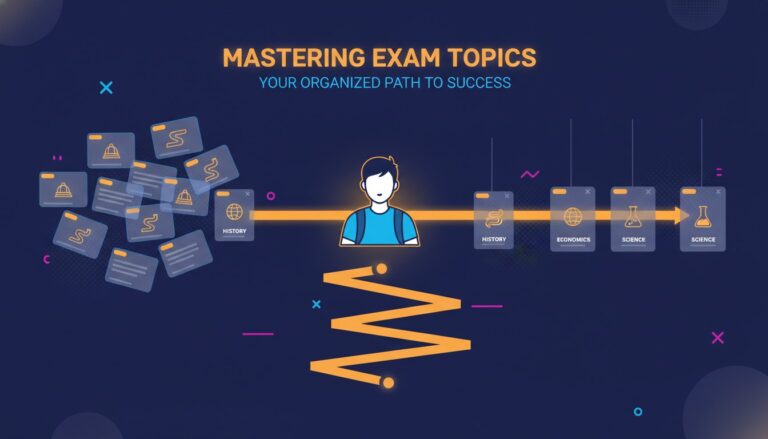
You need a structured way to practice. Start by identifying your weak subtopics using a diagnostic test. Once you know where you’re failing, move to subtopic-wise practice. This is the topper banne ka shortcut because it forces your brain to focus on one specific area until you master it. Don’t just look at the right answer; review the in-depth explanations to understand “Confusion Points” and avoid common traps set by the examiner.
Consistency is your biggest weapon. Use the wrong question tracker to eliminate repeat mistakes. This feature automatically stores every question you get wrong. You can even sort them by frequency to see which subtopics are giving you the most trouble. Finally, track your daily streak on the Aaina dashboard. Seeing that graph go up every day provides the high energy motivation you need to keep going when things get tough.
Stop Reading, Start Solving Subtopic-Wise
Yaar, reading a book 10 times is less effective than solving 100 subtopic questions once. When you solve questions, your brain builds muscle memory for specific facts. You start recognizing how examiners twist simple statements into tricky options. This is why you should practice subtopic-wise instead of just solving random full length papers that touch every subject superficially.
Since many topics overlap across different boards, don’t limit yourself to just one exam. You can combine multi exam PYQs for common subjects like Polity or Geography. For instance, practicing SSC CGL PYQs can give you a fresh perspective on the same topics. This structured, analytical exam preparation ensures you’ve seen every possible variation of a question before it appears on your screen in 2026.
Data-Driven Preparation: Accuracy Over Speed
Stop worrying about how many questions you finished in an hour. Focus on how many you actually got right. A 90% accuracy rate in 20 questions is much better than a 50% rate in 100 questions. High speed with low accuracy is a recipe for failure because of the 1/3 negative marking in Railway exams. You need to be precise, not just fast.
Use the “Exam Booster Tips” found in our detailed solutions to learn related facts quickly. These tips often cover the most repeated points from recent 2025-26 shifts. By focusing on these data driven insights, you transition from random effort to targeted, strategic action. Your Aaina dashboard will show you exactly which subtopics need more work, replacing your anxiety with organized clarity.
Start your journey toward focused, data-backed clarity today by practicing RRB NTPC topic-wise PYQs to see where you truly stand.
PYQKosh: Your Smart Partner for Railway Exam Success
Tired of jumping between random Telegram channels and messy PDFs that lead nowhere? You need a single, definitive destination to turn your hard work into a selection. PYQKosh is designed for this exact purpose, organizing over 1 lakh questions into a logical Subject, Topic, and Subtopic hierarchy.
Our deep RRB NTPC general awareness pyq analysis is built into the very structure of the platform. Instead of solving random papers, you can target the “Gold Mine” subtopics we discussed earlier with surgical precision. This is the smart way to clear RRB NTPC in your first attempt without drowning in an ocean of irrelevant facts.
By using structured, analytical exam preparation, you move away from disorganized chaos. You get a clear path that tells you exactly what to practice next. It is time to stop working harder and start working smarter by focusing on the data that actually matters for your 2026 attempt.
The Aaina Dashboard: See Your Real Progress
The Aaina dashboard acts as your real preparation mirror. It tracks your accuracy, daily practice streaks, and even your peer rank to show you where you truly stand. You can see your progress at both the topic and subtopic level, making your growth visible and measurable.
No more guessing what to study tomorrow. Use your own performance data to identify exactly which subtopic is pulling your score down. Whether it is Modern History or Current Affairs, the Aaina dashboard helps you decide where to put your energy for the maximum impact on your final score.
Eliminating Mistakes with the Wrong Question Tracker
Mistakes are okay, but repeating them is a sin in competitive exams. The Wrong Question tab automatically stores every error you make. You can sort these by recently committed mistakes or by frequency to see which questions you keep getting wrong.
- Re-practice: Solve your wrong questions repeatedly until your accuracy hits 100%.
- Bookmark: Save tricky “Confusion Points” in the Bookmark tab for a quick final week revision.
- In-depth Explanations: Learn from booster tips that cover both right and wrong answers to build a solid foundation.
Yaar, don’t let the same mistake haunt you on exam day. Use the tracker to turn your weaknesses into your biggest strengths. This level of precision is the ultimate topper banne ka shortcut that replaces anxiety with focused, data-backed confidence.
Start practicing RRB NTPC subtopic-wise PYQs on PYQKosh today and see your accuracy soar.
Ready to Claim Your Railway Post?
Success in 2026 depends on how quickly you adapt to the new exam patterns. General Awareness is your biggest weapon to save time and boost your overall merit rank. Focus on high yield subtopics like Modern History and Current Affairs to get the maximum return on your effort.
This RRB NTPC general awareness pyq analysis is your roadmap to a 35 plus score. Don’t waste your energy on random PDFs or theory books that don’t match the current TCS trends. It’s time to move toward focused, data backed clarity.
Yaar, use the topper banne ka shortcut by practicing with over 1 lakh plus questions on PYQKosh. You’ll get detailed explanations with booster tips and the Aaina dashboard to track your real progress. Stop guessing and start solving with precision.
Start your subtopic-wise RRB NTPC practice today!
You’ve got the strategy and the tools, now just stay consistent and believe in your hard work. See you on the merit list!
Frequently Asked Questions
Is RRB NTPC General Awareness different from SSC General Awareness?
Yes, the focus shifts quite a bit between the two. While SSC loves deep Static GK and Art or Culture, RRB NTPC leans much more heavily into General Science and Current Affairs. However, the core concepts of Polity and History remain similar across both exams.
How many years of PYQs should I solve for RRB NTPC 2026?
Focus on the last 3 to 5 years of papers for the most relevant practice. Specifically, prioritize the shifts from 2021 to 2025 because they reflect the current TCS pattern. Papers older than 2016 are often too simple for today’s high competition levels.
Which subject has the highest weightage in RRB NTPC GA?
Current Affairs and General Science are the clear heavy hitters in this section. In recent shifts, Current Affairs accounts for nearly 12 questions, while Science can jump to 15 questions in CBT 2. Mastering these two is the fastest way to boost your score.
Can I clear RRB NTPC GA by just reading Current Affairs?
No, you definitely can’t. While it’s a huge part of the paper, it only covers about 30 percent of the total marks. You need a solid RRB NTPC general awareness pyq analysis to score well in Polity, History, and Science to cross that 35 plus mark.
How do I use the Aaina dashboard for GA preparation?
Use it to spot exactly where your marks are leaking. If the dashboard shows your accuracy in “Modern History” is below 70 percent, stop reading random facts and revise that specific subtopic. It helps you stop guessing and start using data to plan your next study session.
Are science questions in RRB NTPC very difficult?
They aren’t “difficult” in a textbook sense, but they are very application based. Instead of just asking for a definition, RRB often tests how a scientific concept works in real life. Stick to basic NCERT concepts for Physics and Chemistry to handle these easily.
How does subtopic-wise practice help more than full mock tests?
Subtopic practice is like fixing a single leak in a bucket rather than just measuring how much water is left. It builds deep focus and muscle memory for specific facts. This is the topper banne ka shortcut because it ensures you master one small area completely before moving on.
What are ‘Exam Booster Tips’ in PYQKosh?
These are high yield facts found in our detailed explanations. They cover related points that the examiner is likely to ask in future shifts. For every single question you solve, these tips help you learn 3 or 4 extra facts that keep you ahead of other aspirants.