

Article by
Aaisha
A passionate content writer at PYQKosh focused on simplifying Current Affairs and PYQs for competitive exam aspirants. I love turning complex topics into easy, student-friendly content that helps learners prepare smarter and stay consistent in their exam journey.
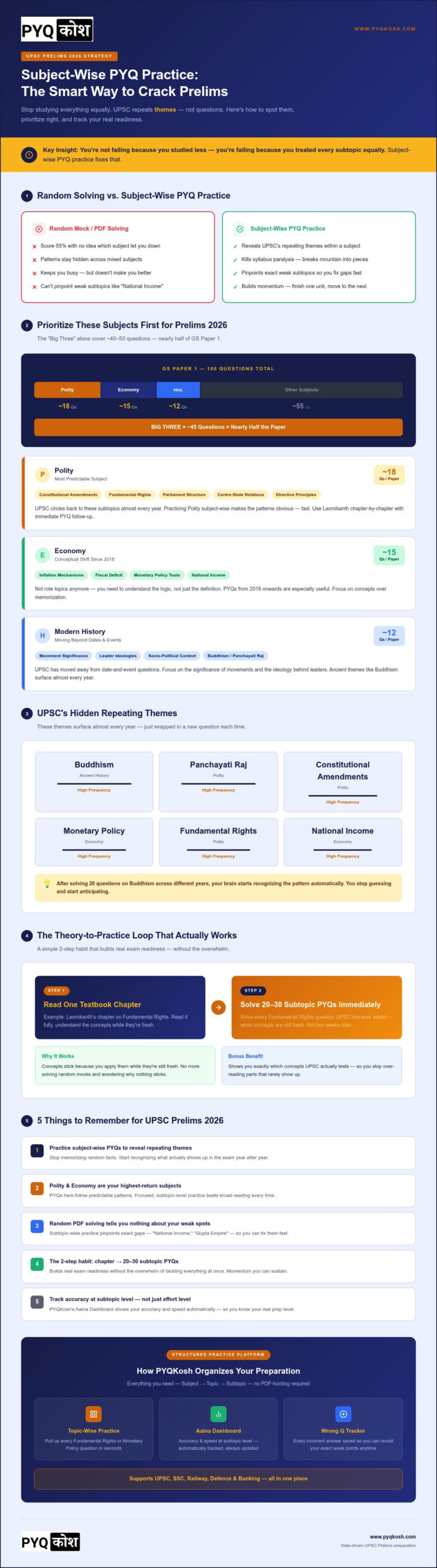
Here’s the hard truth: you’re probably not failing UPSC Prelims because you studied less. You’re failing because you studied everything equally. When you treat a rarely-tested subtopic the same as a theme UPSC has revisited ten times in the last decade, you’re not preparing smart, you’re just staying busy.
If you’ve ever stared at a folder full of random PDFs, wondering which questions actually matter, you already know this pain. Searching for UPSC prelims subject wise PYQ across scattered books and websites is exhausting, and it eats into the hours you should be spending actually practicing.
Here’s what most aspirants miss: UPSC doesn’t repeat questions. It repeats themes. The same constitutional principle, the same economic concept, the same historical movement, just wrapped in a new question every few years. Once you see that pattern, the exam stops feeling random and starts feeling predictable.
This guide will show you exactly which subjects and subtopics carry the most weight in Prelims, how to use subject-wise PYQs to spot repeating themes, and how to track your accuracy so you know when you’re truly ready, not just hoping you are.
Key Takeaways
- Practicing upsc prelims subject wise pyq reveals UPSC’s repeating themes — so you stop memorizing random facts and start recognizing what actually shows up in the exam.
- Polity and Economy are your highest-return subjects for Prelims 2026 — PYQs here follow predictable patterns that reward focused, subtopic-level practice over broad reading.
- Random PDF solving tells you nothing about where you’re actually weak — subtopic-wise practice pinpoints exact gaps like “National Income” or “Gupta Empire” so you can fix them fast.
- A simple two-step habit — finish one textbook chapter, then solve 20–30 subtopic PYQs — builds real exam readiness without the overwhelm of tackling everything at once.
- Tools like PYQKosh’s Aaina Dashboard show your accuracy and speed at the subtopic level automatically, so you always know your real preparation level — not just your effort level.
Why subject-wise PYQ practice is the real game-changer for UPSC
Most aspirants open a random mock test, attempt 100 questions, score 55%, and then have no idea what to do next. Which subject let them down? Which subtopic? No clue. That’s the problem with random practice. It keeps you busy without making you better.
Subject-wise PYQ practice flips this completely. When you work through, say, all Polity questions from the last 15 years in one sitting, you stop seeing isolated questions. You start seeing UPSC’s thinking. You notice how the Union Public Service Commission returns to the same constitutional principles year after year, just from a slightly different angle each time. That shift, from reading to analyzing, is where real preparation begins.
It also kills syllabus paralysis. The UPSC syllabus feels enormous until you break it into subject-level chunks, then topic-level chunks, then subtopic-level chunks. Suddenly, “Indian Polity” isn’t a mountain. It’s Fundamental Rights, Directive Principles, Parliament, and about a dozen other manageable pieces. Each piece has a finite number of PYQs. You can finish one and move on. That’s a momentum you can actually sustain.
Spotting the hidden UPSC themes
UPSC doesn’t recycle questions. It recycles themes. Buddhism, Panchayati Raj, Constitutional Amendments, Monetary Policy — these topics surface in the paper almost every single year. Practicing upsc prelims subject wise pyq makes these patterns jump out at you. After solving 20 questions on Buddhism across different years, your brain starts recognizing the pattern automatically. You stop guessing and start anticipating.
This is the edge that year-wise solving simply can’t give you. When questions are mixed across subjects, the patterns stay hidden. Subject-wise practice brings them to the surface fast.
The ‘Theory-to-Practice’ loop
Here’s a habit that actually works: finish a chapter, then immediately solve all the PYQs from that subtopic. Read Laxmikanth’s chapter on Fundamental Rights, then solve every Fundamental Rights question UPSC has ever asked. The concepts stick because you’re applying them while they’re still fresh, not two weeks later in a mock test.
This theory-to-practice loop is far more effective than saving PYQs for “revision time.” It also shows you exactly which concepts UPSC actually tests, so you can stop over-reading the parts that rarely show up. For a deeper look at why this subtopic-first approach works, this piece on UPSC PYQ subtopic practice breaks it down well.
Platforms like PYQKosh organize their entire question bank by Subject, Topic, and Subtopic, so you can pull up every Fundamental Rights question in seconds, no PDF-hunting required.
UPSC Prelims subjects: What to prioritize first for 2026?
Not all subjects deserve equal time. That’s the uncomfortable truth most aspirants figure out only after their first failed attempt. If you’re preparing for 2026, you need to know exactly where to put your energy first, because spreading yourself thin across every subject is a guaranteed way to clear nothing.
The ‘Big Three’ of UPSC Prelims
Polity, Economy, and Modern History consistently account for roughly 40 to 50 questions in GS Paper 1. That’s nearly half the paper. Nail these three, and you’ve already built a cushion above the cutoff before you even touch Environment or Science & Tech.
Here’s what makes them the best starting point for upsc prelims subject wise pyq practice:
- Polity is the most predictable subject in the paper. Constitutional amendments, Fundamental Rights, Parliament’s structure, the relationship between Centre and State — UPSC circles back to these subtopics almost every year. Practicing them subject-wise makes the patterns obvious fast.
- Economy questions have shifted toward conceptual understanding over the last five years. Inflation mechanisms, fiscal deficit, monetary policy tools — these aren’t rote topics anymore. You need to understand the logic, not just the definition. PYQs from 2018 onwards are especially useful here.
- Modern History has quietly moved away from date-and-event questions. UPSC now asks about the significance of movements, the ideology behind leaders, and the social impact of colonial policies. Solving these subject-wise shows you exactly where that shift happened.
Check out the UPSC Prelims subjects page for a full subject and subtopic breakdown to plan your sequence.
Don’t ignore the ‘Dynamic’ subjects
Environment and Science & Technology feel unpredictable because they’re partly current-affairs-driven. But here’s what most aspirants miss: the underlying concepts are static. Biodiversity conventions, climate frameworks, space missions — UPSC tests whether you understand the core idea, then links it to a recent development.
Subject-wise practice helps you separate the stable theory from the current application. Solve older PYQs to build your conceptual base, then sort by recency to see how UPSC has applied those concepts in 2022, 2023, and 2024 questions. That two-layer approach is far smarter than just reading newspaper summaries.
Geography deserves a separate mention. Map-based questions and physical geography concepts trip up a lot of aspirants because they try to memorize locations without understanding the underlying logic. Practicing Geography PYQs by subtopic, say, rivers, then climate zones, then soil types, builds a mental map that holds up under exam pressure.
Static subject trends won’t tell you where you specifically are weak. That’s why filtering PYQs by subtopic and tracking your accuracy on each one matters more than any generalized trend table.
Subtopic practice vs. random PDF solving: Which is better?
You probably have a Telegram folder bursting with hundreds of unorganized PDFs. Be honest, yaar, how many of those have you actually finished? Most aspirants spend 30 minutes hunting for the “perfect” file and only 10 minutes actually solving it. This “PDF hunting” is a trap that makes you feel productive while your actual preparation stays stuck.
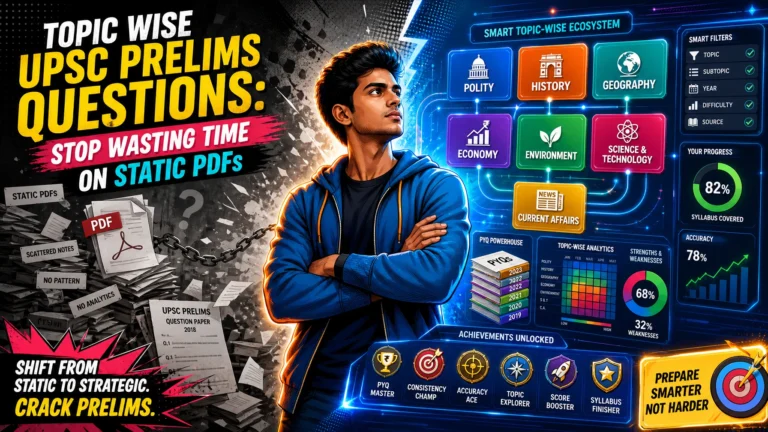
PDFs are dead data. They are just static lists of questions on a screen. They don’t tell you if your accuracy in “National Income” is 20% or 80%. They don’t track which questions you got wrong three times in a row. When you use a structured upsc prelims subject wise pyq approach, you stop being a collector and start being a solver.
Structured practice saves you from the “ctrl+F” nightmare. Instead of scrolling through a 500-page document to find questions on the “Gupta Empire,” you should be able to click a button and start practicing. This efficiency is what separates serious candidates from the crowd.
The problem with ‘PDF Hunting’
Aspirants often mistake “access to material” for “preparation.” Having a thick book of 25 years of questions is useless if you can’t find what you need in five seconds. Randomly solving mixed questions might feel like progress, but it doesn’t build deep subject mastery. You end up repeating the same mistakes because there is no way to track your performance over time.
Stop wasting your limited energy on organizing files. Your job is to solve, analyze, and improve. A data-driven approach shows you your accuracy streaks and daily progress, something a dead PDF or a heavy book can never do.
Why subtopics are the secret to rank
The real game happens at the subtopic level. If you are weak in “Fundamental Rights,” you don’t need to solve a full Polity mock test. You need to solve every single question UPSC has ever asked on that specific subtopic. This targeted practice ensures you have zero blind spots before the big day.
This is why topic-wise UPSC prelims questions are the real game-changer for your 2026 attempt. It makes revision ten times faster during those high-pressure last 30 days. Instead of re-reading everything, you just revisit the subtopics where your accuracy was low.
Using a tool like the Aaina dashboard gives you a clear mirror of your preparation level. You can see your accuracy at the subtopic level and use the “Wrong Question” tab to fix your mistakes automatically. This shift from random effort to targeted, strategic action is how you actually clear the Prelims.
How to master UPSC Prelims PYQs without getting overwhelmed
How many times have you finished a massive textbook chapter only to feel like you’ve forgotten everything by the next morning? It happens because you didn’t test the concept immediately. Mastering the upsc prelims subject wise pyq bank doesn’t require 12 hours of non-stop study. It requires a system that stops you from drowning in data.
Step 1: Pick one subject and finish just one chapter from your standard textbook. Don’t look at the whole book yet; just focus on one theme like “Preamble” or “Inflation.” Step 2: Immediately solve 20 to 30 subtopic-wise PYQs. This forces your brain to recall what you just read, which is the only way to make it stick long-term.
Step 3: Read the in-depth explanations carefully. Don’t just check if you got it right. Pay special attention to the “Confusion Points” to avoid common traps that UPSC sets for candidates who only have surface-level knowledge. Step 4: Use the Bookmark tab for questions that made you think twice. These are your Sunday revision gold mines.
Step 5: Check your Wrong Question tab every three days. If you can’t get a question right on the second or third attempt, you haven’t understood the concept yet. Re-solve these mistakes until your accuracy hits 100% for that specific subtopic. This is how you build real confidence for 2026.
The ‘Booster Tip’ strategy
Don’t just look for the right answer; analyze why the other three options are wrong. UPSC is famous for turning a “wrong option” from a 2022 question into the “right answer” for 2026. If an option mentions a specific term or organization you don’t recognize, look it up. Write one-line notes only for questions you get wrong twice; don’t waste time making notes for things you already know.
Building a daily consistency streak
Solving 100 questions on a random Sunday is a waste of energy. Your brain needs daily discipline to recognize patterns. Even 10 PYQs a day is better than a weekly marathon. Use the Aaina dashboard to track your daily practice and keep your streak alive. Once you see your accuracy graph moving up, the preparation stops feeling like a burden and starts feeling like a game you’re winning.
Start your daily practice streak on PYQKosh today and stop the overwhelm.
Track your UPSC Prelims progress automatically with PYQKosh
Be honest: how are you currently tracking your preparation? A notebook? A mental estimate? Most aspirants run on gut feeling. “I think I’m good at Polity.” “Economy feels okay.” That kind of vague confidence is exactly what collapses under exam pressure on the actual day.
PYQKosh’s Aaina Dashboard replaces guesswork with real data. It shows you your accuracy and speed at the subtopic level, automatically, without you maintaining a single spreadsheet. You can see exactly where you stand in your upsc prelims subject wise pyq practice, not where you hope you stand.
The dashboard tracks questions practiced, daily streaks, weekly progress graphs, and your peer rank. So you’re not just measuring yourself against yesterday’s version of you. You’re seeing how you stack up against the broader aspirant community. That context matters when you’re deciding whether to push harder or move to the next subtopic.
Stop repeating the same mistakes
Here’s a pattern that kills more attempts than any difficult question ever could: making the same mistake at home that you make in the exam hall. You got a Monetary Policy question wrong in March. You forgot about it. You got the same concept wrong again in September. Sound familiar?
The Wrong Question tab fixes this automatically. Every question you get wrong gets stored there, no manual effort needed. You can sort mistakes by frequency, so the concepts that have tripped you up three or four times rise straight to the top. That list is your real revision priority. Not the syllabus. Not a topper’s notes. Your actual, personal weak spots.
Before any major revision session, open that tab first. Solve only those questions. That targeted approach will do more for your score in 30 minutes than two hours of random solving ever could.
Data-driven prep for the modern aspirant
There’s a big difference between “I think I know this topic” and “my accuracy here is 88% across 34 questions.” The second statement is confidence you can actually trust. PYQKosh gives you that second statement, at the subtopic level, for every subject you practice.
Pair this with the prelims upsc question paper analysis to understand how UPSC has shifted its questioning style in recent years. Then use the in-depth explanations inside PYQKosh to understand not just what the right answer is, but why the other three options are wrong. That depth is what separates a 95-scorer from someone who just clears the cutoff.
And if you’re preparing for SSC or Railways alongside UPSC, you don’t need a separate platform. PYQKosh covers all three on one dashboard, so your streak, your wrong questions, and your accuracy data stay in one place.
Your 2026 Prelims Starts With One Smart Decision Today
Every aspirant who clears Prelims has one thing in common: they stopped treating all topics equally and started practicing with intention. That’s the real shift. Not more hours. Not more PDFs. Just smarter, more targeted effort.
The path forward is clear. Prioritize your high-yield subjects, practice upsc prelims subject wise pyq at the subtopic level, and let your accuracy data tell you where to focus next. Stop guessing. Start measuring.
PYQKosh gives you the structure to do exactly that. A database of 1 lakh+ questions organized by subject, topic, and subtopic. The Aaina dashboard tracking your real progress daily. The Wrong Question tab making sure no mistake slips through twice. Trusted by thousands of serious aspirants who’ve replaced scattered effort with a system that actually works.
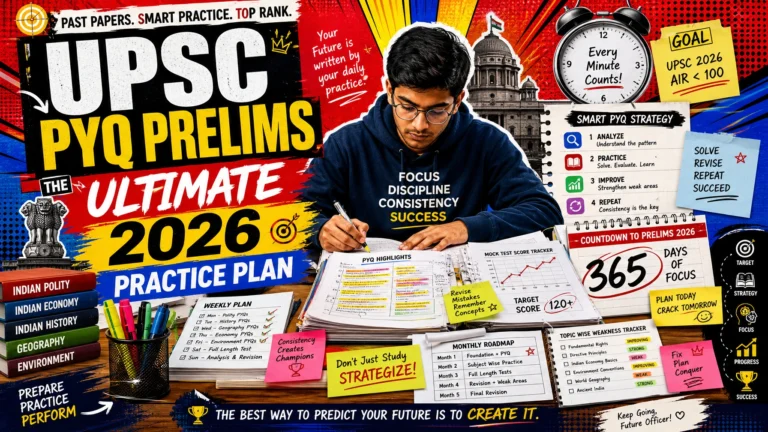
You don’t need a perfect study plan. You need to start today, with one subject, one subtopic, and twenty questions.
Start your subject-wise UPSC PYQ practice on PYQKosh today and give your 2026 attempt the foundation it deserves.
Frequently Asked Questions
Is subject-wise PYQ practice enough to clear UPSC Prelims 2026?
Subject-wise PYQ practice is the most efficient core of your preparation, but it works best when paired with standard textbooks for conceptual grounding. PYQs tell you what UPSC tests and how it frames questions. Textbooks tell you why the answer is what it is. Use both together: read a chapter, then immediately solve its PYQs. That combination builds both knowledge and exam temperament.
For current affairs-linked questions in Environment and Science & Tech, you’ll also need to follow recent developments. PYQs give you the conceptual base; current affairs give you the application layer. Neither alone is sufficient.
How many years of UPSC subject-wise PYQs should I solve?
Solve at least 10 years of PYQs as your foundation, then extend to 15 years for high-yield subjects like Polity and Economy. The last five years (2020 onwards) are especially important because UPSC’s questioning style has shifted toward conceptual and application-based questions. Older questions help you spot recurring themes; recent questions show you the current difficulty level and framing style.
Don’t treat all years equally. Prioritize recency. On PYQKosh, you can sort questions by year, so you can focus on 2020-2024 first before going deeper into older papers.
Can I use UPSC PYQs for other exams like SSC or State PCS?
Yes, with some smart filtering. Polity, History, Geography, and Economy questions from UPSC Prelims overlap significantly with State PCS and SSC General Awareness sections. The conceptual depth required for UPSC is higher, so if you’ve practiced upsc prelims subject wise pyq thoroughly, you’ll find SSC GK questions noticeably easier. PYQKosh supports UPSC, SSC, and Railways on one platform, so you don’t need separate tools to manage this overlap.
How does subject-wise practice help in the CSAT paper?
CSAT (Paper 2) has its own PYQ bank covering Reading Comprehension, Basic Numeracy, and Logical Reasoning. Practicing these subject-wise helps you identify your specific weak areas fast. If your Reading Comprehension accuracy is strong but Basic Numeracy is pulling you down, you know exactly where to spend your next hour. Random mixed practice won’t give you that clarity.
Note: PYQKosh currently covers GS Paper 1 subjects. For CSAT-specific practice, verify which sections are available on the platform before planning your schedule.
What should I do if my accuracy is low in a specific subtopic?
Don’t panic, and don’t just re-read the chapter. First, go back to your Wrong Question tab and solve those specific questions again. Read every explanation carefully, especially why the wrong options are wrong. If your accuracy is still below 60% after two attempts, that’s a signal to revisit the source material at a deeper level, not a broader one.
Narrow your focus further. If “Monetary Policy” as a whole is weak, break it down: is it repo rate mechanics, or RBI’s open market operations? The more precisely you identify the gap, the faster you close it.
Is it better to solve PYQs before or after reading the syllabus?
After reading, not before. Attempting PYQs cold, without any conceptual base, teaches you very little. You end up guessing and accidentally memorizing wrong answers. The right sequence is: read one chapter, solve its PYQs immediately, then check explanations. This theory-to-practice loop is far more effective than saving all PYQs for a “revision phase” that often never comes.
That said, glancing at a subject’s PYQs before starting a chapter can be useful as a preview. It shows you which subtopics UPSC actually tests, so you know where to slow down while reading.
How often should I revise the questions I marked as ‘Wrong’?
Revisit your Wrong Question tab every three days during active preparation, and daily in the last 30 days before the exam. If a question trips you up three times in a row, that concept needs deeper reading, not just more attempts. Sort your wrong questions by frequency so the most repeated mistakes stay at the top of your revision list. That list is more valuable than any topper’s notes because it’s built entirely from your own weak spots.
Does PYQKosh provide explanations for all four options in a question?
Yes. PYQKosh’s in-depth explanations cover not just why the correct answer is right, but also why each of the other three options is wrong. This matters because UPSC often recycles incorrect options from one year as the correct answer in a later year. Understanding why an option is wrong builds the kind of nuanced knowledge that protects you from traps. Each explanation also includes Confusion Points that flag the most common mistakes aspirants make on that specific question.