

Article by
Aaisha
A passionate content writer at PYQKosh focused on simplifying Current Affairs and PYQs for competitive exam aspirants. I love turning complex topics into easy, student-friendly content that helps learners prepare smarter and stay consistent in their exam journey.
Reading the entire Laxmikanth or Bipin Chandra twice won’t guarantee you a seat in the 2026 Mains if you’re still guessing which parts actually matter. Most aspirants fail not because they lack hard work, but because they lack a subtopic wise analysis for UPSC that cuts through the noise.
It’s exhausting, yaar. You finish your NCERTs and spend months in the library, yet your mock scores stay stuck in the 70s because you’re wasting time on low-weightage topics that UPSC hasn’t touched in years.
We’ve been there, and we know the struggle of feeling lost in that vast syllabus. We promise to show you how to stop the guesswork and use data to point you directly to the questions that will appear in the May 24, 2026 Prelims.
We’ll break down the high-priority subtopics you need to master and show you how to track your accuracy without the headache of manual note-taking. Let’s turn your random effort into a targeted strike for success.
Key Takeaways
- Learn why finishing massive textbooks like Laxmikanth isn’t enough and how to escape the common “Subject Trap” that stalls your progress.
- Master the art of subtopic wise analysis for UPSC to break down giant subjects into manageable, high-yield units for precision practice.
- Ditch the cluttered PDFs and discover how data-driven dashboards like Aaina help you track your daily accuracy and speed in real-time.
- Find out how to use a dedicated wrong question tracker to stop repeating the same mistakes and boost your Prelims mock scores.
- Get a simple 3-step daily routine to integrate structured subtopic practice into your 2026 schedule for maximum efficiency.
Why Broad UPSC Subjects are a Trap for Aspirants
You’ve finished the Polity Laxmikanth twice. You’ve highlighted every second line with a yellow marker. Yet, when a tricky “Panchayati Raj” question pops up in your Sunday mock, you’re still stuck between two options. It’s frustrating, right?
This is what we call the “Subject Trap.” You spend two weeks “doing History” or “completing Economics” without a clear map of what actually matters. You feel productive because you’ve read 500 pages, but your marks don’t move. Yaar, random reading se cutoff clear nahi hota. You need a targeted strike.
The secret lies in a subtopic wise analysis for UPSC. The UPSC Civil Services Examination isn’t as random as people claim. There’s a hidden pattern that only becomes visible when you stop looking at broad subjects and start looking at specific sub-themes.
The examiner doesn’t just ask about “Environment” in general. They have a specific interest in the “Wildlife Protection Act” or “International Conventions.” If you don’t know which sub-theme is trending, you’re just shooting in the dark and hoping for the best.
The Problem with the “PDF Culture”
Most aspirants have Telegram folders full of 100+ UPSC Prelims PDFs. They spend hours scrolling through 50-page documents just to find ten relevant questions. This “PDF Culture” is a silent killer of your precious time.
How do you know if your accuracy in “National Parks” is better than “Biosphere Reserves”? With static PDFs, you simply can’t. These papers make it impossible to see your own progress over time. You just keep solving questions without knowing where you are actually failing.
Static resources don’t tell you that you’ve made the same mistake in “Fundamental Rights” four times this month. They don’t show you that your speed is dropping in “Ancient History.” You need a system that tracks these data points for you automatically.
Moving from Hard Work to Smart Work
Smart work means practicing exactly what the examiner loves to ask. When you adopt a subtopic wise analysis for UPSC, you realize you can skip several low-yield sections of the NCERTs. You focus your energy only where the marks are hidden.
This clarity helps you prioritize your revision. Instead of reading all of Modern History again, you might realize you only need to fix your understanding of “Governor Generals.” This is the UPSC PYQ strategy that saves months of wasted effort.
Stop treating every chapter with equal importance. Use data to decide your daily schedule. When you master subtopics one by one, the giant UPSC syllabus suddenly feels manageable. It’s time to stop guessing and start measuring your way to the 2026 Prelims.
Just as a company like Bewlake Lift & Haul Ltd provides the specialized lifting power needed for complex infrastructure projects, a data-driven approach provides the mental leverage you need to tackle the massive UPSC curriculum without burning out.
What is Subtopic Wise Analysis for UPSC?
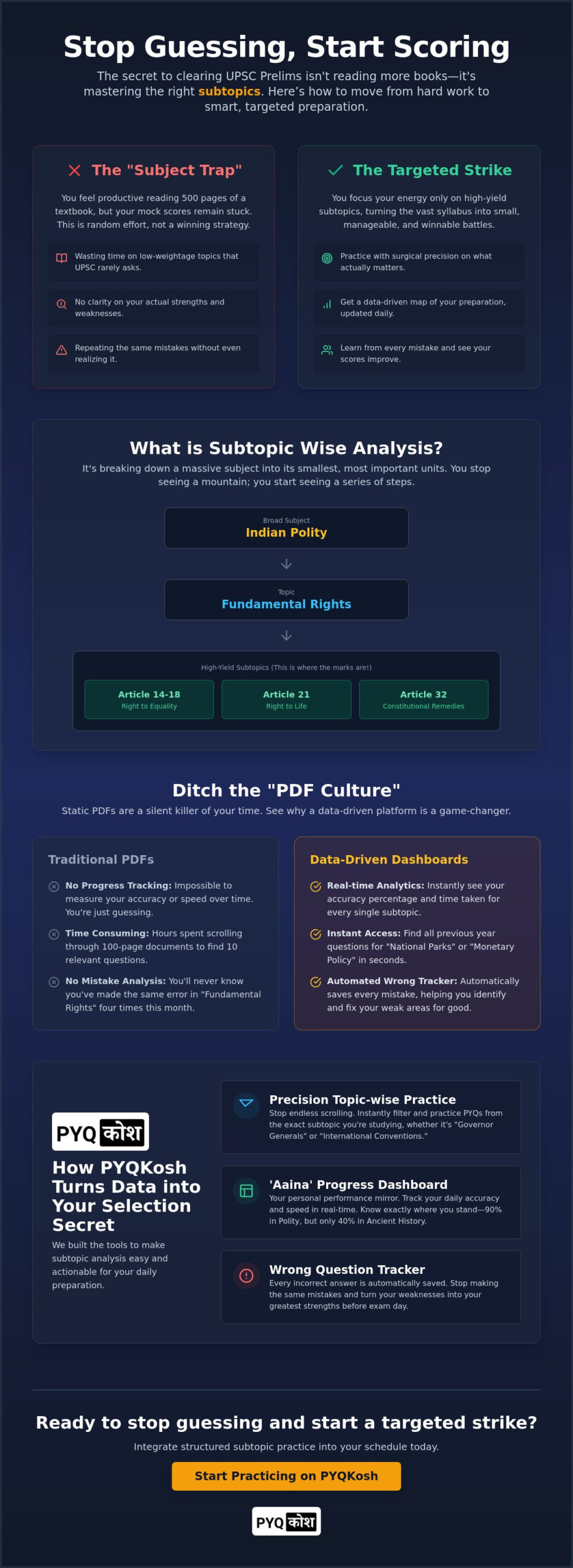
Subtopic-wise analysis for UPSC means breaking down a massive subject into its smallest, logical units so you can practice with surgical precision. It’s not just about “finishing the book.” It’s about conquering one small piece at a time. You stop looking at the syllabus as a mountain and start seeing it as a series of small, winnable battles.
Think of it as a clear hierarchy. You don’t just study “History.” You study “Modern History.” But even that is too broad for the 2026 Prelims. The real magic happens when you drill down further to “Governor Generals,” “Tribal Revolts,” or “Press Acts.” This level of detail is what separates a serious aspirant from the crowd.
This analysis tells you where the marks are hidden instead of just listing what the syllabus is. Looking at a decade of data on UPSC trends, you’ll see that certain sub-themes repeat while others are ignored for years. Data-driven preparation replaces your “gut feeling” with actual performance facts. It takes the stress out of your 11 PM study sessions because you know you’re studying what actually counts.
The Anatomy of a Subtopic
Let’s take Economy as an example. “Banking” is a huge topic. You could spend three days on it and still feel confused in a mock test. But “Monetary Policy Tools” or “Insolvency and Bankruptcy Code” are specific subtopics you must master. Mastering these small areas is much better than “glancing” through five whole chapters in a rush.
When you focus on subtopics, you build deep conceptual clarity. This is the real topper banne ka shortcut. You aren’t just reading; you are solving. You aren’t just hoping; you are knowing. It’s about quality over quantity. Five mastered subtopics will always beat ten half-read chapters on exam day.
Tracking Your Strength Map
Your subtopic data creates a visual map of your preparation. Imagine knowing that you are 90% accurate in “Fundamental Rights” but only 20% in “Directive Principles.” That’s a game-changer. Your data tells you exactly what to revise on Sunday morning. You don’t have to wonder which book to open. You just fix what is broken.
This level of tracking helps you stay motivated. When you see your accuracy climb from 40% to 80% in a subtopic like “Preamble,” you feel the progress. You can start practicing subtopic-wise to build this strength map today. Instead of manual notes, your dashboard tracks every click. It shows your streaks and your weekly graph, ensuring you never waste a single minute on low-yield topics.
PDFs vs. Data-Driven Dashboards: The Reality Check
Scrolling through a 50-page PDF at 11 PM is a nightmare. You’re tired, your eyes hurt, and you’re desperately searching for “Polity” questions from 2024. But even when you find them, you have no idea if you’re actually getting better. This is the “Old Way” of preparation. It’s slow, it’s messy, and it keeps you in the dark about your own progress.
A subtopic wise analysis for UPSC changes the entire game. Instead of a dead document, you get a living dashboard that tracks your every move. When you look at a 14-year analysis of Prelims papers, you realize that UPSC is a strategic mind game. Static PDFs can’t show you that a subtopic like “Global Environmental Conventions” is trending while others have faded away. You need a tool that sorts by recency so you can see exactly how Prelims 2024 and 2025 questions differ from the older patterns of 2015.
Think of your progress dashboard, Aaina, as your personal mirror. It doesn’t lie to you. It shows your streaks, your daily practice count, and your accuracy at the subtopic level. It turns the disorganized chaos of your Telegram folders into a state of focused, data-backed clarity. You stop guessing if you’re ready and start seeing the proof in your weekly graphs.
The “Wrong Question” Tracker
Stop wasting hours maintaining that bulky “Error Notebook.” It’s 2026, yaar; let the technology handle the boring stuff. A smart dashboard automatically saves every failed attempt into a dedicated “Wrong Question” tab. This feature is a lifesaver because it prevents you from repeating the same UPSC mistakes over and over again.
You can sort these mistakes by frequency. If you’ve missed a question on “Presidential Powers” three times, the system puts it right in front of you. You can attack your most stubborn weak spots with surgical precision. This isn’t just practice; it’s a targeted strike on your weaknesses that ensures your mock scores finally start climbing.
Sorting by High-Yield Subtopics
Solving questions in a subtopic with zero weightage is a total waste of your energy. Why spend three hours on a topic that UPSC hasn’t touched in a decade? Use question counts to prioritize your study schedule. If “Preamble” has 15 questions and another subtopic has only one, you know exactly where to spend your morning.
By focusing on high-yield areas, you make your preparation lean and mean. You can start your UPSC CSE Practice by filtering for the most recent and most frequent subtopics. This ensures you’re always aligned with the examiner’s current mindset. It’s about working smarter, not harder, to ensure you’re part of the 933 vacancies announced for 2026.
3 Steps to Use Subtopic Analysis in Your Daily Schedule
Stop making massive, impossible-to-follow study plans that you abandon by Tuesday. Selection in 2026 is about micro-habits, not marathon reading sessions. Here is how to integrate a subtopic wise analysis for UPSC into your daily routine without feeling burnt out.
Step 1: Focus on the micro. Pick exactly one subtopic, like “Preamble” or “Governor Generals,” and solve every PYQ from the last 10 years. Don’t look at the whole subject. Just master that one small slice. This gives you an immediate feel for the examiner’s favorite trap questions.
Step 2: Consult the mirror. Once you finish, check your “Aaina” dashboard. Look beyond the total score. Analyze your accuracy percentage and your average speed per question. If you’re taking two minutes for a question that should take 45 seconds, you need to revisit the core concept.
Step 3: Close the loop. Before bed, spend 15 minutes reviewing your “Confusion Points” and “Booster Tips” in the bookmark tab. These habits take only 5 minutes to execute but save you hours of aimless reading. You can start your daily subtopic practice right now to see the difference.
Mastering the Aaina Dashboard
Your weekly progress graph is your best friend. It shows exactly where you are improving and where you are sliding. Mentor tip: Don’t fear the red marks; they are just your roadmap to the green ones. Every wrong answer is a lesson you won’t forget on the actual exam day.
Use the peer ranking feature to understand your standing in the national competition. It provides a reality check that keeps you grounded and motivated. When you see your rank jump after mastering a difficult subtopic, that’s the best motivation you can get, yaar.
Revision Using the Bookmark Tab
Re-reading a 500-page book is a classic mistake. It’s a waste of time and energy. Instead, use the bookmark tab to create a “custom revision set.” You can sort these by subject or subtopic to focus only on your weak areas. This subtopic wise analysis for UPSC ensures your revision is high-impact and fast.
For those looking for multi-exam synergy, you can access CAPF Exam Practice on the same platform. Solving similar subtopics across different exams builds a rock-solid foundation. It makes you unstoppable across all government exams by proving your concepts are clear no matter how the question is framed.
How PYQKosh Turns Subtopic Data into Your Selection Secret
Stop jumping between five different apps and ten Telegram channels. Centralization is the key to focus. PYQKosh brings 1 lakh plus questions into one place with a structured Subject, Topic, and Subtopic hierarchy. This is where subtopic wise analysis for UPSC becomes a reality instead of just a theory.
This platform was “Made with ❤️ by an Aspirant” who knows exactly why PDFs fail. We know the pain of not finding that one specific question on “Indus Valley Seals” when you need it most. We’ve built the tool we wish we had during our own preparation, focusing on speed, accuracy, and clarity.
Multi-exam support lets you see how the same subtopic is tested in UPSC versus State PCS. It’s a great way to test your conceptual depth. If you can solve a subtopic question in both exams, you’ve truly mastered the concept. This multi-dimensional view ensures you’re ready for any curveball the examiner throws on May 24, 2026.
In-Depth Explanations and Booster Tips
Every right and wrong answer matters for your conceptual clarity. PYQKosh doesn’t just give you the answer key. We provide in-depth explanations that cover why other options were wrong. This helps you eliminate options faster in the actual exam, which is the real secret to high scores.
Booster Tips act like a senior mentor whispering the topper’s secrets in your ear. They highlight “Confusion Points” where UPSC usually sets traps for the unwary. PYQKosh helps you avoid the traps set by the examiner by pointing them out before you ever reach the exam hall.
You can also use the bookmark tab to save these specific tips for your last-minute revision. Instead of searching through bulky books, you have your own personalized “cheat sheet” of high-yield data. This turns your revision into a fast, 15-minute power session that keeps your confidence high.
Start Your Data-Driven Journey Today
Selection is a game of precision, not just volume. You don’t need to read more; you need to read smarter. Stop the disorganized chaos of random mocks and switch to structured, analytical exam preparation. Your data is your best guide to the 933 vacancies available this year.
Your 2026 attempt depends on the data you use today. Check out this UPSC Prelims Analysis to see how the exam is evolving. It’s time to trade your confusion for organized clarity and start seeing the progress you deserve on your Aaina dashboard.
Start practicing your first subtopic for free on PYQKosh today.
Take Control of Your UPSC 2026 Journey
Success in the May 2026 Prelims isn’t about reading the most books; it’s about mastering the most subtopics. We’ve seen how broad subjects act as a trap, making you feel busy without actually improving your mock scores. By implementing a subtopic wise analysis for UPSC, you replace disorganized confusion with a clear, data-backed roadmap to your destination.
Ditch the messy PDFs and let your Aaina dashboard show you the truth about your preparation. With over 1 Lakh structured previous year questions organized into a precise Subject, Topic, and Subtopic hierarchy, you can finally target your weak spots with surgical precision. Stop guessing and start tracking your daily streaks and accuracy in real-time.
You have the talent and the drive, yaar. Now, you just need the right strategy to cross that cutoff line and claim your seat. Start practicing subtopic-wise on PYQKosh today. We’re with you at every step of this journey toward your selection.
Frequently Asked Questions
What is subtopic wise analysis for UPSC and why is it important?
It is the process of breaking down broad subjects into their smallest logical parts for precision practice. Instead of just studying “History,” you focus on specific areas like “Tribal Revolts” or “Press Acts.” This subtopic wise analysis for UPSC helps you identify high-yield areas where the examiner consistently asks questions. It saves you from wasting months on low-weightage topics that rarely appear in the Prelims.
How does subtopic-wise practice differ from standard chapter-wise tests?
Standard tests often cover whole chapters, which can be over 50 pages long and hard to master at once. Subtopic practice is much more surgical. It lets you master a single concept, like “Monetary Policy Tools,” in one sitting. This ensures you don’t move on until you’ve actually conquered the specific logic UPSC uses for that exact theme, making your revision much faster.
Can I track my progress for specific UPSC subjects like History or Polity on PYQKosh?
Yes, you can track your performance at every level. PYQKosh shows your progress for major subjects like History, Polity, and Economy, but it doesn’t stop there. You can see your accuracy and question count for every topic and subtopic. This helps you find exactly which part of the syllabus is pulling your mock scores down so you can fix it immediately.
What is the “Aaina” dashboard and how does it help UPSC aspirants?
Aaina is your personal progress dashboard that acts as a mirror for your exam readiness. It tracks your daily practice count, accuracy, and streaks. The dashboard also provides weekly graphs and peer ranking. It turns your preparation into a game of data where you always know if you’re getting better or staying stagnant. No more guessing; you see the facts.
How do “Booster Tips” and “Confusion Points” help in reducing negative marking?
These features directly attack the cause of negative marking by explaining the examiner’s traps. Booster Tips give you the extra edge needed for selection, while Confusion Points highlight where aspirants usually make silly mistakes. Understanding why an option is wrong is just as important as knowing why one is right. It builds the deep conceptual clarity required to eliminate options confidently.
Is subtopic-wise analysis relevant for UPSC Prelims 2026?
It is more relevant than ever because the May 24, 2026 Prelims will reward precision over random reading. As the competition increases for the 933 vacancies, only those who use subtopic wise analysis for UPSC will be able to cover the syllabus effectively. It is the best way to align your study schedule with the latest 2025 and 2026 exam trends without feeling overwhelmed.
How can I use the “Wrong Question” tab to improve my UPSC mock scores?
The “Wrong Question” tab automatically stores every mistake you make during practice. You don’t need to maintain a physical error notebook anymore. Just sort your mistakes by frequency to see which subtopics you keep failing in. Revisiting these specific questions before your next mock will help you stop repeating the same errors and boost your overall score instantly.
Is data-driven practice better than solving traditional UPSC question paper PDFs?
Data-driven practice is far superior because static PDFs cannot track your speed, accuracy, or streaks. Traditional question papers don’t tell you if you’re actually improving in “Fundamental Rights” over time. A dashboard centralizes everything and provides instant feedback. It helps you work smarter instead of just wasting hours scrolling through disorganized files that don’t show your growth.