

Article by
Aaisha
A passionate content writer at PYQKosh focused on simplifying Current Affairs and PYQs for competitive exam aspirants. I love turning complex topics into easy, student-friendly content that helps learners prepare smarter and stay consistent in their exam journey.
Why Random PYQ Practice is Killing Your Exam Rank
Solving 100 questions a day feels productive, but it means nothing if you keep getting the same subtopics wrong. You're working hard, but your rank isn't improving. What's going wrong?
The problem is often the tools. Traditional PDFs are static; they don't tell you where your speed is dropping or which concepts are your real weak points. This creates a "false sense of security," where practicing easy topics feels good but ultimately hurts your rank.
A data-driven exam analytics dashboard is your digital mirror. It shows you the honest truth about your preparation, turning random effort into a targeted strategy.
The Problem with Static Question Papers
Endlessly scrolling through 500-page PDFs leads to "passive learning," not active recall. It's nearly impossible to track your mistakes across different years and exam shifts. You waste hours manually calculating your accuracy after every practice session, time that could be spent on revision.
Transitioning from Random Effort to Targeted Action
For 2026 aspirants, the mantra is "Work Smarter, Not Harder." A smart dashboard instantly highlights the "High-Yield" topics where you are currently failing. Platforms like PYQKosh replace your disorganized notes and messy Excel sheets with a single source of truth for your performance.
What a Real Data-Driven Exam Dashboard Should Track
Forget vanity metrics. A dashboard built for serious aspirants focuses on what actually builds a rank. It's not just about how many questions you solve, but how you solve them.
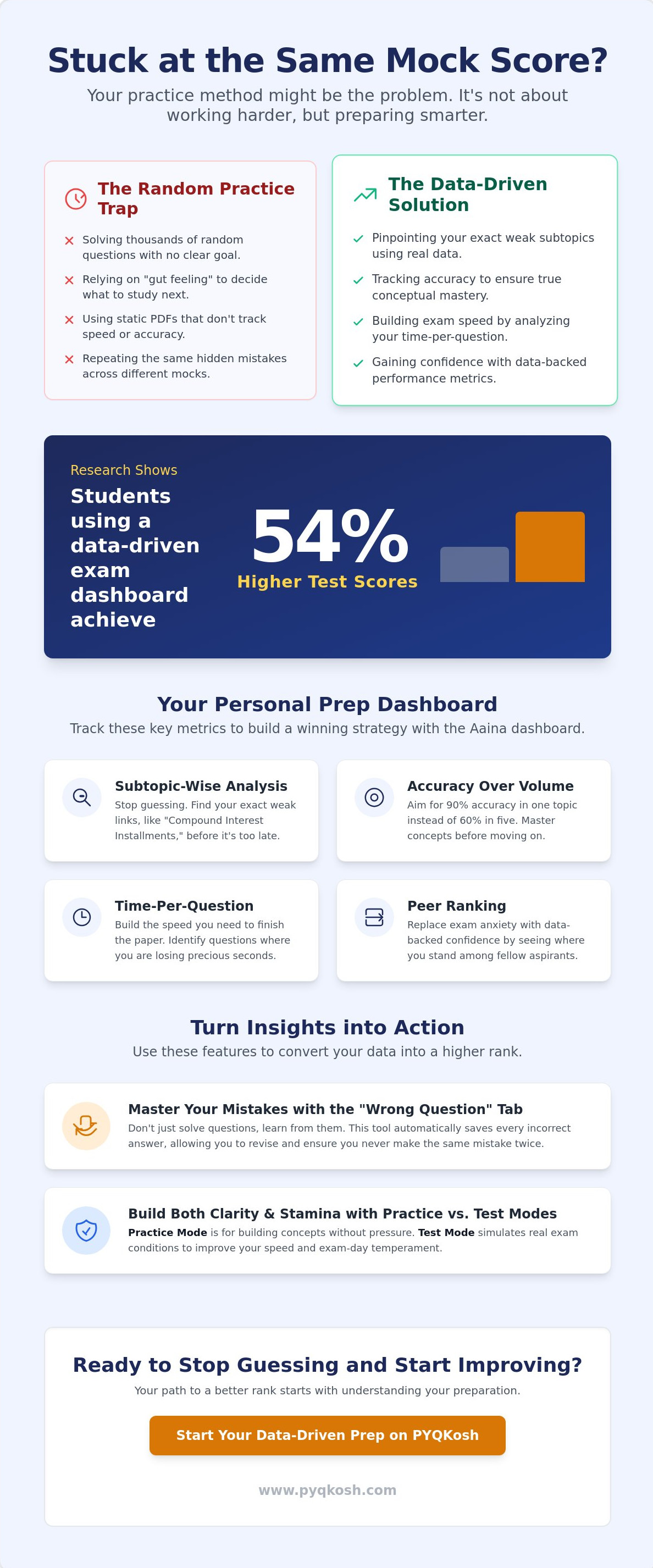
- Accuracy: The single most important metric. High accuracy builds confidence and marks.
- Time-per-question: The metric that decides if you'll even finish the paper on time.
- Daily Streaks: Consistency is the biggest "hack" in competitive exams. A streak tracker keeps you accountable.
- Peer Ranking: Know where you stand in the real competition without the anxiety of a full-length mock test.
Accuracy vs. Volume: The Topper’s Metric
Hitting 90% accuracy in one tough subtopic is far better than scoring 60% in five easy ones. The PYQKosh "Aaina" dashboard shows your true, unfiltered accuracy across every subject, topic, and subtopic. A pro tip: set a "Minimum Accuracy Threshold" (e.g., 85%) for a topic before moving to the next one.
The Psychology of Streaks and Daily Practice
The "Don’t Break the Chain" logic is powerful. Seeing a 10-day practice streak on your dashboard triggers a small dopamine hit, motivating you to keep going. The weekly graph feature helps you spot "Sunday Slumps" or mid-week burnout, so you can adjust your schedule before it's too late. This visual proof of progress is a game-changer during the long months of UPSC prep.
Subtopic-Wise Analysis: Finding Your "Weak Links" Before Exam Day
Saying your "Math" is weak is useless. Knowing your "Compound Interest - Installment Questions" are weak is actionable. This is the power of granular, subtopic-wise analysis.
A good dashboard lets you sort topics by question count and recency, so you can focus on what's most relevant for the 2025–26 exams. It also automates your revision. Instead of manually bookmarking questions, the "Wrong Question Tab" does it for you, helping you find and fix your weak links.
Granular Tracking for SSC and UPSC
For exams like the SSC CGL, understanding subtopic-wise weightage is crucial. Your dashboard should allow you to filter questions by year to see how patterns are changing. This data helps you master one subtopic at a time, building a strong foundation instead of rushing through the entire syllabus with shallow knowledge.
Automating Your Revision with the Wrong Question Tab
The Wrong Question Tab on PYQKosh automatically stores every mistake you make. No more manual tracking. You can even sort these mistakes by frequency to see which concepts you get wrong most often. For a deeper dive, check out this guide on how to use the Wrong Question Tab to stop repeating mistakes.
Building the Topper Mindset with Performance Analytics
Data removes "Exam Fear." When you have objective proof of your readiness, you walk into the exam hall with confidence, not anxiety. It's the final step in shifting your mindset from "I think I know this" to "The data proves I know this."
Using a dashboard like "Aaina" helps you conduct a weekly "Post-Mortem" of your preparation. This is a non-negotiable habit for serious toppers. It's your chance to review what worked, what didn't, and what needs to change.
Peer Rank: The Reality Check You Need
Exams like the UPSC CSE are relative, not absolute. You aren't just competing against the syllabus; you're competing against other serious aspirants. Seeing your rank pushes you to solve "just 10 more" questions. But remember, use your rank as a compass to guide your effort, not as a judge of your worth.
The Weekly Post-Mortem Habit
Here's an actionable tip: spend 30 minutes every Sunday reviewing your weekly graph. Ask yourself: Is my accuracy dropping as I try to increase my speed? Which subtopic is still in the red zone? Based on these red flags, you can create a targeted practice plan for the week ahead.
How PYQKosh Turns Your Raw Data into a Winning Strategy
A question bank with 100,000+ questions is useless without a smart analytical layer on top. PYQKosh is designed to be that layer, turning your practice data into clear, actionable insights.
It centralizes your preparation for SSC, UPSC, and Railways into one dashboard. It gives you both a Practice Mode for building concepts and a Test Mode for building stamina. And with features like the Bookmark Tab, you can organize your most important questions by subject, topic, and even subtopic.
Multi-Exam Support for the Modern Aspirant
Many aspirants prepare for exams like RRB NTPC alongside SSC. Having all your PYQs and performance data in one unified dashboard is a huge advantage. You can easily switch between exam patterns and syllabi without losing your progress or momentum.
Test Mode: The Final Frontier
The in-depth analysis you get after a mock test is different from your daily practice analytics. It gives you a complete breakdown of your performance when you're under pressure. For a complete overview of how to leverage these features, see this smart mentor guide to PYQKosh. Stop scrolling through PDFs and start solving with a clear, data-driven goal.
Frequently Asked Questions (FAQs)
-
Is an exam analytics dashboard better than a simple Excel sheet?
Yes. A dashboard automates everything—tracking accuracy, time, and mistakes. It visualizes your progress with graphs and streaks, saving you hours of manual data entry and giving you clearer insights. -
How does the "Aaina" dashboard help in identifying weak subtopics?
The Aaina dashboard shows you your accuracy percentage for every single subtopic you practice. You can immediately see which areas are red (weak) or green (strong), allowing you to focus your revision where it's needed most. -
Can I track my progress for multiple exams like SSC and UPSC at the same time?
Absolutely. PYQKosh is a multi-exam platform. You can practice for SSC, UPSC, Railways, and other exams, and the dashboard will keep your progress for each one organized separately. -
What is the "Wrong Question Tab" and how does it save time?
It's a feature that automatically saves every question you answer incorrectly. This creates a personalized question bank of your mistakes, so you can revise them directly without having to manually find or bookmark them. -
Does the dashboard show my rank compared to other aspirants?
Yes, the Peer Rank feature shows you where you stand among other serious aspirants practicing on the platform. It helps you understand the level of competition. -
How much time should I spend analyzing my dashboard daily?
You don't need to spend hours. Just 15-20 minutes a day is enough to review your performance, identify one or two weak areas, and plan your next practice session accordingly. -
Is the data-driven approach suitable for Hindi-medium students?
Yes, of course. Data is a universal language. Performance metrics like accuracy, speed, and consistency are valuable for every aspirant, regardless of their medium. -
Can I use the dashboard on my mobile while traveling?
Yes, PYQKosh is a web-based platform that is fully optimized for mobile browsers. You can analyze your performance and practice questions anytime, anywhere.