
Article by
Aaisha
A passionate content writer at PYQKosh focused on simplifying Current Affairs and PYQs for competitive exam aspirants. I love turning complex topics into easy, student-friendly content that helps learners prepare smarter and stay consistent in their exam journey.
You've spent months solving random Telegram PDFs and watching strategy videos, but your mock test scores are still stuck in the same range. Why does it feel like you're running on a treadmill? It's exhausting to put in 10 hours a day only to forget core concepts the moment you sit for a test, yaar. Most aspirants fail not because they don't study, but because they study the wrong things in a disorganized way.
I get it because I've been there too. The frustration of seeing a "wrong" mark on a subtopic you thought you knew is real. You don't need more books; you need a smarter way to track your progress. In this guide, I'll show you exactly how to use specific PYQKosh features for score improvement so you can stop guessing and start targeting your actual weaknesses. We'll map out a clear daily routine using the Aaina dashboard and the Wrong Question tab to build your confidence for the 2026 exam cycle.
Key Takeaways
- Stop wasting hours on unorganized Telegram PDFs and switch to a structured, subtopic-level practice strategy.
- Discover how to use specific PYQKosh features for score improvement by filtering for the latest 2025 and 2026 exam patterns.
- Use the Aaina dashboard and the Wrong Question tracker to identify exactly where you are leaking marks.
- Follow a high-impact 60-minute daily routine that combines quick reviews with intensive practice in Test Mode.
- Centralize your preparation for SSC, Railways, and UPSC on one platform to track your progress across different exams.
Why Your Current PYQ Practice Is Not Increasing Your Score
That feeling when you see a familiar question but still get it wrong? It's incredibly frustrating, yaar. You've probably solved 500 random questions already, yet your marks are stuck. This is the mystery every aspirant faces. Why doesn't hard work always lead to a higher score?
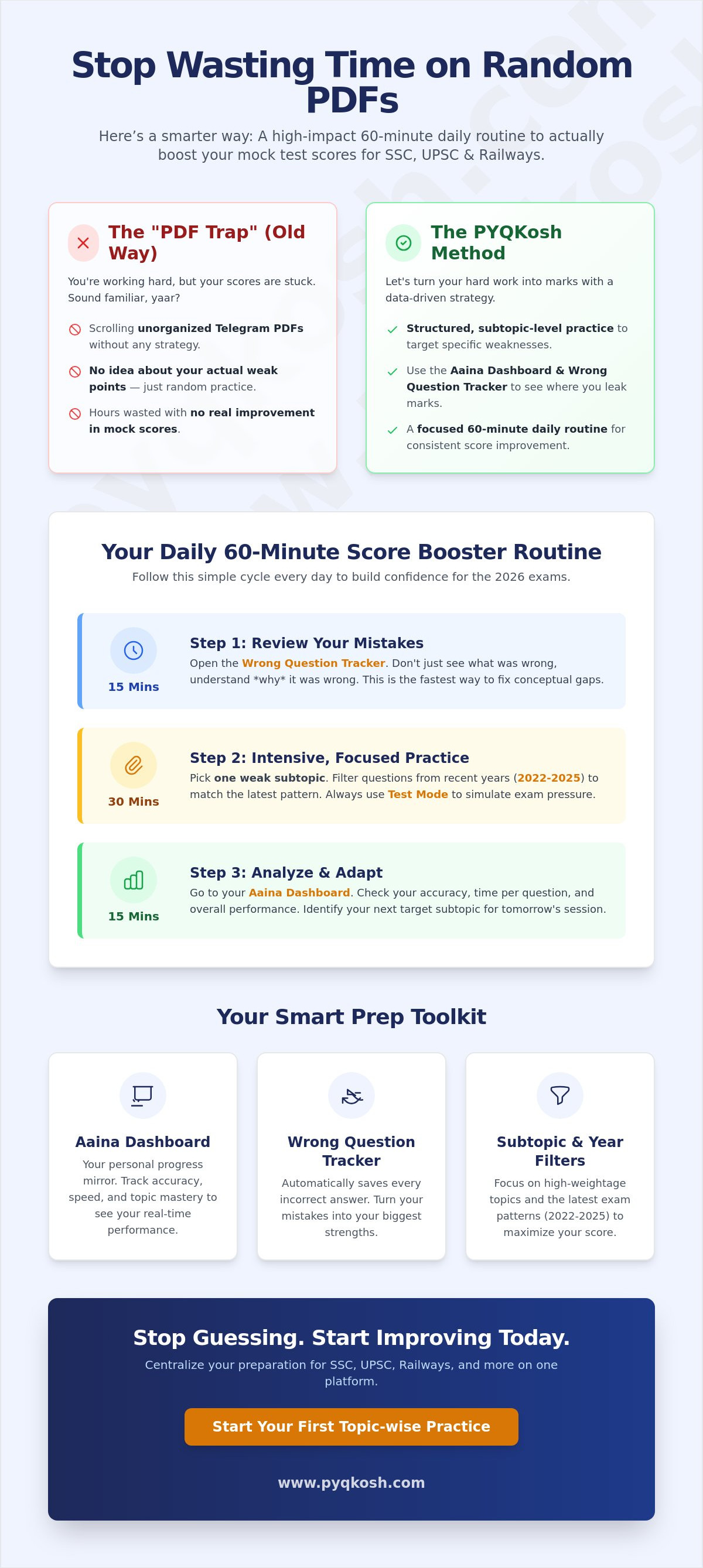
The answer lies in the "PDF Trap." You spend hours scrolling through unorganized Telegram files, thinking you're making progress. In reality, these scattered documents waste your time and kill your focus. They don't tell you where you're failing. They just give you more to read without any strategy.
For the 2026 exam cycle, you must move beyond this disorganized chaos. It's time to adopt a "work smarter, not harder" philosophy. Using specific PYQKosh features for score improvement allows you to stop guessing and start targeting the exact gaps in your knowledge.
The Problem with Disorganized Practice
Studying broad subjects like "History" or "Math" is a huge mistake. These topics are way too wide for effective improvement. If you don't know whether your weakness is in Ancient History or specifically in the Gupta Empire, you can't fix it. Random practice makes it impossible to identify your actual weak points.
Scientific research highlights the testing effect, which proves that active retrieval is the best way to learn. However, this only works if your practice is structured. Instead of random sets, you need structured, analytical exam preparation. This helps you move from confusion to organized clarity, ensuring every minute you spend practicing actually adds to your final score.
Why Subtopic Weightage is the Real Game-Changer
Not all subtopics are equal in SSC or UPSC exams. Some areas appear every year, while others show up once in a blue moon. Spending three days on a low-weightage topic is a waste of energy. You need to know where the marks are hidden.
Focusing on high-weightage areas is the real topper banne ka shortcut. You can see this in action by visiting the SSC CGL exam page to check which subtopics dominate the recent papers. When you prioritize your effort based on data, your accuracy improves naturally. This targeted approach is what separates a serious candidate from the rest of the crowd.
Ready to see where you stand? Start your topic-wise practice now.
Master the Subtopic-Wise Practice Strategy on PYQKosh
Ready to stop scrolling and start scoring? First, log in and select your target exam. Whether it's SSC, UPSC, or Railways, the platform centralizes everything for you. Once you've picked your subject, don't just hit "start." Use the filters to drill down into specific subtopics.
This is where you'll find the most powerful PYQKosh features for score improvement. You can sort topics by the number of questions or by year. If you're aiming for the 2026 cycle, focus on questions from 2022 to 2025. This ensures you're practicing what's actually relevant today.
Always practice in Test Mode for at least 30 minutes. It creates that real exam-day pressure that Practice Mode just can't mimic. It's the best way to train your brain to stay calm when the clock is ticking, yaar. This simple shift in habit builds the stamina you need for the final battle.
Breaking Down Huge Subjects into Mini-Wins
Mastering "Geography" feels impossible, but mastering "Indian Rivers" is doable in an hour. This is the Small Wins method. When you complete a subtopic with 100% accuracy, your confidence levels jump. It's a massive psychological boost that keeps you going when you're tired.
Use the subtopic filters to narrow your focus to just one area at a time. This targeted approach builds muscle memory for specific question patterns. It makes you much faster during the actual test. You can start mastering your first subtopic today to see the difference in your accuracy.
Targeting Recent Trends (2025-2026)
Exam boards change their patterns every few years. What worked in 2018 might be useless now. That's why you must sort your practice by recency. Look for 2024 and 2025 patterns to understand the current mindset of paper-setters.
This is especially critical for dynamic subjects. Older questions in Current Affairs are often irrelevant and just waste your brain space. Check out the latest Current Affairs topics to see exactly what's trending in the 2025-2026 exam cycle.
Staying updated with recent data is the only way to stay ahead of the competition. Don't let outdated materials pull your rank down. Use the sorting feature to ensure your preparation matches the reality of the upcoming 2026 exams.
Using Aaina and the Wrong Question Tracker to Stop Leaking Marks
You study for ten hours, solve hundreds of questions, and still see your mock scores dip. It feels like trying to fill a bucket with holes, doesn't it? You are likely leaking marks on subtopics you think you have mastered. To stop this, you need a mirror that shows you the cold, hard truth of your preparation. Understanding how to use specific pyqkosh features for score improvement is the only way to plug those holes before the 2026 exam cycle begins.
Data-driven tracking is not just a fancy term; it is your survival kit. Instead of guessing which subject needs more time, you should let your performance data guide you. By leveraging these pyqkosh features for score improvement, you transform from a confused aspirant into a focused candidate who knows exactly what to fix every single day.
Decoding Your Performance with the Aaina Dashboard
Aaina means mirror, and that is exactly what this dashboard does for your prep. It reflects your actual readiness without any sugar-coating. The Weekly Graph shows you if your accuracy is climbing or if you are just hitting a plateau. Meanwhile, the Peer Rank feature gives you a reality check by showing where you stand against thousands of other serious aspirants. This is the best way to stay grounded and motivated at the same time.
Use your accuracy percentage as a traffic light. If your accuracy in a subtopic is below 70%, do not move to a new topic yet, yaar! It means your concepts are still shaky. Stay on that subtopic, review the in-depth explanations, and practice until that number turns green. This disciplined approach ensures you don't carry weaknesses forward into the actual exam hall.
The Wrong Question Tracker: Your Automatic Revision List
Forget the old-fashioned way of maintaining a "mistake notebook" by hand. It takes too much time and is impossible to organize. The platform automatically stores every single mistake you make in the Wrong Question tab. This is your most valuable asset. You can sort these errors by frequency to see which specific concepts trip you up repeatedly. If you have made the same mistake three times, that is a red flag you cannot ignore.
Make it a habit to aim for a "Zero-Mistake" list every weekend. Before you start your Sunday, go through every question in your tracker. Sort them by "recently committed" to refresh your memory on your latest slips. Once you can solve your entire "Wrong Question" list with 100% accuracy, you have officially turned your weaknesses into strengths. This is the ultimate topper strategy for 2026.
Your Daily 60-Minute Score Booster Routine for 2026
You don't need five hours of aimless study to win. You just need sixty minutes of focused, high-intensity work every single day. If you use the right pyqkosh features for score improvement, you can achieve more in one hour than others do in a whole day. This routine is designed for the busy aspirant who wants results, not just syllabus completion.
Start with minutes 0-10 by reviewing yesterday’s Wrong Questions. This stops the memory leak immediately. From minutes 10-45, jump into intensive subtopic-wise practice. Use Test Mode to solve 30-40 questions under pressure. Finish your hour, from minutes 45-60, by reading the in-depth explanations for every single question you touched, whether you got it right or wrong.
The Practice-Analyze-Refine Workflow
Checking the right answer is only half the battle, yaar. The real magic happens when you read the in-depth explanation. These explanations cover both the right and wrong options, helping you understand the "why" behind every choice. It is the ultimate way to build conceptual clarity on the go without carrying heavy books.
Keep an eye out for the Exam Booster Tips hidden in these explanations. They give you shortcuts and point out common confusion points that usually trip up students. Since the platform is built for mobile, you can easily follow this routine during your bus ride or lunch break. It's one of the most effective pyqkosh features for score improvement for anyone with a tight schedule.
Bookmarking for Rapid Revision
What do you do when you hit a question that is truly tough? Don't just move on. Use the Bookmark tab to save it for a second look. This creates a personalized hit list of questions that you can revisit in the final seven days before your exam. It turns a stressful week into a smooth, data-backed revision session that actually sticks.
You can sort these bookmarks by subject or topic for a quick two-hour pre-exam sweep. This is especially useful for high-stakes tests where every mark counts. If you are preparing for civil services, check out the UPSC CSE exam page to start bookmarking high-weightage topics now. Stop guessing and start practicing with a plan.
Start your 60-minute booster session now and see your accuracy climb.
Scaling Your Prep Across SSC, UPSC, and Railways
Why waste your phone's storage on five different apps that don't talk to each other? Most aspirants juggle multiple exams like SSC, Railways, and UPSC at the same time. If you use a centralized platform, you can see the overlap between these papers. For example, the math questions you solve for SSC often mirror what you'll find in Railway exams.
By using specific pyqkosh features for score improvement, you can track your progress across different exam categories without losing your data. This centralization saves you hours of switching back and forth. It lets you focus on what actually matters: getting that selection in the 2026 cycle.
Ready to unlock your full potential? You can check the pricing plans to get unlimited access to subtopic-wise practice. It's a small investment in your future that pays off with every mock test you crush.
One Nation, One PYQ Station
Switching between exams on the platform is seamless. You can move from SSC CGL to RRB NTPC with just a few clicks. The best part? The Aaina dashboard keeps your overall streak alive regardless of which exam you are practicing for today.
- Visit the Exam Selection page to see all available government exams.
- Track your accuracy across different subjects to find your universal weak points.
- Maintain a daily practice habit that counts toward your global peer rank.
Final Motivation: From Confusion to Clarity
2026 is the year you stop being just another aspirant and start being an officer. Consistency joined with data-driven practice is the only formula that works. You don't need magic; you need a strategy that identifies your mistakes before the examiner does, yaar.
Trust tools that are built by people who understand your struggle. If you want more specific tactics, read our guide on SSC Exam Questions and Answers 2026. These pyqkosh features for score improvement are your secret weapon to turn your confusion into absolute clarity.
Don't just dream about the uniform or the office. Practice until you earn it.
Time to Turn Your Hard Work Into Selection
Success in the 2026 exam cycle isn't about solving more questions; it's about solving them with a strategy. You've seen how moving from random PDFs to subtopic-level practice can change your accuracy. By using the Aaina dashboard and the Wrong Question tracker, you can finally stop guessing where you stand. These pyqkosh features for score improvement are designed to give you the same edge that toppers use to stay ahead of the crowd.
With over 100,000 Previous Year Questions across 130+ Government Exams, you're joining a community of 2K+ active PYQ learners who are already working smarter. Stop wasting time on disorganized materials that don't track your growth. It's time to replace your confusion with organized clarity and start your journey toward that dream post, yaar.
Pick your exam and start your first subtopic-wise practice session today!
Believe in your potential and stay consistent. The path from aspirant to officer is built one subtopic at a time.
Frequently Asked Questions
How exactly does subtopic-wise practice help me improve my score?
Subtopic-wise practice helps you find and fix specific holes in your preparation. Instead of wasting time on broad subjects you already know, you focus on high-weightage areas where you are actually losing marks. This is one of the key pyqkosh features for score improvement because it builds muscle memory for specific question patterns. You stop being a general student and start becoming a specialist in every topic.
Can I use PYQKosh for multiple exams like SSC and Railway at the same time?
Yes, you can switch between exams like SSC CGL, RRB NTPC, and UPSC on a single platform. Your data stays centralized, so you don't lose your streaks or progress tracking. Solving SSC math often helps with Railway exams, and the platform makes this overlap easy to manage. It is the best way to scale your prep without cluttering your phone with five different apps.
What is the Aaina dashboard and how often should I check it?
The Aaina dashboard is your performance mirror that tracks accuracy, daily streaks, and peer rank. You should check it every evening after your practice session to see where you stand against the competition. It shows you the cold truth about your readiness. If your weekly graph is dipping, you know you need to change your study strategy immediately to stay on track for 2026.
How do I use the Wrong Question Tab to reduce my negative marking?
This tab automatically stores every mistake you make so you can review them later. To reduce negative marking, sort these questions by frequency and solve them until you reach 100% accuracy. This turns your recurring errors into strengths. It is a much faster way to fix conceptual gaps than carrying around a physical mistake notebook, yaar. You fix the error once and never repeat it.
Is it better to practice in Practice Mode or Test Mode for score improvement?
Test Mode is much better for score improvement because it creates real exam-day pressure. Practice Mode is fine for initial learning, but Test Mode trains your brain to solve questions under a ticking clock. This builds the stamina and speed you need for the actual test. Use pyqkosh features for score improvement like Test Mode daily to avoid panicking during the actual 2026 exams.
Does PYQKosh include the latest questions from the 2025 and 2026 exam cycles?
Yes, the platform includes the most recent patterns from the 2025 and 2026 exam cycles. You can sort topics by recency to see what boards are currently asking in their papers. Staying updated with the latest trends is critical for dynamic subjects like Current Affairs. Don't waste your time on outdated questions from ten years ago when the exam pattern has already changed completely.
How much time should I spend on the platform daily to see a real difference?
Spending just 60 minutes daily on high-intensity practice can make a huge difference in your mock scores. Use the first 10 minutes for revision and the next 45 for subtopic practice in Test Mode. This routine is far more effective than studying for 10 hours without a plan. Consistency is the topper banne ka shortcut, especially when you are practicing on mobile during your daily commutes.
What should I do if my accuracy is not improving in a specific subtopic?
Stop moving to new topics and read the in-depth explanations for your wrong answers. These explanations cover confusion points and offer booster tips to help you understand the core concept. If your accuracy is below 70%, you should stay on that subtopic. Use the Bookmark tab to save tough questions and revisit them after a few days to test your memory again until it sticks.