

Article by
Aaisha
A passionate content writer at PYQKosh focused on simplifying Current Affairs and PYQs for competitive exam aspirants. I love turning complex topics into easy, student-friendly content that helps learners prepare smarter and stay consistent in their exam journey.
What if the key to your 2026 success is hidden in a paper from eight years ago? Many aspirants ignore older years, but a deep UPSC 2018 prelims question paper analysis reveals this was the exact moment the exam shifted from simple facts to complex, multi-statement puzzles. This paper changed the rules of the game forever.
I know how it feels to stare at a "None of the above" option and wonder if you've studied the wrong books. It's exhausting to balance static subjects with current affairs while worrying about wasting time on low-yield topics. You aren't alone in this struggle, and the confusion ends here. We've all been there, feeling the pressure of the 933 vacancies announced for 2026.
This guide will decode the 2018 trend shift so you can master high-yield questions for your May 24, 2026 attempt. I'll provide a categorized list of subtopics and a clear strategy to practice efficiently. We'll look at how to use topic-wise practice and the Aaina dashboard to turn your weak spots into strengths. You'll stop guessing and start solving with data-driven confidence.
Key Takeaways
- Learn why 2018 was the turning point for UPSC's shift toward multi-statement conceptual questions.
- Our UPSC 2018 prelims question paper analysis shows exactly how Economy and Environment became the new pillars of the exam.
- Discover why mastering "Medium" difficulty questions is the real secret to clearing the cutoff in 2026.
- Stop wasting time on full-length papers; learn the smart way to practice 2018 questions subtopic-wise.
- Find out how to use the Aaina dashboard to track your accuracy and stay ahead of your peers.
Why the Prelims 2018 Question Paper Still Matters in 2026
Remember that feeling when you've memorized an entire textbook but the actual exam question feels like a total bouncer? That's exactly what happened to thousands of aspirants in 2018. UPSC ne game badal diya by moving away from direct facts and shifting toward deep concepts.
A proper UPSC 2018 prelims question paper analysis shows this was the birth of the "New UPSC." It introduced the heavy multi-statement questions that now define the modern exam. It was the year when the "1 and 2 only" or "None of the above" options became the ultimate speed breakers for unprepared students.
Mastering this specific paper isn't just about solving old questions. It's about building the sharp analytical mindset needed for the UPSC Civil Services Examination in 2026. This paper set the template for everything we see today; from tricky Economy curves to complex Environment logic.
The Shift from Rote Learning to Conceptual Clarity
If you think "ratta marna" will save you on May 24, 2026, think again. After 2018, the era of simple one-liner questions ended. UPSC started testing if you can actually connect the dots between different subjects like Geography and International Relations.
They stopped asking "What is this treaty?" and started asking "Why does this treaty matter for India's trade?" It's all about understanding the core "Why" over the simple "What," especially in current affairs. You need to know the logic behind the news, not just the headline, yaar.
You can see this shift clearly when you use topic-wise practice on PYQKosh. It helps you see how a single concept like "Money Multiplier" or "Inflation" was twisted into complex statement-based questions that year. Seeing these patterns helps you avoid the same traps in your own attempt.
High-Yield Themes that Started in 2018
Some themes like Eco-sensitive zones and Biodiversity became permanent favorites after 2018. Environment and Ecology alone saw 15 questions that year, making it a massive core pillar. These aren't just random topics; they are part of your 2026 syllabus blueprint.
Recurring patterns in International Treaties and Science & Tech also emerged strongly. Don't treat the 2018 paper as ancient history. Treat it as a live map of the topics UPSC loves to revisit every few years in different forms.
Use the "Aaina" progress dashboard to track how well you handle these specific 2018 themes. If your accuracy is low in Biodiversity or Preamble questions, you know exactly where to put more effort. Focusing on these high-yield areas is the smartest way to ensure you are among the 933 selected candidates.
Subject-Wise Weightage: Where UPSC Put the Pressure
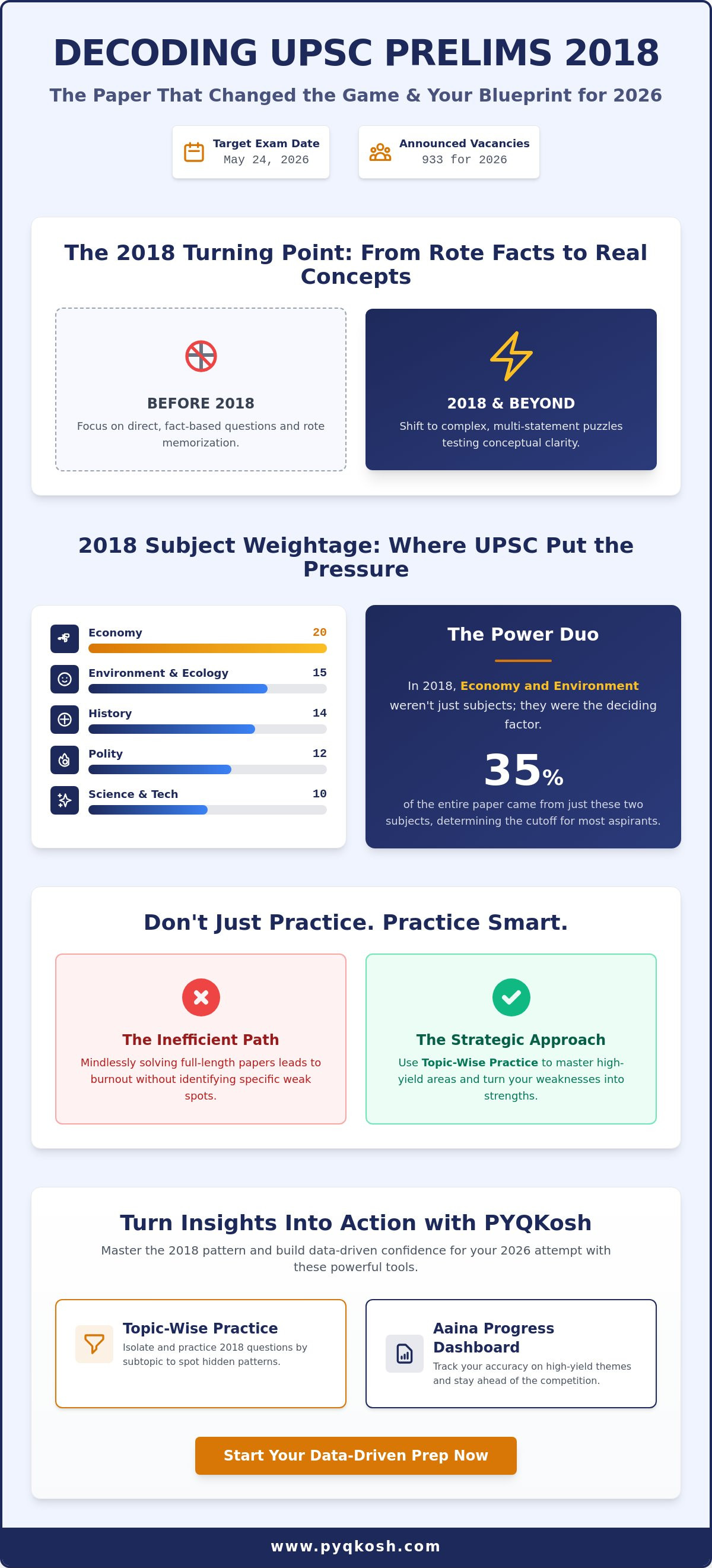
Ever felt like you studied everything but the weightage flipped on you? In 2018, that's exactly what happened. Economy and Environment together decided the cutoff for most people. If you look at the UPSC 2018 Previous Question Papers, you'll see how these two subjects dominated the scene.
Our detailed UPSC 2018 prelims question paper analysis highlights that Economy wasn't just about formulas; it was about real-world application. With 20 questions on the table, it was the biggest pressure point. Science & Tech also took a sharp turn. It moved from textbook physics to emerging tech like AI and Biotechnology. You couldn't just rely on static notes anymore, yaar.
Polity remained a stable source of marks but shifted towards governance and landmark judgments. It wasn't enough to just know the Articles. You had to understand how they were interpreted by the courts. This mix of static and dynamic questions is what made the 2018 paper a real game-changer for aspirants.
Economy and Environment: The Power Duo
Economy dominated with 20 questions, covering Banking, Government Schemes, and Global Trade. They weren't basic. UPSC tested concepts like the Money Multiplier and the role of the RBI in detail. You need to know how the system works, not just definitions. Environment and Ecology followed with 15 questions, becoming a core pillar. This section requires heavy map-based practice and knowledge of international treaties.
Combining these two is your secret weapon for a safe score in 2026. You can start with topic-wise practice to see how these subjects overlap in the 2018 paper. It helps you see the patterns without getting overwhelmed by all 100 questions at once. If you don't know your National Parks or the Paris Agreement details, you're leaving marks on the table.
History and Polity: The Static Backbone
History and Polity remained the backbone, but the style changed. Modern History focused heavily on personalities and specific freedom struggle movements. It wasn't just about the year something happened, but the 'why' behind the movement. A deep UPSC 2018 prelims question paper analysis shows that Polity moved towards the spirit of the Constitution. Constitutional provisions are now more important than ever.
The real surprise was Art & Culture. Many students skipped it, but 2018 proved you can't do that anymore. UPSC started asking about specific architectural styles and philosophical schools. It’s a small section, but it can be the difference between clearing the cutoff or missing it by a few marks. You need to understand how the law impacts the common man, not just memorize the list of Fundamental Rights.
Difficulty Analysis: Was 2018 Really the Hardest Year?
Many seniors still talk about 2018 with a bit of fear in their eyes. Only 21 questions were truly 'Easy' that year. A solid UPSC 2018 prelims question paper analysis proves that the rest required serious brain-picking and deep logic.
The 'Medium' category had 50 questions. This is where the real battle happens, yaar. If you can crack these, you are halfway through the gate. You can't just rely on basic facts here; you need to understand the underlying concepts.
UPSC 2018 killed the old 'simple elimination' trick that everyone used to teach. You need logical guessing now. It's not about how many questions you attempt, but how many you get right. Accuracy is your only savior when the paper gets this tough.
Don't panic by the 'Hard' tag on almost 30% of the paper. It's a signal to be selective. Successful candidates that year knew exactly which bouncers to duck and which ones to hit for a boundary. Learning this skill is vital for your 2026 attempt.
Decoding the 29 'Hard' Questions
What exactly made 29 questions 'Hard' in 2018? It was a mix of vague options and niche topics that nobody expected. Questions on obscure tribal festivals or specific scientific developments in Biotechnology left many aspirants confused.
You must learn which questions to skip to avoid negative marking. Don't let your ego get in the way during those two hours. If you've never heard of a topic, it's probably one of those 29 questions designed to trap you.
Use the in-depth explanations on PYQKosh to understand these traps. Their 'Exam Booster Tips' help you see through the confusion points in tricky 2018 problems. You can even use the "Wrong Question" tab to track if you keep falling for the same vague options during practice.
The Reality of Cut-offs in 2018
The toughness of this paper reflected directly in the lower cut-off. A score of 98-100 was a topper-level performance that year. It proved that you don't need to solve every question to clear the Prelims.
Use this data to set realistic targets for your mock tests. You don't always need a 120+ score to qualify. Focus on maintaining high accuracy in the 'Easy' and 'Medium' segments instead of over-reaching on the 'Hard' ones.
Track your progress on the Aaina dashboard to see where you stand. It shows your accuracy and peer rank, helping you understand if your strategy is working. With only 933 vacancies announced for 2026, every mark counts, so use your data wisely to stay ahead of the competition.
Smart Strategy: How to Practice 2018 Questions Subtopic-Wise
Stop solving full 100-question papers in one go. It's inefficient, yaar. You spend three hours solving and another two hours reviewing things you already know. By the time you reach the tough questions, your brain is fried. This disorganized approach is why many aspirants feel they aren't improving despite hours of hard work.
The secret is to break the paper down. When you perform a UPSC 2018 prelims question paper analysis, you'll see that questions follow specific themes. Instead of a random mix, focus on one subtopic at a time. If you just finished reading about the Preamble or Climate Change, solve only those specific questions from the 2018 paper right now. This locks in the concept while the theory is still fresh in your mind.
Practice only what you just studied. This targeted method helps you see exactly how UPSC twists a single theme into a complex statement. It turns your preparation from a guessing game into a structured, analytical process. You'll start noticing the traps before you even finish reading the question.
Why Subtopic Practice Beats Static PDFs
Most websites just give you a boring PDF with an answer key at the end. But PDFs don't tell you *why* you got a question wrong. Structured practice on PYQKosh provides instant feedback and subtopic-level precision. You can save hours every week by skipping topics you've already mastered and doubling down on your weak areas.
Focusing on the UPSC Prelims Topic Wise Weightage 2026 while practicing ensures you don't over-invest in low-yield topics. Static files make it impossible to track your accuracy over time. With subtopic-wise tracking, you get a clear picture of your readiness for the 2026 attempt without flipping through hundreds of pages.
Setting Up Your 2018 Practice Drill
Dedicate one hour daily specifically for 2018 PYQs. Don't treat it like a final exam yet. Use the 'Practice Mode' to see in-depth explanations immediately after answering each question. This helps you understand the logic while the question is still active in your working memory. Waiting until the end of a 100-question test to check your mistakes is a recipe for forgetting the context.
Use the bookmark tab to save 'confusion points' or questions where you got stuck between two options. Revisit these bookmarked questions once a week. This habit ensures that the tricky 2018 logic becomes second nature to you before you sit for the actual exam on May 24, 2026. You can even sort your practice by question count to tackle the high-yield subtopics first.
Ready to see where you stand? You can start your topic-wise practice now to turn these insights into marks.
Master UPSC PYQs with PYQKosh: Your Aaina to Success
Ever feel like you are running in circles? You solve a question, get it wrong, read the answer, and then forget it two days later. This is the biggest hurdle for any serious aspirant. Our UPSC 2018 prelims question paper analysis proved that the exam is won by those who learn from their errors, not just those who read the most books. You need a way to see your progress clearly without getting lost in a pile of static PDFs.
Practice the 2018 paper on PYQKosh with subtopic-level precision. Instead of solving a random mix of 100 questions, you can target specific areas like 'Banking' or 'International Treaties'. This focused approach ensures that you actually master the logic behind the "New UPSC" style of questions. You can choose between Practice mode for instant learning or Test mode to check your speed and accuracy under pressure.
Our platform doesn't just give you an answer key. It provides in-depth explanations that cover both right and wrong options. This is crucial for the 2018 paper because the options were designed to be confusing. Understanding why an option is wrong is just as important as knowing why one is right. These explanations include exam booster tips and specific confusion points to help you avoid common traps in your 2026 attempt.
Stop Wasting Time on Random Practice
Centralize your prep for UPSC CSE and other major exams like CDS or CAPF on one single platform. Instead of scattered notes, you get a single destination for all your PYQ needs. We use data-driven analytics to show you your actual readiness for the exam. This helps you move from disorganized chaos to a structured, analytical prep plan that saves you hours of frustration every week.
The 'Wrong Question tab' is a lifesaver for revising the 2018 paper. It automatically stores every mistake you make while practicing. You can sort these by recency or by how many times you have got a particular question wrong. This makes your revision sessions incredibly targeted. You aren't just reading; you are fixing specific gaps in your knowledge so you don't repeat them on May 24, 2026.
The 'Aaina' Effect: Seeing Your Real Progress
The 'Aaina' dashboard acts like a mirror for your preparation. It shows your accuracy at the subtopic level so you never have to guess your strengths again. If you're struggling with 'Preamble' but acing 'Modern History', Aaina will tell you exactly where to put more effort. You can use the weekly graph and daily streaks to stay motivated and consistent throughout your journey.
Seeing your peer rank also helps you understand the competition level for the 933 vacancies announced for 2026. It’s about building a habit of precision. You can even sort topics by question count to tackle the most important areas first. Ready to start? Check out our UPSC practice plans and take the first step toward your goal.
Go practice these questions now to see where you stand.
Turn 2018 Lessons into 2026 Success
You've seen why 2018 was the year the game changed forever. It wasn't just about harder questions; it was about a new way of thinking that values logic over rote learning.
This UPSC 2018 prelims question paper analysis proves that conceptual clarity is your best friend for the May 24, 2026 exam. Don't let the 'Hard' questions scare you off.
Stop guessing and start using data to your advantage. With a database of over 100,000 questions and a subtopic-wise performance breakdown, you can fix your weak spots before they cost you a rank.
The Aaina Progress Dashboard will act as your personal coach, showing you exactly how you compare with other aspirants. You have the map; now you just need to start walking, yaar.
Go start practicing UPSC 2018 questions subtopic-wise on PYQKosh today and see your confidence grow.
Frequently Asked Questions
Is the Prelims 2018 question paper too old for the 2026 exam?
No, it's not too old at all. In fact, 2018 was the year UPSC ne game badal diya by shifting its focus from rote learning to conceptual clarity. Many of the multi-statement patterns we see today started right there. A solid UPSC 2018 prelims question paper analysis is essential because it helps you understand the "New UPSC" mindset that will be crucial for your 2026 attempt.
Which subject had the most questions in UPSC Prelims 2018?
Economy dominated the 2018 paper with 20 questions, while Environment and Ecology followed with 15 questions. Together, these two subjects formed the core of the exam. Our UPSC 2018 prelims question paper analysis shows that these questions moved away from basic definitions to testing your understanding of how systems like banking or international treaties actually work in the real world. You can't just rely on ratta marna anymore.
How can I solve the UPSC 2018 paper subtopic-wise?
The smartest way to solve the 2018 paper is by using topic-wise practice on PYQKosh. Instead of burning out on a full 100-question PDF, you can pick subtopics like 'Money Multiplier' or 'National Parks'. This structured approach lets you finish a chapter in your book and immediately test yourself on 2018 questions. It's much more efficient than random practice, yaar.
What was the cut-off for UPSC Prelims 2018?
The cut-off for General category candidates in 2018 was 98 marks. This was a noticeable drop compared to previous years, mainly because the paper was much more analytical and tricky. It teaches you that you don't need to attempt every single question to clear the exam. Focus on high accuracy in the 'Medium' difficulty questions rather than taking blind risks on the 'Hard' ones.
Are 2018 PYQs useful for CDS or CAPF exams too?
They are definitely useful. UPSC often uses similar themes and logic across CDS, CAPF, and the Civil Services Exam. If you master the 2018 UPSC questions, you'll find yourself much more comfortable with the statement-based questions in other defense exams. PYQKosh makes this easy by offering multi-exam support, allowing you to practice all these PYQs on a single platform without jumping between books.
What is the best way to revise my mistakes from the 2018 paper?
Use the "Wrong Question tab" on PYQKosh to handle your mistakes effectively. It automatically saves every question you get wrong, so you don't have to manually note them down in a diary. You can sort these mistakes by frequency to see which concepts keep tripping you up. Revising these specific questions weekly is the best topper banne ka shortcut to ensure your accuracy improves before the 2026 Prelims.
Can I find in-depth explanations for 2018 questions on PYQKosh?
Yes, you get very detailed explanations for every 2018 question. These don't just tell you the right answer; they explain why the other three options were wrong. You also get "exam booster tips" and "confusion points" that highlight exactly where most aspirants make mistakes. This deep analysis helps you build the conceptual clarity needed to handle tricky multi-statement questions in the future.
How does the 'Aaina' dashboard help in UPSC preparation?
The 'Aaina' dashboard provides a data-driven look at your progress. It tracks your accuracy at the subtopic level and shows your peer rank, so you know exactly where you stand in the competition. You can see your daily streaks and a weekly progress graph to stay motivated. It replaces the disorganized chaos of random practice with a structured, analytical plan that shows your real exam readiness.