
Article by
Aaisha
A passionate content writer at PYQKosh focused on simplifying Current Affairs and PYQs for competitive exam aspirants. I love turning complex topics into easy, student-friendly content that helps learners prepare smarter and stay consistent in their exam journey.
Your 100-page PDF is lying to you. You think you’re working hard, but spending two hours scrolling through a massive upsc previous year paper just to find “Polity” questions is a rank-killer. It’s a disorganized mess that leaves you with zero idea if your accuracy is actually improving or if you’re just repeating mistakes, yaar.
I know the struggle of finishing a paper and forgetting the logic behind a wrong answer two days later. With Prelims 2026 set for May 24, you don’t have time to play hide-and-seek with questions. You need a sharper, faster way to spot the hidden patterns UPSC loves to repeat.
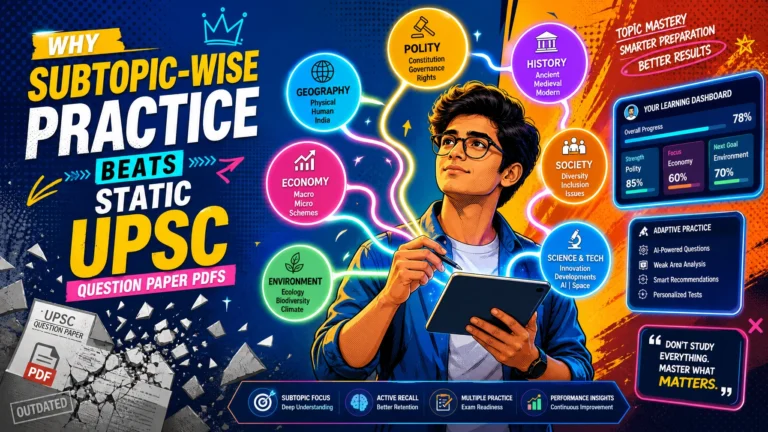
Today, I’ll show you how to swap those random PDFs for subtopic-wise practice that builds real confidence. You’ll learn how to identify high-yield topics instantly and use data-driven tracking to ensure you never get the same question wrong twice.
Key Takeaways
- Stop wasting hours scrolling through disorganized PDFs and switch to subtopic-wise practice to find high-yield questions instantly.
- Master every upsc previous year paper by breaking them down into specific themes like “Preamble” or “Emergency Provisions” for better retention.
- Use the Aaina dashboard to see your real-time accuracy and peer rank, replacing random guesswork with data-backed clarity.
- Fix your negative marking by using the Wrong Question tracker to analyze and correct recurring logic errors.
- Move beyond simple fact-memorization and learn how to tackle the conceptual shift expected in the UPSC Prelims 2026.
The PDF Trap: Why your UPSC previous year paper strategy is failing
Yaar, we have all been there. You open a 50-page PDF on your phone, squinting at the tiny text while sitting in a crowded bus. You spend twenty minutes just scrolling to find where the History section ends and the Geography section begins. By the time you find a question on the Revolt of 1857, your focus is already gone.
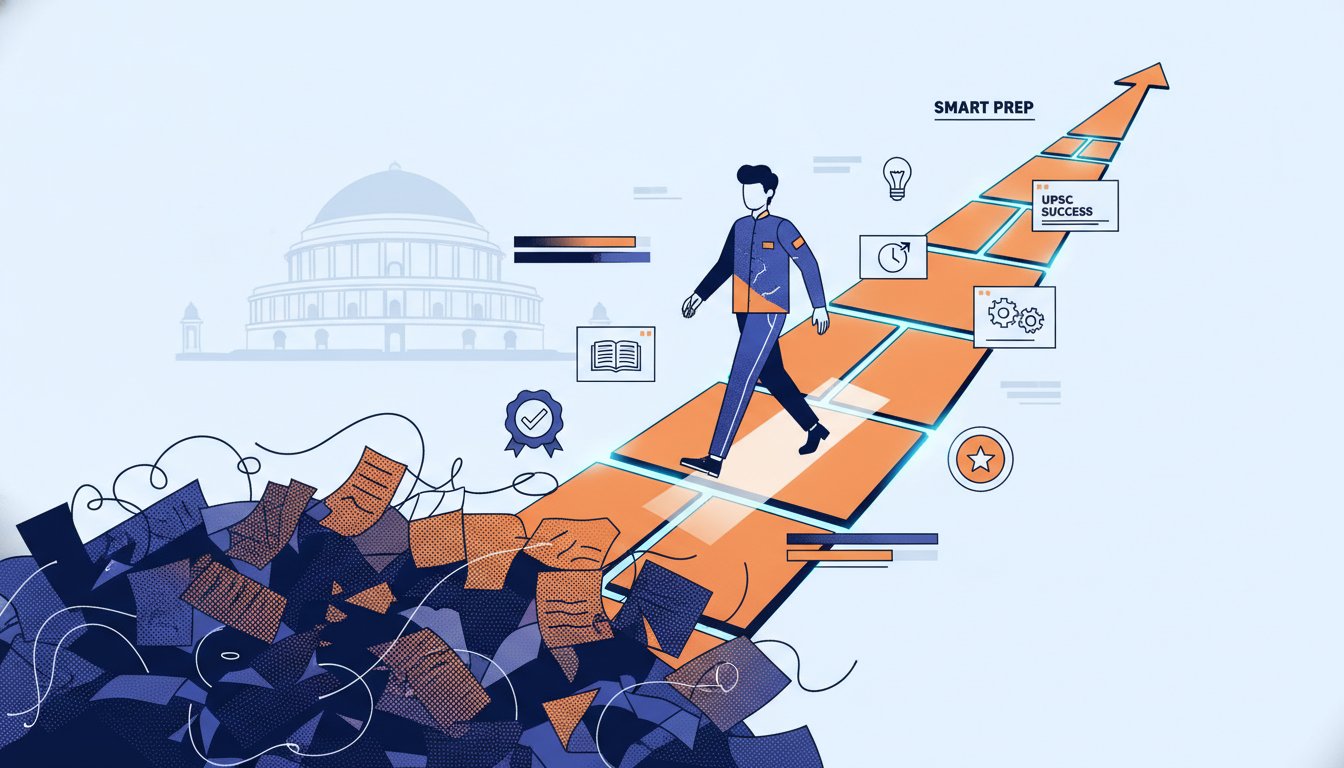
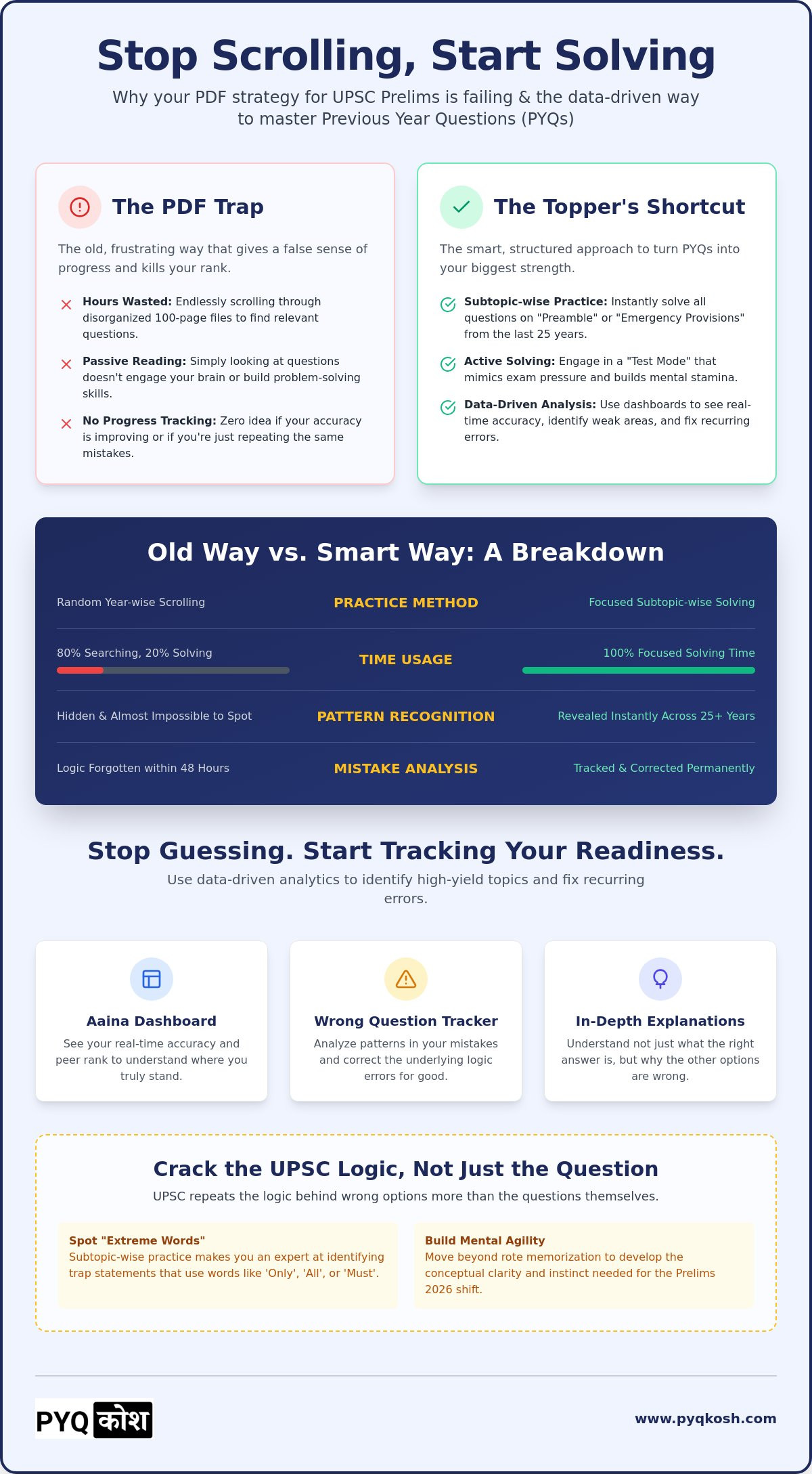
The “PDF Trap” is a dangerous cycle that gives you a false sense of achievement. You think you’re studying because you “read” through three years of papers, but reading is not solving. When you passively scroll, your brain doesn’t engage with the logic of the question. This is why most aspirants forget the reasoning behind a wrong answer within 48 hours.
The Union Public Service Commission (UPSC) designs the Prelims to test your mental agility, not just your memory. Solving a random upsc previous year paper by year makes it almost impossible to spot how they repeat specific themes. If you only look at papers year-by-year, you’ll miss the subtle ways core topics are tested across a decade.
The time-waste of searching vs. practicing
How much time do you waste just organizing your Google Drive folders? If you spend thirty minutes finding the right file or the correct answer key, that is time you could have used to solve 20 high-yield questions. Year-wise solving is a mistake because it keeps you stuck in a linear mindset, hiding the patterns that toppers use to predict the 2026 paper.
Stop being a collector of digital files and start being a solver. Topper banne ka shortcut is not about having the most PDFs; it is about having the most practice. When you switch to a more organized method, you spend 100 percent of your time actually engaging with the content rather than fighting with a file manager.
Why mobile-friendly practice is the real game-changer
Reading a static PDF on a 6-inch screen is a nightmare for your eyes and your focus. It’s too easy to get distracted by a notification or lose your place while zooming in and out. You need a setup where you can jump straight into a specific subtopic without the friction of searching through a 100-page document.
Real growth happens when you use a “Test Mode” that mimics the actual pressure of the exam hall. This helps you build the stamina needed for the two-hour marathon in May. Check out the UPSC CSE section for a better way to practice that actually fits your mobile-first lifestyle.
Mastering the UPSC PYQ: Why subtopic-wise is the topper shortcut
Topper banne ka shortcut simple hai: stop treating subjects like giant, scary blocks. If you just solve a random upsc previous year paper by year, you might get two questions on the President and one on the Governor. That isn’t enough to master the comparison between them. You need to solve “Constitutional Bodies” until you can spot a trap statement from a mile away.
This granular approach is the only way to kill your negative marking. When you solve 50 questions specifically on “Preamble” or “Directive Principles,” you start seeing exactly where you trip up. Is it the specific wording? Is it the legal logic? When you identify these subtopic-level gaps, you stop shooting in the dark during the actual exam.
Muscle memory isn’t just for sports; it’s for exams too. When you see a question on “Money Bills,” your brain should automatically look for the Speaker’s role or the Rajya Sabha’s 14-day limit. This only happens when you’ve solved every version of that question from the last two decades in one go. Organized practice turns these facts into instincts.
Breaking down the UPSC subjects
Not all subjects need the same depth. While Ancient History is a vast ocean, Polity and Geography have “High-Yield” themes that repeat constantly. Some subtopics appear in almost every upsc previous year paper over the last decade. Focusing on these gives you a massive advantage. You can find more details on this UPSC PYQ strategy to see which themes to prioritize first.
The “pattern” hidden in the options
UPSC repeats the “logic” behind the wrong options more than the questions themselves. When you practice by subtopic, you’ll notice how they use “Extreme Words” like Only, All, or Must to frame incorrect statements. This pattern becomes obvious when you see ten different questions on the same topic back-to-back.
- Spot “Extreme Words” that often signal a trap statement in a conceptual question.
- Use “Booster Tips” in explanations to clear up common confusion points between similar topics.
- Analyze why the other three options were wrong to understand the examiner’s mindset.
- Build confidence by seeing how the same logic is applied across 25 years of papers.
Organizing 25 years of papers by theme is the only way to make them useful for your 2026 attempt. If you are tired of searching through random files, try using topic-wise practice to see these patterns for yourself.
How to use old papers to predict UPSC Prelims 2026 trends
Is a 2015 upsc previous year paper still relevant for your 2026 attempt? Bhai, the answer is a big yes. But you have to stop looking for direct repeats and start looking for conceptual depth.
The exam has shifted from “Fact-based” to “Conceptual” questions over the last few years. While the last 5 years help you get the speed and “vibe” of the current pattern, the last 20 years build the logic you need to survive. You need both to clear the cutoff.
Use the sorting feature to prioritize your limited study hours. Sort topics by “Recency” to see what’s trending right now, like specific international treaties. Then, sort by “Frequency” to find the core themes that UPSC never ignores, such as the Governor’s powers or Monsoon patterns.
Analyzing the 2024 and 2025 shift
Recent papers show a massive weightage increase in Environment and Science & Tech. The game changed with “Pair-based” questions where the old “Elimination Method” doesn’t work easily anymore. You can’t just guess your way through; you need to know every statement for sure.
Focus on how current events trigger these static questions. If a new satellite is launched, UPSC might ask about the basic physics of orbits. Explore Current Affairs topics that align with these themes to stay ahead of the curve for 2026.
The CSAT factor: Solving the paper that breaks most aspirants
Don’t let CSAT be the reason you fail Prelims after clearing GS. Many aspirants ignore it until May, but that’s a dangerous mistake. Use PYQs to find your “Safe Score” topics, whether it is Number Systems or Syllogisms. Practice these until they are second nature.
Master Reading Comprehension and Logical Reasoning through subtopic practice. This helps you understand the specific “tone” UPSC uses in its passages. Check out this guide on Mastering the Prelims UPSC Question Paper to secure those qualifying marks without stress.
Stop guessing: Use data-driven analytics to track your readiness
Bhai, if you don’t track your progress, you are just shooting in the dark. Solving a random upsc previous year paper might feel productive, but what is your accuracy in “Fundamental Rights” specifically? If you can’t answer that, you aren’t actually ready for the exam.
Knowing your “Accuracy per Subtopic” is ten times more important than your total mock score. A high total score often hides weak areas that UPSC will exploit on exam day. You need to see the data to fix the leaks in your preparation before it’s too late.
The power of the Aaina dashboard
The Aaina dashboard turns your daily practice into a clear roadmap. It tracks your daily practice streaks to keep you consistent even on those “bad” study days when you feel like quitting. Consistency is the only way to beat the competition in this long journey.
You can also compare your performance with other aspirants to see where you really stand. Seeing your peer rank in real-time gives you a reality check that a static PDF never could. Weekly graphs help you visualize your growth, turning abstract study hours into visible progress you can feel proud of.
Revision that actually works
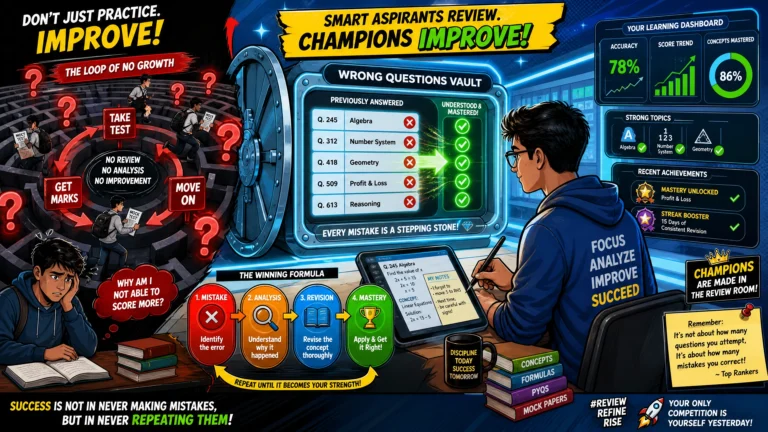
The “Wrong Question” tab is your ultimate weapon for Prelims 2026. It automatically stores every question you get wrong so you don’t have to manually maintain a diary. Instead of re-reading the whole textbook, you just focus on this personalized list of concepts you haven’t mastered yet.
Use the bookmark tab to save tricky questions for that final 10-day revision. Our in-depth explanations include “Confusion Points” and “Exam Booster” tips. These specifically address the common traps UPSC sets, helping you distinguish between similar-sounding legal terms or geographical locations like a pro.
Stop guessing your readiness and start measuring it. Track your progress on the Aaina dashboard today to see where you really stand.
Practice smarter with PYQKosh: Your UPSC 2026 companion
You don’t need a thousand expensive courses or heavy books to clear Prelims. You need the right questions and a way to solve them without losing your mind. With over 1 Lakh questions covering 130 exam categories, PYQKosh is built to be your central practice hub for everything related to government exams.
The choice is yours: use “Practice Mode” when you want to learn from our in-depth explanations or switch to “Test Mode” when you want to simulate the pressure of the actual exam hall. This is how you move from random effort to structured, analytical exam preparation. Every upsc previous year paper you master on this platform brings you one step closer to that final rank list.
We believe in a “no-nonsense” approach to your time. You won’t find live classes, long video lectures, or chat distractions here. It is just you and the questions that actually matter for your success. This focus helps you build the discipline required to tackle the toughest exam in the country.
Multi-exam support for the serious aspirant
Are you preparing for CAPF or CDS alongside the Civil Services? You can practice them all on one platform without jumping between different apps or websites. This cross-exam practice is a smart move for any serious aspirant.
It helps you see how different boards ask questions on the same theme, like the “Preamble” or “Climate Change.” Seeing these variations prepares you for any surprises the 2026 paper might throw at you. View our pricing plans for full access to our entire multi-exam library.
The “Made by an Aspirant” difference
We know the struggle of scrolling through a 100-page PDF at 11 PM because we have been there ourselves. There is no robotic language or “textbook” filler here. Every feature, from the Aaina dashboard to the wrong question tracker, is designed to solve a specific problem we faced during our own preparation.
The subtopic-level organization is our secret sauce. It allows you to master every upsc previous year paper by focusing on one small area at a time until you are perfect. This granular approach builds a level of data-backed confidence that general mock tests simply cannot provide. Start your 2026 journey with a strategy that actually works on a mobile screen.
Go ahead and solve your first set of subtopic questions now to see the difference for yourself.
Your Path to UPSC Prelims 2026 Starts with Strategy
The days of scrolling through messy, disorganized PDFs are over. You now know that mastering every upsc previous year paper requires a sharp, subtopic-wise approach. It is the only way to spot hidden patterns and kill negative marking before May 24 arrives.
By using the Aaina Progress Dashboard and our massive library of 100,000+ Questions, you turn random effort into targeted action. Detailed Explanations with Booster Tips ensure you don’t just solve questions; you master the examiner’s logic. This structured preparation is what separates toppers from the crowd.
Don’t let a disorganized strategy be the reason you miss the cutoff. Success in 2026 isn’t just about working harder; it is about practicing smarter on a platform built for your mobile-first lifestyle. You have the tools, yaar; now it’s time to use them.
Stop wasting time on PDFs and start your subtopic-wise UPSC practice today on PYQKosh!
Frequently Asked Questions
Is solving UPSC previous year papers enough to clear Prelims 2026?
No, solving only the upsc previous year paper isn’t enough; but it is the most critical part of your prep. You still need to cover your basic NCERTs and current affairs to build a strong base. PYQs act as a compass, showing you which parts of the syllabus are high-yield and how UPSC twists simple facts into tricky conceptual questions.
How many years of UPSC PYQs should I solve for the 2026 exam?
You should aim to solve the last 25 years for a solid conceptual foundation. While the exam pattern changed recently, the core concepts in subjects like Polity and Geography remain the same. Use the last 5 years to understand the shift toward “pair-based” questions; but use older papers to master the static logic that toppers rely on.
Are UPSC previous year papers repeated in the actual exam?
Direct repeats are very rare; but themes and logic repeat every single year. UPSC often takes an incorrect option from an old upsc previous year paper and turns it into a full question the next year. If you analyze the explanations deeply, you’ll find that the “logic” of the exam is highly predictable even if the wording changes.
How do I find UPSC previous year papers with topic-wise explanations?
Finding topic-wise explanations in a raw PDF is a nightmare, yaar. Instead of scrolling through 100-page files, use a platform like PYQKosh that categorizes questions into granular subtopics. This allows you to read detailed explanations and “Booster Tips” immediately after solving; which is much better for your memory than searching for scattered answer keys.
Should I solve UPSC PYQs before or after completing the syllabus?
Always solve them while you study each topic rather than waiting until the end. Don’t wait to finish the whole syllabus because you’ll likely forget the details by then. After you finish a subtopic like “Governor,” solve its specific PYQs immediately. This topper banne ka shortcut helps you see if you actually understood the chapter or just read the pages.
What is the best way to revise wrong questions from old papers?
The best way is to use a digital “Wrong Question” tab that updates automatically as you practice. Manual diaries take too much time to maintain and are hard to organize. Focus on questions you’ve missed multiple times. Sorting them by frequency helps you identify your biggest negative marking traps so you can fix them before the 2026 exam.
Can I practice UPSC previous year papers on my mobile phone?
You can; but reading a PDF on a small screen will kill your focus and strain your eyes. It is better to use a dedicated practice mode designed specifically for mobile users. This lets you solve questions one by one, bookmark tricky ones, and check your accuracy on the Aaina dashboard without the friction of zooming in and out of a document.
How does subtopic-wise practice help in eliminating options?
Subtopic practice helps you spot “Extreme Words” like Only, All, or Must more effectively. When you solve 30 questions on the same theme back-to-back, you start noticing the specific tone UPSC uses for wrong options. This builds the instinct you need to eliminate choices confidently even when you aren’t 100 percent sure of the specific fact.