
Article by
Aaisha
A passionate content writer at PYQKosh focused on simplifying Current Affairs and PYQs for competitive exam aspirants. I love turning complex topics into easy, student-friendly content that helps learners prepare smarter and stay consistent in their exam journey.
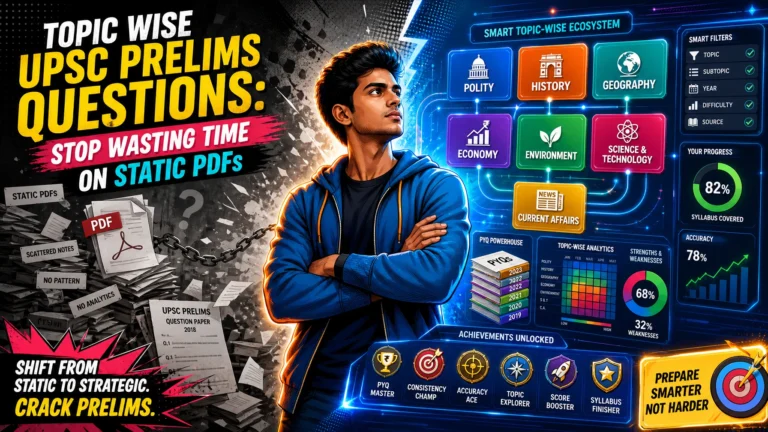
Scrolling through a 500-page PDF at 11 PM isn’t real preparation; it’s just a slow way to burn out. You spend more time searching for specific topics than actually solving them. To clear the cutoff, you must practice last 25 years upsc prelims questions online instead of drowning in static files. It’s the only way to see if you’re actually getting better or just repeating the same mistakes.
I know the struggle of trying to find every question on ‘Inflation’ or ‘Buddhism’ across two decades of papers. It’s exhausting and a waste of your limited energy. You deserve a system that organizes the chaos for you. This guide will show you how to centralize your prep so you can focus on learning rather than searching.
We will break down how to target specific subtopics with precision and use structured, analytical exam preparation to monitor your growth. You’ll see how to stop guessing and start knowing exactly where you stand. Let’s look at how you can transform those 25 years of questions into a clear roadmap for your success.
Key Takeaways
- Stop wasting hours scrolling through massive PDFs and switch to a centralized library that finds specific topics instantly.
- Master recurring exam themes by practicing specific subtopics like Polity or Economy instead of solving random year-wise papers.
- The smartest way to prepare for 2026 is to practice last 25 years upsc prelims questions online with subtopic-level precision.
- Use the Aaina dashboard to track your daily streaks and see a clear graph of your accuracy improvement.
- Build exam-day stamina by using Test Mode and the wrong questions tracker to fix your mistakes before the big day.
Why scrolling through 25 years of UPSC PDFs is wasting your time
We’ve all been there. It’s 11 PM, your eyes are burning, and you’re pinching your phone screen to read a blurry PDF from 2008.
You spend twenty minutes just trying to find where the Geography questions start. This is the PDF trap, yaar. You’re wasting precious mental energy on searching when you should be solving.
Static PDFs are silent time killers. When you solve year-wise, you miss the “big picture” of how themes repeat and evolve.
You might get a Polity question right in the 2015 paper, but you won’t see how that same concept was twisted in 2021 or 2024. To really crack the UPSC Civil Services Examination, you need to see these patterns clearly.
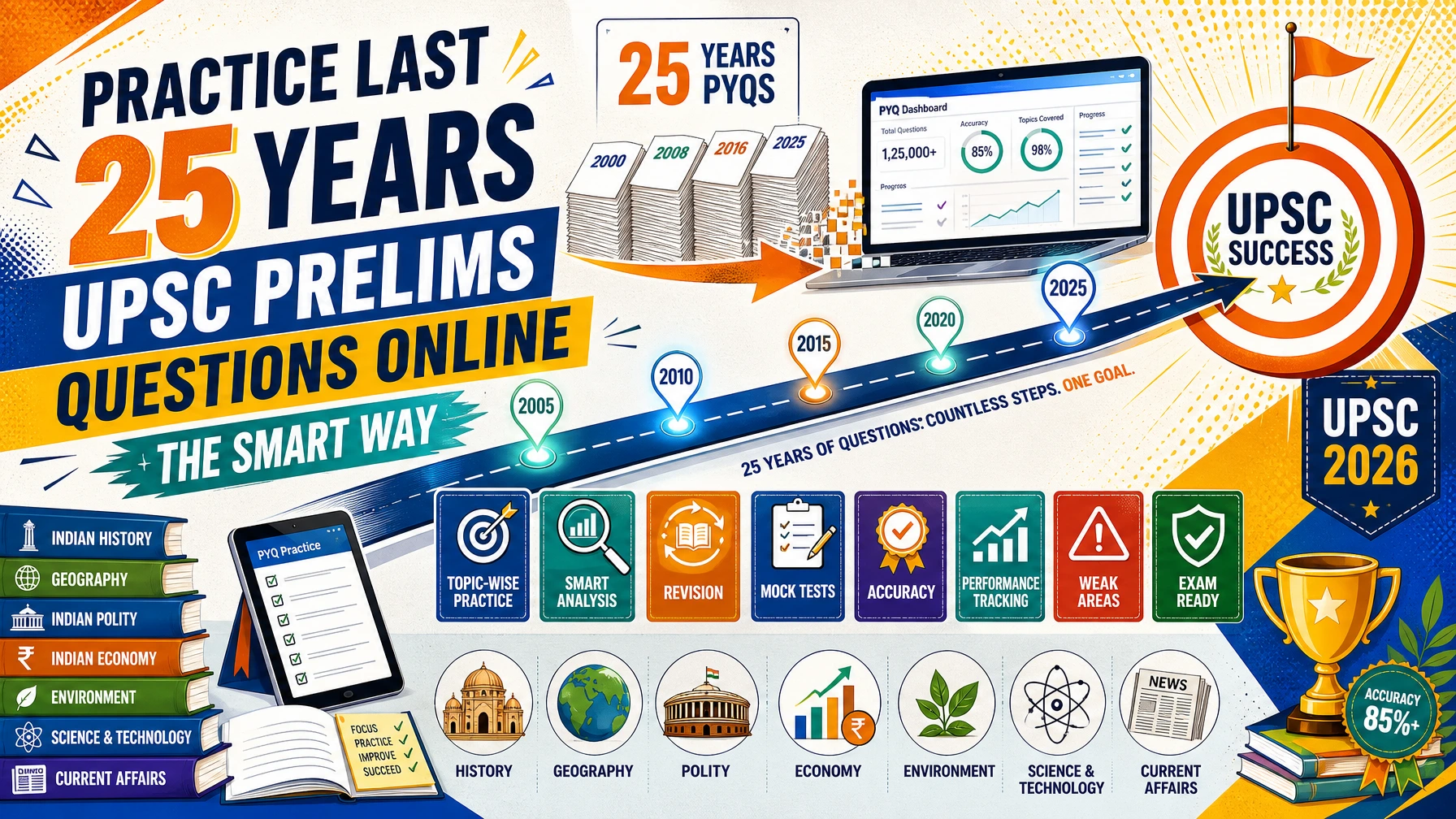
This is why you must practice last 25 years upsc prelims questions online. An online system lets you filter by subtopic instantly and saves you from the headache of tiny text.
Instead of a random mix, you can tackle 50 questions on ‘Panchayati Raj’ in one go. This builds real confidence, not a false sense of security from just “finishing” a paper.
The ‘Information Overload’ problem for 2026 aspirants
Think about the sheer volume. 25 years of papers means more than 2,500 questions. If you try to eat this elephant all at once, you’ll choke.
Toppers don’t just “solve papers.” They master blocks. They pick ‘Ancient India’ or ‘Environment’ and solve every PYQ related to it from the last two decades.
Jumping from a History question to a Science Tech question every two minutes creates massive mental fatigue. Your brain needs time to switch gears between subjects.
By practicing in theme-based blocks, you stay in the “zone.” You start noticing the examiner’s favorite traps and recurring keywords that appear year after year.
Why 2026 demands a structured approach
The game is changing. UPSC is moving away from simple facts toward complex, multi-statement questions that test your deep understanding.
A static PDF doesn’t tell you how the difficulty level of ‘Inflation’ has evolved since 2001. You need to see how the framing has shifted over time.
When you practice last 25 years upsc prelims questions online, you can track your accuracy for each subtopic. You’ll know if you’re actually getting better or just guessing.
2026 aspirants need this data-driven edge to survive the competition. Don’t let a disorganized folder of PDFs be the reason you miss the cutoff this year.
Mastering UPSC themes: How subtopic practice changes the game
Solving a full-length mock paper feels productive, but it’s often a trap. You might score well because you’re good at Geography, while your weak grasp of ‘Panchayati Raj’ stays hidden. This is where the topper logic comes in.
Toppers don’t just solve papers; they master themes. When you practice 50 questions on a single subtopic like ‘Panchayati Raj’ across 25 years, you see every possible way the examiner can twist the same concept.
This granular approach builds the muscle memory you need for the actual exam hall. You stop guessing and start recognizing patterns. It’s the difference between knowing the syllabus and knowing how the Union Public Service Commission (UPSC) actually thinks.
The smartest way to gain this edge is to practice last 25 years upsc prelims questions online. It allows you to isolate specific themes and drill them until you can’t get them wrong. You’ll move from “I think I know this” to “I’ve seen this trap before.”
Breaking down 25 years into high-yield themes
Some topics are evergreen. UPSC asks about ‘Buddhism’ or ‘Fundamental Rights’ almost every two or three years. If you solve these in isolation, you’ll notice the core facts don’t change, but the options do.
You can also strengthen your base by looking at similar themes in other exams. For example, practicing ‘Modern History’ from CDS or CAPF papers can give you a fresh perspective on the same events. Seeing all these questions in one single flow helps you connect the dots faster during the exam.
You don’t need to hunt for these questions yourself. You can easily start topic-wise practice right now to see these connections for yourself without any manual filtering.
Identifying patterns across the decades
If you look at the last 25 years, you’ll see a clear shift. In the early 2000s, questions were often factual. Today, they are deeply analytical and conceptual. You need to adapt to this “new” UPSC while still respecting the old “base” facts.
- Find ‘near-repeats’ where the question from 2004 becomes an option in 2024.
- Sort by recency to focus on the 5-year trends (2021–2026) that define the current difficulty level.
- Spot the examiner’s favorite trap keywords like “only,” “all,” or “drastically.”
By using year-based sorting and subtopic filters, you ensure your preparation stays relevant. You’ll spend less time on outdated styles and more time on the high-yield analytical questions that actually decide the merit list.
Online practice vs. offline PDFs: Which one builds speed?
PDFs are static. They don’t talk back. When you use a book or a file, you’re constantly flipping to the last page to check the answer key. This breaks your flow and kills your speed. You need a setup that mimics the pressure of the exam hall while giving you the freedom to learn at your own pace.
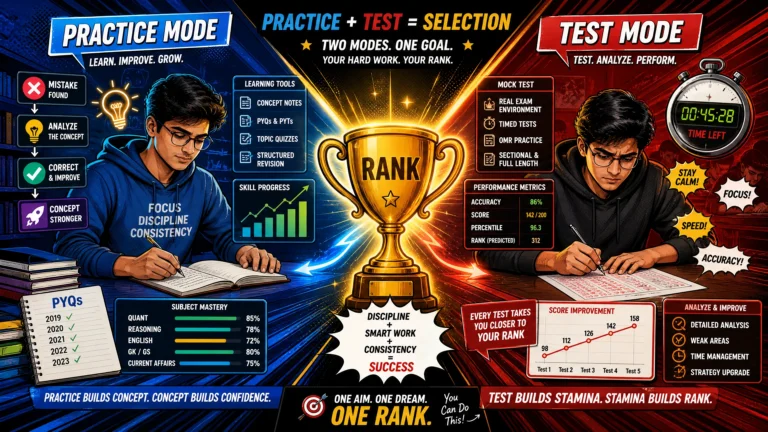
Choosing to practice last 25 years upsc prelims questions online gives you two distinct ways to prepare. You can use ‘Practice Mode’ to learn as you go, or ‘Test Mode’ to build that crucial exam-day stamina. There is a strong scientific basis for practice testing as the most effective way to retain hard facts. It beats passive reading every single time.
Tracking your accuracy percentage per subtopic is the real game changer. If you don’t know your numbers, you’re just shooting in the dark. Structured, analytical exam preparation tells you exactly when you’ve mastered a topic and when you need to dig deeper.
Real-time feedback and in-depth explanations
When you get a question wrong, you need to know why immediately. You don’t have time to search through three different textbooks for an explanation. Online practice provides instant, in-depth explanations that cover both right and wrong options.
Look for ‘Exam Booster’ tips that give you that extra 10% of info needed to clear the cutoff. These small nuggets of data often make the difference between a pass and a fail. ‘Confusion Points’ are also lifesavers. They explain exactly why you might have picked option B when the answer was C. This clarity stops you from making the same mistake twice.
The cost of manual tracking yaar
Let’s be honest, yaar. Marking ‘W’ for wrong and ‘R’ for right in a notebook is a waste of your time. You’re an aspirant, not a data entry clerk. You need to focus your energy on learning the concepts, not on managing your study logs.
A dashboard like Aaina does the heavy lifting for you. It tracks your accuracy percentage for every subtopic automatically. If you see your accuracy in ‘Fundamental Rights’ is already at 90%, you can stop and move to a weaker area. This prevents the “random practice” trap where you keep solving things you already know.
Manual note-making from physical books has a hidden cost too. You spend hours rewriting things that are already available digitally. Instead of writing, use the bookmark tab to save tough questions. You’ll have a personalized revision list ready in seconds, letting you spend your late-night sessions actually solving problems.
Your 2026 roadmap for practicing 25 years of UPSC questions
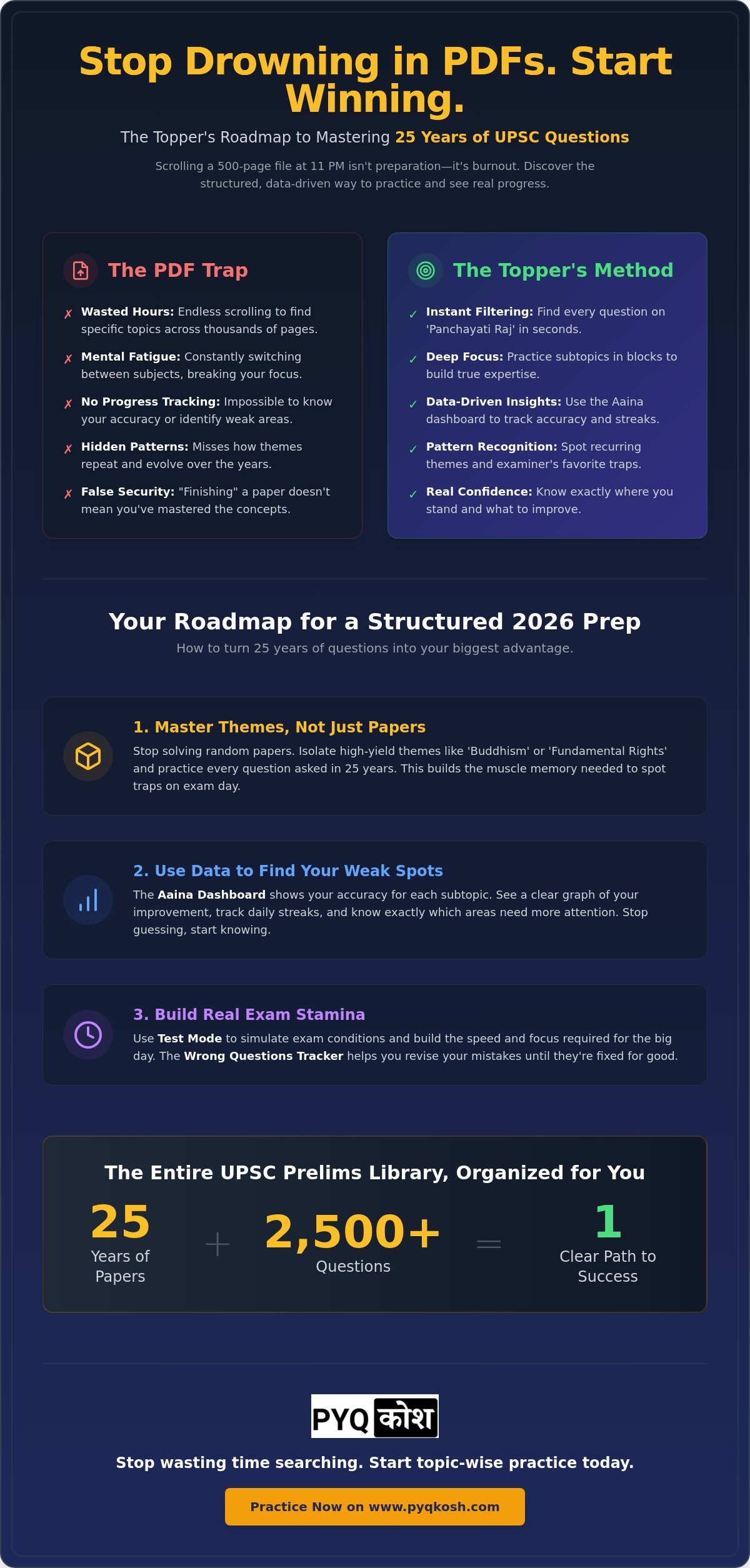
Planning is easy, but sticking to it is the hard part. Most aspirants fail because they have no system to manage the massive pile of PYQs. You can’t just solve random papers and hope for the best. To clear the 2026 prelims, you need a smart roadmap. The most efficient way to stay on track is to practice last 25 years upsc prelims questions online where your progress is tracked automatically.
First, start with Polity and Economy. These are high-weightage subjects that form the backbone of your score. Use the Aaina dashboard to check your daily practice streaks. If you see a break in the chain, get back to work immediately. Don’t let your momentum die, yaar.
Bookmark every tricky question you encounter. Save these for a dedicated ‘Sunday-only’ revision session. Next, attack your ‘Wrong Question’ list. Don’t stop until your accuracy for that subtopic hits 90%. Finally, compare your peer rank. A little healthy competition keeps the fire alive when you’re tired at midnight.
Using the Aaina dashboard to find weak spots
Your gut feeling can lie, but data doesn’t. Look at your weekly graph on Aaina. Is your accuracy actually going up? Or are you just repeating the same mistakes? This dashboard does the analytical heavy lifting so you can focus on studying.
This helps you identify ‘silent killers’—those small subtopics like ‘National Income’ or ‘Local Government’ where you consistently lose marks. Set daily targets to ensure you finish all 25 years of questions before the May 2026 prelims. You don’t want to be rushing through papers in the last month.
Fixing mistakes with the Wrong Question tracker
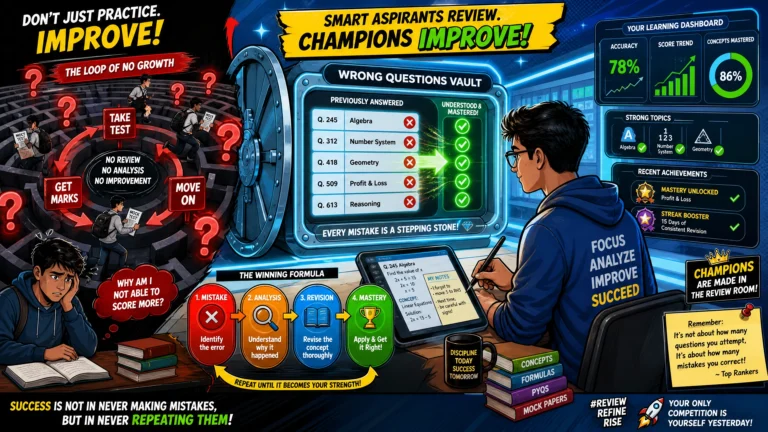
Stop maintaining a physical ‘mistake book’ in a register. It’s too slow and hard to search. Use an automated Wrong Question tracker that stores every error you make. It’s like having a personal mentor pointing out your flaws in real-time.
Sort your mistakes by frequency. If you’ve made the same error on ‘Fundamental Rights’ three times, you haven’t understood the core concept yet. Re-practice these specific questions in ‘test mode’ to prove you’ve actually learned. This is the only way to turn your weaknesses into strengths before exam day.
Ready to build your 2026 streak? You should start your daily practice on PYQKosh right now to see where you stand.
Why PYQKosh is the ultimate library for UPSC aspirants
You don’t need another heavy textbook. You need a better way to use the information you already have. The biggest problem today isn’t a lack of questions; it’s the mess of having them scattered across ten different websites and folders. When you choose to practice last 25 years upsc prelims questions online with us, you get a centralized library of 100,000+ questions across 130+ exams. It’s built by people who have actually sat in those crowded library chairs and felt the 11 PM burn.
The platform understands your daily struggle. If your schedule says ‘Inflation’ today, you shouldn’t have to solve an entire Economy paper just to find five relevant questions. Our subtopic-level organization matches your study plan perfectly. You can also use ‘Exam Booster’ tips to catch those small details that others miss. These tips give you that slight edge needed to stay one step ahead of the competition.
UPSC loves to give you two options that look like twins. Our ‘Confusion Points’ feature helps you tell them apart by explaining the subtle logic behind the trap. This isn’t just a question bank; it’s a structured, analytical exam preparation tool designed to replace disorganized chaos with data-backed clarity.
Multi-exam practice on one single platform
UPSC doesn’t just conduct the Civil Services Exam. They also design the papers for CDS and CAPF. Often, a theme that appears in a CDS paper finds its way into the Prelims a year later. Practicing UPSC CSE and CDS questions together gives you a much deeper grip on how the examiner’s mind works.
Cross-exam practice is the secret to handling the unpredictable nature of the exam. You start seeing common themes and recurring facts across different government exams. This centralization saves you from jumping between multiple apps. You get a definitive destination for every PYQ you will ever need, making your preparation faster and much more efficient.
A focus on precision, not just volume
Volume without direction is just a hobby. You need precision. Our system allows you to sort topics by recency, so you can prioritize the 2025-26 patterns over outdated styles from the nineties. This ensures your brain is tuned to the current level of difficulty and analytical depth.
The bookmark tab is your personal shortcut to success. Instead of re-reading 500 pages of notes, just revisit the specific questions that challenged you before. Join thousands of aspirants who are already practicing smarter and using their time to actually learn rather than manage data. Stop drowning in files and start mastering the syllabus one subtopic at a time.
It is time to stop searching and start solving by practicing on PYQKosh today.
Start your smart preparation journey now
You’ve spent enough time drowning in messy folders and blurry PDFs. It’s time to switch to a system that actually works for you. By moving your focus to subtopic-wise practice, you’ll stop guessing and start mastering the themes that UPSC loves to repeat. Remember, clear data beats a vague gut feeling every single time.
The decision to practice last 25 years upsc prelims questions online will be the turning point in your preparation. You’ll gain access to a massive library of 1 Lakh+ Questions across 130+ exams. With detailed explanations and ‘Exam Booster’ tips, you won’t just solve questions; you’ll understand the logic behind every single option. This is how you build the confidence needed for the actual exam hall.
Don’t let another day go by without knowing your accuracy percentage or peer rank. Use the Aaina dashboard to fix your weak spots and turn them into strengths. You have the ambition, and now you have the right tool to match it. Success is waiting for those who work smarter.
Start practicing 25 years of UPSC subtopic-wise questions on PYQKosh today!
You’ve got this, yaar. Let’s make 2026 the year you clear the cutoff with confidence.
Frequently Asked Questions
Can I practice UPSC prelims questions subtopic-wise for free?
Yes, you can. PYQKosh is currently in its launch phase and offers free access to its entire database. This allows you to practice last 25 years upsc prelims questions online without paying for expensive test series. You can pick specific areas like ‘Buddhism’ or ‘Preamble’ and start solving immediately.
Is it necessary to solve the last 25 years of UPSC prelims questions?
It is highly recommended for building a strong conceptual base. While the last 10 years show current trends, the full 25-year bank reveals how UPSC rotates core themes in Polity and History. Solving this many questions ensures you don’t get surprised by “old school” factual questions that occasionally reappear.
How many questions from the last 25 years are repeated in UPSC?
Direct word-to-word repeats are rare, but theme repeats are very common. Roughly 30% to 40% of questions every year are based on concepts or options mentioned in previous papers. Sometimes a small option from a 2008 question becomes the main topic for a 2026 statement, so don’t ignore the old papers, yaar.
Is online practice better than solving UPSC PYQ books?
Online practice is much faster and more efficient for mobile users. Books are static and don’t provide instant accuracy tracking or timers. When you practice last 25 years upsc prelims questions online, you get immediate explanations and automated mistake logs. This saves you from the old-school struggle of flipping pages to check answer keys.
What is the best way to track my mistakes in UPSC prelims practice?
The smartest way is to use an automated Wrong Question tracker. Instead of writing mistakes in a notebook, use a digital dashboard that stores every error you make. You can sort these by how many times you got them wrong. This helps you focus your revision only on your weakest areas rather than re-reading everything.
How do I find subtopic-wise weightage for UPSC Prelims 2026?
You can find this by sorting topics by ‘question count’ on your practice platform. This shows you exactly which subjects like Environment or Economy have the most questions over the years. It helps you prioritize high-yield topics first so you don’t waste time on low-weightage areas during your final revision months.
Can I practice UPSC and SSC questions on the same platform?
Yes, you can find both on PYQKosh. The platform centralizes over 130 government exams, including SSC, Railway, and Defence. This is perfect for aspirants who are giving multiple exams and want a single, organized library. It prevents you from jumping between different apps and keeps your study data in one place.
What is the Aaina dashboard in PYQKosh?
Aaina is your personal progress dashboard that shows you the “mirror” of your preparation. It tracks your daily practice streaks, your accuracy percentage, and your peer rank. It even provides a weekly graph so you can see if your performance is actually improving or if you’re stuck on the same level.