
Article by
Aaisha
A passionate content writer at PYQKosh focused on simplifying Current Affairs and PYQs for competitive exam aspirants. I love turning complex topics into easy, student-friendly content that helps learners prepare smarter and stay consistent in their exam journey.
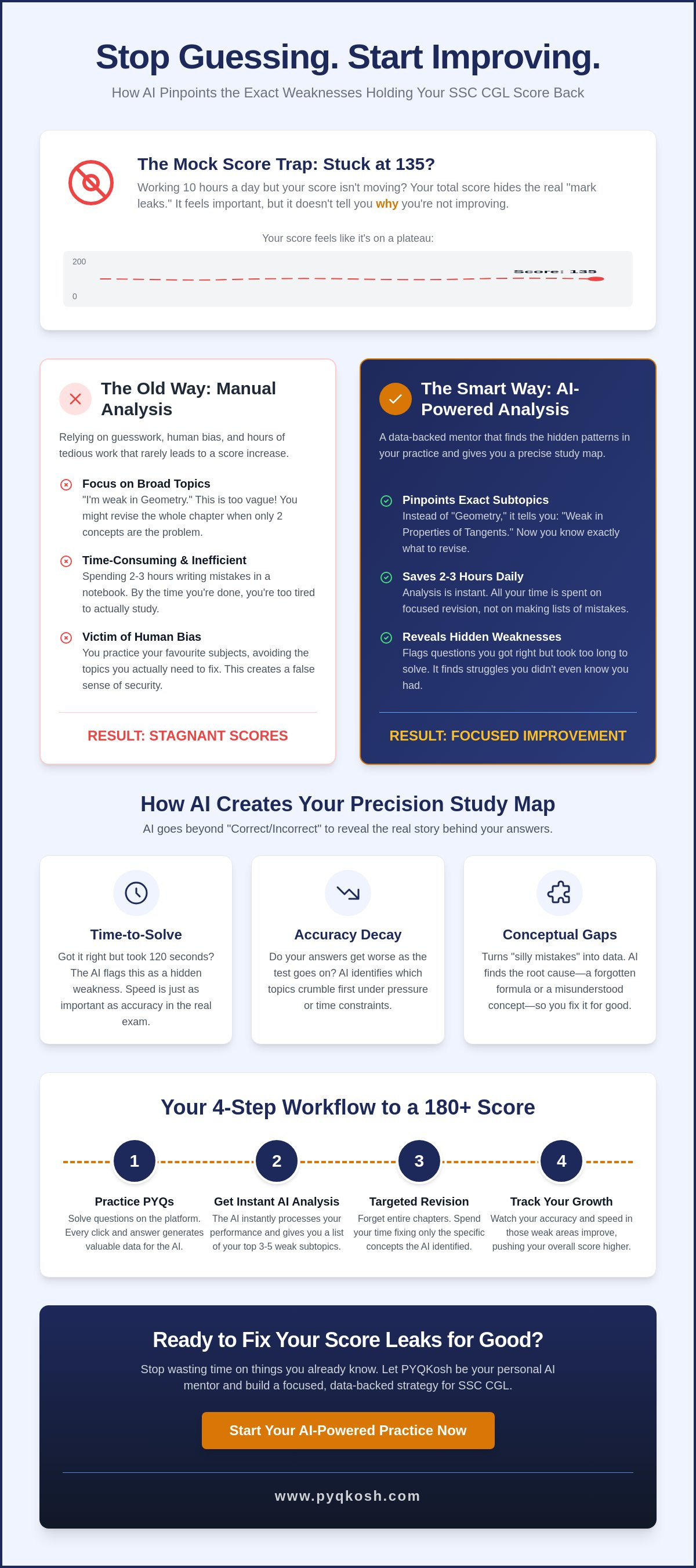
Are your mock scores stuck between 130 and 140? You've completed the syllabus, you practice daily, but your rank just won't budge. It's the most frustrating feeling for any serious SSC CGL aspirant.
You might be hearing a lot about using AI to find weak topics in SSC CGL. While the idea is powerful, the solution isn't some complex, magical algorithm. It's something much more direct and reliable: smart data analysis.
The real secret is a system that tracks every single question you attempt and maps it to its exact subtopic. This gives you a crystal-clear picture of your weaknesses, turning confusion into a precise action plan. Let's break down how to stop guessing and start scoring.
The Mock Test Trap: Why Your Manual Analysis Is Failing You
You finish a mock test, check your score, and feel a temporary sense of relief or disappointment. But this routine is hiding the real problems that are costing you a top rank.
- Your overall score is a 'vanity metric'. A score of 140 doesn't tell you if your weakness is in 'Pipes and Cisterns' or 'Sentence Improvement'. It hides the specific leaks.
- The 'Silly Mistake' myth. We often label conceptual gaps as "silly mistakes." But repeating the same error in a specific question type isn't silly—it's a pattern that needs to be fixed.
- Manual tracking is slow and inaccurate. Writing down mistakes in a notebook takes hours. It's hard to spot deep patterns when you're just listing individual questions.
- The psychological barrier. We naturally prefer practicing topics we're already good at. It feels productive, but it doesn't improve our rank.
The Limitation of Broad Topic Categories
Saying you are weak in 'Geometry' is like saying you need to get better at 'driving'. It's too broad to be useful. This is where most aspirants get stuck. (SSC Combined Graduate Level Examination (CGL))
- 'Geometry' has dozens of subtopics. Your problem might not be with circles or triangles, but specifically with questions on 'Incenters and Circumcenters'.
- Broad revision is inefficient. Revising the entire Geometry chapter for one small weakness is a massive waste of time that could be spent fixing other areas.
- Low-weightage subtopics add up. Ignoring small but consistent errors across multiple subtopics is how a score gets stuck at 130 instead of climbing to 160+.
How Human Bias Ruins Your Study Plan
Your brain is wired to seek comfort, which is terrible for competitive exam preparation. You need objective data to overcome your natural biases.
- The 'comfort zone' trap. You love solving Profit and Loss questions, so you practice them more, creating a false sense of overall preparation.
- Overestimating speed. You might feel fast in your favorite subjects, but data might show you're taking 10 seconds too long on average, which costs you attempts elsewhere.
- From intuition to data. Top rankers don't study based on feelings. They use data to guide every single revision session.
How Smart Data Analysis Creates Your Precision Study Map
Instead of relying on generic AI, a dedicated platform uses smart data analysis. It's the process of using a structured system to find patterns in your speed, accuracy, and consistency across thousands of questions.
- Tracking 'Time-to-Solve'. The system knows you're struggling with a concept if you take 90 seconds on a 30-second question, even if you got it right.
- Identifying Accuracy Decay. It pinpoints topics where your accuracy drops significantly under the pressure of a timer.
- Spotting 'Forgotten' Topics. By tracking your practice history, the system can highlight important subtopics you haven't revised in a while, preventing them from becoming weak again.
The Hidden Metrics Tracked for You
A smart analytics dashboard goes beyond just right or wrong. It reveals the 'how' and 'why' behind your performance, giving you an unfair advantage. (personalized learning pathways)
- Average time vs. Best time per subtopic. See if your speed in a subtopic is consistently good or just a one-time fluke.
- Success rates in 'Test Mode' vs. 'Practice Mode'. Understand how pressure impacts your performance. Learn more about how Test Mode prepares you for exam day.
- The correlation between question difficulty and your response time. Do you slow down on easy questions or panic on hard ones? The data knows.
Actionable Insights for SSC CGL
This isn't just data for data's sake. It's a roadmap to a higher score, designed to give you the fastest possible improvement.
- Estimating your score. The system can project your potential score based on your current mastery of high-weightage subtopics.
- Identifying 'High-Yield' weak areas. It highlights the weak subtopics that, if fixed, will give you the biggest and quickest boost in marks.
- Think of these diagnostics as a digital mentor that never sleeps, constantly guiding your preparation.
Subtopic-wise vs. Topic-wise: The Data-Driven Difference
This is where the magic happens. By breaking down huge subjects into tiny, manageable pieces, you can fix problems with surgical precision.
- Algebra has 15+ subtopics. Your dashboard might show you're excellent in 12 of them but failing in just 3. Now you know exactly what to study tonight.
- The 80/20 rule for CGL. 20% of the subtopics are often responsible for 80% of your mistakes. Data helps you find that 20%.
- Isolating the real problem. Are you weak in 'Time, Speed, and Distance' concepts, or are you just slow at calculations involving fractions? The system can tell.
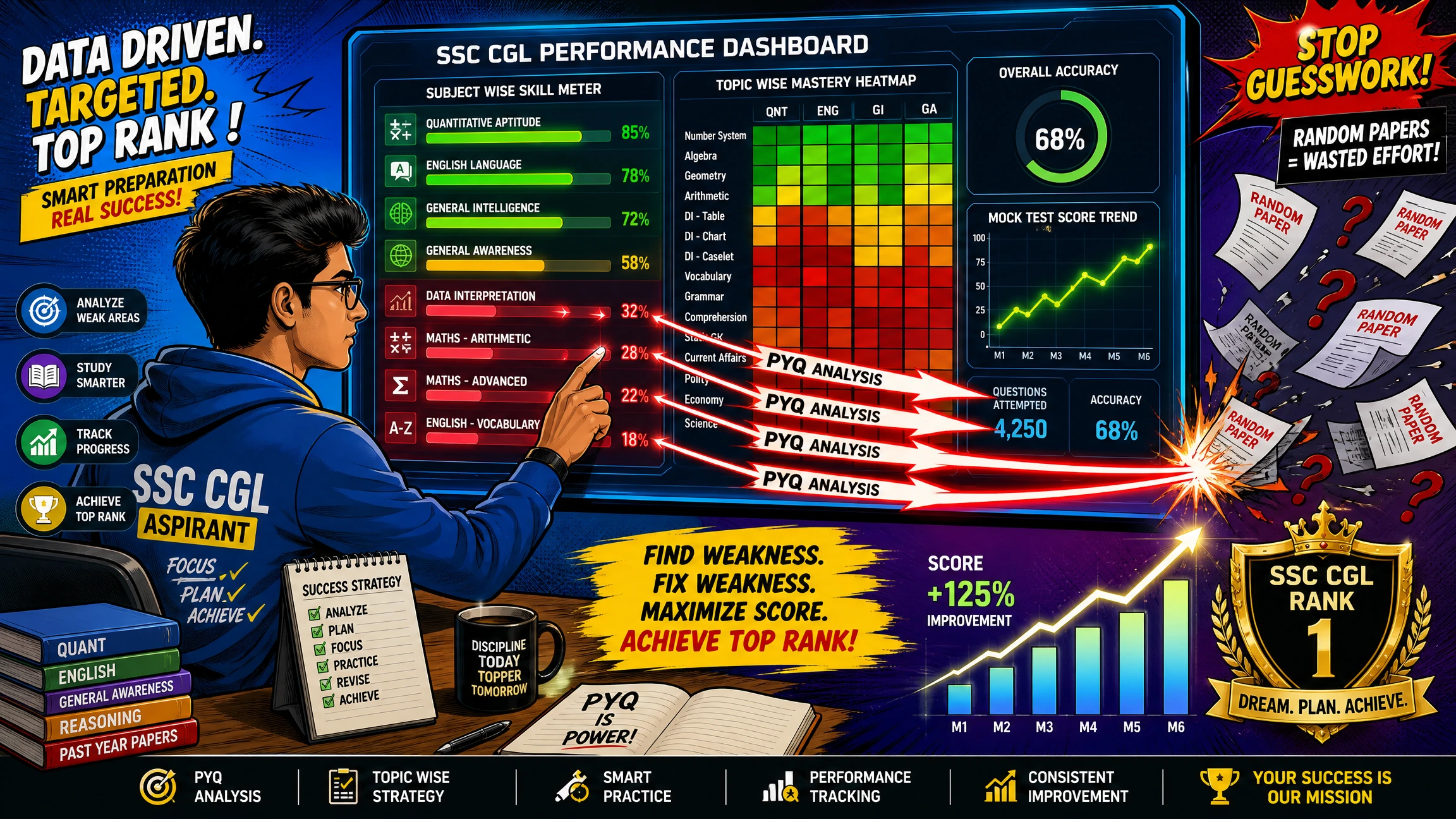
- Here’s a look at a sample dashboard:
- Topic: Quantitative Aptitude
- Subtopic: Percentage
- Accuracy: 58% (Warning!)
- Avg. Time: 45s (Slow)
- Recommendation: Practice 20 more PYQs in this subtopic.
Granularity Is the Secret to Tier 1 Success
Top scorers don't just study subjects; they master subtopics. This level of detail is impossible to achieve with manual tracking alone.
- English Grammar errors. Stop saying you're weak in 'Grammar'. Your dashboard can show your accuracy is 90% in Tenses but only 40% in Subject-Verb Agreement.
- General Awareness. You need to know which parts of Modern History are asked most frequently. This requires a deep SSC CGL subtopic-wise weightage analysis.
Stopping the 'Marks Leak' in Quantitative Aptitude
Every wrong answer is a 'mark leak'. A smart analytics system helps you find the source of the leak and patch it for good.
- Case study: An aspirant improved their 'Time and Work' score by 10 marks after the dashboard showed their only weakness was in 'Pipes and Cisterns' questions.
- Identifying 'Calculation Fatigue'. The data can show if your accuracy drops after the 70th question in a mock, indicating a stamina issue, not a conceptual one.
- Building confidence. Mastering one subtopic at a time builds the momentum and confidence you need to perform well on the actual exam day.
4 Steps to Fix Your SSC CGL Score Leaks Using Smart Analytics
Knowledge is useless without action. Here is a simple, four-step workflow to turn your performance data into a 180+ score strategy.
- Generate Your Baseline Data. Solve at least 50-100 mixed Previous Year Questions (PYQs) in 'Test Mode' on a platform like PYQKosh. This gives the system enough data to analyze.
- Review Your Performance Dashboard. Go to your analytics section and look for subtopics where your accuracy is below 60% or your time-to-solve is much higher than the average.
- Targeted Practice. Use the platform's filters to practice PYQs only from those specific weak subtopics. Don't touch anything else.
- Re-test and Verify. After practicing, take a small, mixed quiz that includes questions from your weak areas to confirm that your concepts have improved.
Filtering the Noise: Focus on What Matters
Your dashboard will show a lot of data. The key is to focus on the patterns, not the outliers.
- Ignore outlier mistakes. If you made one random mistake in a topic you always score 95% in, ignore it. Focus on recurring error patterns.
- Prioritize with weightage data. If you are weak in two subtopics, fix the one that has a higher weightage in the CGL exam first.
- Set 'Smart Targets'. Aim to improve the accuracy of two weak subtopics from 60% to 80% each week. Small, consistent wins lead to big results.
Leveraging Test Mode for Real-World Pressure
The data generated under a timer is the most valuable because it simulates the actual exam environment.
- Data accuracy. Your performance without a timer is not a true reflection of your exam-readiness. Test Mode data is the ground truth.
- Knowing vs. Applying. You might 'know' a formula, but can you recall and apply it correctly in 30 seconds? That's the skill Test Mode builds.
- For more tips, check out this guide on how to practice SSC exam questions effectively.
Level Up with PYQKosh: Your Data-Powered Mentor for SSC CGL
PYQKosh was built to solve this exact problem. It's not just a question bank; it's a smart preparation platform that puts data at the center of your study plan.
- Centralized PYQs. Access over 100,000 questions, all perfectly tagged by topic and subtopic, in one smart dashboard.
- Targeted Improvement Plans. Use our subtopic-wise filters to create practice sets that attack your specific weaknesses.
- Real-time Analytics. Your performance dashboard updates with every single question you solve, giving you instant feedback.
- From 'Hard Work' to 'Data-Driven Success'. Make the switch with a single click and start practicing with purpose.
Why 2026 Aspirants Trust PYQKosh
We are not a big corporation; we are aspirants who faced the same struggles you are facing now. Our platform is built on empathy and a deep understanding of the exam journey.
- The 'Made by an Aspirant' philosophy. We built the tool we wished we had during our own preparation.
- No more scattered PDFs. Everything you need—questions, analytics, and a clear path to improvement—is in one place.
- Ready to see where you stand? Start your diagnostic test on PYQKosh today.
Your Path to the Final Merit List
Success in SSC CGL is not about luck. It's about having a better system than your competition.
- Predictable Results. Consistent, data-driven improvement in your weak subtopics is the only way to achieve a predictable and high score.
- Join a smart community. You'll be part of a group of aspirants who are using data, not just hard work, to clear the exam.
- You have the potential. We provide the data to unlock it.