
Article by
Aaisha
A passionate content writer at PYQKosh focused on simplifying Current Affairs and PYQs for competitive exam aspirants. I love turning complex topics into easy, student-friendly content that helps learners prepare smarter and stay consistent in their exam journey.
Solving 100 questions a day might actually be keeping you from your dream rank if you're doing it the wrong way. Many aspirants think that just "doing questions" is enough, but the real secret to success lies in understanding the balance of practice mode vs test mode for exam prep. If you're constantly checking the solution after every single question, you're building your knowledge but failing to build the "exam nerves" needed for the 2026 SSC CGL sectional timings.
I know how it feels to see your mock scores stall while the exam date creeps closer. It's demoralizing to spend hours studying only to panic when the actual timer starts. In this guide, I'll show you exactly how to stop guessing and start strategizing. You'll learn how to use practice mode to master tough topics and when to switch to test mode to sharpen your speed without losing accuracy.
We're breaking down a clear roadmap for your final 30 days. We will explore how to use PYQKosh features like topic-wise PYQ practice and AI-powered performance analytics to fix your mistakes before they cost you a seat. Whether you are prepping for UPSC, SSC, or Railway exams, it's time to turn your daily grind into a high-speed ranking machine.
Key Takeaways
- Build a solid foundation by prioritizing accuracy first, because speed is a skyscraper that only stands on a stable base.
- Use Practice Mode to gain conceptual clarity and immediate feedback, helping you master the "why" behind every difficult PYQ.
- Learn the strategic shift between practice mode vs test mode for exam prep to master the art of skipping hard questions under pressure.
- Apply the 70:30 rule by starting with heavy practice and gradually moving to full test simulation as your exam date approaches.
- Stop wasting time on 500 page PDFs and use subtopic-wise organization to target your specific weak areas instantly.
The Aspirant’s Dilemma: Speed or Accuracy First?
Every serious aspirant has been there. You set a timer for 60 minutes, open a mock test, and start sweating by the fifth question. You want to solve 100 questions like a topper, but your brain freezes. This is the classic dilemma. Do you focus on finishing the paper, or do you focus on getting every answer right?
The truth is simple. Accuracy is your foundation; speed is the skyscraper you build on top of it. If you try to build a skyscraper on wet sand, it's going to fall. Many students fall into the psychological trap of checking the answer key the moment they get stuck. This creates a false sense of security. You feel like you've learned something, but you haven't actually trained your brain to solve it independently.
Random practice without a clear understanding of practice mode vs test mode for exam prep leads to what I call "fake confidence". You might solve 500 questions this week, but if you didn't do them strategically, you're just wasting your most precious resource: time. With the 2026 SSC CGL introducing mandatory sectional timings, you can no longer afford to be slow in one section and hope to make it up in another.
The Trap of "Infinite Practice"
Why do some people study for 12 hours a day and still fail to clear the cutoff? It's because they're stuck in "infinite practice". They solve paper after paper without analyzing their mistakes. There's a massive difference between knowing a topic and solving it under the ticking clock of an SSC or UPSC exam.
Disorganized practice is just busy work. It feels productive, but it doesn't move the needle on your score. You spend months solving questions you already know while avoiding the ones that actually make you think. This cycle keeps your scores stagnant while the competition moves ahead.
Defining the Two Pillars of Prep
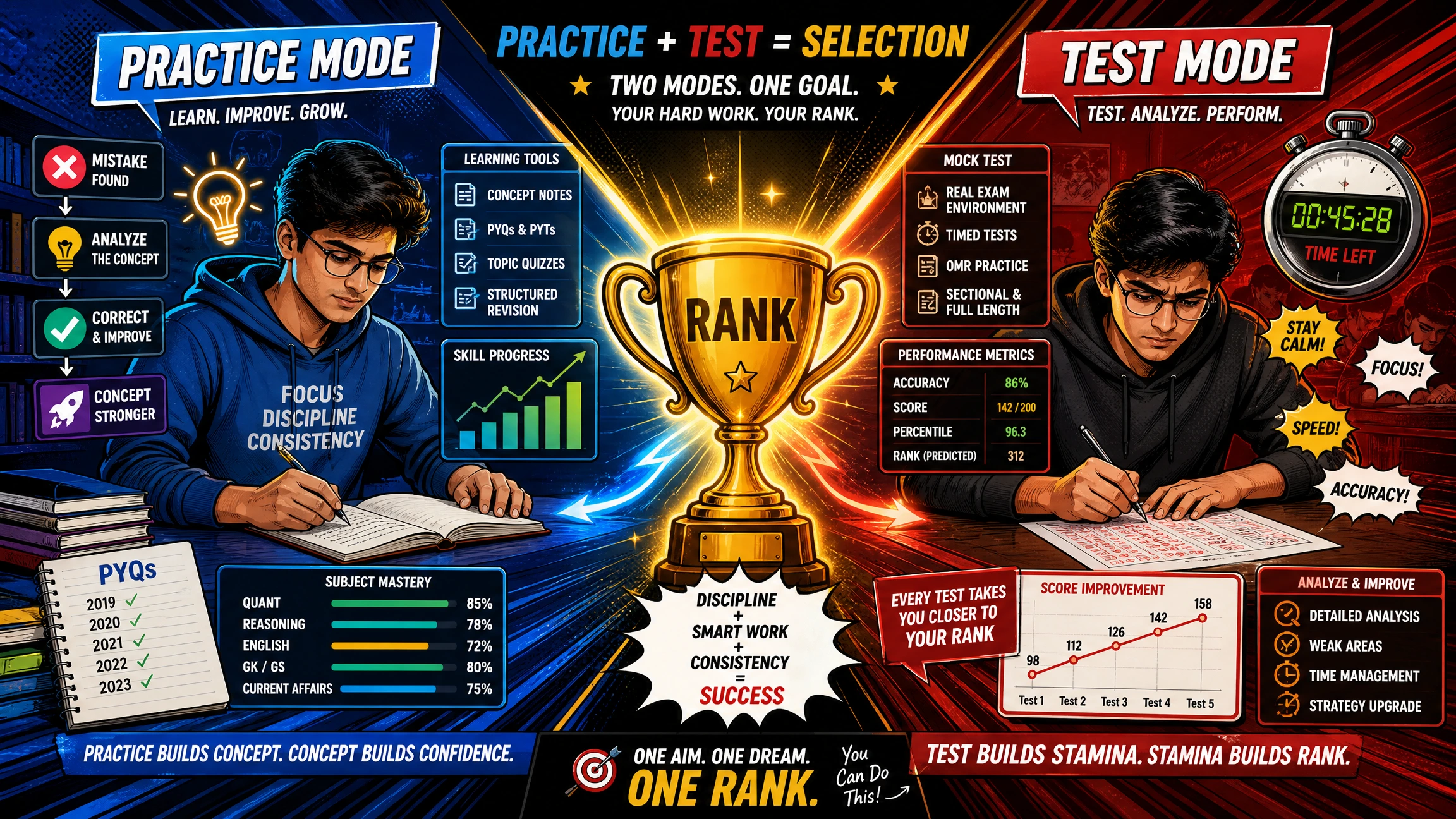
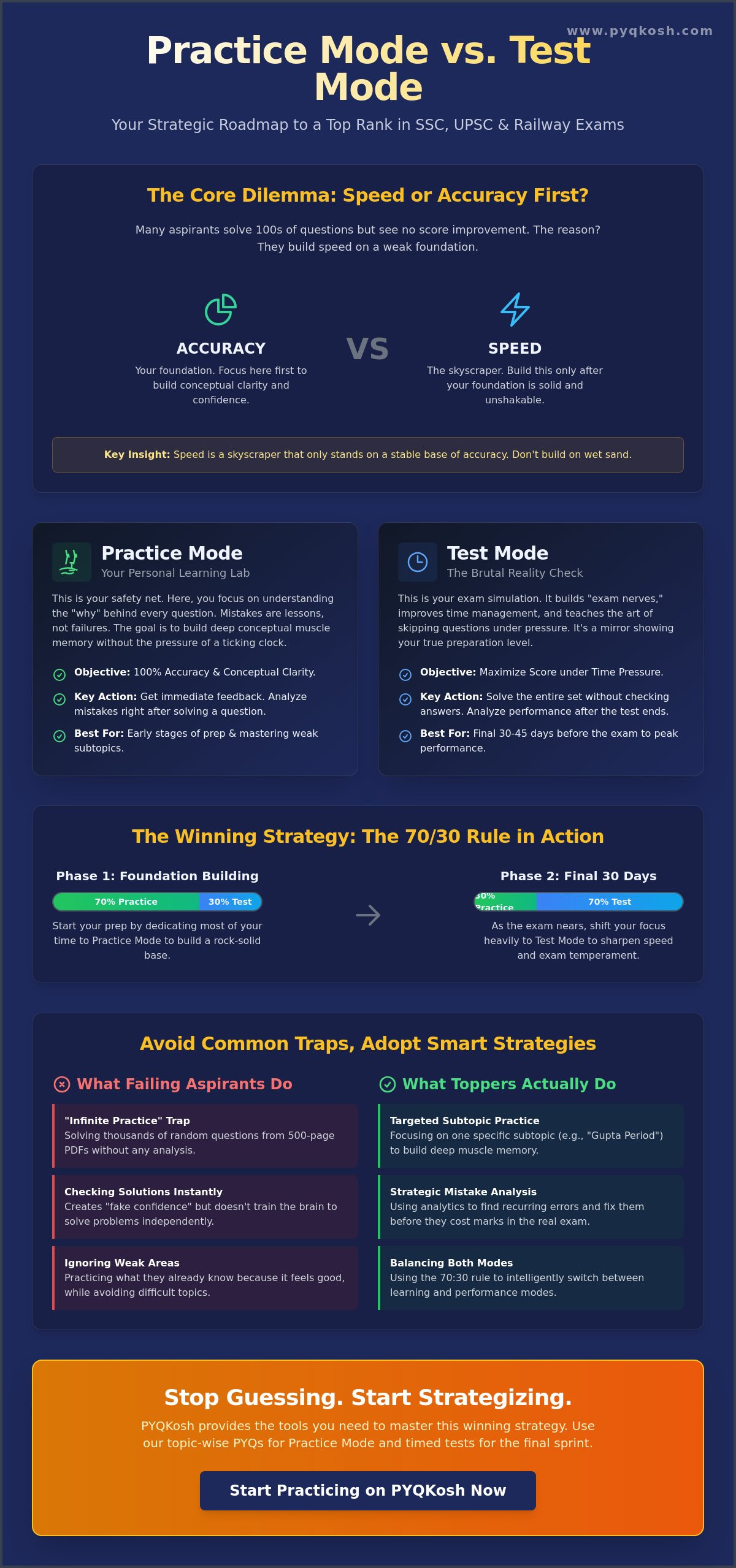
To win, you need to master two distinct styles of study. Practice Mode is your learning lab. This is where you take your time, understand the subtopics, and welcome mistakes. It's about building conceptual muscle. You aren't worried about the clock yet; you're worried about the "why" behind the answer.
Test Mode is your reality check. It's a brutal mirror that shows you exactly where you stand. This is where you leverage the testing effect, a psychological principle proving that the act of trying to retrieve information during a test actually strengthens your memory.
You can't skip either pillar if you want a top rank. If you only practice, you'll freeze in the exam hall when the pressure hits. If you only take tests, you'll keep repeating the same mistakes because your foundation is weak. Balancing both is the only way to ensure your name appears in the final merit list.
Practice Mode: Your Safety Net for Conceptual Clarity
Think of Practice Mode as your personal training lab. When you're tackling a complex math problem or a tricky Polity article, getting it wrong is part of the process. In a full-length test, you'd move on and likely forget why you failed by the time you reach the review stage. Practice Mode stops that cycle. It gives you immediate feedback, turning a mistake into a lesson while the logic is still fresh in your mind.
Choosing between practice mode vs test mode for exam prep depends entirely on your current stage. During the first 60 days of your journey, you shouldn't be obsessed with the clock. You should be obsessed with the "why." This is the time to build the mental pathways that allow you to spot a trap option before you even finish reading the question. You're training your brain to recognize patterns, not just memorize answers.
This phase is where you understand how retrieval practice works to cement long term memory. By seeing the solution instantly, you correct your logic before the wrong method becomes a habit. It's about quality over quantity. If you're ready to build this foundation, you can start with topic-wise PYQ practice to see where you truly stand.
Building Muscle Memory with Subtopic PYQs
Random practice is a recipe for confusion. Solving a random set of 25 questions might cover 25 different topics, leaving you a master of none. Instead, focusing on a specific subtopic, like the "Gupta Period" in Ancient History, allows you to see 10 variations of the same concept in one sitting. This repetition builds muscle memory.
When you see how the SSC or UPSC has framed the same concept differently over the years, you stop falling for distractors. You can find more strategies on this in our guide to SSC Exam Questions and Answers 2026. This targeted approach ensures you aren't just "doing questions" but actually mastering the syllabus.
When Practice Mode is a Lifesaver
We all have that one subject that feels like a mountain. For some, it's Advanced Math; for others, it's Economics. Practice Mode is a lifesaver here because it removes the anxiety of the ticking clock. You can take five minutes to dismantle a single question if that's what it takes to understand the logic.
Analyzing the "SSC Answer Key" logic without pressure helps you decode the examiner's mindset. You begin to notice how certain keywords in the question lead to specific answers. Every mistake becomes a data point for your improvement, rather than a reason to feel demoralized. This is how you turn a weak area into a scoring strength before the final 30-day countdown begins.
Test Mode: The Brutal Mirror Every Aspirant Needs
If Practice Mode is your laboratory, Test Mode is the battlefield. There are no hints here. No "check answer" button exists to save you when you're stuck on a tricky geometry problem or a confusing UPSC statement. It's just you, the ticking clock, and the pressure of the 2026 SSC CGL sectional timings. This is where you find out if you actually know the material or if you've just been coasting on "fake confidence."
The strategic shift between practice mode vs test mode for exam prep is most critical in the final 30 days before your prelims. During this window, you need to stop focusing on learning and start focusing on performing. Test Mode isn't just about getting the right answer; it's about managing your "Exam Temperament." It reveals whether you panic when you see three difficult questions in a row or if you have the mental toughness to stay calm and keep moving.
Scientific research on test-enhanced learning shows that this high-pressure retrieval doesn't just test your memory; it actually makes your brain more efficient at learning new things later. By simulating the exam environment, you're conditioning your mind to stay sharp even when the clock is red. This is the only way to ensure you don't freeze on the actual day of the exam.
Mastering the Art of Skipping
In exams like SSC CGL or RRB NTPC, knowing what NOT to solve is a superpower. You have 100 questions and only 60 minutes. If you spend three minutes on a complex calculation trap, you've already lost the race. Test Mode forces you to develop a "skip reflex." You learn to spot time-consuming questions in three seconds and move on to the easier marks.
This builds the stamina needed to stay focused for the entire duration of the paper. You're training your eyes to scan for keywords and your brain to make split-second decisions. Without this discipline, you'll find yourself finishing only 70% of the paper while the toppers have already moved on to the next section.
Post-Test Analysis: The Real Goldmine
Taking a test and just looking at the final score is a total waste of time. The real rank-building happens in the analysis. You need to categorize every wrong answer. Was it a "Silly Mistake" because you misread the question? Or was it a "Conceptual Gap" because you didn't know the formula? Tracking these data points is the only way to stop repeating the same errors.
When you use SSC CGL PYQ Practice in test mode, you get a clear breakdown of your performance. You can see exactly which subtopics are pulling your average down. This allows you to jump back into Practice Mode for those specific weak areas, creating a feedback loop that guarantees a higher score in your next mock.
The Winning Strategy: Balancing Both for SSC and UPSC
Success in competitive exams isn't about picking a side. It's about mastering the transition between learning and performing. Most aspirants fail because they stay in one mode for too long. If you're only practicing, you'll be too slow on exam day. If you're only testing, you'll never fix your core weaknesses. The real secret is a simple philosophy: Practice by day; Test by night.
When you analyze practice mode vs test mode for exam prep, think of it as a sliding scale. During the first two months of your journey, follow the 70:30 Rule. Spend 70% of your time in Practice Mode to crush subtopics and 30% in Test Mode to keep your speed alive. As you approach the final 30 days before the May 24, 2026 UPSC Prelims or the SSC CGL Tier 1 in August, flip that ratio. You need to become a testing machine to handle the pressure of the actual exam hall.
Never jump into a full mock test without topic-wise practice first. It's a waste of a good mock. You wouldn't run a marathon without training your legs on shorter sprints first. Use Practice Mode to master the individual pieces, then use Test Mode to see how they fit together under a timer. This layered approach ensures you don't get demoralized by low scores early in your prep.
A Weekly Schedule for Smart Aspirants
Don't leave your success to chance. Follow a structured rhythm that builds both your brain and your nerves. A balanced weekly plan looks like this:
- Monday to Friday: Use subtopic-wise Practice Mode. This is for deep learning and fixing conceptual gaps in subjects like Math or History.
- Saturday: Switch to topic-wise Test Mode. Check if you actually remember what you studied during the week without the help of immediate solutions.
- Sunday: Take a full-length mock test. Simulate the exam hall environment perfectly, including the 2026 SSC sectional timings.
Transitioning from Learner to Ranker
How do you know you're ready to switch exclusively to Test Mode? When your accuracy in Practice Mode hits a consistent 85% across all subtopics, you've earned the right to focus on speed. Use UPSC CSE PYQs to test your theme-based readiness. This psychological shift from "learning" to "performing" is what separates a student from a ranker.
Ready to build your own winning schedule? Start your strategic prep on PYQKosh today and master the balance that leads to a top rank.
Mastering PYQs with PYQKosh: Practice Smarter, Not Harder
Stop digging through dusty books and cluttered folders. You need a centralized hub that respects your time and your ambition. Understanding the strategic balance of practice mode vs test mode for exam prep is one thing, but having the tools to execute it is what actually gets you a rank.
PYQKosh gives you the best of both worlds on a single platform. We've eliminated the frustration of hunting through 500-page PDFs just to find a specific subtopic. Everything is organized, searchable, and ready for you to master. This isn't just about doing more; it's about doing what matters to the examiner.
Your AI-powered performance analytics dashboard acts as a brutal mirror. It doesn't just show a score; it tracks your accuracy, speed, and specific conceptual gaps. It tells you exactly where you're failing so you can stop random guessing. Targeted improvement is the only real shortcut to a top rank in SSC, UPSC, or Railway exams.
Why Subtopic-Wise Practice is the Game Changer
Broad topics are often too overwhelming to tackle in a single go. By focusing on high-weightage subtopics like "Percentage" or "Modern History", you build deep expertise quickly. You'll see your progress in real-time through granular analytics that show exactly how your accuracy is trending over time.
Our "Mistake Analysis" feature is like having a personal mentor in your pocket 24/7. It highlights the questions you consistently get wrong, allowing you to jump back into Practice Mode for those specific areas. This feedback loop ensures your preparation is always moving forward, never just spinning in circles.
Your Journey from Aspirant to Officer Starts Here
Don't just solve questions; master the pattern of the exam. The 2026 exam cycle will be more competitive than ever, especially with new sectional timings. Those who work smarter will take the seats. Join thousands of serious aspirants who have already switched to "Smart Prep" to save time and reduce exam-day anxiety.
You have the roadmap. You have the strategy. Now, you just need the discipline to execute. Master the art of practice mode vs test mode for exam prep and watch your mock scores transform into a final merit list rank. Your dream job is waiting for you to claim it.
Master the exam pattern and start your PYQ Practice on PYQKosh now.
Stop Guessing and Start Ranking
You've seen the roadmap. The difference between a dreamer and a ranker isn't just hard work; it's the strategy they use every single day. By mastering the shift between practice mode vs test mode for exam prep, you're no longer just "studying." You're building the specific skills needed to beat the competition and secure your seat in the 2026 exam cycle.
Remember, use Practice Mode to destroy your weak areas and Test Mode to sharpen your nerves for the actual exam hall. Don't wait until the final week to find out you're too slow. Start tracking your progress now and use data to drive your improvement. You've got the talent; you just need the right tools to unlock it.
Join the community of serious SSC, UPSC, and Railway aspirants who trust our AI-Powered Performance Analytics to guide their journey. With over 100,000 topic-wise PYQs at your fingertips, you can stop wasting time on random practice and start focusing on what actually gets results. It's time to turn your hard work into a final rank.
Master your exam pattern with PYQKosh—Start Practicing Now
Your journey from aspirant to officer is a marathon, not a sprint. Stay consistent, trust the process, and keep pushing forward. We're with you every step of the way. See you on the merit list!
Common Questions About Exam Strategy
Is practice mode better than test mode for beginners?
Yes, practice mode is the superior choice for beginners because it focuses on building a conceptual foundation without the anxiety of a timer. When you're just starting, you need to understand the logic behind every solution. Jumping straight into a timed test can lead to demoralization and half-baked learning. Use practice mode to master the basics before you worry about the clock.
How many hours of practice mode should I do daily for SSC CGL?
You should aim for 3 to 4 hours of dedicated practice mode daily if you're in the early stages of your prep. This allows you to cover at least two subtopics in depth, like Geometry or Modern History. As the exam date gets closer, you can reduce this time and shift your focus toward full-length mocks. It's about quality; make sure you're analyzing every mistake during these hours.
Can I clear UPSC Prelims by only using test mode?
It's highly unlikely you'll clear UPSC by only using test mode because the exam requires deep conceptual clarity. While test mode helps with elimination techniques, practice mode is where you actually learn the themes that UPSC repeats. You need both to succeed. Use practice mode to master the syllabus and test mode to sharpen your decision-making skills under pressure.
What is the best way to analyze a test after finishing it?
The best way to analyze a test is to categorize your wrong answers into silly mistakes, time-wasters, and conceptual gaps. Don't just look at the correct answer; understand why you chose the wrong one. Check if you spent too much time on a question you eventually got wrong. This data is the real goldmine that helps you improve your score in the next attempt.
Should I use practice mode for subjects I am already good at?
Yes, but use it differently by focusing only on the toughest subtopics within that subject. Even if you're good at English or Math, there might be specific areas where your accuracy isn't 100%. Use practice mode to maintain your muscle memory and stay updated with the latest PYQ patterns. This ensures your strong subjects remain your highest scoring areas on exam day.
Does PYQKosh offer both practice and test modes for all exams?
Yes, PYQKosh provides both practice and test modes for all major exams including SSC, UPSC, and Railway. This flexibility allows you to choose the right strategy based on your prep stage. You can practice subtopic-wise to build clarity and then switch to test mode to simulate the real exam environment with sectional timings.
How do I improve my speed in test mode without increasing silly mistakes?
To improve speed without errors, you must master the skip reflex in test mode. Practice identifying calculation-heavy traps within the first five seconds and move on. Speed comes from better question selection, not from rushing your calculations. The more you use practice mode vs test mode for exam prep strategically, the more natural this balance becomes.
Is subtopic-wise practice more effective than full-length papers?
Subtopic-wise practice is more effective during the learning phase because it builds deep expertise in one area at a time. Full-length papers are essential for stamina, but they won't fix a specific weakness in Percentage or Polity. Mastering practice mode vs test mode for exam prep means using subtopic practice to fix gaps and full papers to test your overall readiness.