
Article by
Aaisha
A passionate content writer at PYQKosh focused on simplifying Current Affairs and PYQs for competitive exam aspirants. I love turning complex topics into easy, student-friendly content that helps learners prepare smarter and stay consistent in their exam journey.
What if I told you that scrolling through random, 500-page PDFs is actually slowing you down? Most aspirants waste months repeating the same mistakes because they can’t see the patterns in 25 years of papers. It’s frustrating to finish a test and still have no clue if your knowledge of the Gandhian Era is actually solid.
I know how it feels to be buried under study material without a clear roadmap. That’s why mastering upsc modern history pyq subtopic wise is the ultimate secret to success. It turns disorganized practice into a smart, data-driven revision plan that targets your weak spots with surgical precision.
In this guide, you’ll learn how to identify high-yield themes like Social Reforms and use the Aaina progress dashboard to track your daily accuracy. We’ll show you how to move away from random effort and build the confidence you need to clear the Prelims on May 24, 2026.
Key Takeaways
- Stop treating PYQs like a simple test; they are the secret syllabus that reveals how UPSC repeats high-yield themes like the Gandhian Era.
- Ditch the disorganized PDFs and master upsc modern history pyq subtopic wise to see exactly how examiners twist the same concepts over 25 years.
- Use the Aaina dashboard to mirror your preparation and identify if you’re actually weak in Socio-Religious reforms or just need a quick timeline revision.
- Turn your mistakes into strengths by using the Wrong Question tracker, which is the ultimate topper banne ka shortcut for Modern History.
- Build a winning 2026 routine by dedicating 45 minutes every morning to solving 20 targeted subtopic-wise questions before starting your day.
Why Modern History PYQs are the Secret Syllabus for UPSC Prelims
UPSC aspirants often treat the syllabus like a mountain they must climb page by page. But here’s a secret: the official syllabus is just the tip of the iceberg. The real syllabus is hidden in the last 25 years of papers. While questions rarely repeat word for word, the underlying themes are incredibly consistent. If you look at the Civil Services Examination (CSE) papers from the last two decades, you’ll see they have specific “favorite” areas that appear almost every year.
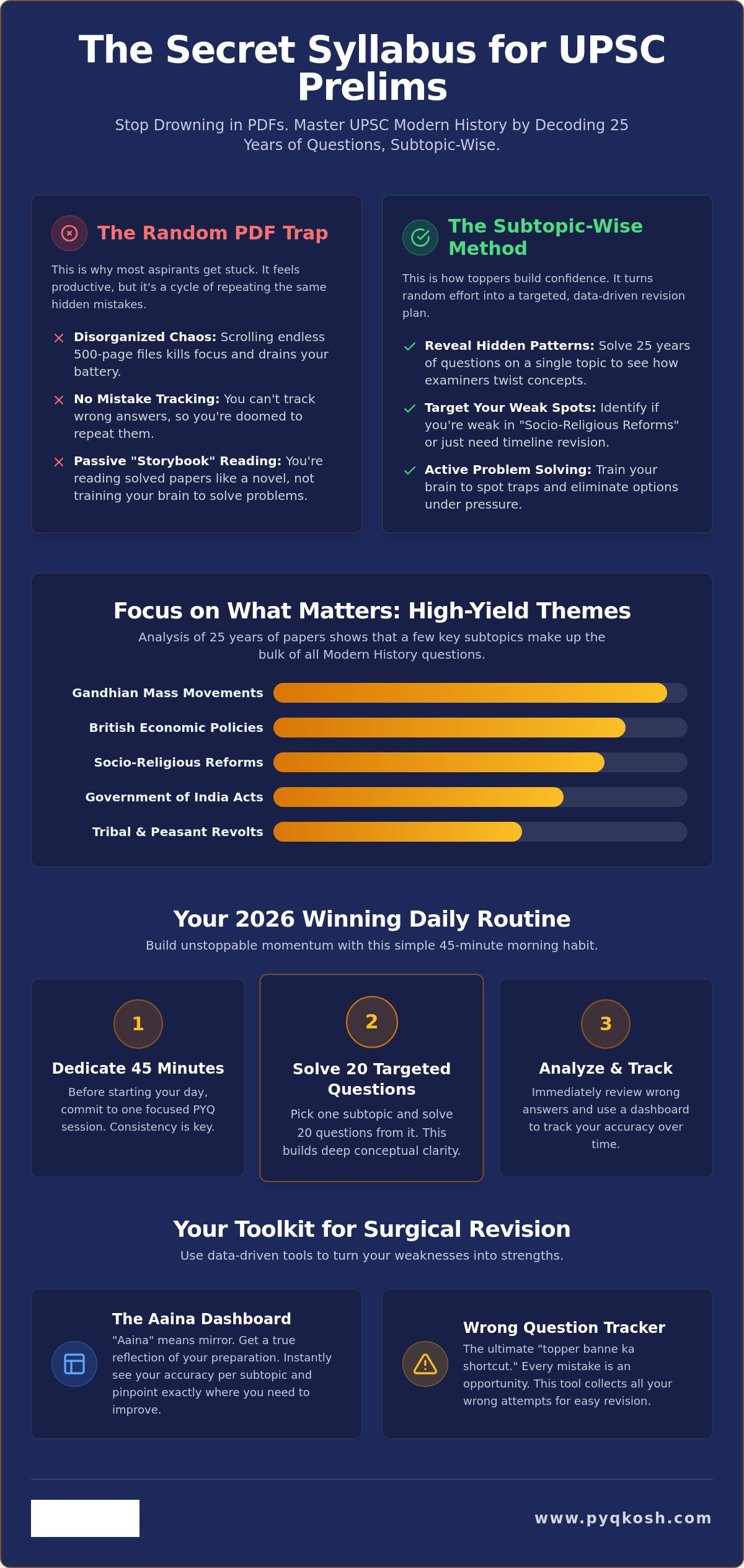
If you analyze the upsc modern history pyq subtopic wise, you’ll notice that the examiner’s mindset hasn’t changed much since the 90s. They still love asking about the nuances of the Government of India Acts or the specific sequence of events during the Quit India Movement. Research shows that just five subtopics, like Gandhian Mass Movements and British Economic Policies, make up a huge chunk of all questions. The 25-year mark is the sweet spot. It’s long enough to reveal every trick in the book but recent enough to stay relevant for your 2026 attempt.
Many students fall into the “storybook trap.” They buy a thick book of solved papers and read them like a novel. This feels productive, but it’s passive learning. You aren’t training your brain to spot traps or eliminate options. You need to stop reading history and start solving it. This approach helps you filter out the low-yield chapters in your textbooks that never actually show up on exam day. Why spend three days on an obscure chapter when 25 years of data shows UPSC doesn’t care about it?
The Problem with Static PDF Downloads
Let’s be honest, those 500-page PDF files sitting in your Telegram folders are disorganized chaos. They kill your focus and drain your mobile battery while you’re trying to study on the go, yaar. You can’t easily search for “Tribal Revolts” across 20 years in a single file without getting a massive headache. There’s also no way to track which questions you got wrong last week. Without a record, you’re doomed to repeat the same conceptual mistakes over and over again.
Why Online Practice Beats Offline Reading
Online practice gives you immediate feedback. When you get a question wrong, the logic is still fresh in your mind. This is the best time to understand why you failed. Practicing in test mode also helps you simulate the real pressure of the Prelims hall. You learn to manage time and handle the stress of multi-statement questions. For a deeper dive into this strategy, check out our UPSC PYQ Prelims guide to see how to structure your daily routine and turn random effort into targeted action.
The Magic of Subtopic-Wise Practice Over Random PDF Solving
Imagine you’re trying to master “Press Acts” during the British era. If you only use the official UPSC PYQ portal, you’ll find year-wise papers. This means you have to scroll through 25 different PDFs just to find five relevant questions. That’s a total waste of energy, yaar. It breaks your flow and kills your focus before you even start solving.
When you solve upsc modern history pyq subtopic wise, you see every question on “Press Acts” from 1995 to 2025 in one go. This reveals exactly how UPSC twists the same concept over decades. One year they ask about the Vernacular Press Act; the next, they focus on the Metcalfe Act. Solving them together builds a subconscious map of the timeline in your head that no textbook can provide.
This targeted approach is the only way to finish the massive Modern History mountain before the 2026 deadline. You aren’t just practicing. You’re decoding the examiner’s brain. By breaking the subject into bite-sized pieces like Civil Disobedience or Tribal Revolts, your revision becomes surgical. You stop guessing and start knowing exactly what the examiner wants from you.
Mastering the Pattern of Repeated Themes
UPSC has a sneaky habit. They often take a “wrong” option from a question asked three years ago and turn it into the “right” answer for next year. By using topic-wise UPSC Prelims questions, you spot these traps instantly. You’ll quickly identify which subtopics are evergreen, like the 1935 Act, versus those that are slowly fading from the examiner’s radar. This is the ultimate topper banne ka shortcut.
Practice Mode vs Test Mode
Don’t just jump into a full-length test. Use Practice Mode first to read in-depth explanations and build your conceptual foundation. Our explanations cover why an answer is right and why the other three are wrong. Once you feel ready, switch to Test Mode to check your speed and accuracy under time pressure. You can even sort topics by question count to find and attack high-yield areas first. If you’re ready to work smarter, you can start your subtopic-wise journey right now.
High-Yield Modern History Themes: What 25 Years of Data Tells Us
If you want to clear the 2026 Prelims, you need to stop studying like a librarian and start studying like a data scientist. 25 years of papers show that UPSC has a specific “personality.” It doesn’t ask everything equally. Some subtopics are gold mines, while others are just distractions that eat up your time, yaar.
The Gandhian Era (1917-1947) is the undisputed king of Modern History. Looking at the data from 1995 to 2023, Gandhian mass movements alone accounted for over 60 questions. That’s a massive concentration of marks in one small window. Constitutional developments and British administrative plans follow closely with about 50 questions. These are the “tough” areas where most aspirants lose marks because they haven’t practiced upsc modern history pyq subtopic wise.
Don’t ignore the 1857 Revolt or Revolutionary movements either. While they might seem simple, UPSC loves to test the specific regional leaders or the names of secret societies. These are easy marks if you’ve decoded the patterns. Solving upsc modern history pyq subtopic wise helps you realize that UPSC isn’t trying to test your memory of every single date. It’s testing your understanding of cause-and-effect and institutional linkages.
The Gandhian Era and National Movement
UPSC focuses heavily on the nuances of the Non-Cooperation, Civil Disobedience, and Quit India movements. They don’t just ask about the year. They ask about the specific demands of different groups like peasants, workers, or business classes. By practicing 25 years of these questions, you’ll see how the same theme is twisted every few years to keep you on your toes.
Social Reforms and Important Personalities
Personalities from Raja Ram Mohan Roy to B.R. Ambedkar are a recurring obsession for examiners. You need to know their specific journals, organizations, and the core philosophy they preached. It’s easy to get confused between similar-sounding organizations. We’ve included “Exam Booster Tips” in our explanations to help you clarify these common confusion points instantly. You can start mastering these high-yield themes on our UPSC CSE practice page and see where you stand today.
How to Use the Aaina Dashboard to Kill Your History Weak Areas
Studying for 12 hours a day doesn’t matter if you’re just reading what you already know. Most aspirants spend weeks on the Gandhian Era because it feels comfortable. Meanwhile, they ignore the 18th-century decline of the Mughals or the early advent of Europeans because those chapters feel a bit dry. The Aaina Dashboard is your personal mirror. It shows you exactly where you stand, yaar. It takes the guesswork out of your preparation by tracking your accuracy at a granular level.
When you solve upsc modern history pyq subtopic wise, the dashboard records every single click. You can see if your accuracy in Tribal Revolts is 80% while your score in British Economic Policies is stuck at 40%. This is how you stop being a generalist and start being a specialist. You can also monitor your daily streaks. Building a 30-day streak isn’t just about a number. It’s about building the discipline required for a 2026 rank. Peer ranking further helps you understand where you stand against the competition for each specific subtopic. If you see that 90% of aspirants are getting a question right and you’re getting it wrong, you know that’s a priority area to fix.
The Power of the Wrong Question Tracker
Stop wasting time marking your books with yellow highlighters. Every mistake you make on the platform is automatically saved in the Wrong Question tracker. You don’t have to carry heavy registers or search through old notes. You can re-practice only your wrong questions until your accuracy hits a perfect 100%. This is the ultimate topper banne ka shortcut. It’s about fixing your leaks before the actual exam day. You don’t want to realize your weak spots on May 24, 2026. You want to fix them now while you still have time to pivot.
Data-Driven Prep for Modern History
Consistency is hard during a long haul like UPSC preparation. Viewing your weekly growth graph helps keep your motivation high. You can see your progress move from a state of disorganized chaos to a state of data-backed clarity over time. The system also helps you identify stale topics. If you haven’t touched the 1935 Act or the Press Acts in two weeks, the dashboard will remind you to jump back in. You can access your UPSC CSE practice plans directly on your phone. This makes it easy to study while traveling or during a short break. If you’re tired of disorganized prep, you should explore the Aaina dashboard today and start tracking your real progress.
Implementing Your 2026 UPSC Modern History PYQ Practice Plan
The best time to train your brain is before the rest of the world wakes up. Dedicate the first 45 minutes of your morning to a focused session. This routine ensures you’re tackling the most important part of your General Studies paper when your focus is sharpest. To make the most of this time, follow these simple steps:
- Select a specific subtopic like “Peasant Movements” or “Governor Generals” from the menu.
- Solve 20 to 25 questions in Test Mode to check your current accuracy level.
- Review every single explanation, even for the questions you got right.
- Bookmark the ones that involve tricky dates or names for a quick Sunday revision.
If you’re commuting or waiting for a bus, you can easily master upsc modern history pyq subtopic wise directly on your phone screen. This turns dead time into productive study hours. Don’t just look for the right answer; analyze all four options. Our in-depth explanations provide a 360-degree view of every topic, turning one single question into four distinct learning points. This method helps you understand why three options were wrong, which is often where the next year’s question comes from. If you are also targeting other exams, you can easily combine your prep with SSC CGL questions to see how different boards approach the same historical events.
Setting Daily Accuracy Targets
You need to be realistic about your progress to avoid burnout. Aim for 90% accuracy in easier topics like the 1857 Revolt or the Advent of Europeans before moving to more complex areas. For tougher subtopics like the 1919 and 1935 Constitutional Acts, even a 70% accuracy rate is a great start. Don’t get discouraged by a low score in a difficult section. Instead, use the dashboard to track these small wins every day. Seeing your accuracy climb from 50% to 75% in a week is a huge motivator. These daily streaks and weekly graphs build the psychological momentum you need for the long haul.
Your Next Steps for UPSC 2026
Stop collecting random PDFs that you’ll never actually open. Start solving questions in a structured environment where every click counts toward your final rank. When you practice upsc modern history pyq subtopic wise, you’re not just reading; you’re actively building the mental muscles needed for May 24. Use our Exam Booster tips to gain an edge over those who only rely on standard textbooks. These tips clarify common confusion points that UPSC loves to exploit in multi-statement questions. Start your online practice session today and turn your preparation from random effort into a data-driven victory.
Practice 25 years of Modern History PYQs on PYQKosh to master every high-yield theme before the 2026 Prelims.
Own Your 2026 Prelims Success Today
You’ve seen the data. Randomly solving year-wise PDFs is a trap that keeps you stuck in the same cycle of confusion. To truly break through, you must master the upsc modern history pyq subtopic wise approach. It’s the only way to transform 25 years of chaos into a clear, actionable roadmap for your 2026 attempt.
By focusing on 1 lakh+ structured questions and using the Aaina performance dashboard, you can stop guessing and start knowing. Don’t just read history; analyze it through detailed 4-option explanations that reveal the examiner’s hidden patterns. Every mistake you track is a potential mark saved on the actual exam day. Fix your weak areas now so they don’t surprise you on May 24, yaar.
The path from a confused aspirant to a confident topper starts with a single smart choice. Stop working harder and start working smarter with a system designed for your mobile-first life. You’ve got the tools and the talent. Now, it’s time to put in the work and make 2026 your year!
Start your subtopic-wise UPSC Modern History practice now!
Frequently Asked Questions
Is 25 years of UPSC Modern History PYQs enough to clear the Prelims?
Yes, 25 years is the perfect timeframe to spot deep examiner patterns. While the syllabus is vast, UPSC consistently focuses on specific themes like the 1935 Act or the Quit India Movement. Analyzing this timeframe helps you build a subconscious map of high-yield areas and ensures you aren’t surprised by the way questions are framed.
How can I practice UPSC Modern History questions subtopic-wise for free?
You can find raw, year-wise papers for free on official government portals, but they are often disorganized chaos. For a more structured approach, practicing upsc modern history pyq subtopic wise on a centralized platform is much smarter. It saves you from the headache of manual sorting and lets you jump straight into solving targeted questions on your mobile.
Which subtopics in Modern History have the highest weightage in UPSC?
The Gandhian Era (1917-1947) is the undisputed king with the highest question density over the last two decades. Constitutional developments and Socio-Religious reform movements are the other major pillars. Focusing on these three subtopics first is a smart move that can help you secure a huge chunk of your History marks with less effort.
Does UPSC repeat Modern History questions from 20 years ago?
UPSC rarely repeats questions word-for-word, but they recycle themes every single year. They often take an incorrect option from a paper 15 or 20 years ago and turn it into the primary focus of a new question. This is why solving older papers is still considered the ultimate topper banne ka shortcut for the 2026 attempt.
How do I track my accuracy while solving UPSC previous year papers?
Manual tracking in a register is a slow process that kills your study momentum. It’s better to use a tool like the Aaina dashboard, which shows your accuracy, daily streaks, and weekly progress automatically. You can see exactly which subtopic needs more work without wasting time on manual data entry or notes.
Is online subtopic practice better than solving year-wise PDFs?
Online practice is far superior because it allows you to sort topics by question count and recency. Year-wise PDFs are disorganized and make it impossible to focus on one specific theme like Tribal Revolts across 25 years. Online platforms turn that disorganized mess into a structured, analytical exam preparation plan that fits in your pocket.
How can the Wrong Question tracker help in Modern History revision?
The Wrong Question tracker acts like a personal mentor who remembers every mistake you’ve ever made. It automatically saves your errors so you can re-practice only your weak areas until you hit 100% accuracy. This ensures you fix your conceptual leaks and build real confidence before you step into the exam hall on May 24.
Can I practice Modern History PYQs for both UPSC and SSC on one platform?
Yes, you can practice for both exams on a single platform that supports multi-exam PYQs. This is a massive advantage if you are targeting multiple government exams simultaneously. You get access to a centralized library of questions for UPSC, SSC, and Railway exams, making your preparation much more efficient and streamlined.