

Article by
Aaisha
A passionate content writer at PYQKosh focused on simplifying Current Affairs and PYQs for competitive exam aspirants. I love turning complex topics into easy, student-friendly content that helps learners prepare smarter and stay consistent in their exam journey.
Did you know that over 30% of your SSC CGL General Awareness marks come from just General Science? Most aspirants waste months reading thick textbooks cover to cover, only to realize they’ve ignored the high-yield topics that actually repeat.
It’s exhausting to scroll through endless Telegram PDFs and feel like you’re forgetting every fact by the next morning. You aren’t alone if you feel like the syllabus is a bottomless pit with no clear starting point.
This guide will change how you look at ssc cgl general awareness previous year question analysis. I’ll show you how to stop guessing and start using a data-backed subtopic strategy to master this section for the 2026 exam.
We will break down the competition for those 12,256 vacancies by identifying specific high-yield areas. You’ll learn how to build a structured daily habit and track your progress at a subtopic level to ensure you’re ready for the Tier 1 exam this August.
Key Takeaways
- Stop reading every chapter and learn to target the high-frequency themes that actually repeat in the TCS pattern.
- Identify the kingmaker subtopics for 2026, such as Art & Culture and Polity, to score high in both Tier 1 and Tier 2.
- Master ssc cgl general awareness previous year question analysis to filter out the noise and focus on the top 10 high-yield topics.
- Escape the “PDF trap” by switching to a structured practice habit that builds speed and accuracy.
- Use the Aaina dashboard to track your subtopic-level progress and ensure you never repeat the same mistake twice.
Why SSC CGL General Awareness Feels Like an Endless Sea (Reality Check)
Aspirant life is tough, yaar. You look at the 25 topics in the General Awareness syllabus and then at your watch. There are only 24 hours in a day. It feels like trying to empty the ocean with a spoon.
This is why a proper ssc cgl general awareness previous year question analysis is your only survival tool. It isn’t just looking at old questions. It is the process of identifying recurring themes from specific TCS-pattern questions.
You might hear that 30 lakh people apply for the Combined Graduate Level Examination (CGL). Don’t let that number scare you. That figure is mostly a myth. Your real competition is only with the small group using data to study.
GA analysis is the bridge between random reading and targeted scoring.
The Trap of the “Complete” Syllabus
Trying to finish the “complete” syllabus is the fastest way to fail this exam. You don’t need to be a history scholar or a scientist. You just need to be a selected candidate.
The secret isn’t knowing what to read. The real topper banne ka shortcut is knowing what to skip. If a topic hasn’t appeared in the last five years, why waste three days on it?
Shift your mindset from “completing books” to “mastering high-yield subtopics.” You can start this journey with topic-wise practice on the SSC CGL exam page where questions are already organized for you.
TCS Pattern: The New Rules of the Game
Since 2018, the game has changed. We’ve moved into a period where GA questions are more analytical. Static GK is no longer separate. It now merges with current affairs subtopics in every shift.
For the 2025-26 cycle, you’ll see questions where a historical event is linked to a recent anniversary. This unpredictability makes GA the kingmaker for Tier 2. You can’t rely on luck anymore.
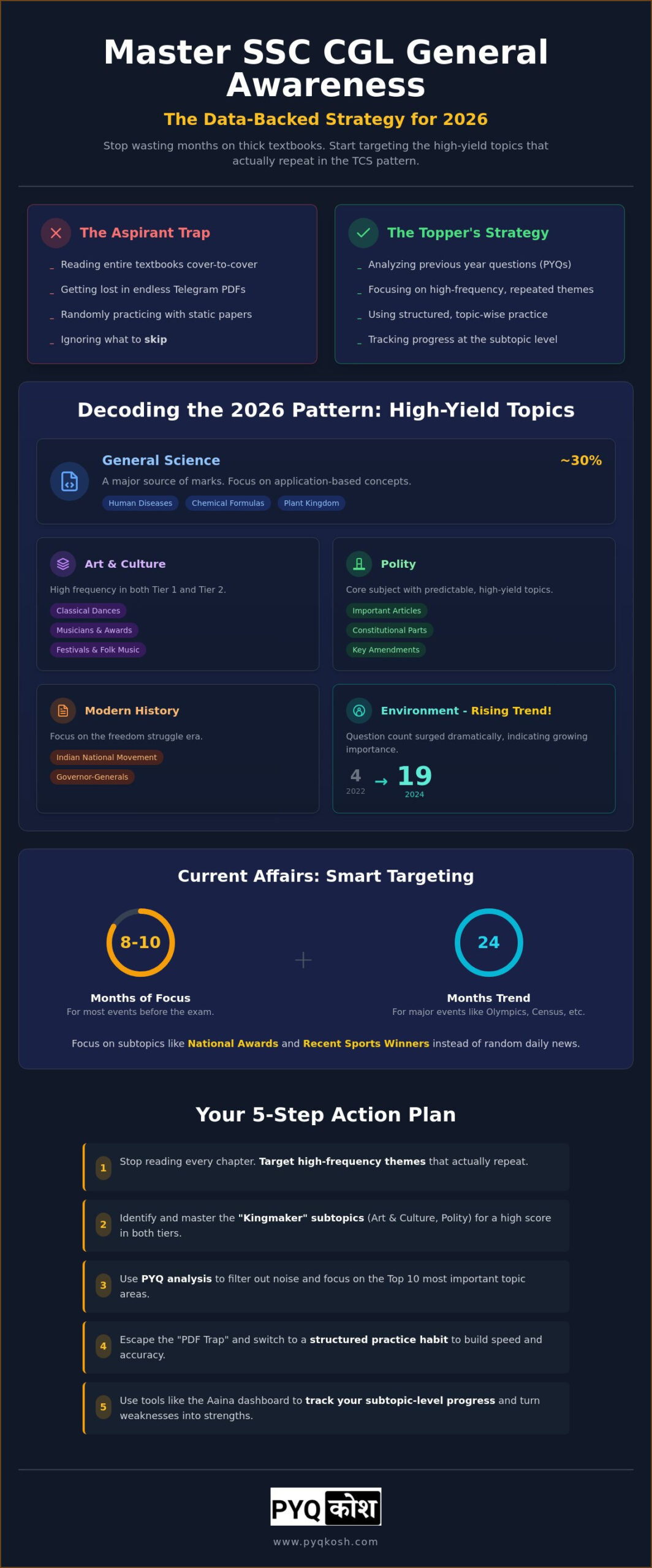
A detailed ssc cgl general awareness previous year question analysis shows that General Science weightage stays high. Meanwhile, Environment questions surged from 4 in 2022 to 19 in 2024. Use this data to win.
Decoding the 2026 Pattern: Subtopic Weightage That Actually Matters
If you think reading a bulky History book cover-to-cover will save you, think again. The 2026 exam cycle demands precision. A deep ssc cgl general awareness previous year question analysis reveals that SSC has moved away from broad questions to very specific subtopics.
You must treat Tier 1 and Tier 2 as a single challenge from day one. Since Tier 1 is qualifying, many students get lazy. But the syllabus is identical. If you don’t master the kingmaker subtopics now, you’ll struggle when the stakes are higher in Tier 2.
Focus on these high-yield areas first:
- Art & Culture: Classical dances, musicians, and their awards.
- Polity: Important Articles, Parts, and Constitutional Amendments.
- Modern History: The Indian National Movement and Governor-Generals.
Science has also evolved. It’s no longer about simple definitions. You need to understand application-based subtopics like chemical formulas, human diseases, and plant kingdom classifications. Check the Staff Selection Commission (SSC) official website for the latest syllabus updates to stay on track.
Static GK: The Foundation of Your Score
Static GK is where you can guarantee marks. High-frequency subtopics like festivals, folk music, and national parks appear in almost every shift. Don’t just read them once and hope for the best. You need to see how they repeat.
You should use topic-wise practice to master these first. The secret is that themes often repeat across SSC, UPSC, and Railway exams. Sorting your practice by question count helps you see exactly what SSC loves asking most.
Current Affairs: Beyond the Monthly PDF
Stop wasting four hours daily on random news. Subtopic-wise current affairs like “National Awards” or “Recent Sports Winners” are much more effective. They help you build a mental map of what actually matters for your shift.
How far back should you go? Data suggests focusing heavily on the last 8-10 months before the August-September Tier 1 exam. However, for major events like the Olympics or the Census, a 24-month trend is safer. Link these events to static subtopics for a 360-degree view of the subject.
If you want to see how these subtopics stack up, try sorting by recency to see the 2025-26 trends immediately.
The PDF Trap: Why Static Question Papers are Killing Your Speed
You probably have a Telegram folder overflowing with “free” PDFs. Admit it, yaar. You’ve spent more time renaming those files and organizing folders than actually solving questions. This is the hidden cost of free resources. Searching for a specific subtopic in a 200-page document is a massive time-waster that kills your momentum.
Passive reading of a ssc cgl previous year paper is a mental trap. It gives you the illusion of knowledge. You read a fact, nod your head, and move on. But when the exam clock starts ticking during the Tier 1 shift, your brain freezes. You can’t recall the data because you never practiced retrieving it under pressure.
Real ssc cgl general awareness previous year question analysis requires active retrieval. You need to switch between Practice mode for learning and Test mode for building exam temperament. Centralizing your library on one structured platform beats ten scattered bookmarks every single time. It turns disorganized chaos into focused, data-backed clarity.
Passive Reading vs. Active Practice
Your brain is naturally lazy. If you just read a fact from a book, it treats it like background noise and forgets it within hours. Subtopic-wise testing forces your brain to work. It has to pull that specific data from your memory and apply it. This process is what actually stores information for the long term.
The topper banne ka shortcut is simple: stop reading and start practicing with in-depth explanations. When you use topic-wise practice, you aren’t just seeing questions. You’re training your mind to recognize patterns in how SSC asks about the same subtopic across different years. This is how you build real speed.
The Frustration of Missing Explanations
A simple answer key that says “Option B is correct” is useless for General Awareness. You need to know why the other three options were there. In modern prep, you must look for “Exam Booster Tips” and “Confusion Points” to stay ahead of the competition. These small details are often the basis for the next year’s questions.
In-depth explanations help you cover four different topics while solving just one question. If a question is about a specific classical dancer, a good explanation will also cover their gharana, their awards, and other famous dancers in that field. This turns your ssc cgl general awareness previous year question analysis into a powerful learning tool rather than just a score-checking exercise.
Your 5-Step Action Plan for Mastering High-Yield GA Topics
Knowing the theory is one thing, but executing a plan is what gets you the post. You need a system that removes the guesswork from your daily routine. Here is how you can use ssc cgl general awareness previous year question analysis to build a bulletproof study habit.
- Step 1: Identify the top 10 high-frequency subtopics using the question count filter. Don’t guess which topics are important; let the data tell you what to prioritize.
- Step 2: Practice 50 questions daily in Test Mode. This builds your exam temperament and teaches you how to manage the clock for the August-September Tier 1 exam.
- Step 3: Review every wrong answer immediately. Use the automated wrong questions tracker to see exactly where you tripped up so you don’t repeat that mistake, yaar.
- Step 4: Check the Aaina dashboard every night. Monitor your daily accuracy and keep your practice streaks alive to build a winning momentum.
- Step 5: Bookmark facts that are hard to remember. Spend 10 minutes every Sunday morning revising only these specific points to keep them fresh.
Applying the Pareto Principle (80/20 Rule)
In SSC, 80% of the marks often come from just 20% of the subtopics. Smart aspirants focus on this core. Use the sorting by recency feature to catch 2025-26 trends first and see what TCS is currently obsessed with.
If a subtopic has only two questions in five years, ignore it. Letting go of low-yield topics isn’t laziness; it’s a strategic move. This is the real topper banne ka shortcut that leaves you more time for kingmaker areas like Art & Culture.
The 24-Hour Revision Loop
Your brain is like a leaky bucket. If you don’t revise within 24 hours, most of what you learned will vanish. Use the Wrong Question Tab to quickly revisit mistakes from the previous day and plug those memory gaps.
Building a streak on your dashboard is a great way to stay motivated when you feel like quitting. Seeing your progress graph go up gives you the confidence that your ssc cgl general awareness previous year question analysis is actually working. It turns preparation into a game you want to win.
Ready to start your streak? You can track your daily progress on the Aaina dashboard right now.
Stabilizing Your Score: How PYQKosh Turns Weakness Into Strength
You’ve got the plan, now you need the engine to run it. PYQKosh gives you access to a massive library of 1 lakh+ questions. These aren’t just dumped in a folder; they are organized down to the subtopic level for maximum efficiency.
This structure is the backbone of any serious ssc cgl general awareness previous year question analysis. You can find exactly what you need without scrolling through endless, messy PDFs. It saves you hours of frustration and keeps your focus sharp on the 2026 goal.
The Aaina dashboard acts as a mirror for your preparation. It shows your true daily and weekly progress, helping you see where you’re actually standing in the crowd. The Aaina dashboard replaces guesswork with data-driven clarity.
Multi-exam support is another game-changer for your 2026 prep. Often, questions in SSC overlap with UPSC CDS or Railway exams. Having them all on one platform means you’re prepared for any surprise the TCS pattern throws at you during Tier 2.
Mastering Mistakes with the Wrong Question Tracker
Stop repeating the same errors in every mock test. The Wrong Question Tab automatically stores every mistake you make. You can sort these by frequency to identify your biggest conceptual gaps before they cost you marks.
If you’ve made the same mistake on “Fundamental Rights” three times, the tracker will highlight it for you. An average student becomes a topper by fixing one mistake at a time. It’s about precision, not just solving thousands of random questions, yaar.
Use the sorting feature to focus on recently committed mistakes. This ensures your latest weak points are fresh in your mind. Fixing these gaps is the real topper banne ka shortcut that most aspirants ignore.
The Power of Peer Ranking and Streaks
Preparation can be lonely, but you aren’t alone in this race. Use the peer rank feature to understand where you stand in the national competition. It’s a reality check that keeps you grounded and motivated to push harder.
The psychological boost of seeing your “daily streak” grow on your phone is real. It turns exam prep from a boring chore into a data-driven mission. You start competing with yourself to keep that streak alive every single day.
Seeing your weekly graph go up provides the confidence you need for the August-September exam. It proves that your ssc cgl general awareness previous year question analysis is paying off. This momentum makes the vast syllabus feel manageable and your success feel inevitable.
Start your first streak today and see your accuracy improve shift by shift.
Stop Guessing and Start Scoring
You now have the exact roadmap to beat the General Awareness section. Success in the 2026 exam isn’t about working harder; it’s about working smarter. Focus on the high-yield subtopics we discussed and leave the low-value chapters behind. Your ssc cgl general awareness previous year question analysis should be your daily compass.
Don’t fall back into the PDF trap. Use a system that tracks your every move and highlights your mistakes. With access to 1 Lakh+ Subtopic-wise Questions and the Aaina Progress Dashboard, you’ll always know exactly where you stand. The Automatic Wrong Question Tracker ensures you never trip over the same hurdle twice.
Start your data-driven General Awareness practice on PYQKosh now!
The 12,256 vacancies are waiting for those who prepare with precision. You’ve got the tools and the strategy. Now, go out there and make it happen, yaar!
Frequently Asked Questions
Is General Awareness analysis enough to crack SSC CGL 2026?
Analysis is the foundation, but you must combine it with consistent practice. It helps you focus on the 12,256 vacancies by filtering out low-yield topics. A solid ssc cgl general awareness previous year question analysis ensures you don’t waste time on irrelevant data, but you still need to put in the hours for active retrieval to score well.
Can an average student score 40+ in CGL Tier 2 General Awareness?
Yes, you can reach this score by mastering high-frequency subtopics rather than the whole syllabus. Tier 2 is the kingmaker, and scoring 40+ is possible if you target Art & Culture, Polity Articles, and Modern History. Most aspirants lose marks due to negative marking, so fixing your accuracy with a data-driven approach is the real topper banne ka shortcut.
How do I use PYQKosh to identify high-yield subtopics?
Use the sorting by question count feature to see which topics SSC asks most frequently. This filter immediately shows you the weightage of subtopics like Classical Dances or Periodic Table trends. It removes the guesswork from your routine and lets you start your preparation with the most important areas first, saving you months of random reading, yaar.
Is it better to practice topic-wise or solve full mock tests?
Start with topic-wise practice to build your base, then move to full mocks. Topic-wise practice helps you master specific subtopics and identify conceptual gaps. Once you’re confident in individual subjects, use full tests to build your exam temperament. This strategy helps you manage the 60-minute Tier 1 time limit without feeling overwhelmed by the mixed syllabus.
What is the best way to remember static GK facts for SSC?
Active retrieval and frequent revision of your wrong answers is the most effective method. Don’t just read facts passively from a PDF. Use the bookmark tab to save hard-to-remember facts and revisit them every week. Testing yourself repeatedly in practice mode forces your brain to store information for the long term rather than forgetting it by the next morning.
How many years of previous year questions should I solve for GA?
Focus on questions from 2018 onwards to match the current TCS pattern. While older questions are okay for basic concepts, the 2022-2025 period shows the most relevant trends in General Science and Environment. Solving the last five years of questions is usually enough to cover the repeating themes that will appear in your 2026 exam shift.
Does SSC repeat questions from UPSC or Railway exams?
Yes, themes and even specific questions often overlap across major government exams. This is why multi-exam support on one platform is so valuable for your ssc cgl general awareness previous year question analysis. Practicing PYQs from exams like CDS or RRB NTPC can give you an edge, especially for tougher Tier 2 questions that require deeper conceptual clarity.
How do I track my daily progress for General Awareness?
Use the Aaina progress dashboard to see your daily and weekly performance in real-time. It tracks your accuracy, questions practiced, and streaks automatically. This dashboard replaces disorganized notes with a clear weekly graph, showing you exactly where you’re improving and which subtopics still need work. It turns your preparation into a data-driven mission you can actually win.