

Article by
Aaisha
A passionate content writer at PYQKosh focused on simplifying Current Affairs and PYQs for competitive exam aspirants. I love turning complex topics into easy, student-friendly content that helps learners prepare smarter and stay consistent in their exam journey.
What if I told you that downloading 10 years of UPSC Prelims PDFs is actually slowing you down? Most aspirants treat upsc cse pyq analysis like a boring history lesson. They scroll through endless files without a real plan. It's a trap. You solve a full paper, feel good for an hour, and then forget the logic by the next morning.
I get it, yaar. The pressure for the May 25, 2025 Prelims is rising fast. It's frustrating to waste hours on low-yield topics while your weakest areas stay hidden. You want to feel certain that your practice actually counts toward securing one of those 979 vacancies.
This guide shows you how to use subtopic-wise analysis to predict high-yield themes. We'll move past random guessing. You'll learn a topper banne ka shortcut to fix repeat mistakes using the Aaina dashboard and the Wrong Question tab. Let's turn your hard work into a data-driven strategy.
Key Takeaways
- Stop wasting time on the "PDF trap" and learn how subtopic-wise practice helps you identify specific conceptual gaps immediately.
- Perform a structured upsc cse pyq analysis to focus on high-yield themes in Economy and Environment that are likely to appear in May 2025.
- Use PYQs to set clear boundaries for your static reading, ensuring you don't get lost in low-yield topics that rarely show up in the exam.
- Master the 3-step strategy of filtering subtopics and using test mode to build active recall and confidence under real exam pressure.
- Leverage multi-exam support and the Wrong Question tab to track your progress and predict trends using questions from CAPF and CDS.
Why Year-Wise UPSC PYQ Analysis is Failing Aspirants Today
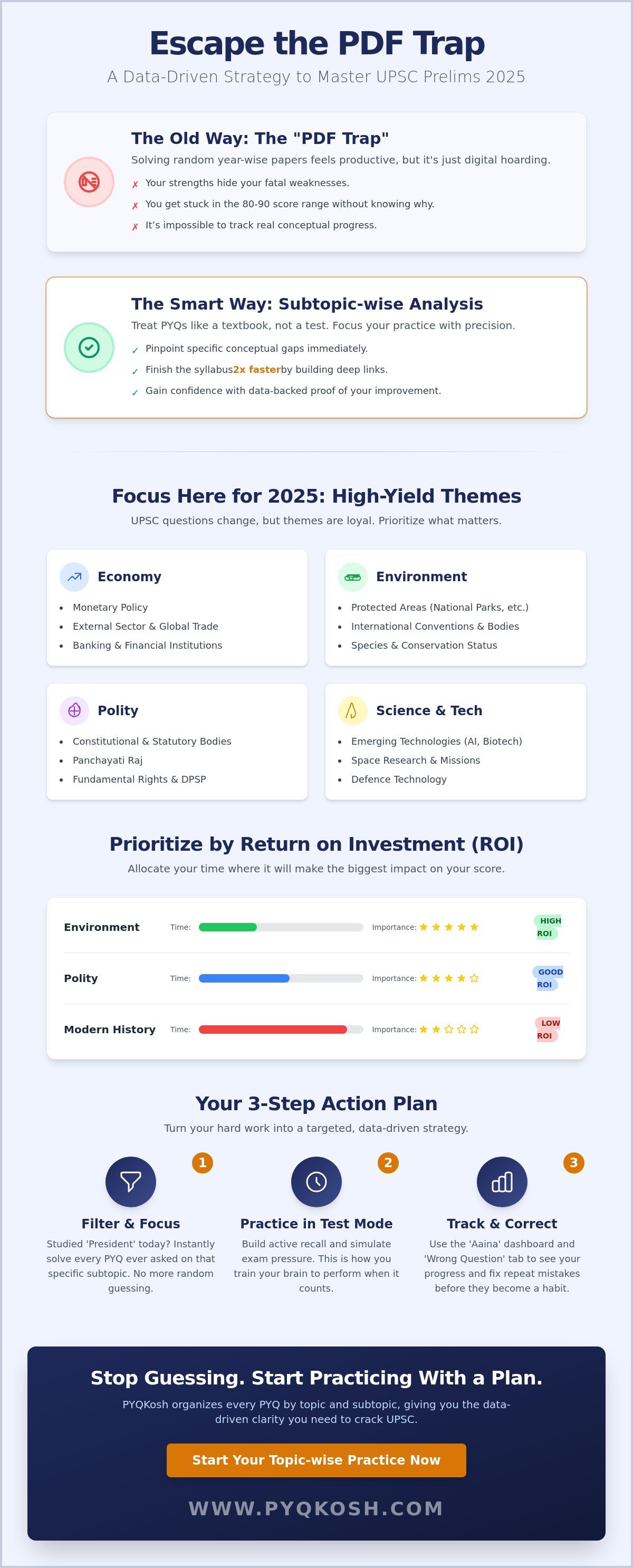
Let's be honest, yaar. We've all been there. You download a folder named "UPSC PYQs 2011-2024" and suddenly feel like you've conquered half the battle. This is the "PDF Trap." It feels like progress, but it's actually just digital hoarding. Solving a random year-wise paper might give you a score, but it won't give you a strategy.
The Civil Services Examination (CSE) is evolving. If you look at the 2024 Prelims, the static portions like Geography and Polity were back in focus. But just knowing that 15 questions came from Polity isn't enough. You need to know which specific subtopics, like Constitutional Bodies or Fundamental Rights, are being targeted. A traditional upsc cse pyq analysis often misses these nuances because it looks at the year, not the theme.
UPSC is shifting. Static year-wise patterns are becoming less predictable than thematic ones. You need a data-driven approach to see the "hidden" syllabus between the lines. This means moving away from scattered PDFs and toward a centralized system that tracks your performance at a granular level.
The Problem with Full-Length Mock Drills
Full papers are great for timing, but they're terrible for learning core concepts. When you solve 100 questions from a 2022 paper, you get a mixed bag. Maybe you scored 95. You feel okay. But what if you got every Parliament question right and every Ancient History question wrong? In a full paper, your strengths hide your fatal weaknesses.
This is why many aspirants get stuck at the 80 to 90 mark range. They don't know which subtopics are pulling them down. The topper banne ka shortcut isn't just solving more papers; it's fixing the subtopic first. Use upsc cse pyq analysis to isolate your weak areas before you ever attempt a full-year paper. It's about precision, not just volume.
Transitioning from Chaos to Organized Clarity
Stop treating every PYQ as a "test" you take once a week. Instead, treat them as a textbook. If you studied "President" today, solve every question UPSC has ever asked on the President right now. This is where topic-wise practice changes the game. It moves you from disorganized chaos to focused, data-backed clarity.
Organizing your prep by subtopic helps you finish the syllabus 2x faster. You aren't jumping between random subjects. You're building deep conceptual links. Centralized resources are always better than scattered notes. When you can see your progress at a subtopic level, your confidence grows because you have proof of your improvement. Stop guessing and start practicing with a plan.
Decoding the UPSC CSE 2025 Trend: High-Yield Subtopics
Most aspirants think UPSC is a game of luck. But if you look closely, the patterns are right there. Your upsc cse pyq analysis should reveal that while questions change, themes are surprisingly loyal. In 2024, subjects like Geography (18 questions) and Environment (15 questions) dominated the paper. For 2025, you can't just read everything. You have to prioritize.
In Economy, stop obsessing over abstract theories. Focus on Monetary Policy and the External Sector. These are 2025 must-reads because they link directly to global trade shifts. For Environment, the trend is moving toward specific "Protected Areas" and "International Conventions." Don't just learn the name of a National Park; learn the river flowing through it and the species it protects.
Polity is also shifting. Basics like Fundamental Rights are still vital, but UPSC is now testing "Constitutional Bodies" and "Panchayati Raj" with more depth. In Science and Tech, the focus has moved from traditional Biology to "Emerging Technologies" like AI and Space Research. If you track these shifts, you'll stop wasting time on low-yield topics that haven't been asked in years.
Subject-Wise Weightage: The 2025 Prediction
Based on the 5-year average, Economy and Environment remain the heavy hitters. Modern History weightage is fluctuating, often replaced by more direct Art and Culture questions. This means you might spend 50 hours on Modern History for just 4-5 questions. It's better to reallocate that time to high-ROI subjects.
| Subject | Importance | Study Time Required |
|---|---|---|
| Environment | Very High | Low (High ROI) |
| Polity | High | Medium |
| Economy | High | Medium |
| Geography | High | High |
| Modern History | Medium | High (Low ROI) |
The "Current Affairs" Connection in PYQs
UPSC doesn't ask random current affairs. They ask about current events that have a strong link to static themes found in upsc cse pyq analysis. For example, if there's a major debate on the Governor's powers, expect a static question on Constitutional Provisions. You can stay updated through UPSC official communications and official press releases to see what the government is prioritizing.
Identifying this "Static-Dynamic" overlap is your real edge. Topics like Inflation or Presidential Elections are classic examples where the news meets the textbook. You can use PYQKosh Current Affairs to bridge this gap easily. It helps you see exactly which static subtopic is trending in the news right now. Start by checking out the topic-wise practice sections to see how current trends fit into the larger PYQ map.
Static vs. Dynamic: How to Balance Your Preparation
Many coaching centers tell you to finish the entire static syllabus first and then touch current affairs. This "Static first, Current later" strategy is a recipe for failure, yaar. UPSC doesn't work in silos anymore. Every question is a mix of textbook facts and real-world application.
A deep UPSC CSE PYQ analysis shows you the exact boundaries of your static reading. You don't need to read every single page of a 700-page textbook. PYQs tell you which chapters to master and which ones to skip entirely. It's about studying what matters, not just everything available.
Toppers use this method to filter their daily newspaper reading. If a news item doesn't link back to a recurring theme in the PYQs, they ignore it. Using structured upsc cse pyq analysis helps you stop wasting time on "junk" current affairs that UPSC never touches. It's the ultimate filter for your brain.
Mastering the Core Pillars
Polity and Economy are your "Insurance" subjects. If you master these through subtopic-wise practice, you're already ahead of 90% of the crowd. Analysis shows you exactly which parts of Laxmikanth are high-yield, like Parliament or Local Government, versus low-yield chapters.
Don't just guess if you're ready. Use the Aaina dashboard to see if your static foundation is actually strong enough. It tracks your accuracy in specific themes so you know exactly where you stand. If your accuracy in "Fundamental Rights" is 40%, you know exactly what to revise tonight.
Filtering the Noise in Current Affairs
Stop reading every news headline like it's a potential question. Focus only on what UPSC has historically asked. For example, if there is news about a new species, check how UPSC has asked about "Protected Areas" in the past. This keeps your prep focused and manageable.
Use the Bookmark tab to save current-linked static questions for quick revision. This bridges the gap between your news reading and your textbook. Daily subtopic quizzes are much better than weekly marathons. They keep your memory sharp and help you catch small mistakes before they become habits. Take a few minutes to practice a specific subtopic today and see the difference.
The 3-Step Strategy to Master UPSC Prelims Using PYQ Analysis
Reading the same Laxmikanth chapter five times won't save you. Passive reading is a slow poison for your rank. To actually clear the Prelims, you need a workflow that forces your brain to work. This is where a data-driven upsc cse pyq analysis becomes your strongest weapon.
Step 1: Filter by Subtopic. Don't just practice "Economy." That's too broad. If you studied "Inflation" today, solve only Inflation questions tonight. This is the topper banne ka shortcut because it keeps your focus sharp and your retention high.
Step 2: Use Test Mode. Practice mode is great for learning, but Test mode simulates real exam pressure. Set a timer. Feel the heat for that specific theme. It trains your brain to handle the May 25, 2025 pressure early on.
Step 3: Analyze the Wrong Question Tab. This is the secret sauce. Most aspirants just look at the correct answer and move on. That’s a mistake, yaar. The real learning happens when you understand exactly why you were wrong in the first place.
Identifying Your "Blind Spots"
You can't fix what you can't see. Use the Aaina progress dashboard to check your accuracy at a subtopic level. It’s a reality check. If your accuracy in "Fundamental Rights" is below 70%, stop everything and re-read that chapter.
Don't just guess your weak areas. Let the data tell you. Once you find a gap, review the in-depth explanations. These cover why an option is right or wrong, plus they offer "exam booster" tips to prevent future errors. It's about turning every mistake into a future mark.
The "Wrong Question" Tracker Logic
UPSC aspirants often repeat the same mistakes year after year. It's a cycle of "silly mistakes" that kills the cutoff. The automated Wrong Question tab saves you from this trap. It stores every mistake you make so you can revisit them easily.
You can sort these mistakes by frequency. This shows you which concepts you truly don't understand versus what was just a one-time slip. Fix these patterns now to avoid heartbreak in 2025. Start building your personalized mistake map with topic-wise practice right now.
Why Topic-Wise Practice is Your Secret Weapon for UPSC CSE 2025
Solving a 100-question PDF at 11 PM when you're exhausted is a waste of time, yaar. Your brain just shuts down. This is where active recall beats passive reading every single time. Research suggests that solving questions is 3x more effective for memory than highlighting a textbook. A structured upsc cse pyq analysis allows you to practice in bite-sized chunks that actually stick.
One of the biggest secrets of toppers is using multi-exam support. UPSC often tests new themes in CAPF or CDS before they ever show up in the Civil Services Prelims. By practicing these related exams, you can predict trends for the May 25, 2025 paper before your competitors even realize what's happening. It's about being one step ahead of the curve.
You also need to squeeze every bit of value out of your mistakes. Our in-depth explanations don't just give you the answer; they offer exam booster tips and clarify confusion points. These small insights can easily add an extra 2 to 4 marks to your final score. In an exam where 979 vacancies are up for grabs, those few marks are the difference between a rank and another year of struggle.
Smart Work Over Hard Work
UPSC preparation is a marathon, not a sprint. Don't burn yourself out on disorganized folders and broken links. Topic-wise practice fits perfectly into a busy aspirant's schedule. Whether you have 10 minutes between classes or 20 minutes before bed, you can finish a subtopic quiz and see your daily streaks grow.
The Aaina dashboard acts as your personal mirror for exam readiness. It centralizes your progress, showing you your accuracy and peer rank in real-time. Instead of feeling overwhelmed by the massive syllabus, you get organized clarity. You'll know exactly which "Smart" alternatives to use instead of traditional, labor-intensive methods that lead to burnout.
Ready to Challenge the UPSC 2025 Pattern?
Stop waiting for the "perfect time" to start your upsc cse pyq analysis. That day never comes. The 2025 cycle demands a more analytical approach than ever before. The 2024 paper already showed us that the "pair-type" questions might decrease, but the focus on core static concepts is stronger than ever.
Master the subtopics today, and the 2025 paper will feel like just another practice set. Use your dashboard to track your weekly graph and stay motivated. When you see your accuracy climbing from 50% to 80% in a difficult subtopic, the anxiety disappears. It's time to replace confusion with a structured, analytical exam preparation strategy that actually works.
Get started with your first subtopic test on PYQKosh today.
Master the 2025 Trends with Data-Backed Practice
The 2024 Prelims proved that core static subjects are back in focus. But the way UPSC asks these questions is more analytical than ever. Relying on basic PDF downloads is no longer enough to secure your rank among the 979 vacancies.
A real upsc cse pyq analysis involves digging into subtopics and fixing your recurring mistakes. By using the Aaina dashboard and the wrong question tracker, you can stop making the same errors that cost others their cutoff marks. It's about replacing random effort with strategic action.
With over 100,000 topic-wise questions and detailed exam booster explanations, you have the ultimate toolkit to master the syllabus. Don't wait for the May 25 exam to find out where your gaps are. Use these data-driven insights to build your confidence one subtopic at a time.
Start your subtopic-wise UPSC PYQ practice on PYQKosh today!
You have the roadmap; now it's time to put in the smart work.
Frequently Asked Questions
Is analyzing UPSC PYQs enough to clear Prelims 2025?
Analyzing PYQs isn't enough on its own, but it is the most critical foundation for your prep. You still need to master the static syllabus and stay updated with current events. Think of upsc cse pyq analysis as the lens that helps you focus on what truly matters in those heavy textbooks so you don't waste time on low-yield topics.
How many years of UPSC PYQs should I analyze?
You should analyze at least 10 to 12 years of papers, specifically focusing on everything post-2011 when the pattern shifted. However, don't just solve them year-wise in one go. Breaking them down by subtopic is much more effective for spotting the long-term thematic trends that UPSC repeats year after year.
Which subject has the highest weightage in UPSC Prelims?
Economy, Environment, and Polity consistently carry the highest weightage in the Prelims. In the 2024 paper, Geography also saw a huge spike with 18 questions. Focus on these core subjects first because they offer the highest return on investment for your study time. Mastering these pillars is your topper banne ka shortcut.
How can I track my performance in UPSC subtopics?
The best way to track your progress is by using a dedicated dashboard like Aaina on PYQKosh. It shows your accuracy at a granular subtopic level in real-time. Instead of guessing, you get a clear picture of whether you're actually improving in specific areas like "Fundamental Rights" or "Monetary Policy" through data-backed insights.
Are PYQs from other exams like CDS or CAPF useful for UPSC CSE?
Yes, PYQs from CDS and CAPF are incredibly useful because the same body conducts them. Often, a new theme or a specific type of factual question appears in these exams a year or two before it hits the Civil Services Prelims. Practicing these multi-exam questions gives you an unfair advantage over other aspirants.
What is the best way to handle current affairs in PYQ analysis?
Link your current affairs reading to static themes identified through upsc cse pyq analysis. If a national park is in the news, check how UPSC has historically asked about "Protected Areas" in previous years. This helps you filter out the daily noise and focus only on news that has a high probability of being asked.
How do I stop making the same mistakes in UPSC Prelims questions?
Use an automated Wrong Question tab to store and review your errors regularly. Many aspirants fail because they repeat the same "silly mistakes" under pressure. By sorting your mistakes by frequency, you can identify deep conceptual gaps and fix them permanently before you sit for the actual exam in May 2025.
Can I practice UPSC PYQs topic-wise on mobile?
You can absolutely practice UPSC PYQs topic-wise on your mobile device. The platform is designed for aspirants who need to study during short breaks or late at night. It is much more efficient than carrying heavy books or scrolling through messy, unorganized PDFs that don't track your actual progress or accuracy.