

Article by
Aaisha
A passionate content writer at PYQKosh focused on simplifying Current Affairs and PYQs for competitive exam aspirants. I love turning complex topics into easy, student-friendly content that helps learners prepare smarter and stay consistent in their exam journey.
What if that 500-page mega-PDF you just saved is actually the reason your rank is stalling? You spend half your night scrolling through a massive, disorganized file on your phone. By the time you find a relevant upsc previous year question, your focus is gone and you’ve learned nothing new.
It’s an exhausting loop. You’re putting in the hours, yet you still don’t know which subtopics are high-yield or why you keep repeating the same mistakes. I’ve been in those shoes, yaar, staring at a screen late at night and feeling like I’m making zero real progress while the competition moves ahead.
It’s time to stop the random PDF madness and get strategic. This article will show you how to master the UPSC 2026 pattern by shifting to subtopic-wise practice that actually sticks. We’ll break down how to spot the themes UPSC loves, use data-driven tracking to stay motivated, and finally fix your weak areas before the May 24 Prelims arrive.
Key Takeaways
- Stop scrolling through endless PDFs and start identifying recurring themes to save hours of study time.
- Master the 2026 pattern by focusing on high-yield subtopics instead of trying to memorize every single year.
- Build a solid revision loop by using structured topic-wise practice that tracks your mistakes automatically.
- Learn how to use every upsc previous year question as a diagnostic tool by reading in-depth explanations for both right and wrong options.
- Centralize your prep with a structured library of over 1 lakh questions to eliminate the chaos of scattered study materials.
Why Solving UPSC Previous Year Questions via PDFs is a Trap
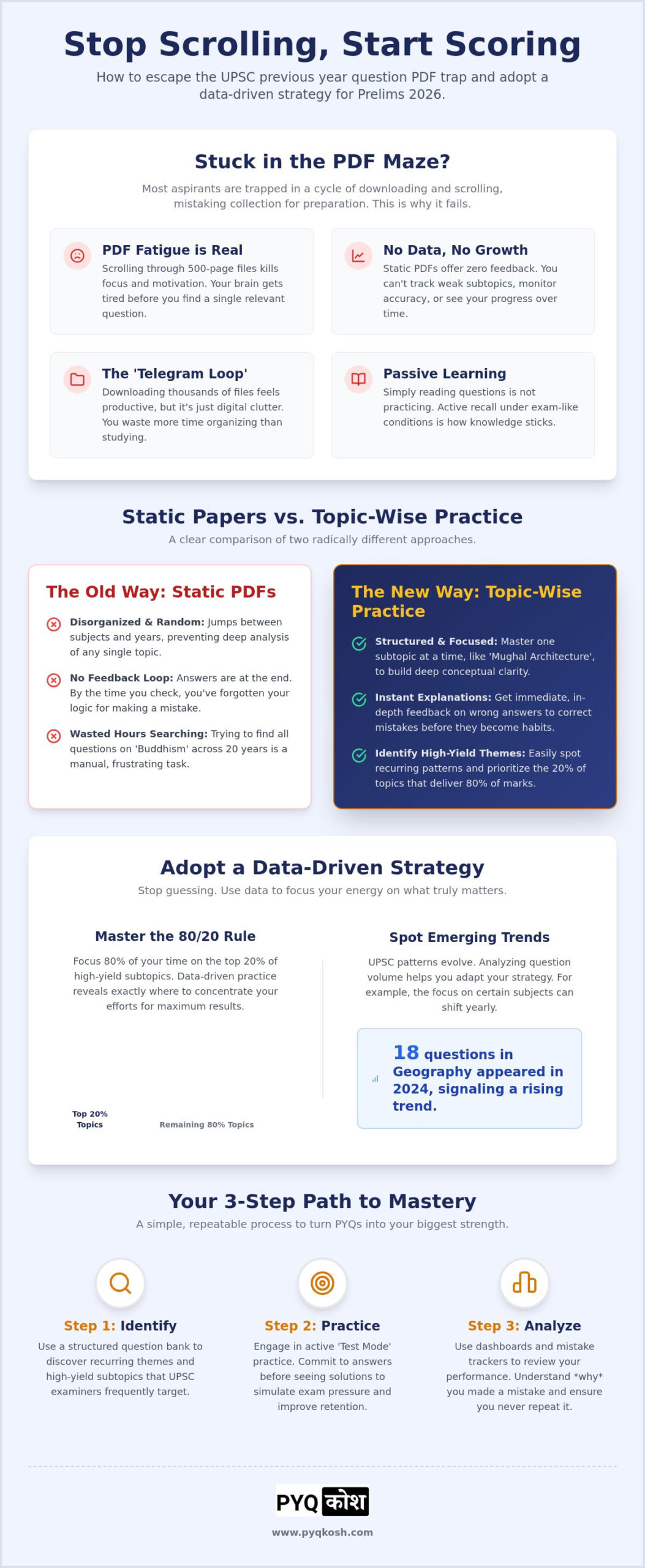
Most aspirants think they’re studying when they download a huge upsc previous year question file from Telegram. But let’s be honest, bhai. How many of those 100-page PDFs do you actually finish? Usually, you just scroll for ten minutes, get a headache, and then check Instagram.
Real PYQ analysis is the process of identifying recurring themes, not just reading old questions. The Union Public Service Commission (UPSC) often leaves a trail of breadcrumbs in their papers. If you’re just looking at a static PDF to check an answer, you’re missing the bigger picture.
PDF Fatigue is a real thing that kills your focus, yaar. Static papers fail because they don’t give you data. You can’t track which subtopics you’ve mastered and which ones are still making you sweat at midnight. Without a way to track progress, you’re just shooting in the dark.
Then there’s the famous ‘Telegram Loop.’ You download thousands of files, thinking you’re preparing. In reality, you’re just suffering from ‘collection-itis.’ This habit leads to digital clutter instead of an actual selection. You need a centralized system, not a folder full of random, messy files.
The difference between ‘reading’ and ‘practicing’ PYQs
Reading a PDF is passive. Your brain doesn’t retain the patterns because there’s no mental struggle. Active practice in ‘Test Mode’ mimics the real exam pressure. It forces you to commit to an answer before you see the solution, which is how you actually learn.
You need instant feedback on wrong answers to stop making the same mistakes. If you wait until the end of a long document to check the key, you’ve already forgotten your logic. Structured practice fixes mistakes immediately, making it the real topper banne ka shortcut.
Why 2026 demands a subtopic-wise approach
The 2026 pattern demands a targeted strategy. UPSC is moving away from generic questions to very specific sub-themes. If you want to find every ‘Buddhism’ or ‘Panchayati Raj’ question across 20 years, a PDF will make you cry. You’ll waste hours searching when you should be solving.
Mastering a specific sub-theme requires seeing how it evolved over decades. This upsc pyq strategy is the secret to clearing Prelims. Using a structured upsc previous year question library lets you master one theme at a time without the PDF mess.
PYQKosh solves this by organizing 1 lakh+ questions into a clean, subtopic-wise format. You get topic-wise practice and a dashboard that shows your daily growth. It’s the smart way to move from random effort to targeted, strategic action.
Decoding the 2026 Pattern: Identifying High-Yield Subtopics
UPSC doesn’t repeat questions word-for-word, but it definitely repeats themes, bhai. If you look closely at the papers from the last few years, the examiner’s favorite areas are hidden in plain sight. Mastering the upsc previous year question isn’t about memorizing the past; it’s about predicting the future.
There are massive benefits of using previous year papers when you analyze them with data. For example, Geography questions have been rising, hitting 18 questions in 2024. If you don’t use question volume to identify these ‘Must-Do’ topics for 2026, you’re just guessing.
Sorting topics by recency is a total game-changer. Trends from 2024 and 2025 are much more relevant for your May 24 Prelims than what happened a decade ago. Focusing on specific subtopics like ‘National Parks’ or ‘Constitutional Bodies’ is the real topper’s shortcut to a high score.
Subject-wise vs. Subtopic-wise: What’s the difference?
Studying “History” is way too broad and overwhelming. Real marks are hidden in “Mughal Architecture” or the “Bhakti Movement.” When you practice at a granular level, you master the sub-themes that UPSC loves to test. This is how you sharpen your logic for the actual exam day.
Granular practice also helps you master the elimination technique again, even with the new ‘Only one pair’ options. When you know a subtopic deeply, you can spot the trap in the statement instantly. You can start this subtopic-wise practice for UPSC CSE to see the difference yourself.
Using data to prioritize your revision
Stop wasting time on low-yield topics that only appear once every ten years. Use the 80/20 rule: spend 80% of your time on the top 20% of high-yield subtopics. Sorting topics by the number of questions shows you exactly where your energy should go.
Efficiency is the only way to beat the 933-vacancy crunch for 2026. Ditch the random study sessions and start using structured, analytical exam preparation. When you know exactly what to revise, your confidence levels will skyrocket before you even enter the hall.
To stay on track, use the Aaina dashboard to monitor your accuracy in these high-yield areas. It’s much better than staring at a blank wall and wondering if you’re actually improving, yaar.
Static Papers vs. Topic-Wise Practice: A Fair Comparison
Think about your study table right now. Is it cluttered with old printouts and messy highlighter marks? Or is your phone storage crying because of a folder named “UPSC PYQ Final”? Marking an upsc previous year question with a yellow pen feels like studying, but it’s often just busy work. You’re decorating a page instead of training your brain to spot patterns.
Static PDFs are a graveyard for focus. When you finish a question, you usually scroll ten pages down to find the key, then search Google for a proper explanation. You’ve wasted five minutes just to understand one single point. A structured library gives you instant feedback. This efficiency creates a powerful “Revision Loop” where you fix a conceptual gap in seconds, not hours.
Data-driven tracking is miles ahead of manual marking. Highlighters don’t tell you if your accuracy in Polity is dropping or if you’re spending too much time on History. A centralized platform organizes the chaos, allowing you to move from random effort to targeted, strategic action. It’s the difference between running in circles and following a GPS to your destination.
The Aaina Dashboard: Seeing your true preparation level
Preparation isn’t just about hard work; it’s about knowing your numbers. The Aaina dashboard tracks your daily practice and accuracy, yaar. It’s a reality check that shows exactly where you stand every single day. Seeing your peer rank keeps you motivated to push harder, while the weekly graphs help you spot if your energy is dipping before it’s too late.
That daily streak isn’t just a number on a screen. It’s a psychological boost that builds the discipline needed for the long UPSC journey. When you see your progress laid out visually, the path to May 24 feels manageable and clear. You stop guessing and start knowing that you’re ready for the challenge.
The Wrong Question Tab: Your secret weapon
Let’s be real: the topper banne ka shortcut is simply not repeating your past mistakes. In a PDF, a wrong answer is forgotten the moment you flip the page. The Wrong Question tab automatically stores every mistake you make during practice or test mode. You don’t have to manually note anything down.
You can sort these mistakes by recency or frequency to see which subtopics are your “silent killers.” If you’ve made the same mistake on ‘Fundamental Rights’ three times, the system will tell you. Use this prelims upsc question paper guide to master this revision strategy and ensure those marks don’t slip away in the actual exam.
The 3-Step Strategy to Master UPSC PYQs Before Prelims 2026
Do you also wait for Sunday to solve a 100-question mock, only to feel exhausted by question 40? Consistency beats intensity every single time, bhai. A 10-hour Sunday marathon usually results in zero retention. Instead, try 30 minutes of daily, focused practice to keep your momentum high.
Solving every upsc previous year question in a random order is a recipe for confusion. You need a system that builds your knowledge block by block. Follow this 3-step strategy to turn your preparation from a chaotic mess into a data-backed success story.
First, pick one specific subtopic and solve at least 20 questions in Test Mode. Don’t just browse through them. Test Mode puts you under pressure and forces your brain to recall information. This active struggle is what makes the concepts stick in your long-term memory.
Second, read the in-depth explanations for every single option. Don’t just look at why ‘A’ is correct. Understand why ‘B’, ‘C’, and ‘D’ were traps. This is how you learn the examiner’s mindset and stop falling for the same tricks in the actual hall.
Third, use your Wrong Question tab every Sunday without fail. Re-solve every question you missed during the week. If you get it right this time, you’ve officially filled a gap. If you miss it again, it stays on your radar until you master it.
How to use ‘Exam Booster Tips’ for extra marks
Look for ‘Confusion Points’ in the explanations to avoid common mistakes that even senior aspirants make. These are the small details that UPSC loves to tweak. Use the ‘Exam Booster’ notes to add extra value to your static GS notes, ensuring your material is always exam-ready.
Understanding why an option is WRONG is just as important as knowing why it’s right. This logic helps you eliminate options even when you aren’t 100% sure about the topic. It’s the most effective way to turn a 50-50 guess into a confident, correct answer.
Managing CSAT and GS together
Don’t ignore CSAT until the last month, yaar. Use subtopic practice for Comprehension and Logic to build speed gradually. If you are also targeting the CAPF or State PCS, this structured approach ensures you don’t mix up the different exam patterns.
Balancing multiple exams is easier when your practice is centralized. You can track your progress across different subjects without losing focus on your main goal. You should practice your first 20 questions now to see how this strategy changes your daily rhythm.
PYQKosh: The Mentor Every UPSC Aspirant Needs
You’ve probably spent hours joining Telegram channels just to find one upsc previous year question from a specific year. Stop being a ‘PDF Collector’ who hoards files but never solves them, yaar. It’s time to become a ‘PYQ Master’ who uses every single question to build a solid rank.
PYQKosh was ‘Made with ❤️ by an Aspirant’ who knows exactly how it feels to be lost in a sea of disorganized data. We built this because we were tired of the PDF mess too. Now, you can access over 1 lakh questions across 130+ exams, all organized by subtopic so you can focus on what actually matters.
The power of the Bookmark Tab is a total game-changer for your revision. Instead of scrolling through 50 pages to find that one tricky Polity question, you can save it by subtopic. This makes your second and third revisions lightning-fast, ensuring you don’t forget what you learned a week ago.
Centralize your preparation in one place
Stop jumping between ten different websites, books, and messy folders. Centralizing your prep in one place is the only way to stay sane in this journey. When everything is in one library, your brain can focus on learning instead of searching for the right upsc previous year question paper.
Every question on the platform comes with the exact exam name, date, and shift. This level of transparency builds total trust, so you know you’re practicing the real thing. Check out our pricing to start your structured journey today and leave the PDF chaos behind.
Your path to LBSNAA starts with one smart habit
Your path to LBSNAA doesn’t require a 15-hour study day from the very start. It starts with one smart habit: a small 10-question quiz every morning to build momentum. This keeps your brain sharp and ensures you’re always in ‘exam mode’ throughout the day.
Let the data show you when you are truly ready for Prelims 2026. When your accuracy in the Aaina dashboard hits the green zone, your confidence will naturally follow. Work smarter, not harder, to clear the most prestigious exam in India and secure your dream service.
Consistency is the real secret to success in this marathon. Use the Wrong Question tab to master your weak areas and turn every mistake into a learning opportunity. Ditch the static PDFs and embrace a structured, analytical exam preparation style that respects your time and effort.
Master the 2026 Pattern and Claim Your Rank
You’ve seen why those messy PDFs are slowing you down, yaar. To clear Prelims 2026, you need to stop hoarding files and start mastering specific sub-themes. Ditching the static papers for a structured library is the first step toward a focused, data-backed strategy.
Your rank depends on how well you analyze every upsc previous year question and fix your weak areas before the big day. Using the Aaina dashboard and the subtopic-level organization will help you stay ahead of the competition. With over 1 lakh questions at your fingertips, you have the ultimate resource to succeed.
Success in UPSC comes to those who work smarter, not harder. Start building your daily practice streak and watch your accuracy grow every single week. You’ve got the potential, bhai, now just use the right tools to unlock it.
Stop collecting PDFs and start practicing UPSC subtopics on PYQKosh today!
Frequently Asked Questions
Is solving only 10 years of UPSC previous year questions enough for 2026?
Yes, 10 years is a solid start, but UPSC often revives older themes from the early 2000s. Instead of just counting years, focus on the depth of the upsc previous year question you solve. Quality analysis of a decade beats a superficial reading of 20 years. Always prioritize the 2024-25 papers to catch the most recent analytical trends before May 24.
How do I start subtopic-wise practice for UPSC Prelims?
Start by picking one high-yield area, like ‘Buddhism’ or ‘Fundamental Rights.’ Instead of solving a full mixed paper, solve 20-30 questions specifically from that subtopic. This helps you see how UPSC changes the framing of the same concept over decades. It’s the best way to build conceptual depth without getting overwhelmed by the vast syllabus, yaar.
Can I use PYQKosh for other exams like SSC or Railway along with UPSC?
You can definitely use it for multiple exams. The platform centralizes 1 lakh+ questions from 130+ categories like SSC, Railway, and Defence. This is perfect if you’re appearing for State PCS or CAPF alongside UPSC. You get the same subtopic-level organization and data-driven tracking for every exam you choose, keeping your preparation organized in one single place.
Are the explanations on PYQKosh detailed enough for self-study?
The explanations are designed specifically for self-study. They don’t just give you the answer; they explain why the other three options were wrong. You’ll find ‘Exam Booster’ tips and ‘Confusion Points’ that highlight common traps. This level of detail helps you add value to your static notes and builds the logic needed to handle unpredictable questions, bhai.
How does the ‘Wrong Question’ tracker help in improving my score?
It acts as a digital diary of your mistakes. Every time you get an upsc previous year question wrong, the system saves it automatically. You can sort these by frequency to see which topics are your “silent killers.” Re-solving these every Sunday ensures you don’t repeat the same errors in the actual exam hall, which is the real secret to increasing your score.
Is it better to solve PYQs subject-wise or year-wise?
Subtopic-wise practice is much better for building a strong foundation. It allows you to master one theme completely before moving on to the next. Year-wise papers are useful for the final two months to test your time management. For the majority of your preparation, stick to subtopics so you can identify the recurring patterns that UPSC loves to repeat.
How can I track my daily consistency during UPSC preparation?
The Aaina dashboard is your best friend for tracking consistency. It shows your daily practice volume, accuracy rates, and even your peer rank. Seeing your daily streak grow provides a psychological boost that keeps you motivated. It transforms your preparation from a guessing game into a structured journey where you can see your improvement in real-time.
Does the platform cover CSAT previous year questions too?
Yes, the platform covers CSAT themes in a structured way. You can practice comprehension, logical reasoning, and basic numeracy through subtopic-wise modules. Since many aspirants find CSAT challenging lately, practicing these questions in Test Mode helps build the speed and accuracy required to clear the 33% qualifying mark without any last-minute panic.