

Article by
Aaisha
A passionate content writer at PYQKosh focused on simplifying Current Affairs and PYQs for competitive exam aspirants. I love turning complex topics into easy, student-friendly content that helps learners prepare smarter and stay consistent in their exam journey.
Ever spent three hours scrolling through a 1,000-page PDF of year-wise questions, only to realize you still don’t know why you keep getting “Fundamental Rights” questions wrong? It’s a common trap, yaar. You’re working hard, but without focusing on upsc topic wise previous year questions, you’re just guessing your progress.
I know how it feels when you’ve finished the Polity syllabus but still make silly mistakes in mock tests. The truth is, year-wise solving is great for testing, but it’s terrible for mastering the syllabus. You need a system that highlights your weak spots before the May 24, 2026 Prelims.
In this guide, I’ll show you how to stop drowning in disorganized files. You’ll learn how to use subtopic-wise practice to identify exactly where you’re losing marks. We’ll also see how to track your mistakes automatically so they don’t repeat on exam day.
We’re going to cover everything from subject-wise weightage to building a personal “Wrong Question” tracker. By the end, you’ll have a clear, data-driven roadmap to handle the 2026 pattern with total confidence and grab one of those 933 vacancies.
Key Takeaways
- Stop guessing what is important and use PYQs to reveal the hidden syllabus that the official notification does not tell you.
- Learn to practice upsc topic wise previous year questions right after reading a chapter to build instant confidence and concept clarity.
- Identify high-weightage subtopics like Panchayati Raj or Climate Change by sorting questions by frequency and recency.
- Use the Aaina dashboard to monitor your accuracy and daily streaks so you stay ahead of the competition for 2026.
- Automatically track and fix your silly mistakes using a dedicated system for wrong questions instead of searching through old notes.
Why UPSC Topic Wise Previous Year Questions are Your Real Syllabus
The official syllabus for the UPSC Civil Services Examination is famously vague. It mentions broad headers like “Indian Polity” or “Economic Development,” but it doesn’t tell you which specific lines of the NCERT to highlight. This is why upsc topic wise previous year questions are your actual syllabus. They act as a bridge between reading theory and clearing the cut-off.
Think of it as a map for the 2026 cycle. While the notification gives you the destination, the PYQs show you the exact path toppers take. You stop guessing what might be important and start focusing on what UPSC actually cares about. This is the shift from random hard work to structured, analytical exam preparation.
The Trap of Year-Wise PDF Solving
Most aspirants download a massive 1000-page PDF of the 2024 or 2025 paper and start solving. It feels like you’re making progress, but you’re actually stuck in a loop. Solving a random mix of 100 questions doesn’t help you master a specific subject. If you’re weak in “Ancient History,” solving one question from a 2023 paper won’t fix the root cause.
PDFs are also a huge pain to use on a mobile screen, yaar. You spend more time zooming in and out than actually thinking about the options. Plus, you can’t easily see how a single concept, like “Panchayati Raj,” has changed over the last ten years. You need a system that groups these together so you can see the evolution of the examiner’s mindset.
Decoding the Hidden UPSC Pattern
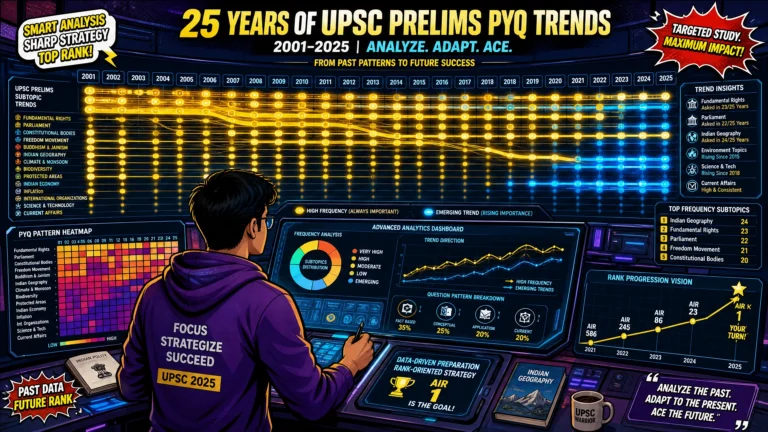
UPSC rarely repeats the exact same question, but it repeats themes every single year. Topics like “Buddhism,” “Inflation,” or “National Parks” are high-yield areas that appear frequently. When you use upsc topic wise previous year questions, you spot these patterns instantly instead of spending hours searching through books.
Subtopic-level practice is the real topper banne ka shortcut. It exposes your conceptual gaps in minutes. For example, you might know “Parliament” well, but you consistently fail at questions about “Parliamentary Committees.” On PYQKosh, you can jump straight into that subtopic to fix the error. This targeted approach ensures you don’t repeat the same silly mistakes on May 24, 2026.
Data-driven preparation means knowing exactly where you stand before the exam starts. You don’t need more notes; you need better practice. By focusing on subtopics, you turn a vague syllabus into a clear checklist of things to master.
Breaking Down UPSC Prelims Subjects: From Geography to Polity
You’ve finally finished the 700 pages of Laxmikanth and you feel like a king. But then you sit for a mock test and realize you can’t remember the difference between a Statutory Body and a Constitutional Body. This happens because you’re studying for the subject, not for the exam. Toppers don’t just “study Polity”; they master subtopics through upsc topic wise previous year questions.
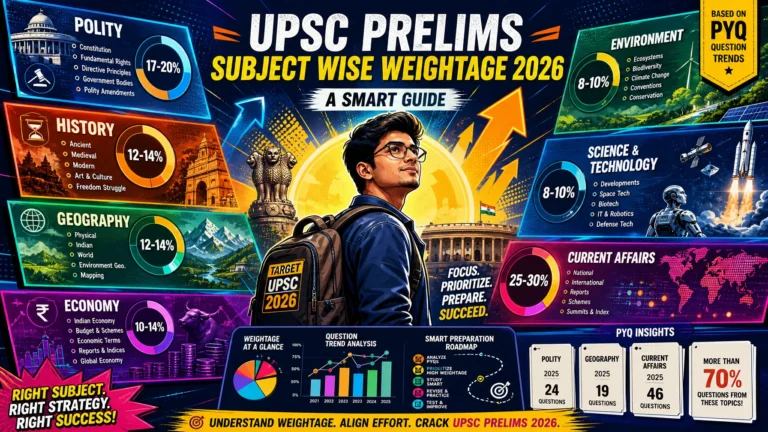
Mastering UPSC prelims subjects requires a surgical approach. You need to know exactly how UPSC frames questions in History, Polity, Economy, Geography, Environment, and Science & Technology. Instead of reading blindly, you should focus on the granular hierarchy of each subject. This is exactly how we’ve organized over 1 lakh questions on our platform, making sure you don’t waste time on irrelevant data.
High-Yield Subtopics You Cannot Ignore
Don’t try to memorize every single page of your standard books. Focus on the areas where UPSC consistently digs deeper. For Polity, you should prioritize Constitutional Bodies and the Preamble. For Economy, spend your energy mastering “Banking and Monetary Policy” by solving at least 10 years of subtopic-specific questions. In Environment, trace the pattern of questions on Protected Areas and International Conventions. These are the themes that will likely define the 2026 Prelims on May 24.
CSAT: The Often Forgotten PYQ Treasure
Listen, yaar, CSAT is becoming the biggest hurdle for even the most serious aspirants. It’s no longer just a qualifying paper you can ignore until April. You need to use upsc topic wise previous year questions to master Reading Comprehension logic. UPSC has a specific way of framing “Statement-based” questions in CSAT. By practicing these subtopics specifically, you learn the examiner’s trap before you even enter the hall.
If you’re feeling overwhelmed by the sheer volume of topics, start by checking your accuracy on the Aaina progress dashboard to see which subject needs your immediate attention. This data-driven approach ensures you’re ready for the 933 vacancies announced for 2026.
Remember, the goal isn’t to know everything; it’s to know what matters most. Try practicing a few subtopics today and see the difference in your confidence.
How to Analyze UPSC PYQ Trends for 2026
Ever spent two weeks memorizing the entire list of Governor-Generals, only to realize UPSC hasn’t asked a direct question on them in years? It’s a classic trap. You’re studying hard, but you’re not studying smart. You need to know which topics actually carry weight before you open your books.
This is where upsc topic wise previous year questions become your best friend. Instead of guessing, use the “Sort by Question Count” feature on PYQKosh to see which subtopics are the real “kings” of the exam. If a subtopic has 50 questions over the last decade, it’s a priority; if it has two, move it to the bottom of your list.
Don’t forget the “Recency Factor.” A question from 2025 is far more valuable than one from 2010. The examiner’s mindset changes every few years, so prioritize the latest papers to understand the current “vibe” of the exam. Building a priority list through upsc pyq analysis is the first step to clearing the 2026 cut-off.
Tracking Subject Weightage Over 10 Years
Subject weightage isn’t static. Look at Geography, for example; there’s been a sudden rise in Agriculture-related questions recently. You can’t see these shifts in a random PDF. Use the “Aaina” dashboard to visualize where the most questions are coming from in real-time.
This is the definition of “Work Smarter, Not Harder.” When you see a subject’s weightage increasing, you adjust your schedule. Data-driven prep ensures you’re always focusing on the high-yield areas that will actually get you those marks on May 24, 2026.
Identifying Repeat Themes vs. Repeat Questions
UPSC is smart, yaar. They won’t repeat the exact same question word-for-word, but they keep the core concept identical. They might change the options or frame it as a statement-based question, but the logic remains.
Use our “Exam Booster Tips” and “Confusion Points” to understand why an answer is right. Most importantly, analyze the wrong options too. Often, a wrong option in 2024 becomes the main question in 2026. Analyzing why you got a question wrong is just as important as finding the right one.
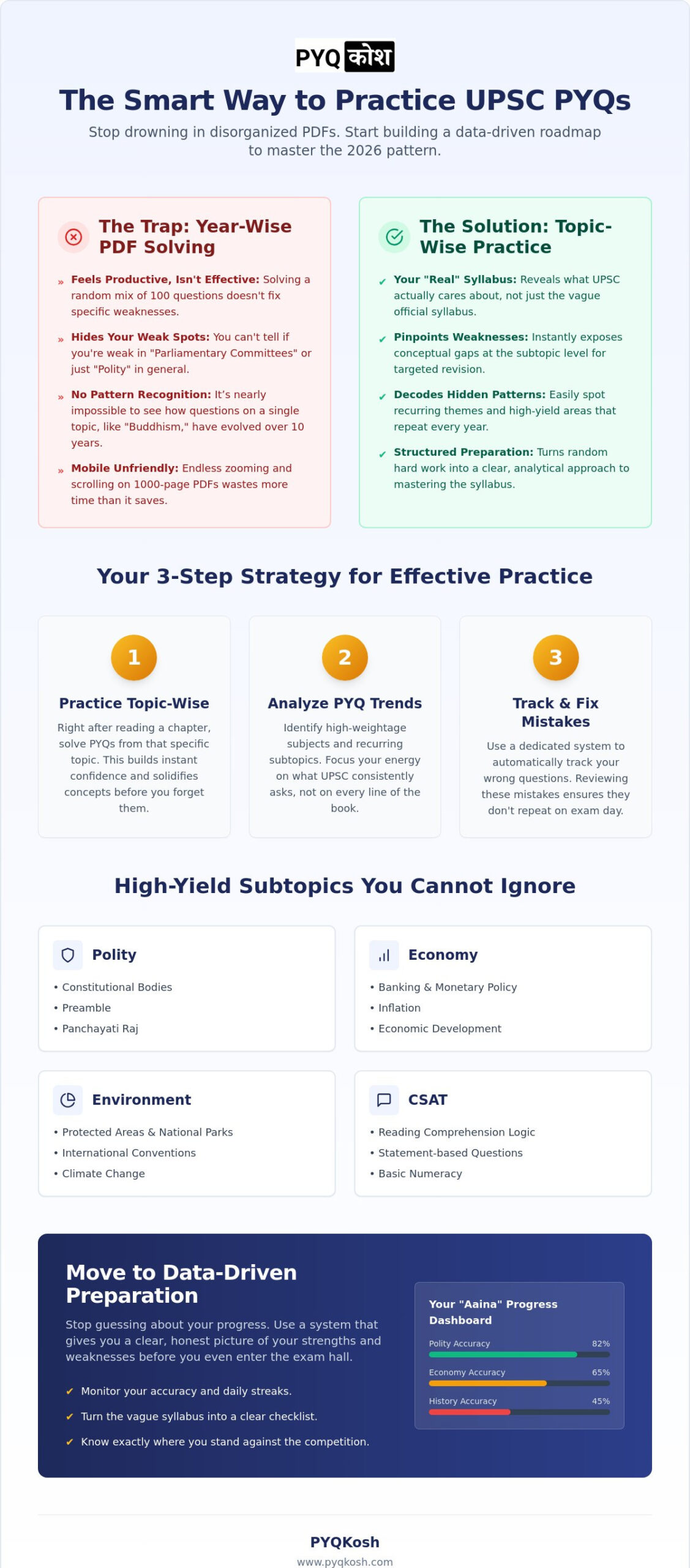
The 3-Step Strategy to Practice UPSC PYQs Effectively
You’ve finished a heavy chapter on the “Governor-General of India” and you feel like you’ve mastered it. But can you solve a 2024 question on the same topic under pressure? Most aspirants wait until April to touch the prelims upsc question paper. By then, it’s often too late to fix deep-rooted conceptual holes.
To clear the May 24, 2026 exam, you need a strategy that builds your confidence day by day. Don’t treat PYQs as a final test; treat them as a learning tool. Follow this simple 3-step loop to stay ahead of the competition:
- Step 1: Finish a chapter in your standard book and immediately solve its upsc topic wise previous year questions.
- Step 2: Switch to “Test Mode” for that subtopic to simulate real exam pressure and check your actual accuracy.
- Step 3: Dedicate every Sunday to revising only your “Wrong Questions” and “Bookmarks” to seal the gaps.
Phase 1: Subtopic-Wise Foundation Building
Don’t wait for the full syllabus to finish before you start practicing. That’s a recipe for disaster, yaar. Treat every subtopic as a mini-battle you need to win. If you’re studying “Fundamental Rights,” solve every question UPSC has asked on it since 2011 before moving to the next chapter.
Use the “Aaina” dashboard to track your accuracy per topic in real-time. If your accuracy in “Ancient History” is below 60%, you know exactly where to put more effort. This data-driven approach keeps you focused on your weak areas instead of wasting time on what you already know. It’s the smartest way to handle the 933 vacancies announced for 2026.
Phase 2: Mastering the Wrong Question Loop
The real topper secret isn’t just solving questions; it’s mastering the ones you got wrong. Most people look at the explanation once and forget it. You need to be different. Our “Wrong Question Tab” automatically saves every mistake you make, so you don’t have to maintain a messy diary.
Try solving your wrong questions at least 3 times until your accuracy hits 100%. You can even sort them by “Frequency of Mistakes” to see which conceptual traps keep catching you. Combine this with the “Bookmark” tab for questions that were tricky but you got right by luck. This loop ensures that by exam day, you’ve eliminated all your “silly mistake” zones.
Ready to turn your mistakes into marks? Start your daily practice streak on PYQKosh today.
Why PYQKosh is the Smartest Way to Practice UPSC PYQs
Tired of juggling five different apps and ten Telegram channels just to find one reliable source? It’s time to stop the chaos and centralize your prep. PYQKosh isn’t just another question bank; it’s a complete “Practice-to-Revision” loop designed for your 2026 attempt.
Most aspirants fail because they practice randomly without tracking their growth. By using upsc topic wise previous year questions on a single, data-driven platform, you turn your preparation into a precise science. You’ll know exactly which subtopics are your strength and which ones are dragging your score down.
Our system focuses on structured, analytical exam preparation rather than just mindless clicking. Every explanation is built to save you time, featuring “Exam Booster Tips” that give you that extra edge. We also highlight “Confusion Points” to ensure you don’t fall for the common traps UPSC sets for the 933 vacancies available this cycle.
Aaina Dashboard: Your Prep Mirror
The Aaina dashboard acts as your personal mentor by tracking your daily practice, accuracy, and weekly progress graphs. You can see your growth visually, which is a huge confidence booster when you’re feeling low. It’s the reality check every serious aspirant needs before the May 24, 2026 Prelims.
Maintaining “Streaks” is essential for staying consistent during the long and tiring UPSC journey. When you see your daily streak growing, you’re less likely to skip your practice sessions. Plus, our peer ranking feature shows you exactly where you stand among thousands of other aspirants, pushing you to work harder every day.
Multi-Exam Edge: UPSC, CAPF, and CDS Together
One of the biggest secrets of toppers is practicing across different UPSC-conducted exams. The commission often shares a similar logic and question bank for the UPSC, CDS, and CAPF examinations. If you only solve Civil Services papers, you’re missing out on nearly 40% of the potential patterns.
By practicing upsc topic wise previous year questions from CDS and CAPF, you get a much broader view of how the examiner thinks. Centralizing all these exams on one platform saves you months of wasted time searching through disorganized websites or heavy books. It’s the ultimate topper banne ka shortcut for anyone serious about 2026.
Start practicing your first subtopic for free on PYQKosh today.
Your Roadmap to the 2026 Prelims Cut-off
Clearing the UPSC Prelims isn’t about how many books you finish; it’s about how many patterns you recognize. By switching to upsc topic wise previous year questions, you’ve already taken the first step toward a smarter 2026 attempt. You now have the system to break down complex subjects into manageable subtopics and track every mistake through the Aaina dashboard.
Don’t let those 933 vacancies intimidate you. With 1 Lakh+ structured questions and detailed explanations featuring booster tips at your fingertips, you’re not just practicing; you’re evolving. Every wrong question you fix today is a potential mark saved on May 24. You’ve got the tools and the strategy; now all that’s left is the hustle.
You can do this, yaar! Start your subtopic-wise UPSC practice on PYQKosh today!
Frequently Asked Questions
Is practicing UPSC topic-wise PYQs enough to clear Prelims 2026?
It is the most critical part of your prep, but you must pair it with reading standard textbooks. While books give you the data, upsc topic wise previous year questions teach you how to apply it. This combination helps you identify the high-yield themes that actually appear on exam day.
How many years of UPSC topic-wise previous year questions should I solve?
You should aim to solve at least 10 to 12 years of questions to see the full pattern. Give extra attention to the 2021 to 2025 papers because the exam has become more conceptual recently. These latest trends are your best guide for the May 24, 2026 attempt, yaar.
Does UPSC repeat questions from previous years?
UPSC rarely repeats questions word-for-word, but they repeat themes like Buddhism or Inflation almost every year. The secret is to analyze the options in these PYQs. Often, a wrong option from a 2023 paper becomes the main question in the 2026 exam.
How is topic-wise practice different from solving full-length mock tests?
Topic-wise practice builds your foundation chapter by chapter so you can master specific concepts. Full-length mock tests are better for checking your speed and stamina. You shouldn’t jump into mocks until you’ve cleared your conceptual gaps through subtopic-level practice.
Can I practice UPSC PYQs for CSAT on PYQKosh?
Yes, you can practice Reading Comprehension and Interpersonal skills questions in a structured way. We help you master the specific logic UPSC uses in its passages. This ensures you don’t get stuck in the qualifying paper while your GS score is high.
What is the best way to revise wrong questions for UPSC?
The best way is to use a dedicated Wrong Question tab that stores your mistakes automatically. Don’t just read the right answer once and move on. Solve your mistakes at least three times until your accuracy reaches 100 percent to eliminate silly mistakes.
Are these questions based on the official UPSC answer key?
All answers are strictly verified against the official UPSC keys to ensure total accuracy. We also provide in-depth explanations that cover why an option is right and why others are wrong. Our booster tips help you understand the deeper logic behind every question.
Can I use PYQKosh for other exams like CDS and CAPF alongside UPSC?
You can access CDS and CAPF questions on the same platform to get an edge. Since the same commission sets these papers, they often share the same question bank and themes. Using upsc topic wise previous year questions across multiple exams helps you master the “UPSC logic” faster.